$26 Billion: An 'All-Chinese Team' Backs the World's Highest-Valued AI Programming Company

marsbitPublicado em 2026-05-31Última atualização em 2026-05-31

Resumo

Cognition AI, the company behind the AI programmer "Devin," has raised over $1 billion in new funding at a valuation of $26 billion, just eight months after reaching a $10.2 billion valuation. The round was led by Lux Capital, General Catalyst, and 8VC. Founded by three young Chinese entrepreneurs with strong competitive programming backgrounds, Cognition initially gained fame with Devin, marketed as the world's first AI software engineer capable of handling tasks from start to finish. While its early demos were impressive, real-world usage revealed reliability and cost-effectiveness issues, leading to a significant price cut for Devin in 2025. A pivotal moment came when Cognition acquired the assets of AI IDE company Windsurf after a failed acquisition by OpenAI. This move gave Cognition a crucial developer-facing tool, allowing it to pursue a two-pronged strategy: Devin for autonomous task execution and Windsurf for integrated, collaborative coding within an IDE. This shift helped the company move away from the controversial "AI replacement" narrative towards a model of augmenting human engineers, particularly for repetitive or maintenance tasks. This strategic pivot is backed by strong commercial metrics. The company reports a 10x increase in enterprise usage this year, with an annual revenue run-rate of $492 million and a 50% month-over-month growth in enterprise Devin usage over the past six months. Its client list now includes major corporations like Goldman Sachs an...

By AI Alphabet

$26 billion is the latest price tag the capital market has placed on AI programming company Cognition.

Just last September, Cognition AI had barely crossed the $10 billion valuation threshold, and at that time, it was already enough of a Silicon Valley legend.

Three young Chinese co-founders, collectively winners of 5 International Olympiad in Informatics gold medals, built the prototype of "the world's first AI software engineer" Devin from a short-term rental apartment. In just over two years since its founding, the company's valuation had surged to $10 billion.

Chinese, Olympiad, Harvard, MIT, dropping out to start a business, AI Agent... each label is attention-grabbing enough. Cognition is undoubtedly one of the most story-rich companies in the AI programming track.

Now, this story has been pushed a significant step forward by the capital market.

According to a Bloomberg report, Cognition AI, the company behind Devin, has secured over $1 billion in new funding, with a post-money valuation reaching $26 billion. This round was co-led by Lux Capital, General Catalyst, and 8VC, with participation from Ribbit Capital, Atreides Management, Founders Fund, and others. Cognition has officially confirmed this funding round and its latest valuation.

This means that in just over eight months since its previous valuation of $10.2 billion, Cognition's valuation has grown to 2.5 times its original value.

01 What Capital is Buying is More Than Just an AI Programmer

The leading capital in this round is quite representative.

Lux Capital is a highly recognizable hard-tech fund in Silicon Valley, with long-term investments in frontier science, deep tech, AI, robotics, aerospace, defense, and computing infrastructure—projects that are "relatively hardcore." On its own investment page, Cognition is categorized under "Productivity Enhancement + Infrastructure + Computer Science."

It can be said that Lux Capital's investment in Cognition focuses on Cognition's potential to turn AI Agents into software engineering infrastructure.
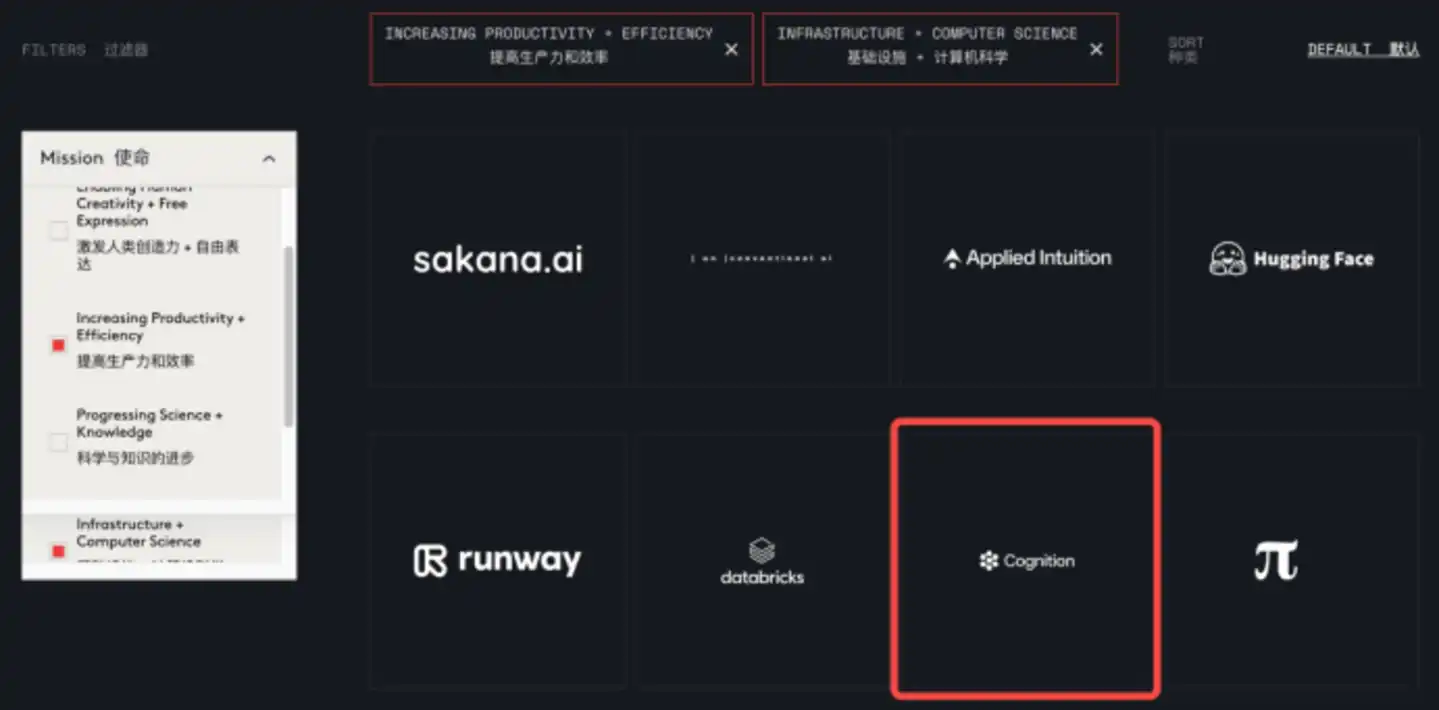
General Catalyst, on the other hand, focuses on the opportunity for enterprise processes to be transformed by AI. This firm is not just a traditional VC; it calls itself a "global investment and transformation company" on its website, emphasizing 'transformation' in recent years—using capital, operations, and corporate relationships to drive the transformation of traditional industries and large institutions.

Besides Cognition, General Catalyst is also doubling down on Anthropic. Over the past year, it has participated in multiple massive funding rounds for Anthropic.

As a co-leading firm, 8VC brings imagination for government and large enterprise deployments. This firm has long bet on "enterprise software infrastructure within complex organizations," and Cognition's client list already includes government or public-sector clients like the US Army, US Navy, and NASA. 8VC's participation as a lead investor affirms Cognition's narrative.

In addition to the three leading firms, existing shareholder Founders Fund continues to increase its stake. The approximately $400 million funding round in 2025, which valued the company at around $10.2 billion post-money, was led by Founders Fund. This firm, co-founded by Peter Thiel, has always had an aggressive investment style, preferring technology companies that can reshape industrial structures, such as SpaceX, Palantir, Anduril, Stripe, OpenAI, etc.

Lux Capital long bets on hard tech and frontier computing, General Catalyst excels at enterprise software and large institution transformation, 8VC carries enterprise software and government market genes, and Founders Fund is one of Cognition's early shareholders. The simultaneous presence of these types of capital in Cognition's funding round is enough to indicate that investors no longer see Cognition merely as a developer tools company, but as a candidate for the next generation of software engineering infrastructure.

The $26 billion post-money valuation fully proves market confidence, and the most direct reason capital is willing to continue driving up the price is growth.

Cognition has presented very solid commercialization data: enterprise usage has grown over 10-fold since the beginning of this year, revenue run-rate has jumped from $37 million in May last year to the current $492 million, and enterprise-side Devin usage has maintained a 50% month-over-month growth for the past six months.

Although $492 million is not confirmed annual revenue but an annualized run-rate calculated based on the current income pace, this growth curve is still astonishing. Investors can already see enterprise clients genuinely paying, genuinely using, and usage is still rapidly climbing—this is nothing short of legendary for a company founded in 2023.

The AI programming track is indeed thriving. Code, issues, tests, PRs, documentation are inherently highly digital work objects; whether a task is completed can be verified through tests, code reviews, and deployment results.

And for enterprises, software teams always have an endless list of tasks, each time-consuming and expensive (at least, senior engineers' hourly rates are expensive). If an AI Agent can reliably take over a portion of clear, repetitive, and verifiable software engineering tasks, it becomes engineering capacity that enterprises are willing to pay for.

Behind the $26 billion, what capital is truly buying is a judgment: software development is becoming the earliest work scenario where AI Agents are being procured on a large scale by enterprises.

02 After Devin's Explosive Popularity, Reality Poured Cold Water

Cognition first gained widespread attention through what, at the time, seemed an extremely bold vision.

Before Devin, AI programming tools mostly remained in "assistant" roles. GitHub Copilot helps programmers complete code, ChatGPT and Claude can explain errors and generate functions, while Cursor integrates AI into the editor, allowing developers to write and edit simultaneously.

But Devin took a significant step forward. It was directly defined by Cognition as an "AI Software Engineer." Users only need to describe requirements in natural language, such as developing a website, building an application feature, or fixing an issue in a codebase, and Devin would independently break down the task, write the code, fix bugs, until the project runs.

When Cognition released the Devin demo in March 2024, the entire developer community was ignited. It was promoted as the world's first AI programmer, and to some extent, became one of the landmark products that truly brought the vibe coding wave into the mainstream.

The founders themselves also came with a story. All three—Scott Wu, Steve Hao, and Walden Yan—are Chinese and hail from the informatics Olympiad circle, collectively holding 5 IOI gold medals. They are not traditional business-oriented founders but resemble a group of young people exceptionally skilled at coding, trying to train another entity that can code.

After Devin's launch, the company quickly secured support from top-tier VCs like Founders Fund, Khosla Ventures, and Bain Capital Ventures, forming a strong capital lineup. Enterprise clients also began to emerge, with names like Goldman Sachs, Citi, and Ramp being linked to Devin.

In July 2025, when Goldman Sachs introduced Devin, a Fast Company headline even directly stated, "Goldman Sachs's New AI Software Engineer Never Sleeps." This highlighted one of the most compelling aspects of Agents for enterprises: they can operate 24/7, no shifts needed, never stopping due to nights, weekends, or time zones.

That was Cognition's earliest moment in the spotlight. A young team, Chinese founders with informatics competition backgrounds, an AI Agent claiming to handle software development end-to-end, plus top-tier VC and major client endorsements. All these elements together formed almost the standard opening of a Silicon Valley AI legend.

However, a tall tree attracts the wind. When the story is told too beautifully, problems inevitably follow.

Initially, Devin's breakout success was largely built on the company's demos. When external developers began scrutinizing frame-by-frame and testing in real environments, doubts emerged. Some believed Devin's demos were carefully edited, omitting processes that made it appear less perfect. For instance, one segment was questioned for potentially showing Devin creating a bug and then fixing it, presenting the illusion of smoothly completing the task.

Devin thus became embroiled in a "fakery" controversy for a period—its promotional tone leaned too heavily towards AI being fully autonomous, but real engineering environments are far more complex than demos.

Software development is never just about writing code; it involves requirement understanding, architectural judgment, contextual memory, team conventions, and a host of implicit constraints not written into issues. An Agent running doesn't mean it always runs in the right direction; it can generate code, but that doesn't mean the code is merge-worthy.

When Devin officially launched, the gap became even more apparent.

Its initial price was very high, starting at $500 per month. But its performance didn't seem to justify such a high price: Answer.AI continuously tested Devin for a month, assigning it 20 real engineering tasks. The result was only 3 successes, 14 failures, and 3 uncertain outcomes.
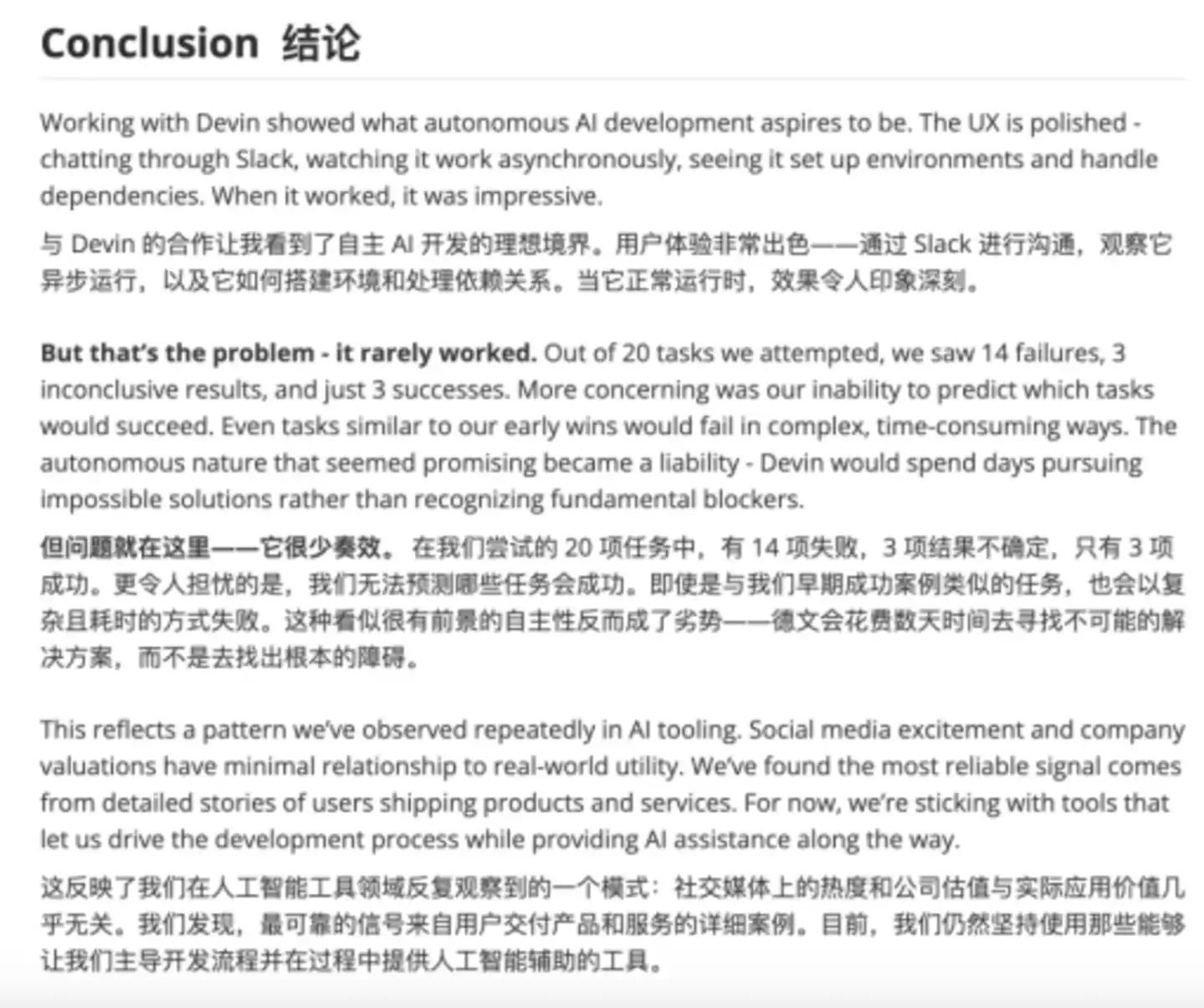
The biggest issue wasn't just the high failure rate, but the unpredictability of failures.

Some tasks that didn't seem complex would lead Devin into dead ends; some tasks themselves were infeasible, yet it would keep trying; sometimes it would generate overly complex, hard-to-maintain code, ultimately forcing engineers to spend more time reviewing and cleaning up.

And all this at such a high price.

Cognition also realized the $500/month threshold was too high. In April 2025, Cognition launched Devin 2.0, reducing the starting price from $500 per month to $20 and introducing a more flexible pay-as-you-go model.

But price reduction isn't a panacea. A tool designed to enhance efficiency ending up wasting more time and energy is hard to justify.

This is the core early-stage contradiction of autonomous Agents: the more AI resembles an independent engineer, the more users need to trust it, but the more it operates like a black box, the more troublesome deviations become.

Devin promised "give me the task," but many real engineering tasks aren't suitable to be handed over completely so early. An Agent running on its own for a long time and finally delivering a PR sounds advanced; but if PR quality is unstable, the engineer's review cost becomes even higher.

Interestingly, amidst this contrast, it was Cursor that captured the first wave of genuine developer dividends.

Because Cursor didn't initially promise to replace programmers. Its logic was gentler and more aligned with real workflows: AI helps modify code, explain errors, refactor files, generate tests on the side, but the developer remains in the editor. It's like a driving school car—you can at least hit the brakes when things seem off.

If Cognition's story ended here, it might have become another "hype" company lifted by the AI boom and then pulled back to earth by real user experience. But as mentioned earlier, reality is often more complex, and the AI programming track itself didn't stand still.

After Devin ignited the imagination of an "AI Software Engineer" and Cursor proved developers still needed a sense of control, foundation model giants like OpenAI, Google, and Anthropic also accelerated integrating coding capabilities into their own products and platforms.

On one side, the more controllable IDE route was rapidly expanding; on the other, model giants were moving down to the application layer. For Cognition to survive, it had to change.

And it was at this time that it "picked up" the treasure left by Windsurf.

03 Grasp Both Sides Firmly

The battle for Windsurf was arguably one of the most dramatic events in the AI coding tools sector in 2025.

At that time, Windsurf was already a highly regarded company in the AI IDE track. It was initially courted by OpenAI, with both sides engaged in lengthy acquisition talks, and the outside world once thought the deal was sealed.

However, the transaction ultimately didn't materialize, with one key reason being the complex partnership between OpenAI and Microsoft. At that time, Microsoft held broad licensing rights to OpenAI's technology and products, and Microsoft-owned GitHub Copilot was a major competitor in the AI programming space. Windsurf was concerned that if acquired by OpenAI, its technology and products might become entangled in the licensing framework between OpenAI and Microsoft, indirectly flowing to a potential competitor.

Just as OpenAI retreated, Google swiftly stepped in.

Google secured a non-exclusive license to Windsurf's technology for $2.4 billion, while bringing Windsurf CEO Varun Mohan, co-founder Douglas Chen, and several key R&D personnel to Google DeepMind.

It happened on a Friday, very quickly. Google took the founders and some core technology licenses. OpenAI failed to complete the acquisition. Windsurf's original corporate entity, product, brand, clients, and 250 employees were left in an awkward position.

It was at this moment that Cognition made its grand entrance.

The incident occurred on a Friday; by Monday, Cognition announced its acquisition of Windsurf's remaining assets, including the Windsurf IDE product itself, intellectual property, trademarks, brand, enterprise customer base, user data, and most of the remaining team's employees.

This move was almost crucial for Cognition's later return to the game, as it addressed exactly what Devin lacked most: a developer entry point.

Following the Windsurf acquisition, Cognition's commercialization pace noticeably accelerated. Windsurf itself already had $82 million in Annual Recurring Revenue (ARR) and over 350 enterprise clients at the time of acquisition. Cognition later disclosed that this acquisition more than doubled the company's ARR, and within seven weeks post-acquisition, the combined enterprise ARR grew over 30%.

Previously, Devin represented a more radical route. It wanted users to hand tasks to a cloud-based Agent, letting it plan, execute, debug, and deliver results autonomously. But Cursor's rise proved developers weren't necessarily willing to hand over tasks completely from the start. They were more accustomed to staying in the editor, watching AI modify code step-by-step, taking over and correcting course at any time.

Windsurf's addition gave Cognition an IDE, finally providing Cognition with more than just the "hand the task to AI" product form.

It began walking on two legs: one is Devin, responsible for asynchronous cloud-based task execution, suitable for handling engineering work that can be broken down, verified, and delivered as PRs; the other is Windsurf, responsible for the IDE entry point, allowing developers to work alongside AI in the coding environment, covering daily development scenarios similar to Cursor's domain.

If users are uncomfortable handing the steering wheel entirely to AI, then bring AI back into the editor as a controllable assistant. If enterprises indeed have a large volume of clear, repetitive, verifiable engineering tasks, let Devin act as a "formal employee" and take over part of the work in the background.

Cognition is no longer solely pursuing an all-powerful, autonomous AI programmer that can independently complete all tasks. It now covers two real needs within software engineering.

This coincidentally forms a contrast with the recently controversial Antigravity 2.0: Google initially focused on an IDE, but after the Antigravity update, it shifted directly towards a more Agent Manager-like interface, jumping from controllable IDE collaboration to black-box Agent scheduling. The direction is ambitious but also more prone to encountering Devin's early problems again.

Individual developers buying tools often consider feel, efficiency, price, and experience. If a tool isn't user-friendly, it's quickly abandoned. But enterprises buy processes and capacity. As long as an Agent can integrate into existing engineering systems and stably produce results for a portion of tasks, it has a chance to become a budget line item.

The most noticeable change in Cognition's narrative later lies here.

Early Devin was like an AI programmer in the spotlight, trying to prove it could code like a human programmer (without needing rest). Later Cognition seemed more like selling a suite of enterprise engineering automation systems: Devin handles asynchronous execution, Windsurf handles the development entry point, and enterprise clients embed them into their own software development workflows.

According to a May 29 TechCrunch interview, CEO Scott Wu clearly pulled Devin back from the "replace programmers" narrative. When asked if Devin could replace a mid-level programmer, his response was "Yes and no."

He emphasized that Cognition never shaped Devin towards "replacing humans." The team members themselves are programmers and don't wish for programmers to lose jobs. He stated Devin's capability varies with tasks, roughly between junior and mid-level engineers; it's more suited for handling the long-tail maintenance tasks many programmers dislike, such as legacy software upgrades, platform migrations, etc., freeing engineers from such grunt work to focus on more creative endeavors.

The two-legged combination precisely avoids the shortcomings of a single product. With only Devin, it appears too radical, and users worry about autonomous Agents being uncontrollable. With only Windsurf, it easily falls into direct competition with products like Cursor, Copilot, Claude Code, Codex. But Devin plus Windsurf gives Cognition a more complete story: serving developers' daily coding scenarios and serving enterprises needing to delegate tasks to Agents.

The data presented in the latest funding round also indicates its story is being validated by the market.

The company states enterprise usage has grown over 10-fold since the beginning of this year, revenue run-rate has reached $492 million, and enterprise-side Devin usage has maintained a 50% month-over-month growth for the past six months.

Clients like Goldman Sachs, Mercedes-Benz, Citi, Dell, Cisco, NASA, US Army, and US Navy also make its enterprise narrative no longer just a demo story.

The $26 billion valuation isn't capital buying a perfect programmer-replacing Devin, but the potential following Cognition's pivot: in the earliest landing sector for AI Agents, it could become the new entry point for enterprise software engineering.

Future software development will likely not completely revert to the era of human engineers coding alone, nor will it immediately transform into AI Agents taking over everything automatically. A more foreseeable scenario is a hybrid system: humans determine direction within the IDE, with AI assisting; some tasks are broken out and handled asynchronously by cloud-based Agents; code is still tested, reviewed, merged, and humans ultimately bear responsibility.

Cognition is betting on this middle ground.

Perguntas relacionadas

QWhat is the latest valuation of Cognition AI after its recent funding round?

AAfter its recent funding round, Cognition AI's post-money valuation reached $26 billion.

QWhat were some of the initial criticisms and challenges faced by Cognition's flagship AI programmer, Devin?

ADevin faced criticisms for high pricing, unreliable performance with unpredictable failures, and concerns that its early demos were overly polished, leading to skepticism about its readiness for real-world engineering tasks.

QHow did the acquisition of Windsurf benefit Cognition AI's business strategy?

AThe acquisition of Windsurf provided Cognition with a popular IDE product, established enterprise customers, and intellectual property. This allowed Cognition to offer both an autonomous agent (Devin) and a collaborative IDE tool, addressing different software development needs and accelerating its commercialization and revenue growth.

QWhich major venture capital firms led the latest funding round for Cognition AI?

AThe latest funding round for Cognition AI was co-led by Lux Capital, General Catalyst, and 8VC.

QHow has Cognition AI's narrative about its product Devin evolved according to CEO Scott Wu?

ACEO Scott Wu shifted Devin's narrative away from being a direct replacement for human programmers. He emphasized that Devin is designed to handle tedious maintenance tasks, freeing up human engineers for more creative work, and that the company's goal is to augment, not replace, software developers.

Leituras Relacionadas

Alibaba 'Stocks Up', ByteDance 'Trains'

"In late May, two closely timed events in China's AI industry clearly revealed the divergent strategic approaches of two tech giants: Alibaba and ByteDance. Alibaba is aggressively integrating AI into its existing commercial ecosystem, prioritizing immediate monetization. Its Qwen App now fully integrates with Taobao, leveraging the platform's 4-billion-item database for AI-powered shopping features like virtual try-on and price comparison. Internally, Alibaba has reorganized to incentivize AI-driven business growth, notably through the 'Agentic Commerce Trust Protocol' to enable AI-agent transactions. Financially, it emphasizes ROI, with CEO Daniel Wu stating every AI chip purchased is generating revenue. Alibaba's strategy bets that foundational AI model capabilities won't be leapfrogged in the next five years, allowing its 'AI-as-a-utility' approach to succeed. In stark contrast, ByteDance's Seed division focuses on pushing the frontiers of AGI with a long-term, research-oriented mindset. Its video generation model, Seedance 2.0, topped international benchmarks. The division, led by researchers Wu Yonghui and product head Zhu Wenjia, is tasked with 'exploring the upper limits of intelligence,' even considering open-sourcing its models—a rare move among Chinese firms. ByteDance is investing heavily, with reports of its 2026 capital expenditure plan being nearly triple that of 2024, funded by its substantial private profits. This allows it to pursue projects like an 8-month research paper questioning if video models are true 'world models,' devoid of immediate commercial pressure. The core divergence is less about corporate philosophy and more about structural constraints. As a publicly traded company, Alibaba is bound to quarterly financial expectations, forcing a pragmatic, revenue-focused AI integration. As a private entity, ByteDance has the luxury to fund long-term, high-risk foundational research without answering to public markets. The article concludes that the true determinant of a Chinese company's AI path is its IPO status, suggesting that if ByteDance were public, or if Alibaba were private, their strategies might well be reversed."

marsbitHá 58m

Alibaba 'Stocks Up', ByteDance 'Trains'

marsbitHá 58m

Why More AI Agents Does Not Equal Higher Productivity?

Editor's Note: As AI Agents become cheaper and easier to use, a new constraint emerges: the cost isn't in launching more Agents, but in the human attention required to manage, judge, and integrate their outputs. This hidden cost is called the "orchestration tax." The article argues that a developer's cognitive bandwidth is the key bottleneck—a serial, non-parallelizable resource akin to a Global Interpreter Lock (GIL). While many Agents can run concurrently, their results ultimately require human judgment for review, conflict resolution, and final integration. Therefore, more Agents don't automatically mean higher productivity; they can simply create longer queues, lead to cognitive fatigue, and create the illusion of busyness without real output. The core solution is to design workflows around this scarce human attention. Key strategies include: scaling the number of Agents to match review capacity (not UI capacity), categorizing tasks (delegating independent ones, keeping complex judgment-heavy ones serial), batch reviewing results to minimize context-switching costs, automating verifiable checks to reserve human judgment for critical decisions, and protecting focused, uninterrupted thinking time. Ultimately, the critical skill is not launching many Agents, but architecting systems that respect the fundamental limit of human attention. Unpaid "orchestration tax" accumulates as both technical and cognitive debt, undermining system understanding and quality. True productivity comes from thoughtfully managing the single-threaded resource—your focus.

marsbitHá 2h

Why More AI Agents Does Not Equal Higher Productivity?

marsbitHá 2h

Three Years Later: Looking Back at My Predictions About ChatGPT in 2023

Three Years Later: Revisiting My 2023 Predictions on ChatGPT In March 2023, shortly after ChatGPT's launch, I made 20 predictions about its future. Now, in mid-2026, I've used AI agents to fact-check each one against the latest data. Overall, most major directional forecasts were correct, with only one outright error (incorrectly stating GPT-4 had 100 trillion parameters). Key successes included predicting that RAG and retrieval architectures would become the standard for handling knowledge and hallucinations, that natural language interfaces (LUI) would create a massive new industry layer beyond the models themselves, and that China would develop viable large language models, significantly closing the performance gap with Western counterparts within about three years. Predictions about the absence of mass unemployment, the rise of a new "robot network" for agent communication, and ChatGPT not possessing consciousness also held true in their core arguments. However, the "devil was in the details." Errors frequently involved specific numbers, timelines, or overlooking distributional effects. I tended to overestimate the speed of adoption (e.g., for agent networks) while underestimating the ultimate scale of capabilities or costs (e.g., AI winning IMO gold without tools, or the extreme capital required for frontier models). Other misjudgments included: underestimating how AI would reinforce, not dissolve, information filter bubbles; incorrectly assuming AI-generated content would easily circumvent copyright (it has instead triggered record-breaking settlements); and misidentifying where value would be captured (it accrued overwhelmingly to the compute layer, like Nvidia, not just the application or model layers). Key lessons from reviewing these predictions are: 1) Directional and mechanistic insights are far more reliable than precise numbers or absolute statements. 2) There's a consistent bias to overestimate short-term speed but underestimate long-term magnitude. 3) Errors often lie in missing distributional impacts within a generally correct aggregate trend. 4) Predictions phrased with nuance and caveats aged the best. 5) Some fundamental debates (e.g., on machine consciousness or the ultimate value chain) remain unresolved even after three years. This exercise is less about scoring the past and more about establishing rules for clearer thinking about the next three years of AI.

marsbitHá 9h

Three Years Later: Looking Back at My Predictions About ChatGPT in 2023

marsbitHá 9h

Trading

Spot
Futuros

Artigos em Destaque

O que é $S$

Compreender o SPERO: Uma Visão Abrangente Introdução ao SPERO À medida que o panorama da inovação continua a evoluir, o surgimento de tecnologias web3 e projetos de criptomoeda desempenha um papel fundamental na formação do futuro digital. Um projeto que tem atraído atenção neste campo dinâmico é o SPERO, denotado como SPERO,$$s$. Este artigo tem como objetivo reunir e apresentar informações detalhadas sobre o SPERO, para ajudar entusiastas e investidores a compreender as suas bases, objetivos e inovações nos domínios web3 e cripto. O que é o SPERO,$$s$? O SPERO,$$s$ é um projeto único dentro do espaço cripto que procura aproveitar os princípios da descentralização e da tecnologia blockchain para criar um ecossistema que promove o envolvimento, a utilidade e a inclusão financeira. O projeto é concebido para facilitar interações peer-to-peer de novas maneiras, proporcionando aos utilizadores soluções e serviços financeiros inovadores. No seu núcleo, o SPERO,$$s$ visa capacitar indivíduos ao fornecer ferramentas e plataformas que melhoram a experiência do utilizador no espaço das criptomoedas. Isso inclui a possibilidade de métodos de transação mais flexíveis, a promoção de iniciativas impulsionadas pela comunidade e a criação de caminhos para oportunidades financeiras através de aplicações descentralizadas (dApps). A visão subjacente do SPERO,$$s$ gira em torno da inclusão, visando fechar lacunas dentro das finanças tradicionais enquanto aproveita os benefícios da tecnologia blockchain. Quem é o Criador do SPERO,$$s$? A identidade do criador do SPERO,$$s$ permanece algo obscura, uma vez que existem recursos publicamente disponíveis limitados que fornecem informações detalhadas sobre o(s) seu(s) fundador(es). Esta falta de transparência pode resultar do compromisso do projeto com a descentralização—uma ética que muitos projetos web3 partilham, priorizando contribuições coletivas em vez de reconhecimento individual. Ao centrar as discussões em torno da comunidade e dos seus objetivos coletivos, o SPERO,$$s$ incorpora a essência do empoderamento sem destacar indivíduos específicos. Assim, compreender a ética e a missão do SPERO é mais importante do que identificar um criador singular. Quem são os Investidores do SPERO,$$s$? O SPERO,$$s$ é apoiado por uma diversidade de investidores que vão desde capitalistas de risco a investidores-anjo dedicados a promover a inovação no setor cripto. O foco desses investidores geralmente alinha-se com a missão do SPERO—priorizando projetos que prometem avanço tecnológico social, inclusão financeira e governança descentralizada. Essas fundações de investidores estão tipicamente interessadas em projetos que não apenas oferecem produtos inovadores, mas que também contribuem positivamente para a comunidade blockchain e os seus ecossistemas. O apoio desses investidores reforça o SPERO,$$s$ como um concorrente notável no domínio em rápida evolução dos projetos cripto. Como Funciona o SPERO,$$s$? O SPERO,$$s$ emprega uma estrutura multifacetada que o distingue de projetos de criptomoeda convencionais. Aqui estão algumas das características-chave que sublinham a sua singularidade e inovação: Governança Descentralizada: O SPERO,$$s$ integra modelos de governança descentralizada, capacitando os utilizadores a participar ativamente nos processos de tomada de decisão sobre o futuro do projeto. Esta abordagem promove um sentido de propriedade e responsabilidade entre os membros da comunidade. Utilidade do Token: O SPERO,$$s$ utiliza o seu próprio token de criptomoeda, concebido para servir várias funções dentro do ecossistema. Esses tokens permitem transações, recompensas e a facilitação de serviços oferecidos na plataforma, melhorando o envolvimento e a utilidade gerais. Arquitetura em Camadas: A arquitetura técnica do SPERO,$$s$ suporta modularidade e escalabilidade, permitindo a integração contínua de funcionalidades e aplicações adicionais à medida que o projeto evolui. Esta adaptabilidade é fundamental para manter a relevância no panorama cripto em constante mudança. Envolvimento da Comunidade: O projeto enfatiza iniciativas impulsionadas pela comunidade, empregando mecanismos que incentivam a colaboração e o feedback. Ao nutrir uma comunidade forte, o SPERO,$$s$ pode melhor atender às necessidades dos utilizadores e adaptar-se às tendências do mercado. Foco na Inclusão: Ao oferecer taxas de transação baixas e interfaces amigáveis, o SPERO,$$s$ visa atrair uma base de utilizadores diversificada, incluindo indivíduos que anteriormente podem não ter participado no espaço cripto. Este compromisso com a inclusão alinha-se com a sua missão abrangente de empoderamento através da acessibilidade. Cronologia do SPERO,$$s$ Compreender a história de um projeto fornece insights cruciais sobre a sua trajetória de desenvolvimento e marcos. Abaixo está uma cronologia sugerida que mapeia eventos significativos na evolução do SPERO,$$s$: Fase de Conceituação e Ideação: As ideias iniciais que formam a base do SPERO,$$s$ foram concebidas, alinhando-se de perto com os princípios de descentralização e foco na comunidade dentro da indústria blockchain. Lançamento do Whitepaper do Projeto: Após a fase conceitual, um whitepaper abrangente detalhando a visão, os objetivos e a infraestrutura tecnológica do SPERO,$$s$ foi lançado para atrair o interesse e o feedback da comunidade. Construção da Comunidade e Primeiros Envolvimentos: Esforços ativos de divulgação foram feitos para construir uma comunidade de primeiros adotantes e investidores potenciais, facilitando discussões em torno dos objetivos do projeto e angariando apoio. Evento de Geração de Tokens: O SPERO,$$s$ realizou um evento de geração de tokens (TGE) para distribuir os seus tokens nativos a apoiantes iniciais e estabelecer liquidez inicial dentro do ecossistema. Lançamento da dApp Inicial: A primeira aplicação descentralizada (dApp) associada ao SPERO,$$s$ foi lançada, permitindo que os utilizadores interagissem com as funcionalidades principais da plataforma. Desenvolvimento Contínuo e Parcerias: Atualizações e melhorias contínuas nas ofertas do projeto, incluindo parcerias estratégicas com outros players no espaço blockchain, moldaram o SPERO,$$s$ em um jogador competitivo e em evolução no mercado cripto. Conclusão O SPERO,$$s$ é um testemunho do potencial do web3 e das criptomoedas para revolucionar os sistemas financeiros e capacitar indivíduos. Com um compromisso com a governança descentralizada, o envolvimento da comunidade e funcionalidades inovadoras, abre caminho para um panorama financeiro mais inclusivo. Como em qualquer investimento no espaço cripto em rápida evolução, potenciais investidores e utilizadores são incentivados a pesquisar minuciosamente e a envolver-se de forma ponderada com os desenvolvimentos em curso dentro do SPERO,$$s$. O projeto demonstra o espírito inovador da indústria cripto, convidando a uma exploração mais aprofundada das suas inúmeras possibilidades. Embora a jornada do SPERO,$$s$ ainda esteja a desenrolar-se, os seus princípios fundamentais podem, de facto, influenciar o futuro de como interagimos com a tecnologia, as finanças e uns com os outros em ecossistemas digitais interconectados.

69 Visualizações TotaisPublicado em {updateTime}Atualizado em 2024.12.17

O que é $S$

O que é AGENT S

Agent S: O Futuro da Interação Autónoma no Web3 Introdução No panorama em constante evolução do Web3 e das criptomoedas, as inovações estão constantemente a redefinir a forma como os indivíduos interagem com plataformas digitais. Um projeto pioneiro, o Agent S, promete revolucionar a interação humano-computador através do seu framework aberto e agente. Ao abrir caminho para interações autónomas, o Agent S visa simplificar tarefas complexas, oferecendo aplicações transformadoras em inteligência artificial (IA). Esta exploração detalhada irá aprofundar-se nas complexidades do projeto, nas suas características únicas e nas implicações para o domínio das criptomoedas. O que é o Agent S? O Agent S é um framework aberto e agente, especificamente concebido para abordar três desafios fundamentais na automação de tarefas computacionais: Aquisição de Conhecimento Específico de Domínio: O framework aprende inteligentemente a partir de várias fontes de conhecimento externas e experiências internas. Esta abordagem dupla capacita-o a construir um rico repositório de conhecimento específico de domínio, melhorando o seu desempenho na execução de tarefas. Planeamento ao Longo de Longos Horizontes de Tarefas: O Agent S emprega planeamento hierárquico aumentado por experiência, uma abordagem estratégica que facilita a decomposição e execução eficientes de tarefas intrincadas. Esta característica melhora significativamente a sua capacidade de gerir múltiplas subtarefas de forma eficiente e eficaz. Gestão de Interfaces Dinâmicas e Não Uniformes: O projeto introduz a Interface Agente-Computador (ACI), uma solução inovadora que melhora a interação entre agentes e utilizadores. Utilizando Modelos de Linguagem Multimodais de Grande Escala (MLLMs), o Agent S pode navegar e manipular diversas interfaces gráficas de utilizador de forma fluida. Através destas características pioneiras, o Agent S fornece um framework robusto que aborda as complexidades envolvidas na automação da interação humana com máquinas, preparando o terreno para uma infinidade de aplicações em IA e além. Quem é o Criador do Agent S? Embora o conceito de Agent S seja fundamentalmente inovador, informações específicas sobre o seu criador permanecem elusivas. O criador é atualmente desconhecido, o que destaca ou o estágio nascente do projeto ou a escolha estratégica de manter os membros fundadores em anonimato. Independentemente da anonimidade, o foco permanece nas capacidades e no potencial do framework. Quem são os Investidores do Agent S? Como o Agent S é relativamente novo no ecossistema criptográfico, informações detalhadas sobre os seus investidores e financiadores não estão explicitamente documentadas. A falta de informações disponíveis publicamente sobre as fundações de investimento ou organizações que apoiam o projeto levanta questões sobre a sua estrutura de financiamento e roteiro de desenvolvimento. Compreender o apoio é crucial para avaliar a sustentabilidade do projeto e o seu impacto potencial no mercado. Como Funciona o Agent S? No núcleo do Agent S reside uma tecnologia de ponta que lhe permite funcionar eficazmente em diversos ambientes. O seu modelo operacional é construído em torno de várias características-chave: Interação Humano-Computador Semelhante: O framework oferece planeamento avançado em IA, esforçando-se para tornar as interações com computadores mais intuitivas. Ao imitar o comportamento humano na execução de tarefas, promete elevar as experiências dos utilizadores. Memória Narrativa: Utilizada para aproveitar experiências de alto nível, o Agent S utiliza memória narrativa para acompanhar os históricos de tarefas, melhorando assim os seus processos de tomada de decisão. Memória Episódica: Esta característica fornece aos utilizadores orientações passo a passo, permitindo que o framework ofereça suporte contextual à medida que as tarefas se desenrolam. Suporte para OpenACI: Com a capacidade de funcionar localmente, o Agent S permite que os utilizadores mantenham o controlo sobre as suas interações e fluxos de trabalho, alinhando-se com a ética descentralizada do Web3. Fácil Integração com APIs Externas: A sua versatilidade e compatibilidade com várias plataformas de IA garantem que o Agent S possa integrar-se perfeitamente em ecossistemas tecnológicos existentes, tornando-o uma escolha apelativa para desenvolvedores e organizações. Estas funcionalidades contribuem coletivamente para a posição única do Agent S no espaço cripto, à medida que automatiza tarefas complexas e em múltiplos passos com mínima intervenção humana. À medida que o projeto evolui, as suas potenciais aplicações no Web3 podem redefinir a forma como as interações digitais se desenrolam. Cronologia do Agent S O desenvolvimento e os marcos do Agent S podem ser encapsulados numa cronologia que destaca os seus eventos significativos: 27 de Setembro de 2024: O conceito de Agent S foi lançado num artigo de pesquisa abrangente intitulado “Um Framework Agente Aberto que Usa Computadores como um Humano”, mostrando a base para o projeto. 10 de Outubro de 2024: O artigo de pesquisa foi disponibilizado publicamente no arXiv, oferecendo uma exploração aprofundada do framework e da sua avaliação de desempenho com base no benchmark OSWorld. 12 de Outubro de 2024: Uma apresentação em vídeo foi lançada, proporcionando uma visão visual das capacidades e características do Agent S, envolvendo ainda mais potenciais utilizadores e investidores. Estes marcos na cronologia não apenas ilustram o progresso do Agent S, mas também indicam o seu compromisso com a transparência e o envolvimento da comunidade. Pontos-Chave Sobre o Agent S À medida que o framework Agent S continua a evoluir, várias características-chave destacam-se, sublinhando a sua natureza inovadora e potencial: Framework Inovador: Concebido para proporcionar um uso intuitivo de computadores semelhante à interação humana, o Agent S traz uma abordagem nova à automação de tarefas. Interação Autónoma: A capacidade de interagir autonomamente com computadores através de GUI significa um avanço em direção a soluções computacionais mais inteligentes e eficientes. Automação de Tarefas Complexas: Com a sua metodologia robusta, pode automatizar tarefas complexas e em múltiplos passos, tornando os processos mais rápidos e menos propensos a erros. Melhoria Contínua: Os mecanismos de aprendizagem permitem que o Agent S melhore a partir de experiências passadas, aprimorando continuamente o seu desempenho e eficácia. Versatilidade: A sua adaptabilidade em diferentes ambientes operacionais, como OSWorld e WindowsAgentArena, garante que pode servir uma ampla gama de aplicações. À medida que o Agent S se posiciona no panorama do Web3 e das criptomoedas, o seu potencial para melhorar as capacidades de interação e automatizar processos significa um avanço significativo nas tecnologias de IA. Através do seu framework inovador, o Agent S exemplifica o futuro das interações digitais, prometendo uma experiência mais fluida e eficiente para os utilizadores em diversas indústrias. Conclusão O Agent S representa um ousado avanço na união da IA e do Web3, com a capacidade de redefinir a forma como interagimos com a tecnologia. Embora ainda esteja nas suas fases iniciais, as possibilidades para a sua aplicação são vastas e cativantes. Através do seu framework abrangente que aborda desafios críticos, o Agent S visa trazer interações autónomas para o primeiro plano da experiência digital. À medida que avançamos mais profundamente nos domínios das criptomoedas e da descentralização, projetos como o Agent S desempenharão, sem dúvida, um papel crucial na formação do futuro da tecnologia e da colaboração humano-computador.

652 Visualizações TotaisPublicado em {updateTime}Atualizado em 2025.01.14

O que é AGENT S

Como comprar S

Bem-vindo à HTX.com!Tornámos a compra de Sonic (S) simples e conveniente.Segue o nosso guia passo a passo para iniciar a tua jornada no mundo das criptos.Passo 1: cria a tua conta HTXUtiliza o teu e-mail ou número de telefone para te inscreveres numa conta gratuita na HTX.Desfruta de um processo de inscrição sem complicações e desbloqueia todas as funcionalidades.Obter a minha contaPasso 2: vai para Comprar Cripto e escolhe o teu método de pagamentoCartão de crédito/débito: usa o teu visa ou mastercard para comprar Sonic (S) instantaneamente.Saldo: usa os fundos da tua conta HTX para transacionar sem problemas.Terceiros: adicionamos métodos de pagamento populares, como Google Pay e Apple Pay, para aumentar a conveniência.P2P: transaciona diretamente com outros utilizadores na HTX.Mercado de balcão (OTC): oferecemos serviços personalizados e taxas de câmbio competitivas para os traders.Passo 3: armazena teu Sonic (S)Depois de comprar o teu Sonic (S), armazena-o na tua conta HTX.Alternativamente, podes enviá-lo para outro lugar através de transferência blockchain ou usá-lo para transacionar outras criptomoedas.Passo 4: transaciona Sonic (S)Transaciona facilmente Sonic (S) no mercado à vista da HTX.Acede simplesmente à tua conta, seleciona o teu par de trading, executa as tuas transações e monitoriza em tempo real.Oferecemos uma experiência de fácil utilização tanto para principiantes como para traders experientes.

1.2k Visualizações TotaisPublicado em {updateTime}Atualizado em 2025.03.21

Como comprar S

Discussões

Bem-vindo à Comunidade HTX. Aqui, pode manter-se informado sobre os mais recentes desenvolvimentos da plataforma e obter acesso a análises profissionais de mercado. As opiniões dos utilizadores sobre o preço de S (S) são apresentadas abaixo.

活动图片














