Shiba Inu (SHIB) рискует рухнуть на 13% и вот почему

cryptonews.ruPublicado em 2021-09-26Última atualização em 2024-08-26

За последние семь дней цена популярного токена Shiba Inu (SHIB) поднялась более чем на 11%, но целый ряд факторов способен помешать дальнейшему росту криптовалюты

Разбираемся, что может обвалить SHIB на 13% и почему рынок не проявляет интереса к Shiba Inu.

Низкая ликвидность и слабый интерес

В последнее время токен Shiba Inu становится все менее ликвидным, на что указывает недавнее увеличение разницы между ценами покупки и продажи актива.

Читайте также: Экосистема Shibarium от Shiba Inu отметила первую годовщину
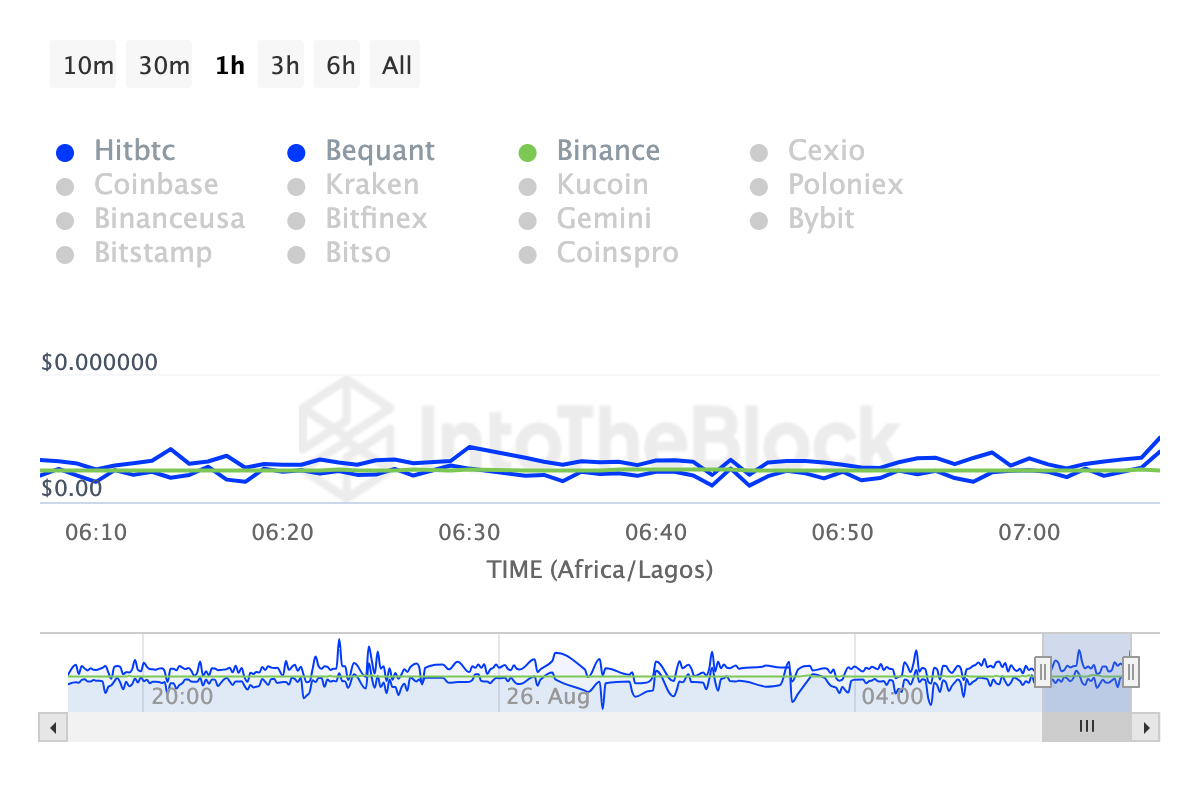
Разница между ценами покупки и продажи Shiba Inu. Источник: IntoTheBlock

Кроме того, рост сети (Network Growth) Shiba Inu также замедляется. Этот показатель отслеживает темпы привлечения новых пользователей и их активность. Для составления полной картины индикатор фиксирует количество всех новых адресов, которые совершают свои первые транзакции в блокчейне SHIB.

Обычно рост этого показателя говорит о том, что интерес сообщества к монете растет, что может поддержать укрепление криптовалюты. Если же показатель падает, можно предположить, что комьюнити теряет интерес к активу. В этой ситуации долгосрочный спрос на токен сокращается, усиливая давление на цену.
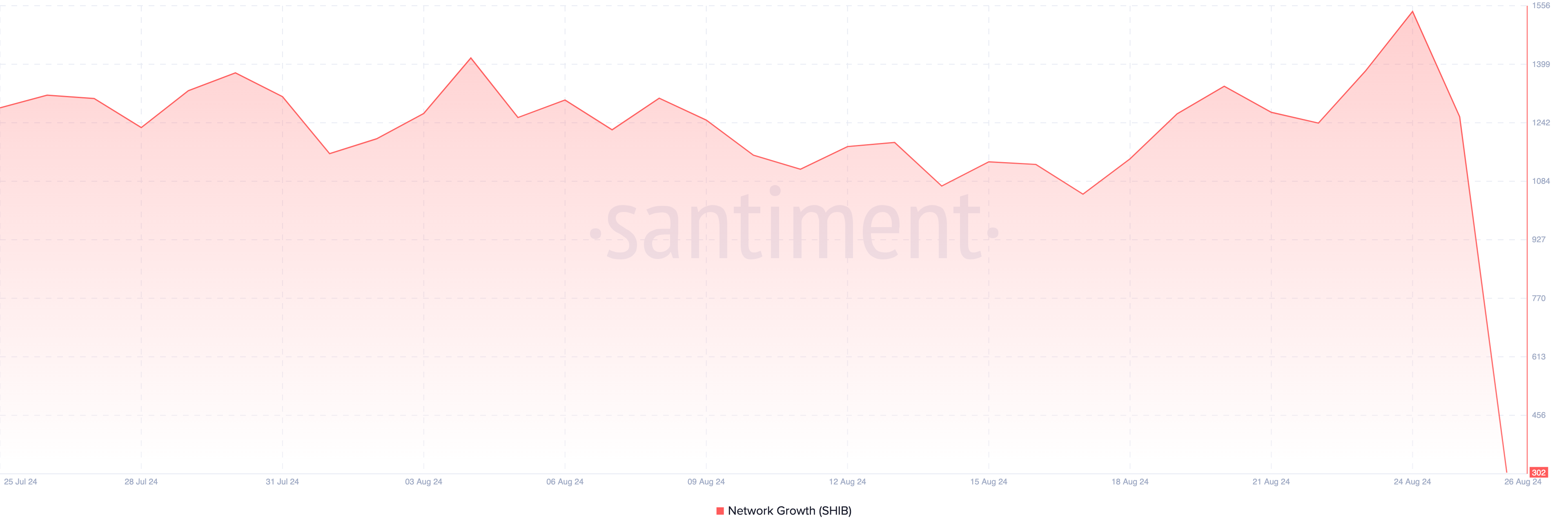
Рост сети Shiba Inu. Источник: Santiment

О том, почему инвесторы ждут биткоин по $100 000 в сентябре, читайте в нашей специальной статье.

Прогноз SHIB: не упустить критическую поддержку

На момент написания этого анализа SHIB торгуется по $0,00001466, за сутки потеряв чуть более 4%. При этом за последние семь дней криптовалюта подорожала более чем на 11%.

С технической точки зрения, Shiba Inu все еще уязвима — особенно при условии, что проблемы с ликвидностью сохранятся. Значения индикатора Чайкина (Chaikin Money Flow, CMF) также снизились — значит, сейчас происходит фаза распределения, а не накопления. Это мешает привлекать ликвидность, необходимую для выхода из нисходящего тренда. Традиционно низкие значения CMF сигнализируют о том, что давление продаж на актив возрастает.

Если этот тренд продолжится, SHIB будет трудно удержаться на текущих ценовых уровнях. Тогда риск дальнейшего снижения для альткоина возрастет.

Читайте также: Команда Shiba Inu поделилась планами запуска L3-блокчейна и нескольких новых токенов
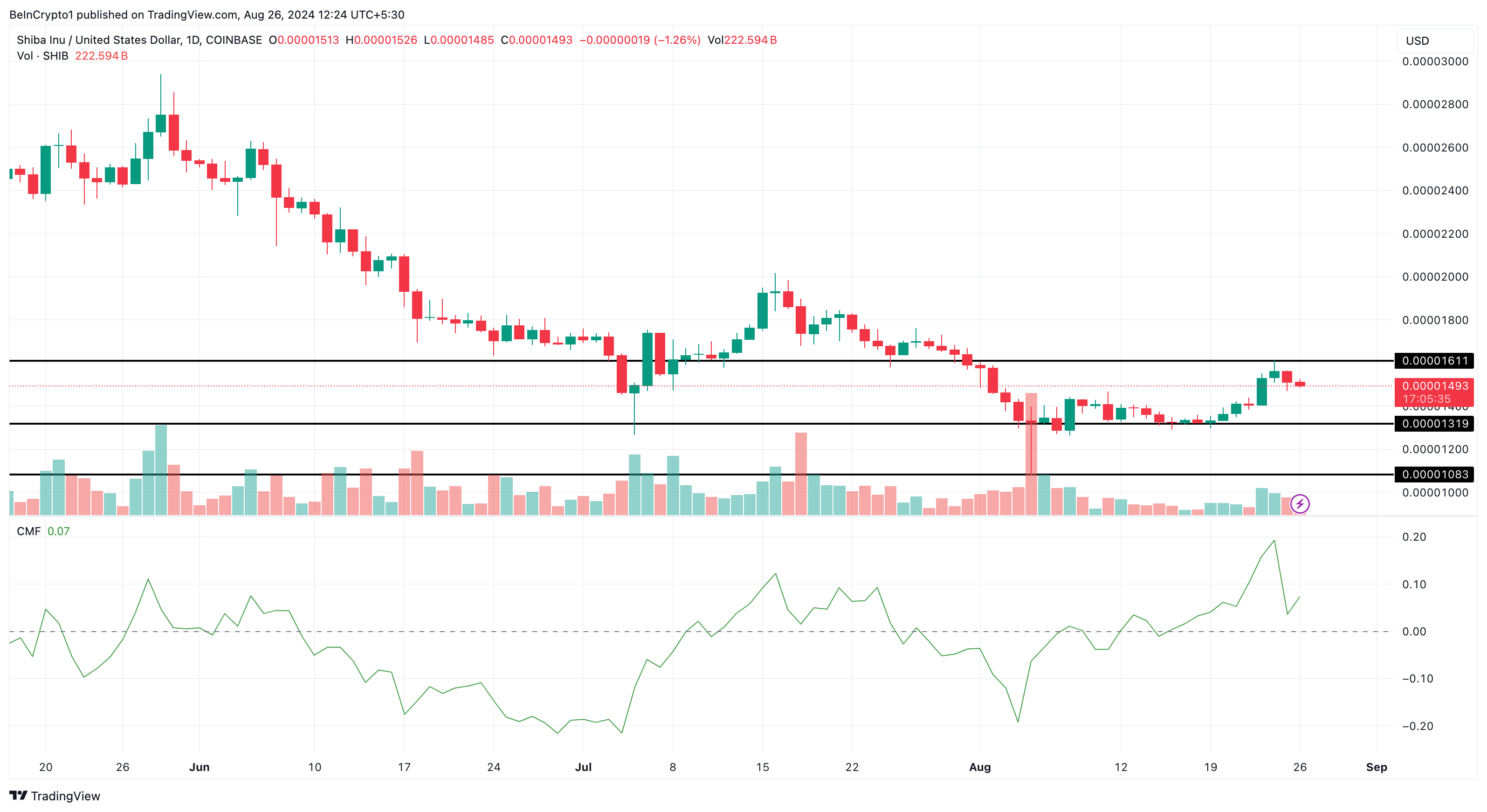
Ежедневный анализ Shiba Inu. Источник: TradingView

Важнейшим уровнем остается поддержка на $0,000013. Если цена Shiba Inu просядет ниже нее, возможно падение к $0,000010.

С другой стороны, уровень сопротивления на $0,000016 — ключевой для быков, которые хотят продолжить рост. Если быкам удастся переломить направление тренда и пробиться выше этой отметки, то перед SHIB откроются перспективы восстановления до $0,000020.


Criptomoedas em alta

Leituras Relacionadas

GPT-5.6 Countdown: Abandon the Illusion of a Single API, Computational Iteration Can't Outpace a Single Page of Compliance

In mid-June, three seemingly independent industry events—the compliance-driven throttling of Fable 5, the open-sourcing of GLM-5.2, and the leaked release timeline for GPT-5.6—are pushing the global AI industry toward a watershed moment. These shifts signal a fundamental restructuring of the industry's underlying logic. First, **"usability" has substantially overtaken "advanced capabilities"** as the primary weight, pushing the global large language model (LLM) supply chain into a "dual-track" phase of controlled closed-source and local open-source coexistence. Second, **the competitive moats of closed-source giants are shifting**. Their technical focus is moving from "language intelligence" toward "spatial intelligence (world models)"—a domain heavily reliant on computing power. Third, faced with常态化 transnational compliance risks, **a "model-agnostic" decoupled design has become a survival necessity for application-layer developers to maintain business continuity.** The article details how Anthropic's Fable 5, despite its advanced engineering feats, was restricted for non-U.S. citizens within 72 hours of launch, highlighting how geopolitical compliance can instantly limit even the most advanced models. In response, the open-source camp, exemplified by Zhipu AI's MIT-licensed GLM-5.2, is gaining market share by offering stable performance improvements and significant cost advantages (up to 70% savings for enterprises), while achieving full adaptation with domestic semiconductor platforms. Meanwhile, closed-source leaders like OpenAI are pivoting. The anticipated GPT-5.6 reportedly shifts focus from language to spatial intelligence and world models, aiming to rebuild a generational gap in areas like 3D understanding, simulation, and industrial design that demand immense compute. The core conclusion is that the LLM supply chain's logic has changed. Enterprises must now evaluate infrastructure based on a composite of technical performance and policy compliance. For developers, complete reliance on a single closed-source API poses unacceptable risk. Implementing a truly model-agnostic architecture—enabling swift switches to compliant, locally deployable open-source alternatives—is no longer just good practice but a fundamental baseline for business continuity.

marsbitHá 2h

GPT-5.6 Countdown: Abandon the Illusion of a Single API, Computational Iteration Can't Outpace a Single Page of Compliance

marsbitHá 2h

Is the 'Token Subsidy War' Among AI Giants Almost Over?

The article discusses the ongoing "token subsidy war" among AI giants like OpenAI and Anthropic, questioning whether it's nearing its end. It reveals that current AI subscription prices are heavily subsidized, with some plans offering tokens at up to 70 times the actual cost to attract and retain heavy users, especially developers and enterprises. This strategy mirrors past internet-era subsidy battles, but with a key difference: AI tokens lack "lock-in" effects. Unlike ride-hailing or food delivery apps, users can easily switch between AI providers as APIs become standardized, making it difficult for companies to raise prices post-subsidy. The piece highlights a structural asymmetry in the competition. Giants like Google, with massive advertising revenue, can afford to subsidize tokens indefinitely, akin to using "tokens as a weapon." In contrast, venture-backed companies like OpenAI and Anthropic face pressure to become profitable, especially as they approach IPO. The article cites Google Ventures founder Bill Maris, who suggests Google could slash token prices by 80%, putting immense pressure on competitors. Two potential endgames are presented: the "internet service" model (subsidize, monopolize, then raise prices) and the "utility" model (tokens become a standardized, low-margin commodity like electricity). Given the low switching costs, the latter seems more likely. The competition may not have a single winner but could instead accelerate AI's evolution into a foundational, infrastructure-level technology, akin to a public utility. For now, users continue to benefit from heavily subsidized token costs.

marsbitHá 2h

Is the 'Token Subsidy War' Among AI Giants Almost Over?

marsbitHá 2h

Beyond the Stadium: The Profitable Games Surrounding the World Cup

"Beyond the Pitch: The Profit Game Around the World Cup" The FIFA World Cup transcends being a sporting spectacle, evolving into a massive global arena for speculation and profit-seeking. The 2026 tournament has amplified this dynamic, creating a multi-layered ecosystem of financial opportunism alongside the football. **Prediction markets** have surged into the mainstream. Platforms like Polymarket and Kalshi saw trading volumes for World Cup contracts soar, attracting new users with their financial trading model and high-profile, chain-based wealth stories that overshadow traditional sports betting in terms of growth and narrative. However, **traditional sportsbooks** remain the dominant force, leveraging established user habits, legal markets, and comprehensive product offerings to handle the vast majority of speculative wagers, with projections suggesting record-breaking betting volumes. Capital markets also react. **"Concept stocks"** in countries like South Korea and Japan experience volatile price swings based on team performance and anticipated fan spending on items like chicken, beer, and viewing parties, effectively becoming a stock market reflecting fan sentiment. The **ticket resale market** has become a sophisticated arena for arbitrage. Prices fluctuate wildly based on team draws and star power, with sellers sometimes listing tickets they don't yet own in a practice akin to short-selling, while FIFA's own "Right to Buy" tokens add another layer of speculative trading. **Collectibles and merchandise** offer another avenue. Panini sticker albums, with their inherent scarcity and nostalgic value, can become high-value collectibles. Limited-edition or locally themed jerseys command significant premiums on secondary markets, and even counterfeit vendors profit from fans' desire for affordable match-day identity. The **cryptocurrency** space has seen a frenzy of speculative, unauthorized World Cup-themed meme coins on chains like Solana. These tokens, often exploiting team names and player imagery, experience extreme pump-and-dump cycles, creating stories of massive gains for a few early entrants and steep losses for many others. Finally, an entire industry thrives on **providing information and tools** to other speculators. Developers create platforms like SeatSidekick to track ticket inventory and prices, while paid Telegram groups and subscriptions sell betting tips and predictions, monetizing the widespread desire for an informational edge. In essence, the World Cup has become a compressed, global laboratory for speculation. While the games determine champions on the field, a parallel, complex network of financial transactions—spanning prediction contracts, bets, stocks, tickets, collectibles, crypto, and information services—settles its own scores in the global market.

marsbitHá 3h

Beyond the Stadium: The Profitable Games Surrounding the World Cup

marsbitHá 3h

Trading

Spot
Futuros

Artigos em Destaque

Como comprar SHIB

Bem-vindo à HTX.com!Tornámos a compra de SHIBA INU (SHIB) simples e conveniente.Segue o nosso guia passo a passo para iniciar a tua jornada no mundo das criptos.Passo 1: cria a tua conta HTXUtiliza o teu e-mail ou número de telefone para te inscreveres numa conta gratuita na HTX.Desfruta de um processo de inscrição sem complicações e desbloqueia todas as funcionalidades.Obter a minha contaPasso 2: vai para Comprar Cripto e escolhe o teu método de pagamentoCartão de crédito/débito: usa o teu visa ou mastercard para comprar SHIBA INU (SHIB) instantaneamente.Saldo: usa os fundos da tua conta HTX para transacionar sem problemas.Terceiros: adicionamos métodos de pagamento populares, como Google Pay e Apple Pay, para aumentar a conveniência.P2P: transaciona diretamente com outros utilizadores na HTX.Mercado de balcão (OTC): oferecemos serviços personalizados e taxas de câmbio competitivas para os traders.Passo 3: armazena teu SHIBA INU (SHIB)Depois de comprar o teu SHIBA INU (SHIB), armazena-o na tua conta HTX.Alternativamente, podes enviá-lo para outro lugar através de transferência blockchain ou usá-lo para transacionar outras criptomoedas.Passo 4: transaciona SHIBA INU (SHIB)Transaciona facilmente SHIBA INU (SHIB) no mercado à vista da HTX.Acede simplesmente à tua conta, seleciona o teu par de trading, executa as tuas transações e monitoriza em tempo real.Oferecemos uma experiência de fácil utilização tanto para principiantes como para traders experientes.

531 Visualizações TotaisPublicado em {updateTime}Atualizado em 2026.06.02

Como comprar SHIB

Discussões

Bem-vindo à Comunidade HTX. Aqui, pode manter-se informado sobre os mais recentes desenvolvimentos da plataforma e obter acesso a análises profissionais de mercado. As opiniões dos utilizadores sobre o preço de SHIB (SHIB) são apresentadas abaixo.

活动图片