行情震荡下仍旧有赚钱良机埋伏5种加密货币牛市成为百万富翁

币界网Publicado em 2024-08-21Última atualização em 2024-08-21

币界网报道:

行情分析:

昨天日内最高61400,晚10点美股开盘后,两个小时就跌至58600一线,全天涨幅尽数抹去,早8日线收阴,带长上影线,预计本周还是震荡。当前主流币种仍是期货带动现货,合约绞肉机行情,多看少动。

活跃山寨目前波动较小,例如SATS、SAGA、TIA等,并且8月5日与7月5日两个低点差不多,成交量有放大迹象,日线各指标出现底背离,要密切关注,后续如果跟随大饼下跌确认供应区支撑力度,有可能是一个极好的左侧现货建仓机会,并且最近几年的10月,山寨都有一波不错的上涨行情。

个人观点:

想必大家都知道昨天上线一款国产游戏《黑神话悟空》,一上线爆火海内外,也带动相关股票的上涨,同时 web3 也跟着这波热度也推出一些活动,那么我们反思下,现在这款游戏那么火,币圈的游戏板块币种会不会也跟上呢?

其次对于昨天走势出现一根针,也暗示着未来几天行情波动也随之到来,玩合约的家人们更需要谨慎交易。

019331065d4887298c980eb12823e9fa.png

市场震荡仍有赚钱机会!埋伏5种100倍加密货币成为百万富翁!

1.APT

Aptos (APT) 网络是一条快速增长的 L1 链,完全摊薄估值约为 28 亿美元,日均交易量约为 2.24 亿美元。Aptos 网络由 Meta 的 Diem 区块链的前工程师开发,受到了 web3 开发人员和投资者的极大关注。 领先的稳定币发行商 Tether 也宣布计划在 Aptos 网络上推出其 USDT 产品。

c85de4b7db888acdbcf25a05626e0112.png

2.MATIC

MATIC 在市场波动中展现出强大韧性,近期反弹和鲸鱼投资的支持预示其未来稳定性和增值潜力。MATIC 价格在 0.4001 至 0.4571 美元之间波动。4 小时图上,10 日移动平均线为 0.427 美元,100 日均线为 0.414 美元,形成了显著的看涨交叉信号。支撑位在 0.422 美元,阻力位在 0.55 美元,表明有强支撑和潜在上涨空间。RSI 为 58.86,显示市场略微偏向买入,MACD 指标同样展现出强劲动能和成交量增长,短期内可能继续上涨。

a057bec9f8282d5ba8215557b57bd90a.png

3.DOGE

狗狗币最初只是个玩笑,后来逐渐发展成为一种广为人知的加密货币,拥有热情的社区和日益增长的实用性。狗狗币经常与网络文化和社交媒体趋势联系在一起,其价值得到了伊隆·马斯克等知名人物的支持。狗狗币拥有加密货币世界中最专注的社区之一,这不断推动着它的普及和使用。有影响力的人物和名人的支持大大提升了狗狗币的知名度和市场价值。尽管市场波动,但狗狗币一直在市值最高的加密货币中保持着强势地位。

1b6c6f8ac5868a6b4ce5438b3f7a62a1.png

4.ATOM

ATOM 价格走势在 1D 图表中显示下降通道,50D 和 200D EMA 的死亡交叉是看跌信号。此外,Cosmos 的市值已跌破 20 亿美元,市场排名下滑至第 42 位。如果 Cosmos 背后的团队通过决议和发展来加强网络,并通过社交活动来加强社区。到年底,山寨币的价格可能会升至 25.06 美元的潜在高点。未来三年,发展计划将有助于提高可扩展性和交易速度,从而推动网络用户群的增长。

e0e3403df7fd5004525efe93ec6e663e.png

5.ORDI

过去几天, ORDI价格继续呈现中性价格走势,表明对该山寨币的看涨情绪较弱。积极的一面是,尽管过去 30 天内录得 22.39% 的修正,但它仍在全球加密货币榜单中稳居第 92 位,表明前景看好。相对强弱指数 (RSI) 在其价格图表中显示一条持续的平线,表明市场上山寨币的价格走势疲软。然而,平均趋势线显示出潜在的看涨收敛,表明趋势逆转的可能性很高。如果 ORDI 价格维持在支撑位 28.25 美元上方,多头将准备在未来一段时间内测试其阻力位 39.75 美元。

8a622367cf62967efc825b990ef9f738.png

Leituras Relacionadas

Tencent Buys Baidu Chips

China's internet giants, once defined by building closed, self-sufficient empires, are undergoing a fundamental shift. A key signal is Baidu's plan to spin off its AI chip unit, Kunlun Xin, for a Hong Kong IPO targeting a $50 billion valuation, potentially exceeding its parent company's worth. Concurrently, Alibaba's T-Head is also pursuing independence. Most significantly, reports indicate that rival Tencent has become a major customer for Kunlun Xin's chips. This move, where competitors begin procuring each other's core technologies, marks a decisive break from the past era of internal duplication and isolation. It signals the maturation of China's AI industry into a more open, specialized ecosystem. The underlying driver is the immense and clear cost of AI infrastructure, particularly the exploding demand for inference compute driven by AI agents and applications. Hardware is no longer just an internal cost center but a profitable, strategic business in itself. Globally, a parallel trend is evident as OpenAI, Google, Amazon, and others develop their own AI chips to control costs and optimize performance. The competition has moved beyond model benchmarks to a deeper, foundational war over token cost efficiency, inference cluster performance, and secure, scalable computing power. Baidu and Alibaba aren't dismantling their empires but are instead decoupling non-core, capital-intensive infrastructure to participate in and shape a larger, collaborative industrial base. The era of the all-encompassing super-app is giving way to an age of strategic specialization and open ecosystem building in the AI race.

marsbitHá 14m

Tencent Buys Baidu Chips

marsbitHá 14m

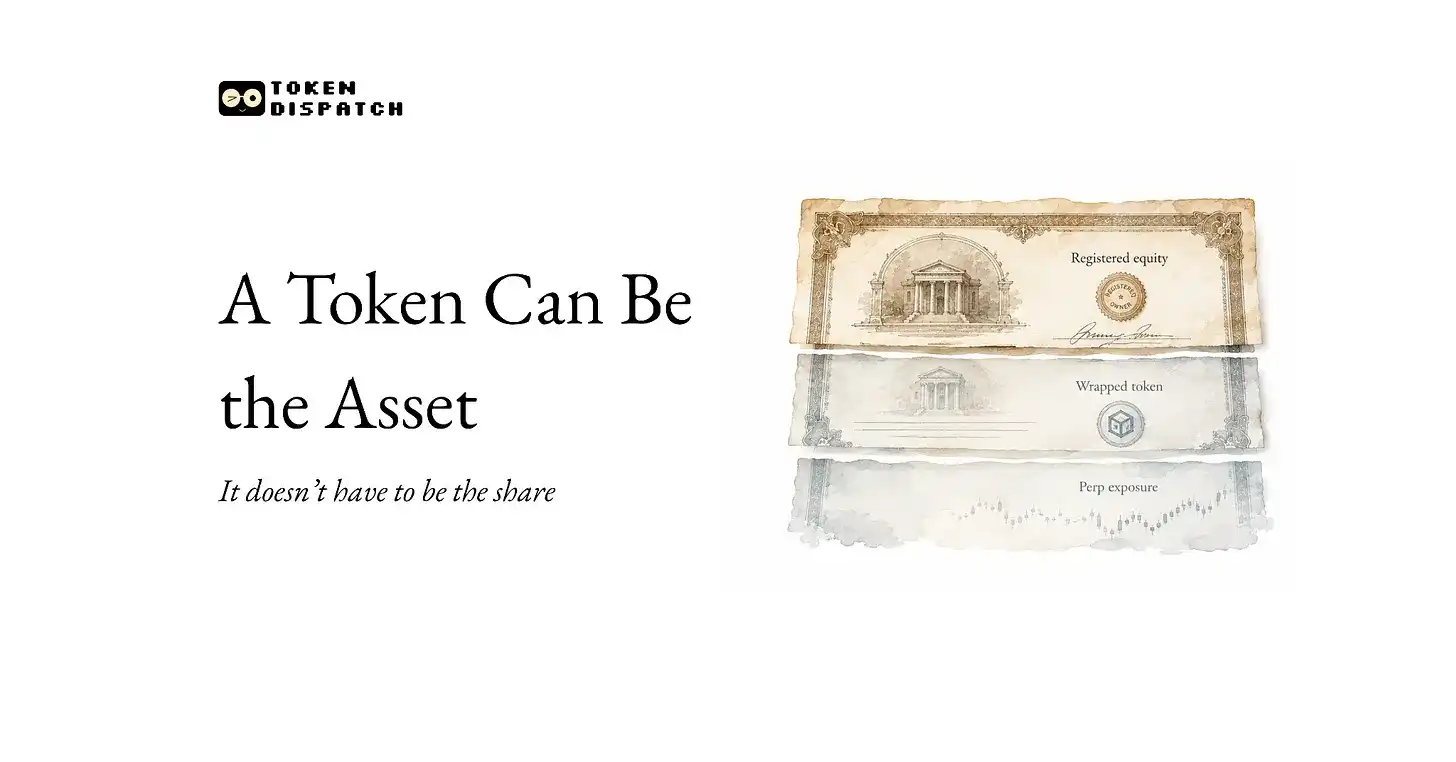
The Token Itself Is an Asset: Three Types of Tokenized Stocks, Which One Suits You?

"Tokenized Stocks: Three Types, Which One Fits You? For investors outside the US, buying stocks like SpaceX or Nvidia is difficult, requiring brokers, cross-border transfers, and often accredited investor status. Blockchain offers an alternative through tokenized stocks, a term encompassing three distinct products with vastly different ownership, voting, and profit rights. 1. **Full Real Ownership**: Companies like Superstate register native equity directly on-chain (e.g., Solana). Holders are on the official shareholder registry, with full voting rights, dividends, and legal ownership. This offers maximum rights but potentially less DeFi flexibility. 2. **SPV-Backed Tokens (Surrendered Ownership for DeFi Composability)**: Issuers like Backed (xStocks) and Ondo use offshore Special Purpose Vehicles (SPVs) to hold underlying shares 1:1 and issue tracking tokens. Investors get price exposure and dividends (reinvested as more tokens) but hold a claim on the SPV, not direct stock ownership. This enables use as collateral in DeFi protocols (Kamino, Morpho) and 24/7 minting/redemption, but carries SPV counterparty risk (highlighted by the PreStocks collapse). 3. **Perpetual Futures (Pure Price Speculation)**: Platforms like TradeXYZ (on Hyperliquid) and Ostium offer perpetual contracts. These are synthetic derivatives with no underlying stock ownership, using funding rates to track spot prices. They require only a price oracle, allowing extremely fast listing (e.g., SpaceX pre-IPO) and high leverage, attracting speculators. Their trading volume far exceeds tokenized spot products. The core value of tokens is that they don't need to replicate full stock ownership. Most retail investors never vote. Tokenization creates layered financial tools: full equity for institutions, composable tokens for DeFi users, and perpetuals for leveraged traders."

marsbitHá 14m

The Token Itself Is an Asset: Three Types of Tokenized Stocks, Which One Suits You?

marsbitHá 14m

AI as the Boss: Nearly Bankrupts 10 Companies...

A recent study from Princeton University tested 14 AI models, including large language models (LLMs) and a rule-based algorithm, in a simulation where they acted as CEOs of a virtual SaaS startup over 500 days. The goal was to grow an initial $1 million capital. The results were stark: only four "CEOs" ended with a profit. The top performer was Claude Fable 5, multiplying the capital 47-fold to $47.15 million. Claude Opus 4.8 and GPT-5.5 followed. Notably, the fourth profitable entity was a simple, pre-programmed rule-based algorithm, which outperformed many advanced LLMs with $15.76 million in profit. Five other models, including several major LLMs, went bankrupt before the simulation ended. Key takeaways from the research highlight that successful AI CEOs demonstrated a tendency for exploration and adaptation over caution. They excelled in discovering hidden information, predicting future cash flow, adapting quickly to changes (like competitor moves), and engaging in strategic "if-then" planning. The study also found that equipping LLMs with programming-agent frameworks, optimized for coding tasks, actually harmed their performance in this CEO role, suggesting a need for domain-specific adaptations. The article concludes by contrasting AI's current operational proficiency within defined frameworks with the type of visionary, intuitive decision-making—exemplified by figures like Steve Jobs—that truly drives transformative business strategy. This critical "matrix-drawing" capability, it argues, remains uniquely human.

marsbitHá 24m

AI as the Boss: Nearly Bankrupts 10 Companies...

marsbitHá 24m

Tokens as Assets: Which Type of Tokenized Stock Is Right for You?

**Tokenized Stocks: Three Models, Which Suits You?** For investors outside the US, accessing stocks like SpaceX or NVIDIA is often difficult, requiring compliant brokers and cross-border transfers. Blockchain offers an alternative through tokenized stocks, but this term encompasses three distinct models with vastly different ownership, voting rights, and economic benefits. The first model offers full, direct ownership. Platforms like Superstate register shares directly on-chain (e.g., Solana), with holders listed on the official shareholder registry, granting full voting rights, dividends, and legal status. The second model sacrifices direct ownership for DeFi composability. Issuers like Backed and Ondo use offshore Special Purpose Vehicles (SPVs) to issue tokens 1:1 backed by real shares. Holders gain price exposure and automated dividend accruals (via token balance increases), and tokens can be used as collateral in DeFi protocols. However, this introduces SPV counterparty risk, as seen in the PreStocks collapse. The third model abandons ownership entirely for pure price speculation. Perpetual futures platforms like TradeXYZ (on Hyperliquid) and Ostium create synthetic markets using price oracles and funding rates to track stock prices. They require no underlying shares, enabling rapid listing (e.g., SpaceX pre-IPO) and high leverage, which explains their trading volumes being 4-5x higher than tokenized spot markets. The core insight is that tokens derive value without needing to replicate full stock ownership. Most retail investors rarely exercise voting rights. These three models cater to different needs: direct ownership for institutions, DeFi-composable tokens for on-chain users, and perpetuals for leveraged, speculative traders. Tokenization is not a mere stock substitute but a new class of layered financial instruments.

Foresight NewsHá 25m

Tokens as Assets: Which Type of Tokenized Stock Is Right for You?

Foresight NewsHá 25m

Trading

Spot
活动图片