Куда инвестировали институционалы в июле

cryptonews.ruPublicado em 2022-01-07Última atualização em 2024-08-07

В июле количество инвестиций в криптовалютные проекты значительно возросло. По данным RootData, всего венчурные компании объявили о 113 вложениях, что на 12% больше, чем в июне

Общий объем инвестиций в криптопроекты в июле 2024 года составил более $1 млрд. Это значительно превышает показатель июля, когда институционалы потратили на это $735 млн.

Как прошел июль

Активность венчурного капитала часто используется для оценки интереса крупных инвесторов к крипторынку. Последние данные об инвестициях со стороны институционалов в криптовалюты показывают положительную динамику роста.

По сравнению с предыдущим месяцем количество публично раскрытых криптопроектов увеличилось на 12%. Июль оказался третьим месяцем по количеству раундов финансирования в текущем году, уступая лишь марту и маю, на которые пришлось 190 и 155 раундов соответственно.

Общая сумма собранных средств в июле составила $1,01 млрд, что на 26,5% больше, чем $735 млн, собранных месяцем ранее.

Читайте также: Топ альткоинов для инвестиций во второй половине 2024 года
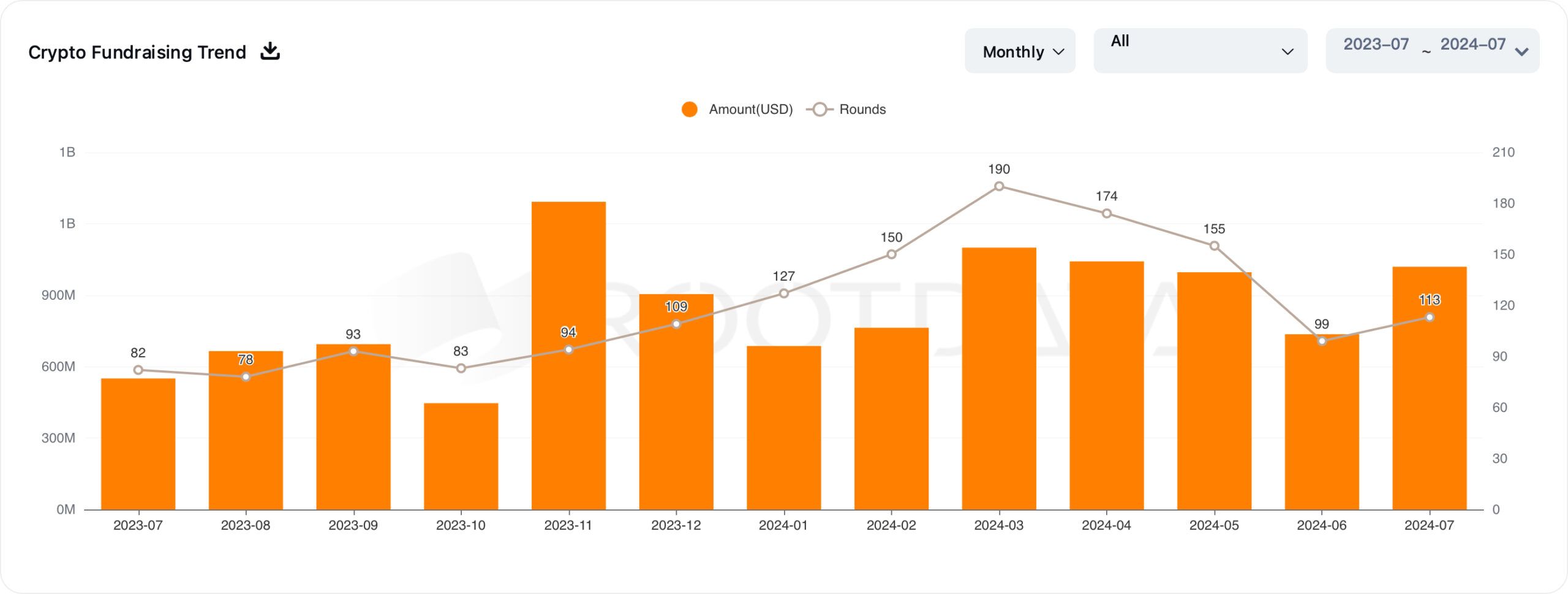
Тенденции сбора средств в криптоиндустрии. Источник: RootData

Инвесторы продолжают активно вкладывать средства в криптовалютный сектор, несмотря на общую экономическую неопределенность.

Кроме того, меняется способ распределения капитала между различными секторами криптоиндустрии. Это указывает на то, что инвесторы становятся более избирательными и обращают внимание на новые перспективные направления.

Сектор инфраструктуры блокчейна, включая решения первого и второго уровней (L1/L2), привлек почти 20% от общего объема инвестиций за июль. За ним следует направление децентрализованных финансов (DeFi), на которое пришлось 5,8% финансирования. Меньше всех получила сфера централизованных финансов (CeFi) — около 2,2%.

Важно отметить, что приведенные цифры не включают сделки по слиянию и поглощению.

Куда инвестировали институционалы

Iris Energy

Инвестиции в майнинговую компанию Iris Energy стали одним из ключевых событий июля. Фирма привлекла $413 млн за счет размещения акций.

В первом квартале майнер также получил финансирование в размере $257 млн и еще $44,8 млн между 31 марта и 15 мая. Привлеченные средства помогут Iris расти и расширяться после последнего халвинга биткоина (BTC), который снизил скорость майнинга в два раза и тем самым повлиял на прибыльность майнинг-компаний.

Block Mining

Еще одно важное событие июля — сделка Block Mining на $92,5 млн. Майнера биткоина из Кентукки, США, купила компания Riot Platforms за $18,5 млн наличными и $74 млн в акциях RIOT.

Теперь Block Mining может заработать дополнительные $32,5 млн за счет увеличения мощностей. Riot, в свою очередь, увеличит свой хешрейт и расширит географическое присутствие на рынке.

Читайте также: Облачный майнинг — список лучших сайтов 2024

«При оценке потенциальных партнеров по поглощению стало очевидно, что Riot Platforms не только разделяет наше видение энергоэффективного майнинга биткоина, но и дополняет нашу культуру, в которой ценятся командная работа, креативность и неустанное стремление к совершенству. Вместе мы с радостью используем наши коллективные силы и опыт для создания центров обработки данных биткоина, которые выведут нас на передовые позиции в отрасли», — отметил Майкл Столцнер, генеральный директор и сооснователь Block Mining.

Sentient и другие

Протокол искусственного интеллекта (ИИ) Sentient привлек $85 млн в раунде, который возглавили Pantera Capital и Framework Ventures. Раунд стал самым успешным среди инфраструктурных блокчейн-проектов.

Sentient Labs планирует использовать полученные средства для ускорения разработки своей ИИ-платформы с открытым исходным кодом. Кроме того, стартап собирается расширить команду, наняв экспертов в области исследований ИИ и блокчейн-инженерии, а также намерен наладить партнерские отношения с ведущими академическими институтами и лидерами индустрии.
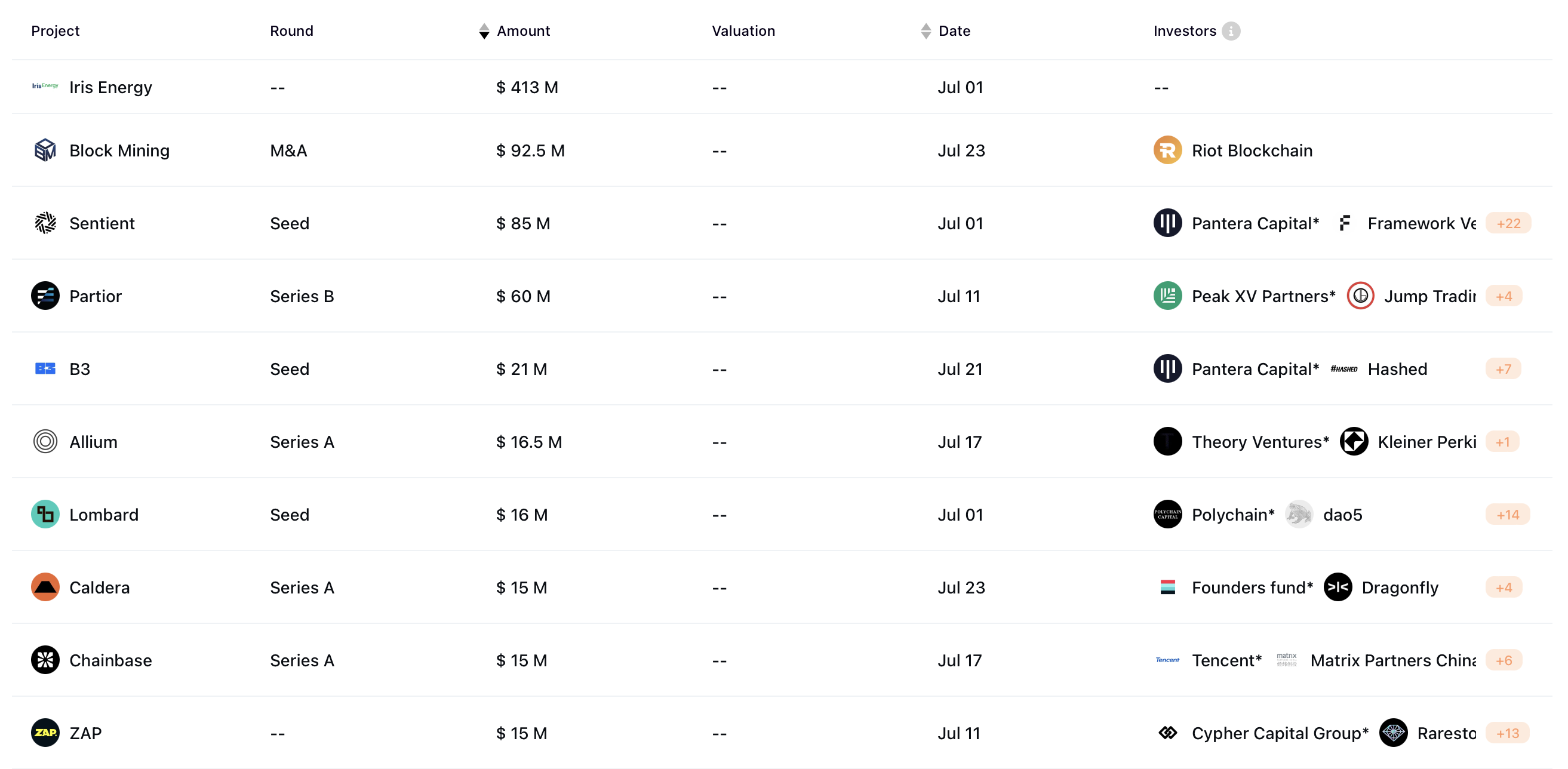
Наиболее финансируемые криптопроекты июля 2024 года. Источник: RootData

Значительные инвестиции также получила блокчейн-сеть платежей Partior — $60 млн. Проект заручился поддержкой таких традиционных банковских гигантов, как JPMorgan и Standard Chartered.

Без вложений не остался и игровой сектор (GameFi). Финансирование получило сразу несколько проектов, включая B3 и Allium.

Leituras Relacionadas

AC Exits Sonic Board, 'DeFi Godfather' Pulls Off Another Strategic Retreat

Andre Cronje, known as the "DeFi Godfather," and two other founding directors have stepped down from the Sonic Labs board. The S token, once valued at $1.03, has plummeted 97% to $0.028, and the chain's TVL has evaporated 98% from its peak. In his exit statement, Cronje clarified he was a technical architect, not a founder, and distanced himself from token economics and migration decisions behind the token's crash. Cronje revealed his focus for the past 18 months has been his new project, Flying Tulip. This project raised $200 million privately last year at a $10 billion valuation. Its token design includes a perpetual put option (ftPUT NFT) for early investors, allowing them to redeem their initial investment at any time—a protection not extended to public market buyers. This pattern mirrors Cronje's past exits from projects like Yearn Finance and Fantom, where he departed near peak hype, leaving later holders to bear significant losses. Sonic itself has seen a complete management overhaul in recent months. The article frames this as a microcosm of the broader crypto bear market, where Layer-1 chains are bleeding value. It highlights a harsh reality: a project's valuation is often tied to a founder's reputation rather than fundamentals. Ironically, Flying Tulip is set to launch first on the Sonic chain Cronje just left, underscoring a disconnect between the person and the platform.

marsbitHá 18m

AC Exits Sonic Board, 'DeFi Godfather' Pulls Off Another Strategic Retreat

marsbitHá 18m

Dialogue with KK, Founder of Hash Global: Do VCs Still Invest in Blockchain Games Now? What Kind of Projects Can Still Get Funding?

**Title: Dialogue with KK, Founder of Hash Global: Do VCs Still Invest in Blockchain Games? What Kind of Projects Can Still Get Funding?** **Summary:** KK, partner at Hash Global, discussed the evolving landscape of Web3 investment and blockchain games in a recent interview. He noted that the industry has moved past its initial hype phase into a more sober "second half," where VCs now prioritize core questions: Is the game actually fun? Does it have real users? Can it generate revenue? Key insights include: * **Web3 Investment Evolution:** The sector is increasingly adopting traditional investment logic, focusing on business models, value capture, and tangible worth over pure narrative. * **Blockchain Game Fundamentals:** The paramount criterion for any game is being genuinely fun and engaging. Web3 elements (like asset issuance and value distribution) should enhance an already solid product, not be a substitute for poor gameplay. Play-to-Earn is seen as a potential final stage, not a starting point. * **Current Investment Thesis:** Hash Global remains active in gaming, favoring projects with low barriers to entry, strong social/competitive elements, and the ability to generate real revenue (e.g., through ads, skins) like traditional Web2 games before scaling. Essential criteria are: 1) A fun core loop understandable without Web3 knowledge, 2) Web3 mechanisms that genuinely improve asset distribution and community participation, and 3) A capable, long-term-focused team with proven product-building experience. * **Team Focus:** The firm concentrates on investing in Chinese teams, leveraging cultural familiarity and judgment. * **Web3 Application Outlook:** Large-scale adoption may be accelerated by AI in areas with significant pain points in distribution (e.g., creator economy) or in "Non-Financial RWA" sectors like entertainment/culture. * **BNB Ecosystem:** Hash Global is bullish on BNB, viewing its ecosystem as significantly undervalued, with real users and global capital access. * **Investor Advice:** In the current bear market, KK expresses respect for new institutional investors entering Web3, as it indicates deep research rather than hype-chasing. A key lesson is managing pace—maintaining optimism tempered with realism to ensure longevity.

marsbitHá 51m

Dialogue with KK, Founder of Hash Global: Do VCs Still Invest in Blockchain Games Now? What Kind of Projects Can Still Get Funding?

marsbitHá 51m

A New Player Enters at Third Place, Rothera Disrupts the Prediction Market Landscape

"Rothera Skyrockets to Third in Prediction Market Rankings, Disrupting Industry Landscape" Rothera, Robinhood's newly launched prediction market platform, has rapidly climbed to become the third-largest player in the sector by trading volume, trailing only giants Kalshi and Polymarket. Its growth is attributed not to attracting new users, but to migrating existing Robinhood user orders away from partner Kalshi. Previously, Robinhood served as a major distribution channel for Kalshi, accounting for an estimated 25%-35% of its volume. With the launch of Rothera, Robinhood now internally executes events like World Cup contracts, capturing revenue that was previously shared with Kalshi. Data shows Rothera's weekly trading volume surged from $21.9 million to $559 million within weeks, reaching nearly one-fifth of Polymarket's volume. Analysts estimate Robinhood's prediction market business could generate around $10 billion in annual revenue at this pace, potentially surpassing its historical crypto revenue peak. In response, Kalshi is reportedly exploring new distribution channels by engaging with investment banks for a potential IPO, requiring them to integrate their systems with Kalshi to access institutional clients. This shift highlights a new competitive focus in prediction markets: controlling user access and distribution channels rather than just product offerings.

marsbitHá 59m

A New Player Enters at Third Place, Rothera Disrupts the Prediction Market Landscape

marsbitHá 59m

Trading

Spot
Futuros
活动图片