
SignalPlus宏观分析(20240613):美国经济“软着陆”

Odaily星球日报Publicado em 2024-06-13Última atualização em 2024-06-13

Resumo

CPI数据远低于预期,核心CPI环比增长0.16%(是2021年8月以来的最低水平),远低于市场预期的0.3%。尽管宏观环境整体走强,加密货币价格整周都处于挣扎状态。

SignalPlus宏观分析(20240613):美国经济“软着陆”

SignalPlus宏观分析(20240613):美国经济“软着陆”

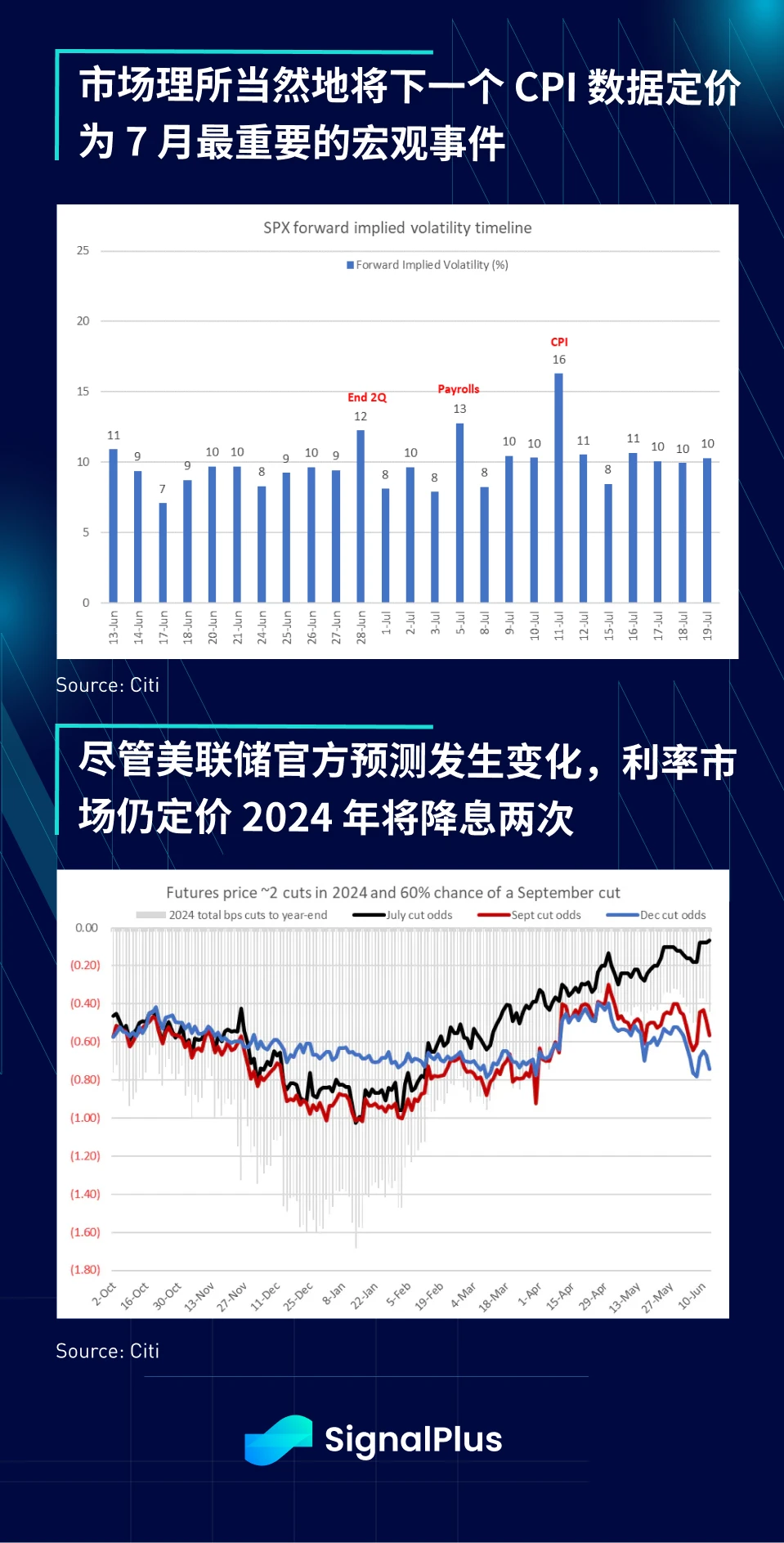
万众瞩目的宏观双重头条日终于到来,且结果不负众望。首先 CPI 数据远低于预期,核心 CPI 环比增长 0.16% (是 2021 年 8 月以来的最低水平),远低于市场预期的 0.3% ,其中“超级核心 CPI”尤其疲软,出现负值;服务支出下滑,商品价格持平,住房通胀上升但仍处于可控范围内。CPI 公布后,华尔街经济学家们迅速将 PCE 预测从 2.8% 下调至 2.6% ,朝着美联储长期目标的正确方向前进。

SignalPlus宏观分析(20240613):美国经济“软着陆”

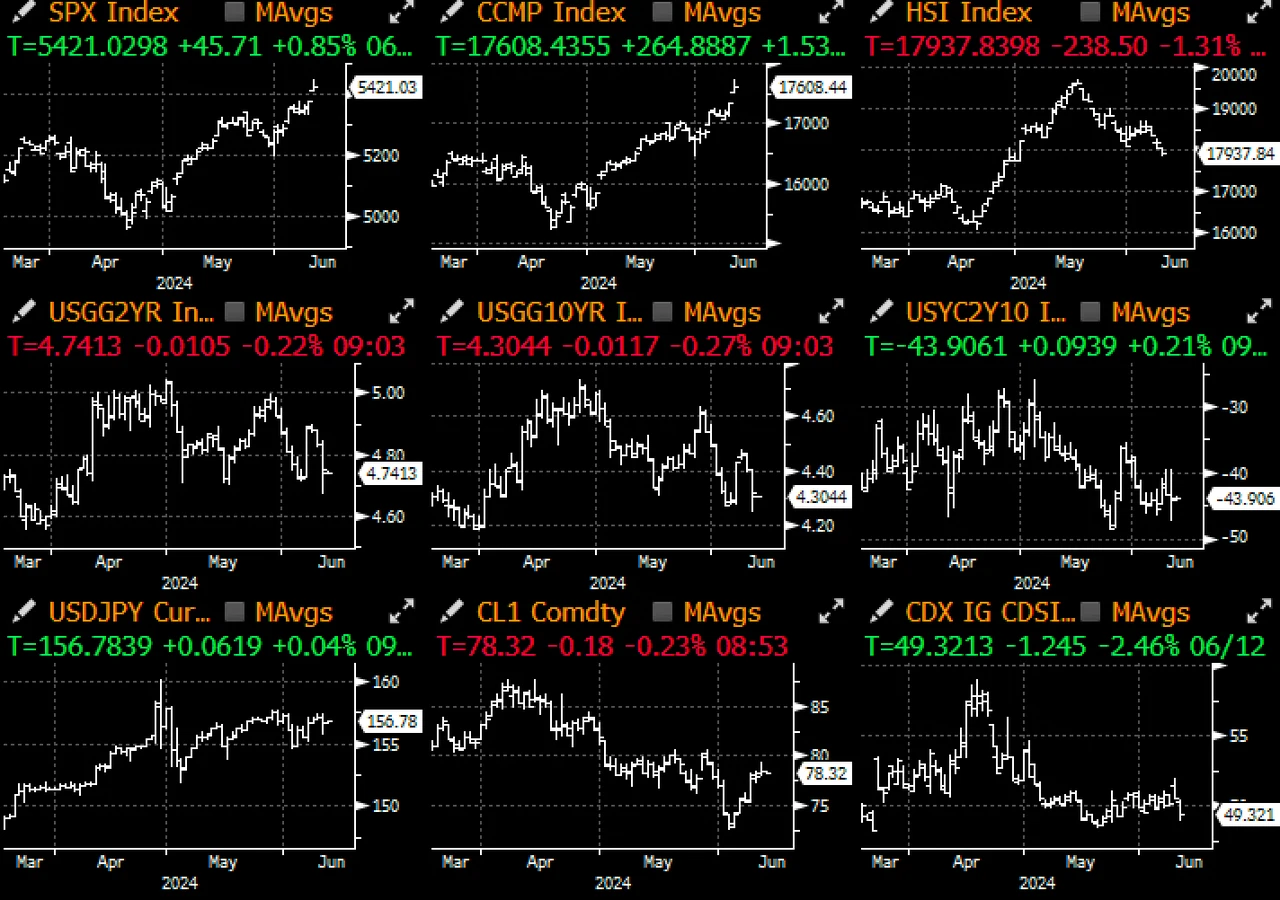
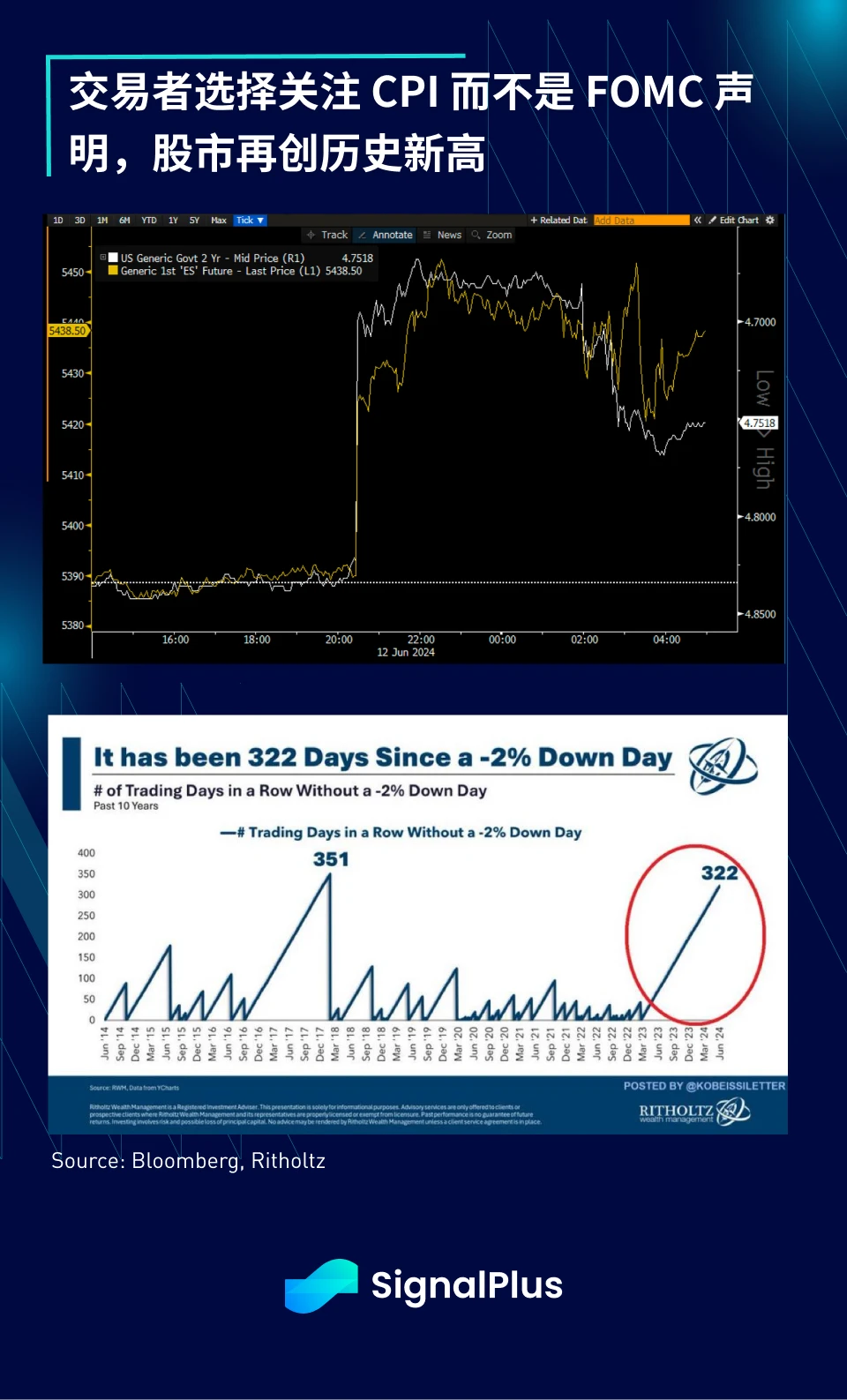
宏观市场对数据反应剧烈,美债牛陡走势加剧, 2 年期收益率大幅下跌 17 个基点,定价反映 12 月 FOMC 会议的降息预期一度高达 51 个基点。而股市也出现多个标准差的波动,随着市场预期下午 2 点的 FOMC 会议将倾向鸽派,SPX 和 Nasdaq 指数双双上涨 1.5% ,创下新高。

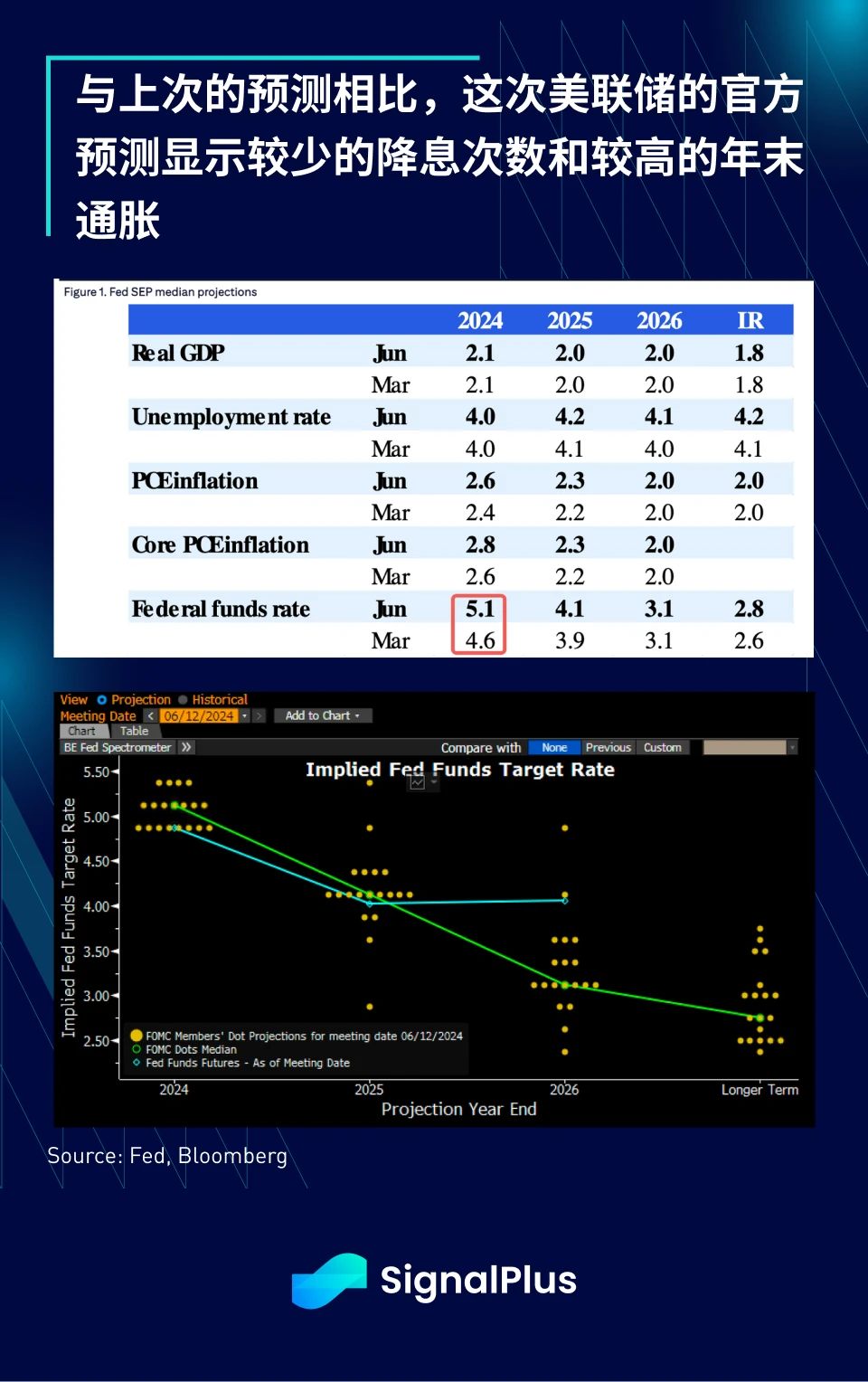
有趣的是,FOMC 最初的声明和点阵图带来一些鹰派冲击,最新的美联储预测显示 2024 年仅有 1 次降息,比之前预测的 3 次更少,此外,预测核心 PCE 通胀在年底为 2.8% ,高于先前预测的 2.6% 。
SignalPlus宏观分析(20240613):美国经济“软着陆”

自然地,Powell 主席在记者会的大部分时间里都试图将论述拉回鸽派立场,明显试图淡化官方预测的重要性。Powell 主席甚至明言,“多数”官员并未将低于预期的 CPI 数据纳入其预测,因此这些预测数据在某种程度上已经过时,真是相当机智的应对。

此外,Powell 指出,就业市场已回到相当于疫情前的状态,职缺数、离职率和劳动力供应的恢复都显示出正常化的迹象。在经济方面,美联储认为增长将以稳健的速度继续,官员们“在某种程度上看到了希望看到的情况,也就是需求逐渐降温”。最后,他也强调美联储正在关注下行风险,并希望将经济软着陆作为首要任务。

总结来说,Bloomberg 指出 Powell 提到通胀 91 次,而就业市场仅提到 37 次,表明价格压力仍然是主要关注点,股票市场顺应潮流,决定重新关注早前的 CPI 数据,SPX 指数收在 5, 438 点附近,接近历史新高,而 2 年期和 10 年期美债收益率分别收在 4.70% 和 4.3% 附近,均是一周低点。SPX 指数目前处于历史上第二长的不超过 2% 跌幅的连续纪录,只要再一个月就能再创纪录!
SignalPlus宏观分析(20240613):美国经济“软着陆”

SignalPlus宏观分析(20240613):美国经济“软着陆”

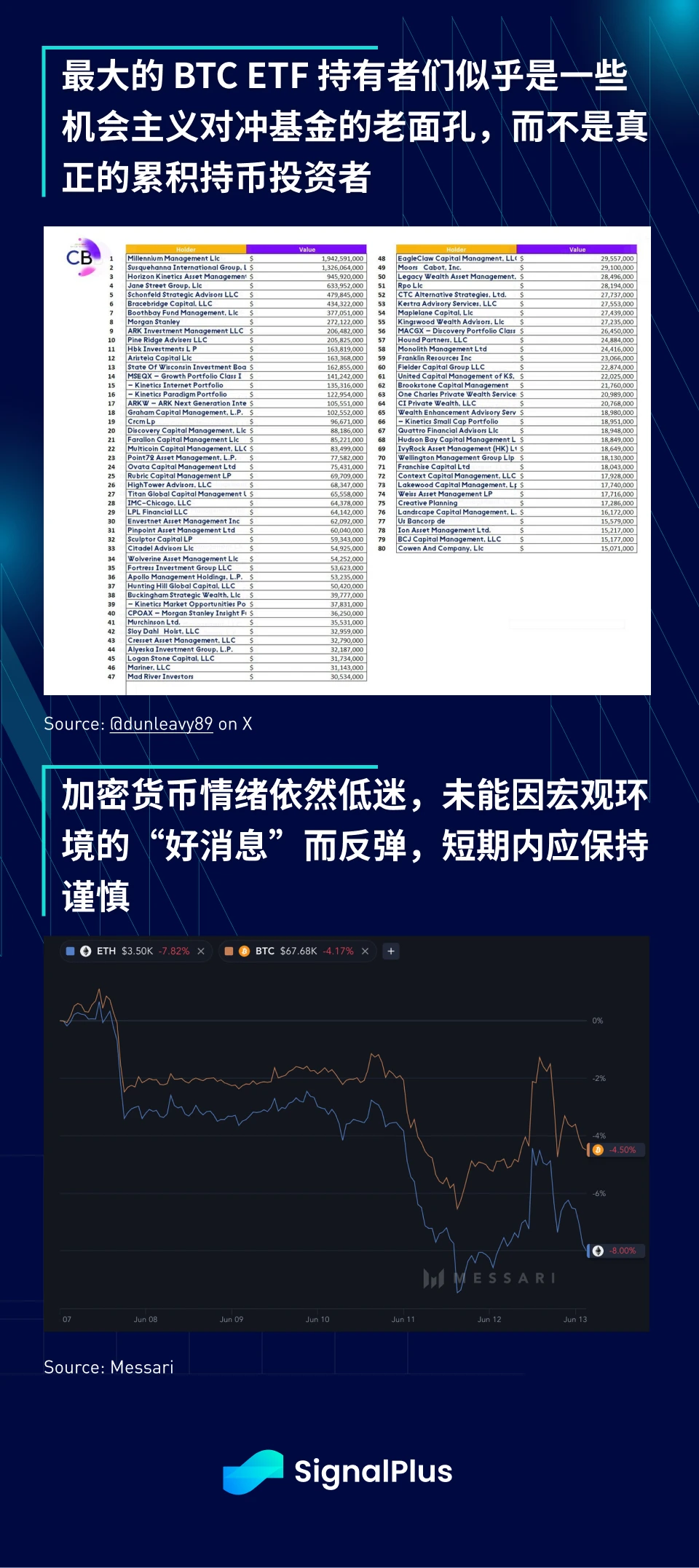
尽管宏观环境整体走强,加密货币价格整周都处于挣扎状态。市场仓位偏多头,加上 BTC ETF 持有者的组合引发市场疑问 - 年初至今的资金流入有多少是为了累积持币而不是相对价值或基差交易?导致 BTC 一直难以突破 7 万美元。ETH 本周也下跌 8% ,主要是由于 ETF 获批的刺激已经消退,同时手续费的下滑和来自 L2 的竞争仍在继续。  目前技术面看起来有点挑战,若股市情绪迟来地反转,加密货币可能会很容易受到冲击。
SignalPlus宏观分析(20240613):美国经济“软着陆”

SignalPlus宏观分析(20240613):美国经济“软着陆”

您可在 ChatGPT 4.0 的 Plugin Store 搜索 SignalPlus ,获取实时加密资讯。如果想即时收到我们的更新,欢迎关注我们的推特账号@SignalPlus_Web3 ,或者加入我们的微信群(添加小助手微信:SignalPlus 123)、Telegram 群以及 Discord 社群,和更多朋友一起交流互动。SignalPlus Official Website:https://www.signalplus.com
Leituras Relacionadas

Former SpaceX Engineer Reconstructs Financial Execution System Using First Principles

Former SpaceX engineer Lex Li applies "First Principles Thinking" to financial infrastructure with Plan Execution Lab, recently raising angel funding at a $50M post-money valuation. The team argues that the core function of finance is capital allocation, and the critical gap is not in trading but in execution, which remains highly manual and fragmented. While assets, liquidity, and settlement have migrated on-chain, execution workflows (monitoring, risk management, liquidity coordination) are still human-native. In an era of accelerating AI agents, strategy decay is rapid, shifting the competitive edge from having the best strategy to having the most robust execution network. Plan Execution Lab introduces two core components: 1. **PlanX**: A Financial Execution Protocol designed as infrastructure for the migration from CEX to DEX, providing on-chain execution capabilities, liquidity access, risk management, and capital orchestration. 2. **Xgent**: An Autonomous Financial Runtime. Users define investment intents, risk preferences, and constraints; Xgent automatically constructs an execution graph, verifies it, and handles ongoing execution and optimization—streamlining the process from Intent to Autonomous Execution. The long-term vision is to create the "Bloomberg Terminal for Autonomous Finance"—a shared operating environment and execution network built collectively by participants like execution nodes, liquidity providers, and autonomous agents. The future of finance, they contend, belongs not to isolated algorithms but to open, collaborative execution networks.

marsbitHá 19m

Former SpaceX Engineer Reconstructs Financial Execution System Using First Principles

marsbitHá 19m

Former SpaceX Engineer Reconstructs Financial Execution System from First Principles

Plan Execution Lab, a financial infrastructure project founded by former SpaceX engineer Lex Li, has raised angel funding at a $50M post-money valuation. The startup is applying "first principles thinking" from Li's SpaceX experience to rethink financial market execution. Their analysis posits that while assets, liquidity, and settlement have moved on-chain, the execution layer remains fundamentally human-dependent and fragmented. In the era of AI Agents, strategy advantages decay rapidly, shifting the competitive edge from isolated algorithms to robust **execution networks**. Plan Execution Lab's solution is a two-part system: **PlanX**, a Financial Execution Protocol designed to facilitate the migration from centralized exchanges (CEX) to on-chain markets by providing core on-chain execution capabilities; and **Xgent**, an Autonomous Financial Runtime. Xgent allows users to define investment goals and constraints, then autonomously constructs and manages the execution logic—moving from **Intent to Execution Graph to Verification to Autonomous Execution**. The long-term vision is to create the "Bloomberg Terminal for Autonomous Finance"—an operating environment not for humans, but for agents and execution nodes. The future financial system, they argue, will be a collaborative network built by diverse participants contributing execution capabilities, not secret strategies. The core competition will shift to who builds the most powerful and adaptive execution network.

链捕手Há 20m

Former SpaceX Engineer Reconstructs Financial Execution System from First Principles

链捕手Há 20m

First Long-Horizon Doc2Repo Training Dataset: Code Agents Move Beyond Bug Fixing and Begin Creating Repositories

With the advancement of LLM Code Agents, the research focus is shifting towards long-horizon, real-world tasks, moving beyond simple bug fixes to full repository generation. To address this, researchers from Renmin University of China introduced the DeNovoSWE dataset. This dataset focuses on long-term software engineering tasks, specifically the "document-to-repository" challenge—generating an entire, executable code repository from a task description. The DeNovoSWE construction method employs a Divide & Conquer approach. It breaks down target repositories into core capabilities and uses a multi-agent Draft-Critic-Repair workflow to automatically generate high-quality, evaluation-aligned task documents. The dataset also implements difficulty-aware filtering to balance quality and diversity. The result is a high-quality, anti-leakage dataset of 4,818 instances. Experiments show that models trained on DeNovoSWE achieve significant improvements in long-horizon repository generation. For instance, Qwen3-30B-A3B-Instruct's performance on the BeyondSWE-Doc2Repo benchmark increased from 5.8% to 47.2%, and on NL2RepoBench from 4.3% to 23.0%. Similar gains were observed with stronger backbones, demonstrating that dedicated long-horizon training data is crucial for advancing Code Agents from maintainers to architects capable of planning and building complete software projects from scratch.

marsbitHá 35m

First Long-Horizon Doc2Repo Training Dataset: Code Agents Move Beyond Bug Fixing and Begin Creating Repositories

marsbitHá 35m

Even CZ Praised Hyperliquid as 'Awesome', But Its Biggest Moat Might Also Be Its Biggest Risk

In an episode of Galaxy Brains, Binance founder CZ praised Hyperliquid as "awesome" but clarified that while its product is strong, Binance cannot compete in its specific niche due to Hyperliquid's no-KYC, decentralized model. CZ noted he would not personally operate such a model, highlighting the inherent legal and compliance risks tied to its access advantage. The discussion underscores a core market structure conflict: on-chain perp platforms like Hyperliquid thrive on open, low-barrier access, which regulated exchanges like Binance cannot replicate without abandoning their global compliance posture. However, this very advantage makes Hyperliquid a clear target for regulatory scrutiny. The UK FCA has already issued a warning against Hyperliquid for potentially offering unauthorized services to UK users, framing it as a financial services provider rather than neutral infrastructure. Historical cases like the CFTC's action against bZeroX and Ooki DAO further illustrate that regulators may pursue decentralized structures if they facilitate leveraged trading for retail users without proper controls. Meanwhile, regulated venues like Cboe are developing US-compliant "continuous futures" that mimic perpetual exposure, narrowing the product gap. Hyperliquid's long-term edge may increasingly hinge on its access model—the very feature most exposed to regulatory pressure. The key question is whether its "access premium" can withstand escalating legal challenges as on-chain perps gain mainstream attention.

marsbitHá 53m

Even CZ Praised Hyperliquid as 'Awesome', But Its Biggest Moat Might Also Be Its Biggest Risk

marsbitHá 53m

Trading

Spot
Futuros
活动图片