Sam Bankman-Fried Asks Court to Cut Prison Time to 63-78 Months

CoinDeskPolicyPublicado em 2024-02-27Última atualização em 2024-02-28

Resumo

Bankman-Fried's lawyers objected to the Presentence Investigation Report (PSR) which recommends a sentence of 100 years in prison calling it "grotesque."

Former FTX boss Sam Bankman-Fried (SBF), found guilty of fraud last year and due to be sentenced next month, has asked the court for a ‘just' sentence of 63 to 78 months, according to a court filing submitted Tuesday.

Bankman-Fried’s lawyers objected to the Presentence Investigation Report (PSR), which recommends a sentence of 100 years in prison, calling it “grotesque.”

8.9K
Advertisement
Advertisement

The lawyers argue that “an appropriate method of arriving at a just sentence" would be to consider an adjusted offense level based on “zero loss," which would lead to “an advisory Guidelines range of 63-78 months.”

The lawyers said when all factors are considered, "Including Sam’s charitable works and demonstrated commitment to others, a sentence that returns Sam promptly to a productive role in society would be sufficient, but not greater than necessary, to comply with the purposes of sentencing.”

Edited by Parikshit Mishra.

Leituras Relacionadas

Strategy Sells BTC at Loss, Trump Media Cuts Crypto Business, Grayscale Withdraws Altcoin ETFs: Crypto Market Experiences Sharp Retreat Within a Week

In a single week, three key players in the crypto world pulled back simultaneously, signaling a market-wide retreat. MicroStrategy sold 1,690 BTC at a loss to repurchase its discounted preferred shares. Trump Media reported a quarterly net loss of $238.1 million, largely due to a $190.4 million crypto asset impairment, and announced a scaling back of its crypto ambitions. Grayscale withdrew its filings for spot ETFs tied to Cardano (ADA), Polkadot (DOT), and Hedera (HBAR) within minutes. Individually, these are company updates; together, they point to a sharp ebb tide in crypto. However, in this industry, such contractions are not an end but a prelude. Unlike traditional markets, crypto lacks institutional buffers. Its cleansing happens violently through price crashes and leverage implosions, which are painful but necessary to purge weak hands—speculators, over-leveraged entities, and undisciplined corporate buyers—and transfer their holdings to stronger ones. Previous cycles washed out retail and projects, laying groundwork for DeFi and institutional products like spot Bitcoin ETFs. The current phase targets corporate and institutional excess. MicroStrategy's sale shows even "forever holders" face balance sheet realities. Trump Media's retreat highlights the perils of undisciplined corporate treasury management. Grayscale's product pruning reflects a cooling institutional appetite for altcoins beyond BTC and ETH. This painful process creates a cleaner market structure. It shifts the focus from speculative narratives to fundamentals like cash flow and asset quality. As weak hands exit, selling pressure subsides, paving the way for sustainable growth. The last cycle built ETFs on FTX's ashes. This one may forge a more mature, resilient foundation from the lessons of the corporate "buy-the-dip" era. The path forward, while uncertain, holds promise for a healthier market.

marsbitHá 5m

Strategy Sells BTC at Loss, Trump Media Cuts Crypto Business, Grayscale Withdraws Altcoin ETFs: Crypto Market Experiences Sharp Retreat Within a Week

marsbitHá 5m

Why do people like Luke still want to fork Bitcoin despite having no support? BIP-100 has already been declared a failure!

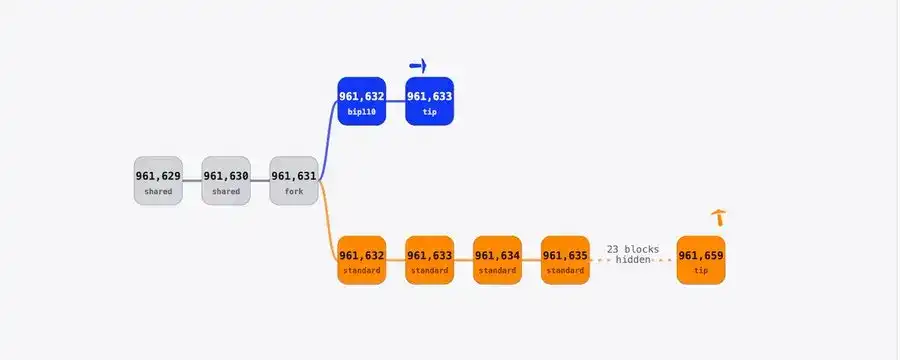
On August 8th, the Bitcoin network experienced a contentious fork triggered by BIP-110, despite the proposal having only 2.53% miner signaling support in the prior period. Led primarily by developer Luke Dashjr and based on his Bitcoin Knots implementation (not merged into Bitcoin Core), this User-Activated Soft Fork (UASF) aimed to impose strict new limits on non-financial data (like Ordinals inscriptions) within blocks to reduce long-term node costs. The fork activated at block height 961632, with BIP-110 nodes rejecting blocks without the required signaling. This created two chains: the dominant original chain continuing normally, and a low-hashrate BIP-110 chain which quickly fell behind. The core conflict is between those viewing block space as a fee market open to all data and those prioritizing Bitcoin as a monetary network, seeking to ban what they see as blockchain "spam." BIP-110's strategy relied on economic nodes (exchanges, wallets) adopting the new rules first, hoping to force miners to follow. However, this has not materialized. The BIP-110 chain now faces severe challenges: extremely slow block times potentially stretching over 1.9 years before its rules would even activate, a lack of broad economic support, and no automatic replay protection. For most users, Bitcoin's main chain operates unchanged. The immediate technical impact is limited to services running BIP-110 software, which now see a different blockchain. The event highlights ongoing ideological disputes within Bitcoin but, given its minimal support, is unlikely to alter the main network's trajectory.

marsbitHá 12m

Why do people like Luke still want to fork Bitcoin despite having no support? BIP-100 has already been declared a failure!

marsbitHá 12m

Hardcore Research Report: After a Stunning Debut, A Frame-by-Frame Breakdown of Robinhood Chain's Revenue Potential

**Summary: The Revenue Potential of Robinhood Chain vs. Its Declining Core Crypto Business** A detailed analysis of Robinhood's crypto trajectory reveals a stark contrast: while the company's overall revenue hit a record high of $1.31B in Q2 2026, its crypto-specific business is in sharp decline. Crypto revenue fell 38% year-over-year to $100M, now constituting only 8% of total revenue. Retail crypto trading volume and the share of crypto in customer assets also dropped to multi-year lows. In this context, Robinhood Chain, the company's newly launched Layer 2 blockchain, represents a major strategic bet. Its launch was notably strong, generating $3.6M in Real Economic Value (REV) in July 2026, or 38% of all tracked L2 revenue that month—surpassing established networks like Polygon and Base. However, this early activity was heavily driven by meme coins (51% of spot volume), not the chain's stated focus on Real World Assets (RWAs), which accounted for only 5%. The report argues that Robinhood Chain's infrastructure-layer revenue alone is insufficient to meaningfully revive the crypto division. The entire L2 revenue market is structurally shrinking and too small. Robinhood's clearest monetization path lies at the application layer: 1. **USDG Stablecoin:** Robinhood's native stablecoin could generate significant interest income. At a current $333M supply (assuming a 3.5% yield), it represents ~$10.5M in annualized revenue. Scaling USDG to $1B+ would create a substantial, durable income stream. 2. **Application Distribution:** Robinhood's main app holds immense distribution value. Evidence suggests protocols like Morpho pay for integration, driving significant user deposits. In contrast, distribution via the standalone Robinhood Wallet has shown limited value so far. The known, quantifiable revenue streams from Robinhood Chain (chain REV, USDG interest, shared Lighter fees) total ~$54.8M annualized—only about 14% of Robinhood's annualized crypto revenue. The conclusion is that for Robinhood Chain to become a meaningful growth driver, Robinhood must successfully commercialize its application-layer advantages—primarily by scaling USDG and monetizing its main app's user reach—or use the chain as a funnel into its higher-value traditional products. Based on current data, the chain is not yet a significant contributor to company profits.

marsbitHá 26m

Hardcore Research Report: After a Stunning Debut, A Frame-by-Frame Breakdown of Robinhood Chain's Revenue Potential

marsbitHá 26m

Trading

Spot
活动图片