[dragon and tiger list] BTC investors account for 76% of profits. How can investors who lose 80% of their profits in one year get back

Huobi ResearchPublicado em 2022-05-06Última atualização em 2022-05-07

Resumo

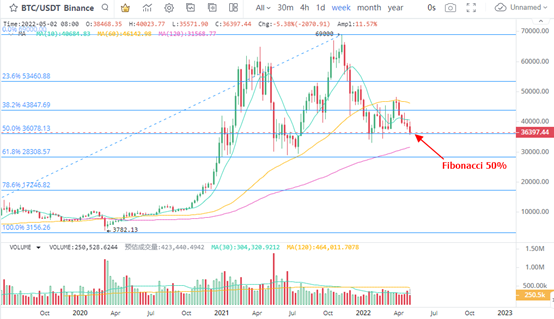
On the weekly K-line level, the decline of BTC has reached the key point of $36078 corresponding to 50% of Fibonacci.

1. Market trend: low rebound, creating trading opportunities

On the weekly K-line level, the decline of BTC has reached the key point of $36078 corresponding to 50% of Fibonacci. On May 5, BTC hit a minimum of US $35500 and once fell below 50% of Fibonacci in the short term, with clear signs of adjustment. Meanwhile, in terms of decline within one year, since the decline of US $57446 on May 5, 2021, the cumulative decline of BTC has expanded to 38%.

In terms of support worthy of attention, 61.8% of Fibonacci's support is more effective. It was recognized as a typical support line in mid-2021, and the corresponding price is US $28308. At present, the support corresponding to 50% is weak, and the risk of BTC falling near us $36078 increases.

Defensive investors can refer to US $28308 suggested by 61.8% Fibonacci as an important low suction point, and pay attention to the buying opportunities from this split line to US $36078 upward and US $17246 downward.
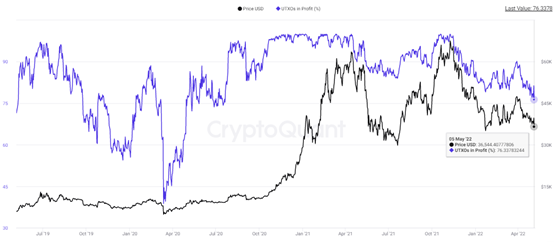
In terms of indicators, measuring the overall profit proportion of BTC investors is very important to confirm trading opportunities. The decrease in the ratio of BTC's profitable utxo to the total utxo will reduce the selling pressure brought by profitable investors and increase the probability of BTC's bottom building success accordingly.

The latest data show that the utxo of BTC was 76.34% on May 22, indicating that most investors in transfer transactions still made profits. Historically, investors can effectively verify the bottom signal after their profitability has fallen to the range of 40% to 60%. Before that, investors who buy BTC at a low price can build positions in batches, so as to effectively avoid risks.

Considering that BTC has been adjusted for more than one year since 2021, the chip concentration of more than $30000 has increased. Therefore, in the phase of BTC's continued retreat, the reduction of investor profitability may appear in the near future.
2. Rise and fall performance of top 100 currencies in market value within one year

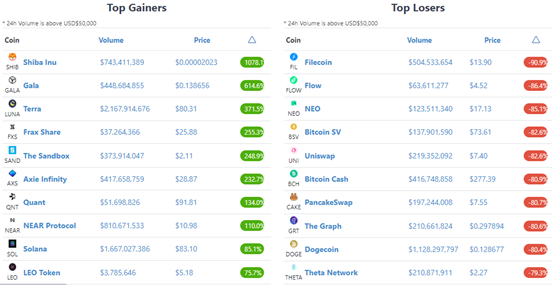
Over the past year, among the top 100 currencies with market value, Shib has the highest increase, reaching 1078%. Secondly, gamefi concept currency Gala, algorithm stability currency Luna, FXS and meta universe concept sand all increased by more than 200%.

On the decline list, fil, flow and Neo fell by 90.9%, 86.4% and 85% respectively. In the bear market, when the decline reaches 80%, the maximum cash holding loss can also reach 80%. In this way, the increase required for breakeven can reach up to 500%. Therefore, in the face of the bear market, it is important to reduce positions and buy at a low price, so as to reduce losses and seize the opportunity to buy at a low price.
3. Rise and fall performance of top 300 currencies in market value within one year

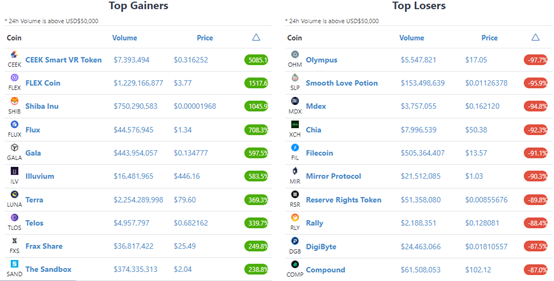
Among the top 300 currencies by market value, the volatility intensity in the past year is higher. On the list of increase, the largest increase of the top 300 market value currencies was ceek, with 5085%, and the second highest flex increased by 1517%.

In terms of the decline list, among the top 10 currencies with the largest decline, comp has the smallest decline of 87%, and there are as many as 6 currencies with a decline of more than 90%. Only from the decline list, among the investors who have held money for a year, they have lost the most money on fil, XCH and comp. In terms of circulation market value, the circulation market value of fil, XCH and comp can reach US $2.732 billion, US $177 million and US $697 million. The larger the market value, the corresponding loss of circulation market value can reach US $24 billion, US $1.59 billion and US $6.2 billion respectively.

Leituras Relacionadas

Won't US Stocks Ever Fall Again? The 'Great Melt-up' Trap in the Era of High Debt

The article analyzes a popular theory circulating online that the U.S. stock market may be mathematically incapable of a true, sustained decline due to the country's massive and growing national debt. The argument suggests that the government's only path to managing this debt is through inflation and money printing, which would nominally lift asset prices like stocks, creating a perpetual "melt-up." The author places this idea within the historical context of market melt-ups, such as the dot-com bubble and Japan's asset bubble, where prices detach from fundamentals driven by momentum and FOMO. While acknowledging that a high-debt environment creates incentives for inflation, which is generally favorable for assets over cash, the article refutes key claims of the online theory. It clarifies that interest payments are not about to exceed GDP, that printing money is not the only option for the government, and that stocks do not reliably rise in lockstep with hyperinflation, citing historical examples from Germany, Zimbabwe, and Venezuela. The more probable outcome, according to the author, is a prolonged period of financial repression—moderate inflation above interest rates that slowly erodes debt and cash purchasing power, leading to nominally higher asset prices but potentially lower real returns. The core warning is that while long-term market trends may be upward, this does not eliminate the risk of significant interim crashes (30%, 40%, or more) or guarantee real wealth creation during inflationary times. The conclusion advises against betting one's entire financial future on a smooth, perpetually rising market narrative. Instead, it recommends a disciplined, diversified strategy involving productive assets (stocks, real estate, some gold, short-term bonds) and an adequate cash buffer to avoid forced selling during downturns. The key takeaway is to avoid extreme concentration in expensive assets and leverage, and not to base investment decisions on the hope that every market dip will inevitably be rescued.

marsbitHá 23m

Won't US Stocks Ever Fall Again? The 'Great Melt-up' Trap in the Era of High Debt

marsbitHá 23m

The Fate of Digital Banks: No Fancy App Can Outshine a Banking License

The Fate of Digital Banks: A Flashy App is No Match for a Banking License The article argues that despite attracting billions of users with fee-free checking accounts and sleek apps, most "neobanks" struggle to be profitable because their core business—transaction fees—is inherently low-margin. The real profit engine of banking is lending (credit), which generates interest income. However, many early neobanks operated without their own banking licenses, which restricted their ability to lend at scale. Examples like Nubank, Revolut, and Chime illustrate the point. While they gained users with free accounts, their eventual profitability came from rolling out credit products. The piece highlights systemic risks for neobanks that rely on third-party infrastructure, citing the Synapse bankruptcy, which froze user funds and revealed the fragility of such models. The solution, according to the author, is obtaining a formal banking license, like the U.S. OCC's national trust charter. This provides regulatory backing, allows direct custody of funds, and eliminates dependency on intermediary partners. The trend is now evident in the crypto sector, where companies like Kraken, SoFi, and others are actively pursuing such licenses. The article concludes that while technology changes, the fundamental business logic of banking—profiting from lending—remains constant. Successful digital banks ultimately conform to this old model, just with better interfaces and fairer terms.

Foresight NewsHá 31m

The Fate of Digital Banks: No Fancy App Can Outshine a Banking License

Foresight NewsHá 31m

In the Name of Charity, For the Benefit of the Family: How the Trump Family Turns Philanthropy into Profit?

Charity for Profit: How the Trump Family Turned Philanthropy into Personal Gain Amid a recent controversy over misleading claims about his cryptocurrency company American Bitcoin, Eric Trump invoked his children's cancer charity as evidence of his good intentions. While his Curetivity foundation (formerly the Eric Trump Foundation) has donated over $25 million to St. Jude Children's Research Hospital, an investigation reveals a pattern of self-dealing and opaque practices that benefited the Trump family business. Internal documents show that from 2011 to 2016, over $500,000 from the charity was funneled back to Trump-owned properties for event costs, transactions often omitted from tax filings. This created clear conflicts of interest, with figures like former club manager and current White House aide Dan Scavino involved on both sides. Public claims of "one of the lowest expense ratios" were contradicted by records showing significant spending on entertainment, auctions, and transportation. Facing scrutiny in 2017, Eric Trump distanced himself from the board and rebranded the foundation. After a state investigation shifted focus to compliance rather than enforcement, he returned as the public face. Fundraising events, now less transparent, continue at Trump venues. Estimates suggest these events have directed over $1 million to the Trump Organization over two decades. The same playbook of optimistic claims and obscured financial realities is now evident in Eric Trump's role at American Bitcoin. He promoted it as a highly profitable venture with low mining costs, but reports indicate most Bitcoin was purchased with funds from constant stock issuance, not mined, with actual costs far higher than claimed. While the company's stock has crashed nearly 90% from its peak, Eric Trump's personal stake remains valuable. The recurring pattern involves aggressive public defense, legal maneuvering to bury records, making minimal changes to satisfy regulators, and eventually repackaging the venture to regain trust, often successfully.

marsbitHá 40m

In the Name of Charity, For the Benefit of the Family: How the Trump Family Turns Philanthropy into Profit?

marsbitHá 40m

Trading

Spot
Futuros
活动图片