【龙虎榜】BTC明显遇阻120日均线,多头大量爆仓增加下跌机会

火必研究院Publicado em 2022-04-22Última atualização em 2022-04-28

Resumo

BTC短线冲高回落,遇阻重要成本价,提示看跌信号。

1、大盘走势:多头爆仓增加,市场摇摇欲坠

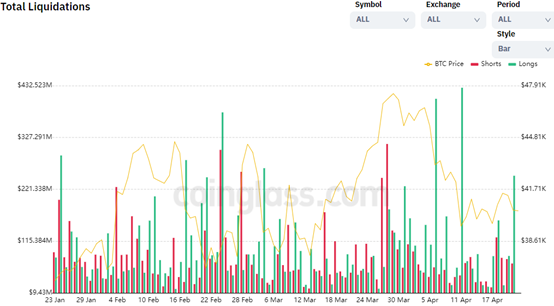
整体市场爆仓规模维持高位运行,特别是2022年3月31日以后,多头被爆仓规模始终明显高于空头,说明整体市场走势较弱。近期整体市场多头被爆仓规模可达4亿美元,4月21日多头被爆仓2.48亿美元,而空头被爆仓仅为6900万美元。可见,多头频繁失利意味着目前行情破位的可能性依然很高。
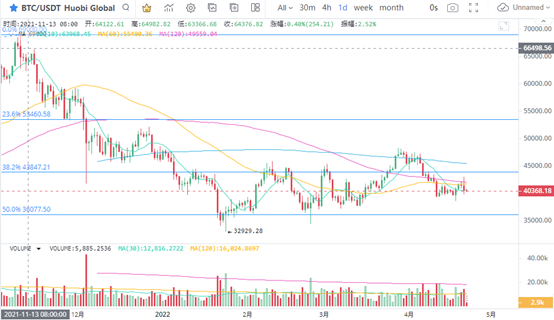
日K线方面,BTC价格表现为震荡下跌,目前均线对BTC的压制非常有效,120日均线就可以阻止BTC反弹向上。区间波动方面,BTC运行在斐波那契50%对应的36077美元上方。考虑到近期交易量表现出零散的特征,多头并未组织起有效攻势,横盘期间价格下跌的高概率事件。
2、恐慌指数解读:

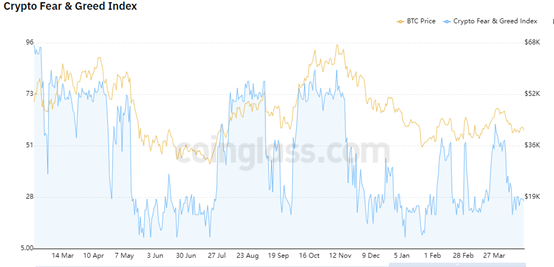
恐慌指数低于30的位置运行,目前波动空间非常小,并且已经持续了多个交易日。因此,恐慌指数也构成了局部三角形的调整形态,脱离该三角形区域以后,BTC等主流币的单边趋势将会持续。恐慌指数在2022年以来持续低于50,表明多头实力不占优势,恐慌情绪随时可能蔓延,今后的价格下跌也在预期中。
3、龙虎榜:

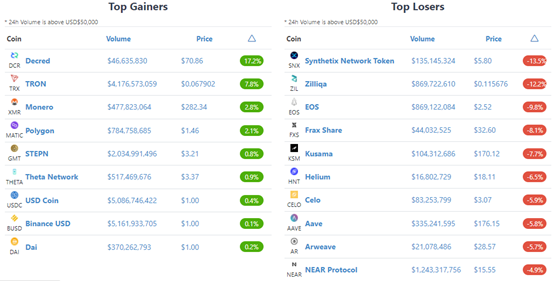
在主流币整体回撤期间,上涨的币种明显减少。市值前100的币种里,涨幅靠前的币种稳定币和平台币较为抗跌,DAI、USDC、BUSD等稳定币小幅反弹。上涨的币种里,DCR涨幅较大,其他币种涨幅有限。
涨幅榜

DCR

作为BTC的山寨版,DCR交易量表现较为低迷,短线放量不足以吸引大资金入市交易。在目前多数主流币表现不佳的背景下,DCR的上涨仅为个案,因此追踪风险较大,不宜投入更多资金买入。

MATIC

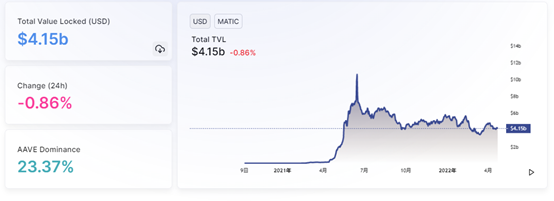
MATIC是一种协议和框架,用于构建和连接与以太坊兼容的区块链网络。在以太坊上聚合可扩展的解决方案,支持多链以太坊生态系统。

Matic Network是一个第二层扩展性平台,实现快速、简单和安全的链下交易,不仅可以支付交易,还可以实现广义的脱链智能合约。Matic Network是以太坊生态系统的重要贡献者,致力于实施等离子MVP(最低运行的等离子体),WalletConnect协议和以太坊事件提醒引擎-Dagger做出了突出贡献。Matic代币用于权益押注,参与侧链网络的证明共识机制。

MATIC价格稳定,其锁仓量也是波动较小。从价格走向看,MATIC的区间波动特征明显,因此在行情不佳的情况下,MATIC的短线波动就会出现。区间震荡阶段,MATIC的温和走势或将延续。日线级别的交易量不大,价格还可能维持稳定运行。
跌幅榜

跌幅榜单里,SNX、ZIL和EOS都是短线表现强势的币种,出现了缩量回调的情况。因此,目前行情处在多头观望而空头实力较强的阶段。底部还将进一步确认,BTC以及主流币才看企稳上涨。
Leituras Relacionadas

Kevin Warsch's Fed Decision Nears: Here's Why TD Securities Thinks the Dollar Could Still Fall

The upcoming Federal Reserve decision under Chair Kevin Warsh is widely expected to result in no change to interest rates for the fifth consecutive meeting, with market-implied probability at 95-98%. Bitcoin has already reacted to this uncertainty, briefly dropping before stabilizing near $63,660, extending its July losses. TD Securities argues that despite this consensus, markets are still mispricing the risk of a rate hike. The bank contends that the dollar is poised to fall once the Fed confirms a hold, as current pricing reflects an exaggerated probability of tightening driven by geopolitical risk premiums, not likely Fed action. This potential mispricing represents one of the largest gaps between market expectations and actual Fed policy in a decade. Post-decision, TD forecasts further dollar weakening, expecting a roughly 2% decline by late 2026, as the Fed is seen maintaining rates absent clear evidence of sustained inflation and labor market strength. For Bitcoin, the Fed's tone is critical. A hold accompanied by dovish signals, strong AI investment forecasts, and positive upcoming PCE inflation data could support a move toward $68,000-$70,000. Conversely, unexpectedly hawkish communication risks pushing prices back toward the $58,000-$60,000 range. A weaker dollar, as predicted by TD, could also provide a supportive backdrop for Bitcoin and other risk assets.

cryptonews.ruHá 7m

Kevin Warsch's Fed Decision Nears: Here's Why TD Securities Thinks the Dollar Could Still Fall

cryptonews.ruHá 7m

What Happens When Two Miners Find a Block in the Same Second? How the 'Orphan Race' Unfolds

Bitcoin mining is a race without a real-time referee. A newly mined block must physically propagate across the global peer-to-peer network before consensus is reached on the chain's tip. This takes seconds, sometimes longer on congested connections. If a second miner finds a valid block before learning of a competing one, they build on their last-known version and broadcast their own block. For a short time, two equally valid blocks exist at the same height, creating a temporary chain split. The network resolves this not by voting or timestamps, but by Proof-of-Work: the chain that accumulates the most work becomes canonical. Blocks on the losing side are "orphaned" or "stale." Their miners lose the block reward and fees, though unconfirmed transactions return to the mempool. Usually, a single subsequent block resolves the tie. A notable two-block reorganization occurred on March 24, 2026. Antpool and Foundry USA mined competing versions of block 941,881 seconds apart. ViaBTC extended Antpool's chain, while Foundry extended its own, creating a one-block split. Foundry then pulled ahead by mining six consecutive blocks, making its chain the heaviest. All nodes switched to Foundry's chain, orphaning blocks from Antpool and ViaBTC. While such multi-block reorganizations are rare, the underlying race condition is common. Analysis shows about 9.2% of block intervals in a sample period were under 60 seconds, each representing a potential short-lived race. Fast relay networks have reduced propagation delays, making prolonged splits rarer. However, the event highlighted a trend of hash rate concentration, where well-resourced pools have a higher chance of winning any specific race and mining consecutive blocks, marginalizing smaller miners.

cryptonews.ruHá 17m

What Happens When Two Miners Find a Block in the Same Second? How the 'Orphan Race' Unfolds

cryptonews.ruHá 17m

AmericanFortress proposed a scheme to protect crypto wallets from quantum threats

AmericanFortress has published a preprint detailing ZKPoSP, a cryptographic scheme designed to protect hierarchically deterministic (HD) cryptocurrency wallets from potential quantum attacks without requiring users to change their addresses. The proposed scheme replaces classical digital signatures with non-interactive zero-knowledge (NIZK) proofs, aiming to maintain compatibility with existing address formats. The company also introduced the QBIP32 scheme, intended to generate a signing scalar, a separate quantum-resistant proof, and a chain code in a single function call. According to the authors, QBIP32 can be applied to various elliptic curves of prime order, including secp256k1 and Ed25519. The post-quantum security of the scheme is described as "conjectured," relying on the quantum resistance of the underlying hash functions and NIZK proofs. However, for the scheme to function in a given blockchain network (like Bitcoin, Ethereum, or Solana), nodes would need to support verification of these new proofs instead of standard signatures—a capability currently not implemented. An implementation in Rust using RISC Zero reportedly takes 12–13 seconds to generate a proof and 9–10 milliseconds to verify it. The publication follows other industry efforts to address quantum threats, including reports from Galaxy on vulnerable assets, new hardware wallets like the PQ1, and consortiums like the Bitcoin Security Consortium pledging funding for post-quantum cryptography research. This new work specifically focuses on HD wallets and positions ZKPoSP/QBIP32 as a general mechanism for multiple curves and networks.

cryptonews.ruHá 27m

AmericanFortress proposed a scheme to protect crypto wallets from quantum threats

cryptonews.ruHá 27m

Trading

Spot
活动图片