Ethereum: Dencun Upgrade Likely Delayed To Early Next Year

BitcoinistPublicado em 2023-12-11Última atualização em 2023-12-11

Resumo

The anticipated Ethereum upgrade, dubbed Dencun, amalgamating the consensus layer (Deneb) and the execution layer (Cancun), is poised for a...

The anticipated Ethereum upgrade, dubbed Dencun, amalgamating the consensus layer (Deneb) and the execution layer (Cancun), is poised for a likely delay to early next year. The discussions during the Ethereum All Core Developers Consensus Call (ACDC) #118, chaired by Danny Ryan from the Ethereum Foundation, signposted this potential delay amid discussions surrounding the pivotal Ethereum Improvement Proposals (EIPs) such as EIP-4844. In a recent blog post, Galaxy Digital Vice President of Research, Christine Kim, highlighted the developments.
Delay Concerns And Strategic Discussions
Tim Beiko of the Ethereum Foundation, during the ACDC call, raised the prospect of Dencun not launching on the mainnet before the close of 2023, considering its absence on public testnets and the approaching Devconnect conference in November 2023. “If we don’t launch a [public] testnet before DevConnect, it’s probably unlikely we can go live on the mainnet before the Christmas holidays,” Beiko stated, hinting at a plausible deployment in 2024.
Core developers have centered their deliberations on the strategic deployment of Dencun, scrutinizing the sequence of its launch on the testnets like Goerli and Holesky. The focus has been on utilizing the deprecated testnet Goerli, permitting developers to assiduously experiment with Dencun specifications before transiting to Holesky. The consensus during the call leaned towards prioritizing the launch on Goerli to preclude any adverse ramifications on the long-lived network like Holesky.
Developments On Devnet-9
Devnet-9, serving as a precursor for Dencun, is slated to instigate the test phase next week, featuring the full suite of the Dencun upgrade and acting as the first testing ground for the activation of EIP 7514 and 7516. Parithosh Jayanthi, a DevOps Engineer at Ethereum Foundation, conveyed the team’s readiness for this impending launch, with several Execution Layer (EL) and Consensus Layer (CL) clients such as Lodestar, EthereumJS, Lighthouse, and Geth confirming their preparedness.
However, developers acknowledged the necessity for flexibility, allowing for the launch of Devnet-9 even if all clients are not ready, with Jayanthi affirming, “We can still start the devnet as long as we have at least a couple of clients ready and we can add the rest post [launch].”
Implementation Of EIP-4844
EIP-4844, or proto-danksharding, forms the cornerstone of the Dencun upgrade, poised to enhance Ethereum’s scalability and augmenting the capabilities of Layer 2 solutions. The upgrade addresses both the temporary storage and retrieval of off-chain data and aims to alleviate transaction costs on Layer 2 rollup solutions, such as Optimism and Arbitrum.
This proposal necessitated a meticulous verification process dependent on a secret value generated through a multi-party ceremony that spanned from January to August 2023. The deployment strategy for this EIP is currently under rigorous testing on Devnet-9, with developers mulling over the incorporation of a trusted setup derived from the multi-party ceremony results.
Carl Beek from the Ethereum Foundation is spearheading the conversion of these results into a standardized format, although he communicated that the timing for this conversion is “very tight” for the upcoming Devnet-9.
In conclusion, the Dencun upgrade, combining Deneb and Cancun, marks a significant step in Ethereum’s evolution, integrating vital improvements and focusing on scalability. However, the intricate processes, strategic decisions on deployment, and extensive testing phases underscore the complexity of this upgrade.
The likelihood of Dencun seeing the light of day this year appears dim, with early 2024 emerging as a probable timeframe for its deployment.
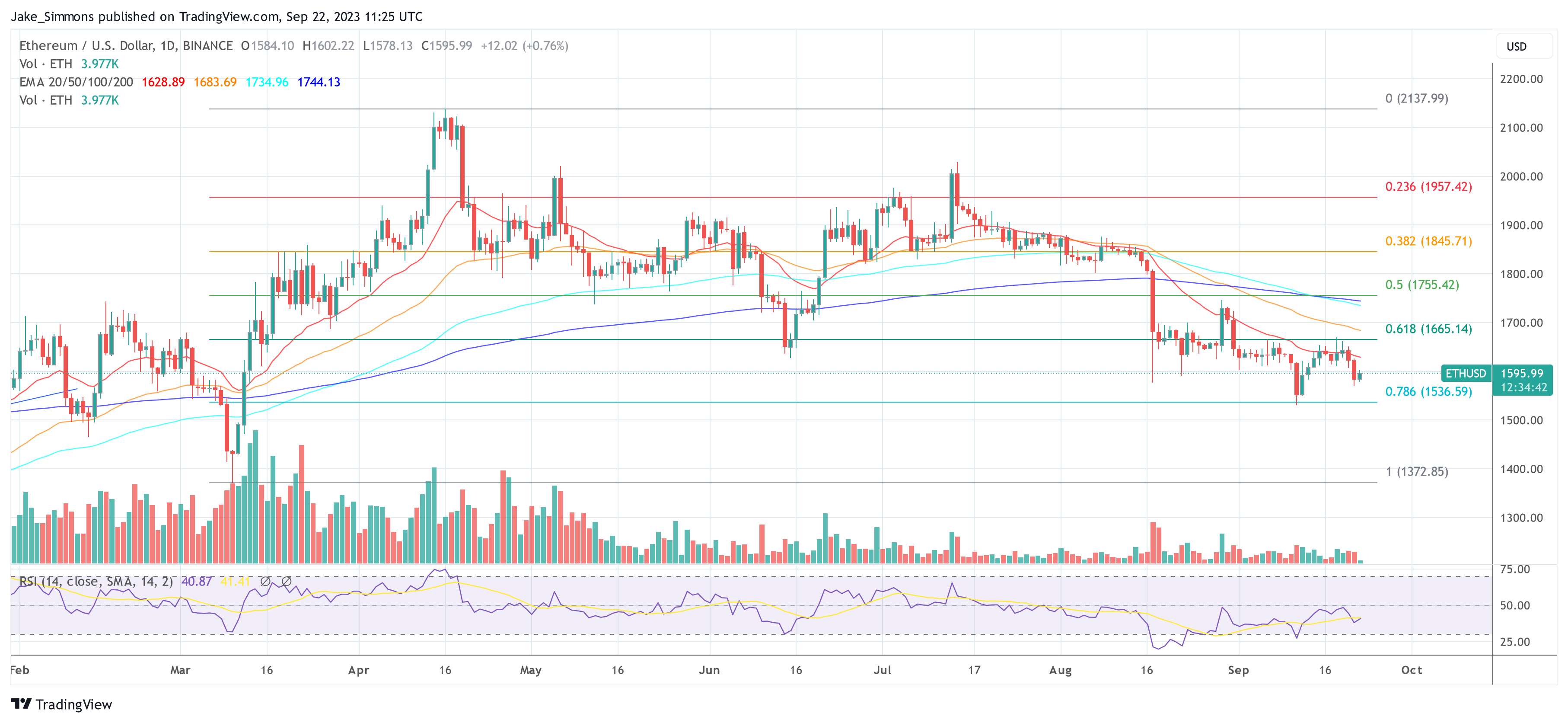
At press time, ETH traded at roughly $1,596.
Ethereum price

ETH price rejected at 61.8% Fib, 1-day chart | Source: ETHUSD on TradingView.com Featured image from Shutterstock, chart from TradingView.com

Criptomoedas em alta

Leituras Relacionadas

Gold Price Achieves Strongest Rally in 46 Years, Tokenized Gold Trading Volume Already Exceeds Full-Year 2025

Gold is experiencing its strongest rally since 1979, with prices reaching a record high near $5,600 per ounce in January. This surge is driven primarily by central banks, not retail investors. In 2025, central banks net purchased 863 tonnes of gold, with a similar increase expected in 2026. Traditional gold investment methods—physical bullion and ETFs—present trade-offs like storage issues, limited access, or management fees. Tokenized gold emerges as a third option: digital tokens representing ownership of physical bars stored in professional vaults. These tokens are globally transferable in seconds, divisible, and redeemable for physical metal. The potential impact mirrors that of dollar stablecoins. Stablecoins digitized the dollar, enabling cheap, instant, global transfers and driving adoption from $27 billion in 2020 to over $3 trillion today. Similarly, tokenized gold solves gold's "form problem"—its lack of divisibility, portability, and accessibility. Adoption is accelerating. In Q1 2026, tokenized gold trading volume hit $90.7 billion, surpassing the $84.6 billion for all of 2025. Its market cap exceeded $6 billion, growing 5.5 times faster than physical gold holdings in the quarter. While concerns about counterparty risk exist, tokenized gold represents a direct claim on allocated bars, with major issuers providing regular attestation reports. Just as stablecoins placed dollars on a digital, global rail, tokenized gold now offers a more practical form for this ancient asset, potentially expanding access to billions.

marsbitHá 17m

Gold Price Achieves Strongest Rally in 46 Years, Tokenized Gold Trading Volume Already Exceeds Full-Year 2025

marsbitHá 17m

Japanese Rates Return to 1996 Levels, Can Bitcoin Withstand the September Rate Hike?

Japanese borrowing costs have hit their highest levels since 1996, with yields on 30-year bonds reaching 4.185%. This marks a significant shift for a country long reliant on negative rates. Concurrently, Bitcoin surged 22% past $80,000, seemingly decoupled from the bond market turmoil. Historically, the massive yen carry trade has fueled global risk assets, predicated on near-zero Japanese rates. This assumption is now challenged. A potential rate hike by the Bank of Japan in September could strengthen the yen, forcing carry trade unwinds and potentially triggering a global deleveraging event, as seen in August 2024 when Bitcoin fell sharply. Conversely, if the yen weakens further, Bitcoin could attract Japanese investors as a hedge against currency depreciation and the country's massive debt burden. Institutional adoption in Japan is growing, with regulatory changes paving the way for potential crypto ETFs by 2027. The key variable is the BoJ's September policy signal. If it hints at a rapid tightening cycle to combat inflation and support the yen, risk assets like Bitcoin may face selling pressure from carry trade liquidation. However, if debt sustainability concerns limit its hawkishness, leading to a weaker yen, Bitcoin could benefit. Currently, the market is betting on a slow-motion debt crisis, not a sudden collapse. While Bitcoin shows resilience, its fate remains tied to the direction of the yen and the scale of any carry trade unwind.

marsbitHá 20m

Japanese Rates Return to 1996 Levels, Can Bitcoin Withstand the September Rate Hike?

marsbitHá 20m

How Can Bitcoin Resist Quantum Computers? A Comparison of Three Lattice-Based Signature Schemes

"Bitcoin's Quantum Defense: A Comparison of Three Lattice-Based Signature Schemes" by the Blockstream Research Team explores how Bitcoin can transition to quantum-resistant digital signatures, as current schemes like Schnorr and ECDSA are vulnerable to quantum computers. The report evaluates three lattice-based signature candidates—Dilithium, Falcon, and Hawk—against criteria like on-chain cost (key/signature size), implementation complexity, deployment risks, and support for Bitcoin's key derivation standard (BIP-32). The analysis recommends a minimum Security Level 3 for Bitcoin due to its long-term security needs. Dilithium (ML-DSA) is praised for its simplicity and integer-only operations, making it easier to implement securely, but it has the largest signature size (~5.3 KB for Level 3). Falcon (FN-DSA) offers the most compact signatures (e.g., ~3.1 KB for Level 5) and the fastest verification, though its signing requires complex floating-point sampling—a solvable engineering challenge. Hawk, despite its small size, was withdrawn from NIST standardization after a security vulnerability was discovered, highlighting the importance of conservative security margins. Currently, neither Dilithium nor Falcon has a fully viable, production-ready BIP-32 key derivation method. The report concludes that if a lattice-based scheme had to be chosen now, Falcon-1024 would be the preferred option for its balance of size, speed, and mature security assumptions. However, the short-term recommendation remains hash-based signatures (like SPHINCS+) for their lower risk, with a potential future hybrid or full transition to Falcon once its standard (FN-DSA) is finalized and well-supported.

marsbitHá 22m

How Can Bitcoin Resist Quantum Computers? A Comparison of Three Lattice-Based Signature Schemes

marsbitHá 22m

Trading

Spot

Artigos em Destaque

Como comprar OP

Bem-vindo à HTX.com!Tornámos a compra de Optimism (OP) simples e conveniente.Segue o nosso guia passo a passo para iniciar a tua jornada no mundo das criptos.Passo 1: cria a tua conta HTXUtiliza o teu e-mail ou número de telefone para te inscreveres numa conta gratuita na HTX.Desfruta de um processo de inscrição sem complicações e desbloqueia todas as funcionalidades.Obter a minha contaPasso 2: vai para Comprar Cripto e escolhe o teu método de pagamentoCartão de crédito/débito: usa o teu visa ou mastercard para comprar Optimism (OP) instantaneamente.Saldo: usa os fundos da tua conta HTX para transacionar sem problemas.Terceiros: adicionamos métodos de pagamento populares, como Google Pay e Apple Pay, para aumentar a conveniência.P2P: transaciona diretamente com outros utilizadores na HTX.Mercado de balcão (OTC): oferecemos serviços personalizados e taxas de câmbio competitivas para os traders.Passo 3: armazena teu Optimism (OP)Depois de comprar o teu Optimism (OP), armazena-o na tua conta HTX.Alternativamente, podes enviá-lo para outro lugar através de transferência blockchain ou usá-lo para transacionar outras criptomoedas.Passo 4: transaciona Optimism (OP)Transaciona facilmente Optimism (OP) no mercado à vista da HTX.Acede simplesmente à tua conta, seleciona o teu par de trading, executa as tuas transações e monitoriza em tempo real.Oferecemos uma experiência de fácil utilização tanto para principiantes como para traders experientes.

597 Visualizações TotaisPublicado em {updateTime}Atualizado em 2026.06.02

Como comprar OP

Discussões

Bem-vindo à Comunidade HTX. Aqui, pode manter-se informado sobre os mais recentes desenvolvimentos da plataforma e obter acesso a análises profissionais de mercado. As opiniões dos utilizadores sobre o preço de OP (OP) são apresentadas abaixo.

活动图片