Inflation Slowed Down Again in a Victory for the Fed

BarronsPublicado em 2023-06-14Última atualização em 2023-06-14

Resumo

The Federal Reserve’s quest to rein in inflation is far from over, but fresh data on price growth suggest things are moving in the right direction.

The Federal Reserve’s quest to rein in inflation is far from over, but fresh data on price growth suggest things are moving in the right direction.

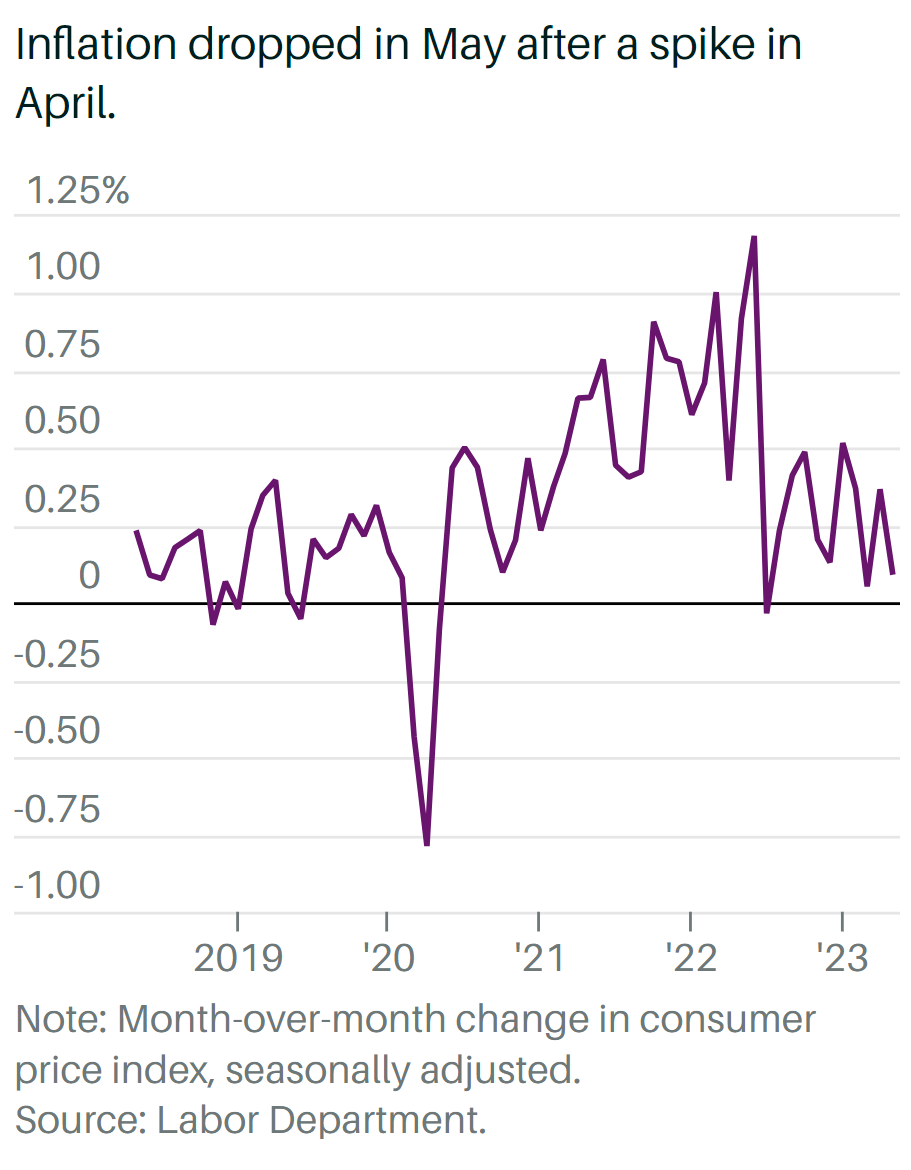
The headline consumer price index climbed 0.1% in May to reach a 4% annual pace, coming in below economists’ expectations and reflecting the slowest pace of growth since March 2021. The drop was fueled largely by a steep decline in energy costs, which fell 3.6% over the month, while prices for airfares and household furnishings also decreased.

Beneath the headline numbers, the details of the report were more mixed. Core prices, which exclude the volatile food and energy sectors, climbed 0.4% in May, matching April’s pace as shelter costs remained strong and used-car prices jumped. But core CPI slowed on an annual basis, to 5.3% in May from 5.5% the month before.

Overall, the report offered few surprises and came in better than expected at the headline level. That will clear the way for the Fed to hold interest rates steady at its June policy meeting, which wraps up on Wednesday. As of mid-morning Tuesday, after the data’s release, investors were pricing in a 94% chance that the central bank won’t raise rates this month.

But even with a June interest-rate hike likely off the table—an outcome for which Fed officials had long been laying the groundwork—the question will soon be what happens after that. The central bank made clear in recent weeks that any decision to hold interest rates steady in June wouldn’t mean the Fed’s work is done, as it could decide to lift the policy rate by another quarter-point in July.

While another round of jobs and inflation data will be released before then, May’s CPI report should keep the possibility of a future hike very much alive. Despite the improvement in headline inflation, a handful of categories continued to show persistent strength in price growth.
“It would likely have taken a meaningful upside inflation surprise to convince the Fed to hike in June,” wrote Seema Shah, chief global strategist at Principal Asset Management. “With inflation coming broadly in line with expectations, the pressure is off.”

The stock market opened higher Tuesday after the CPI release, as markets cheered the increased likelihood that the Fed’s policy arm wouldn’t vote to raise rates after Wednesday’s meeting. The Dow Jones Industrial Average was up 230 points, or 0.7%, while the S&P 500 was up 0.7% and the Nasdaq Composite had gained 0.8%.

One of the biggest contributors to core inflation in May was shelter, as rents climbed 0.5% over the month to reach an 8.7% annual pace. The other major contributor was used cars and trucks, whose prices climbed 4.4% for the second consecutive month.

Economists are optimistic that price gains in both of these areas will soon fade, bringing core inflation down. Private-sector data on rent costs, which reflect price changes in closer to real time, have suggested for months that relief should be coming soon. And the spike in used-car prices “is not sustainable,” as Wells Fargo economists Sarah House and Michael Pugliese wrote.

“That said, directional progress should not be confused with mission accomplished,” House and Pugliese added. “There is a lot of ground to cover between the 5.0% run rate of core inflation today and the [Fed’s] 2% goal.”

Excluding used-car prices, core CPI still rose 0.3% over the month, according to a calculation from Gregory Daco, chief economist with EY-Parthenon. Core price growth has moved in a narrow range between 0.3% and 0.4% since October of last year, despite the Fed’s best efforts to cool things down.

The Fed has been especially focused in recent months on core services excluding rent as it searches for indications of where underlying inflation is heading. Because private-sector data have long been suggesting that a slowdown in rent growth is on the way, the Fed presumes other services categories will provide better clues as to whether inflationary pressures are easing.

Here, May’s data again showed persistent strength. The core services category excluding rent and an equivalent measure for homeowners rose 0.2% over the month, accelerating from April’s 0.1% climb, BMO Capital Markets strategist Ben Jeffery found.

And a number of categories, from food and hospital services to transportation and tobacco products, all saw price growth accelerate in May.

“Don’t get sidetracked by falling headline inflation,” says John Leer, chief economist with Morning Consult. “The Fed may pause hiking rates tomorrow, but it will have to raise rates again if it hopes to tame inflation.”


Leituras Relacionadas

Jensen Huang: Prompts are Becoming Obsolete, Loops are the New Paradigm

Jensen Huang, alongside AI leaders like Peter Norvig, Boris Cherny, and Andrew Ng, is advocating for a shift from "prompt engineering" to "loop engineering" as the new paradigm for AI development. Instead of manually crafting individual prompts, the focus is now on designing autonomous loops—systems where AI agents execute tasks, self-validate results, and iterate until completion without constant human oversight. A loop is a management framework that enables agents to operate independently. Key implementations are seen in Claude Code (with features like /loop, /goal, and /schedule) and OpenAI Codex, which employ multiple agents working in parallel within isolated environments. A core principle is the separation of roles: one agent (or model) performs the task, while an independent agent (or a smaller, separate model) validates the output to ensure objectivity. The article outlines a practical roadmap for implementing loops, starting with a "four-condition test" to assess suitability, building a minimal viable loop, and emphasizing critical pitfalls to avoid, such as lacking hard stop conditions or allowing loops to handle tasks requiring human judgment. This evolution is framed as the fourth major shift in AI interaction: from Prompt Engineering (crafting instructions) to Context Engineering (providing background information), then to Harness Engineering (building tool-enabled environments), and finally to Loop Engineering (creating self-sustaining systems). This progression reflects a consistent trend of increasing abstraction, moving human involvement from direct instruction to system design and rule-setting. The concept has academic roots in frameworks like ReAct, which formalized the "reason-act-observe" cycle. While loop engineering promises greater automation, experts caution about managing token costs and warn against outsourcing understanding—AI can assist, but deep problem comprehension remains essential.

marsbitHá 37m

Jensen Huang: Prompts are Becoming Obsolete, Loops are the New Paradigm

marsbitHá 37m

GPT Designs GPT

OpenAI has unveiled its first custom AI chip, Jalapeño, a move signaling a strategic shift beyond being a mere model company. While many see it as a challenge to NVIDIA, its core aim is to control the entire intelligent production pipeline—from models and chips to data centers and energy. The key driver is the evolving competitive landscape: model advantages are shrinking, while the computational gap in areas like cost-per-token, system throughput, and energy efficiency is becoming the true long-term barrier. Jalapeño is primarily an inference chip, targeting the massive and growing "inference tax"—the daily operational cost of generating tokens for services like ChatGPT and APIs. By designing its own hardware optimized for its specific workloads and future product roadmaps (even using AI to aid the chip design process), OpenAI aims to drastically reduce token generation costs and improve system efficiency. This creates a potential flywheel: better models help design better chips, which lower costs for running next-generation models, supporting more users and products, which in turn provides more data to refine future chips. The strategy mirrors Apple’s integrated approach, building a closed loop where hardware, software, and applications are co-optimized. In the long term, OpenAI is not trying to become the next NVIDIA (a supplier of "shovels" to all AI companies) but to own and operate the entire "mine"—selling the end product of intelligence itself. This move marks OpenAI's ambition to evolve from creating the smartest models to controlling the foundational infrastructure of AI production.

marsbitHá 1h

GPT Designs GPT

marsbitHá 1h

Ethereum Foundation Interim Executive Director Speaks Out: What Is Our Mission?

The Ethereum Foundation's core mission is to ensure Ethereum remains a truly permissionless, censorship-resistant, private, and open infrastructure for large-scale, sovereign coordination. The article clarifies the EF's focus and dismisses irrelevant objectives, such as pursuing institutional popularity or short-term speculation. Its core work centers on eliminating systemic weaknesses. This involves fortifying Ethereum across multiple layers—protocol, access, user, and institutional—against exploitation, control, or surveillance. Key initiatives include minimizing harmful MEV and preventing privileged control over transaction flow, making unconditional privacy a foundational default, ensuring staking remains permissionless and decentralized, and strengthening user-facing access points to uphold autonomy. Concurrently, the EF aims to seize strategic opportunities. These include leading the transition to post-quantum cryptography, achieving a fully verifiable protocol stack, establishing Ethereum as private digital cash, integrating user-owned AI agents with personal wallets, and demonstrating that trusted-neutral infrastructure can competitively handle disintermediated coordination at an institutional scale. The article also addresses recent organizational changes, stating that personnel departures were due to strategic realignment, role fit, or natural evolution. It clarifies the approach to spin-outs, emphasizing that external funding will be provided only for work critical to the EF's mission that reduces Ethereum's dependency without creating new risks or mission drift. Ultimately, the EF is committed to building an enduring, neutral system that reshapes global coordination, focusing relentlessly on the principles of censorship resistance, openness, privacy, and sovereignty (CROP).

链捕手Há 1h

Ethereum Foundation Interim Executive Director Speaks Out: What Is Our Mission?

链捕手Há 1h

Trading

Spot
Futuros
活动图片