Cardano and Solana Surpass Top 10 Cryptos in Weekly Gains as Market Rebounds

u.todayPublicado em 2022-03-30Última atualização em 2022-03-29

Resumo

According to CoinMarketCap, Cardano's (ADA) price is up more than 29.47% since last week.

Contents

Inflows into the Solana ecosystem

Ethereum dApps can now run on Cardano
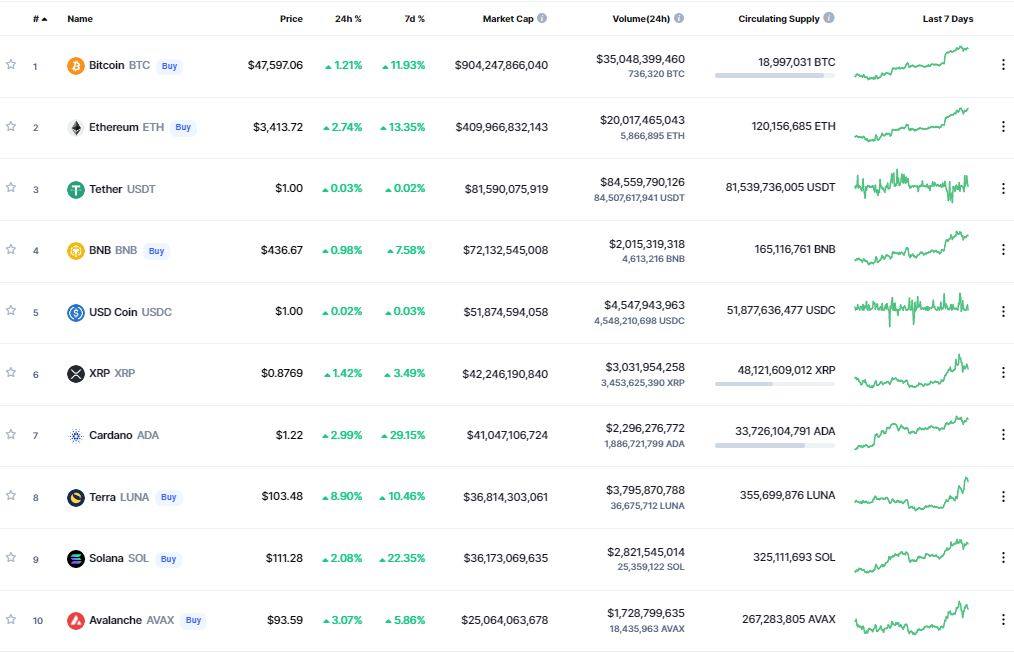
According to CoinMarketCap, Cardano's (ADA) price is up more than 29.47% since last week, outperforming the rest of the top 10 largest cryptocurrencies by market capitalization in weekly gains. Ethereum killer Solana is also leading with a 23.07% weekly gain, falling behind Cardano in gains over the past seven days.
CoinMarketCap

Data Source: CoinMarketCap Cardano continued its positive run from lows of $0.77 on March 14  to reach intraday highs of $1.22 at the time of publication. At press time, ADA was changing hands at $1.21, up 2.46% in the last 24 hours per CoinMarketCap data.
The whole cryptocurrency market is now in a recovery mood, with the price of Bitcoin recently reaching a multi-month high of $48,240 on March 28.
Inflows into the Solana ecosystem
According to data provided by digital asset management firm CoinShares, Solana-based institutional investment products recorded a record-breaking $87 million worth of inflows during the previous week.
Solana has now attracted a total of $241 million worth of assets under management, which makes it the fifth-most popular cryptocurrency with institutional investors.
Solana trades at $111.58 at press time, up 5.51% on the day.
Ethereum dApps can now run on Cardano
The Milkomeda Foundation has announced the debut of C1, an Ethereum Virtual Machine-compatible sidechain that is directly connected to the Cardano blockchain.
Users may now move assets effortlessly between the two blockchains, allowing popular Ethereum-based decentralized apps (dApps) to function on top of Cardano. This is accomplished using Milkomeda's wrapped smart contracts technology, which was just pioneered.
In February, the Milkomeda Foundation announced a partnership with Nomad, an interoperability protocol, to make it possible to easily bridge assets from the Ethereum network. The bridge between Cardano and Ethereum was then launched in testnet mode later that month.

Leituras Relacionadas

Why is XRP in the red now after a 50% weekly surge?

XRP fell 2.2% over 24 hours after a 49.4% surge in the previous week, moving back into negative territory. The drop coincides with major banks advancing blockchain-based payment solutions that address the need for prefunding in cross-border transfers, potentially competing with XRP's use case. JPMorgan Chase expanded its blockchain settlement system, Kinexys, to eight currencies, allowing clients to move and exchange funds around the clock without needing a separate crypto asset. Similarly, Citigroup operates a round-the-clock USD clearing network and offers Citi Token Services for tokenized deposits, aiming to speed up payments while reducing the amount of capital required upfront. While its 90-second settlement is slower than XRP Ledger's 3-5 seconds, using cash already held in a regulated bank may be more critical for companies. Furthermore, SWIFT has facilitated interoperability between different bank-issued tokenized deposits without a common cryptocurrency. In a recent pilot, HSBC and Standard Chartered completed a cross-border transaction using SWIFT's ledger to coordinate and settle obligations between their separate token systems. SWIFT reports that 17 banks across six continents are preparing for real transactions using this model. These developments in traditional finance present alternative, bank-integrated pathways for instant, cross-border value transfer, potentially impacting the demand and price trajectory for XRP.

cryptonews.ruHá 3m

Why is XRP in the red now after a 50% weekly surge?

cryptonews.ruHá 3m

The Ambition of the OEM: Dissecting Leju Robot's External Investments to Understand the 'Ecosystem Positioning' Battle in the Humanoid Robot Track

Leju Robotics, a leading humanoid robot manufacturer from China, is aggressively building an industrial ecosystem through strategic investments as it pursues a public listing. Founded in 2016 and known for its "Kuavo" robot, Leju saw its revenue surge to 258 million yuan in 2025, though it remains unprofitable. Its IPO plan, submitted in May 2026, outlines a strategy focused on cost reduction and full-stack capability development. Analysis of Leju's 13 disclosed investments reveals a three-pronged approach to securing its value chain. First, it targets core components like precision actuators (e.g., Lingxinqiaoshou), joint modules, and motors to control costs and supply. Second, it invests in software and AI layers, including companies working on foundational models and embodied intelligence datasets, to develop an independent "brain" while maintaining partnerships with giants like Huawei. Third, it forms alliances with firms in logistics and service robotics to transform from a hardware seller into a solution provider for real-world applications. While this investment network aims to create a competitive moat and support Leju's industrialization story, risks persist. The company faces ongoing losses, declining gross margins, and potential industry price wars. Many investments are early-stage with long payback periods and unproven synergistic benefits. Leju's strategy exemplifies how humanoid robot players are moving beyond pure R&D to ecosystem competition, betting that controlling the "hard work" of the supply chain will be the ultimate barrier to entry.

marsbitHá 15m

The Ambition of the OEM: Dissecting Leju Robot's External Investments to Understand the 'Ecosystem Positioning' Battle in the Humanoid Robot Track

marsbitHá 15m

Trading

Spot
活动图片