【劲爆数据】空头爆仓5.88亿美元,BTC多头占比维持高位

火必研究院Publicado em 2022-03-29Última atualização em 2022-04-01

Resumo

从交易所BTC存量变化看,2月份到3月份的流出数量增加,表明BTC的抛售压力继续减轻。

本栏目梳理日内现货市场和期货市场的交易状态,分析BTC及整体市场的交投表现。帮助投资者挖掘有效交易信号。

行情观点

BTC和ETH等主流币持续反弹期间,已经触及1年来投资者的成本价。目前来看,过去一年中交易的投资者多数获利,使得行情进一步向上的动力增强。目前趋势对多头有利,合约仓位达到近期高位,表明做多意愿提升。

现货

1、交易所BTC存量

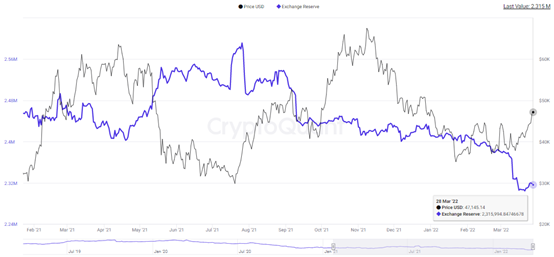
交易所BTC存量下降到了3月28日的231.5万枚BTC。从交易所BTC存量变化看,2月份到3月份的流出数量增加,表明BTC的抛售压力继续减轻。尽管近期BTC存量出现反弹迹象,但是反弹空间不大。交易所BTC存量最高达到了231.98后回撤,说明BTC抛压小幅增加以后回落,短线看多BTC趋势。
2、全网市值和交易量

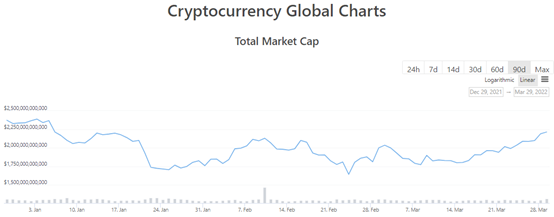
过去24小时整体市场交易量为1254.3亿美元,整体市值增幅为1.5%到22406亿美元。关注过去3个月内整体市场的交易量和市值表现,全网市值波动空间在16423亿美元到23877亿美元之间,当前市值几乎为3个月内最高峰。市值连续变化的形态上,表现为双底反转,提升看多信号。
合约

BTC等主流币的合约交易能够发现现货价格,提升价格运行方向。同时,也能够为现货投资者提供套期保值的方法。分析合约多空持仓方向、仓位变化以及杠杆率表现,可以帮助我们确认交易信号。

1、全网爆仓统计

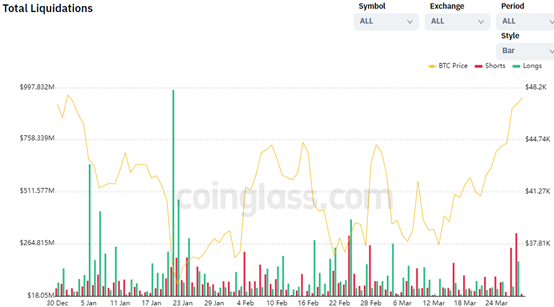
爆仓数量提示了价格运行期间行情阻力释放的效果,爆仓数量越大,说明反向的资金实力越大。过高的爆仓金额短时间出现以后,也可以提示价格反转信号。因为资金在短时间内增加爆仓反向的持仓数量,推动行情短时间内反转运行。

全网合约爆仓

3月29日,全网合约空单爆仓达0.62亿美元,全网多单爆仓达0.11亿美元。3月27日以来的3个交易日内,空单爆仓规模达2.44亿美元、3.13亿美元和0.31亿美元,同期,多单爆仓规模为0.62亿美元、1.79亿美元和0.11亿美元。空单累计爆仓5.88亿美元,意味着多头实力强劲,市场在近期呈现出单边趋势倾向。
2、全网持仓和成交额统计

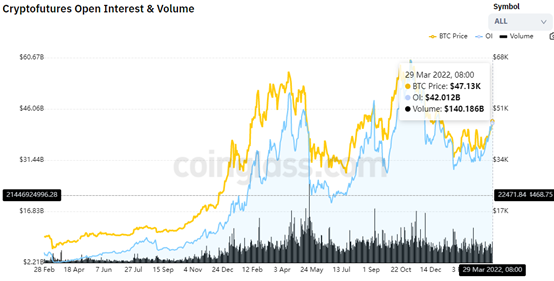
全网合约成交量表现稳定,3月29日的持仓量回升到420亿美元,相对1月23日最低286.7亿美元大幅增长46.5%;成交额为1400亿美元。值得注意的是,合约仓位是1年内最高水平,预示着整体市场热度正在持续增长。
3、交易所多空持仓统计

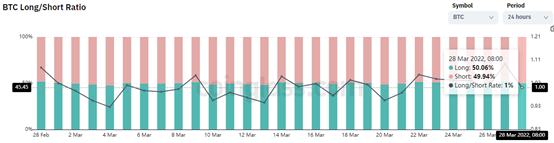
交易所多空持仓占比直观体现了多空实力,动态的多空占比更好的验证了买卖信号。多方持仓占比较多的时候,提示买方实力较强,BTC价格易涨难跌。相反,则空头实力较强,提示了做空信号。

3月29日,BTC多空单比例为1 %,多单占比50.06%,而空单占比为49.94%。多方占比优势从3月22日以后连续占优势,推动BTC价格继续上行。目前来看,BTC多头占比有小幅下降迹象,短线可关注低吸机会。
4、合约资金费率

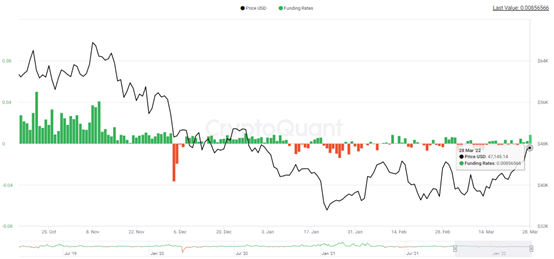
合约资金费率越高,表明多头对价格上涨的信息更大。BTC最新的资金费率数值显示,2022年以来资金费率波动空间较小,更多交易日的融资成本低于0,意味着投资者融资买入BTC的成本很低。

在低买入成本推动下,BTC价格震荡企稳。同时,融资成本也出现了小幅回升迹象。最新3余29日的融资成本达到了0.0085。从绝对值来看,数值远低于2021年11月4日以前的水平。这说明,资金主力有足够低的成本优势,来买入BTC和推升价格涨幅。

Leituras Relacionadas

LeCun Continuously Endorses, New Work VISReg Tackles the Core Challenge of 'Representation Collapse' in JEPA World Models

"VISReg: A New Self-Supervised Learning Method Tackles Representation Collapse in JEPA World Models" Yann LeCun has highlighted the new self-supervised learning (SSL) work VISReg (Variance-Invariance-Sketching Regularization), which addresses the core challenge of "representation collapse" in JEPA-based world models. SSL often collapses, mapping different inputs to similar vectors, losing discriminative power. While methods like VICReg and SIGReg attempted to regularize the representation distribution, they suffered from issues like vanishing gradients during collapse or coupled scale and shape optimization. VISReg overcomes these by decoupling the regularization into independent "scale" and "shape" objectives. It uses a variance term to prevent amplitude collapse (providing constant gradient even during collapse) and a sliced Wasserstein distance (SWD) based sketching target with stop-gradient to align the distribution shape to an isotropic Gaussian, without interfering with scale. This approach, requiring only ~15 lines of PyTorch core code, offers linear computational complexity and scales efficiently across multiple GPUs. Evaluated across 15 datasets (in-domain, out-of-distribution/OOD, dense prediction), VISReg outperforms 7 mainstream SSL methods (MoCoV3, DINO, iBOT, I-JEPA, MAE, data2vec) without relying on heuristic tricks like EMA or stop-gradient. Key results include: superior average OOD accuracy; matching DINOv2's OOD performance using only ~1/10 of the data (ImageNet-22K vs. LVD-142M); better transfer learning fine-tuning results across multiple datasets; and competitive performance in semantic segmentation and generative guidance. VISReg also demonstrates robustness on low-quality data like long-tailed or low-rank datasets where other methods fail. The work provides a more stable, efficient, and generalizable regularization solution for SSL and JEPA models.

marsbitHá 5m

LeCun Continuously Endorses, New Work VISReg Tackles the Core Challenge of 'Representation Collapse' in JEPA World Models

marsbitHá 5m

Argentine Banking Groups Quietly Develop Peso-Pegged Stablecoins for the Institutional Market

Argentine banking groups are quietly developing peso-pegged stablecoins for the institutional market. While US dollar-linked stablecoins like USDC and USDT are popular in Argentina, fintech companies are now focusing on local alternatives. Two major initiatives are underway. The BIND Group, through its virtual asset service provider BEN, is developing a peso stablecoin and has partnered with Circle to offer institutional clients payment and treasury use cases. Separately, the Petersen Group is developing a stablecoin called DIPE via a subsidiary, supported by crypto-as-a-service company Lirium. Both projects are being advanced by entities backed by banking conglomerates, not the banks themselves, due to a Central Bank of Argentina ban from May 2022 prohibiting private banks from offering crypto services to clients. The primary target is the institutional sector, which could benefit from the programmable features of a digital peso for treasury management, event-triggered blockchain payments, and collateralized lending management. These initiatives could expand to private banks in the future if the central bank lifts its crypto ban. This development comes as regulators scrutinize existing crypto offerings; in March, the national securities regulator highlighted that the "argt peso" stablecoin was being offered as a security without proper compliance.

cryptonews.ruHá 12m

Argentine Banking Groups Quietly Develop Peso-Pegged Stablecoins for the Institutional Market

cryptonews.ruHá 12m

Pi Network Price Forecast: Can a $12 Million Robotics Bet Save PI From a New All-Time Low?

Pi Network (PI) price faces intense pressure, dropping to $0.07286 on July 28th (-5.60%). It is testing key technical support at the lower Bollinger Band ($0.07003), just above its all-time low. A close below this level would signal a likely plunge into uncharted territory with no established historical support underneath. The sell-off is fueled by viral market criticism regarding unclear tokenomics. An analysis by Mahidhar Crypto highlighted unanswered questions about Pi's total supply of 100 billion tokens, with only 16.8% currently minted/mainnet. This lack of clarity on the remaining ~83.2B tokens and the absence of a burn mechanism have created uncertainty, pressuring marginal holders to sell. Amidst the bearish sentiment, Pi Network Ventures participated in a $12M seed round for physical AI robotics startup Axis Robotics. While this signals ecosystem expansion beyond crypto, its direct impact on the PI token price is considered indirect at best against the dominant supply-side concerns. **Price Forecast Scenarios:** * **Bull Case:** PI holds above $0.07003, and the Pi Core Team addresses tokenomics concerns, shifting narrative to ecosystem growth. A recovery toward the Bollinger Band middle line at $0.08614 is possible. * **Bear Case:** PI breaks below $0.07003 support. Continued silence from the core team allows supply fears to persist, accelerating selling into price discovery with no floor below.

cryptonews.ruHá 16m

Pi Network Price Forecast: Can a $12 Million Robotics Bet Save PI From a New All-Time Low?

cryptonews.ruHá 16m

Trump's AI Plan Could Replace 50 State AI Laws With One Set of Rules

The Trump administration is reportedly close to establishing a national framework for regulating artificial intelligence. According to The Information, this initiative aims to replace the patchwork of approximately 50 differing state-level AI laws with a single, federal standard. The core proposal, outlined in the White House's National AI Policy Framework, would centralize AI policymaking in Washington, D.C., offering developers more consistent and transparent rules on issues like child safety, AI-generated deepfakes, and the use of regulatory sandboxes. This move addresses growing concerns that the current fragmented regulatory landscape, with states like Colorado, Texas, and California enacting their own rules, creates a compliance burden for AI companies. A unified federal system is intended to streamline regulations, allowing businesses to spend less time adapting to state laws and more time on innovation. The administration's strategy also includes an executive order signed by President Trump in June 2026, which focuses on enhancing cybersecurity for advanced AI systems. A major unresolved question in the proposal, however, is how to regulate open-source AI models. The framework does not clearly define an approach, despite expert warnings that such models pose unique governance challenges due to their free modification and distribution. While the fate of the legislative proposal in Congress remains uncertain, its existence signals Washington's intent to become the primary authority governing AI technology, a move that would have significant global implications given the dominance of U.S. firms in the AI sector.

cryptonews.ruHá 16m

Trump's AI Plan Could Replace 50 State AI Laws With One Set of Rules

cryptonews.ruHá 16m

Trading

Spot
活动图片