Pi Network Price Forecast: Can a $12 Million Robotics Bet Save PI From a New All-Time Low?

cryptonews.ruPublicado em 2026-07-28Última atualização em 2026-07-28

Resumo

Pi Network (PI) price faces intense pressure, dropping to $0.07286 on July 28th (-5.60%). It is testing key technical support at the lower Bollinger Band ($0.07003), just above its all-time low. A close below this level would signal a likely plunge into uncharted territory with no established historical support underneath. The sell-off is fueled by viral market criticism regarding unclear tokenomics. An analysis by Mahidhar Crypto highlighted unanswered questions about Pi's total supply of 100 billion tokens, with only 16.8% currently minted/mainnet. This lack of clarity on the remaining ~83.2B tokens and the absence of a burn mechanism have created uncertainty, pressuring marginal holders to sell. Amidst the bearish sentiment, Pi Network Ventures participated in a $12M seed round for physical AI robotics startup Axis Robotics. While this signals ecosystem expansion beyond crypto, its direct impact on the PI token price is considered indirect at best against the dominant supply-side concerns. **Price Forecast Scenarios:** * **Bull Case:** PI holds above $0.07003, and the Pi Core Team addresses tokenomics concerns, shifting narrative to ecosystem growth. A recovery toward the Bollinger Band middle line at $0.08614 is possible. * **Bear Case:** PI breaks below $0.07003 support. Continued silence from the core team allows supply fears to persist, accelerating selling into price discovery with no floor below.

PI is trading at $0.07286 on July 28, down 5.60%, putting pressure on the lower Bollinger Band as viral criticism of the tokenomics circulates without official rebuttal from the Pi Core Team, with the all-time low sitting just below the current price.

PI is Within One Daily Close of Posting a New Record Low
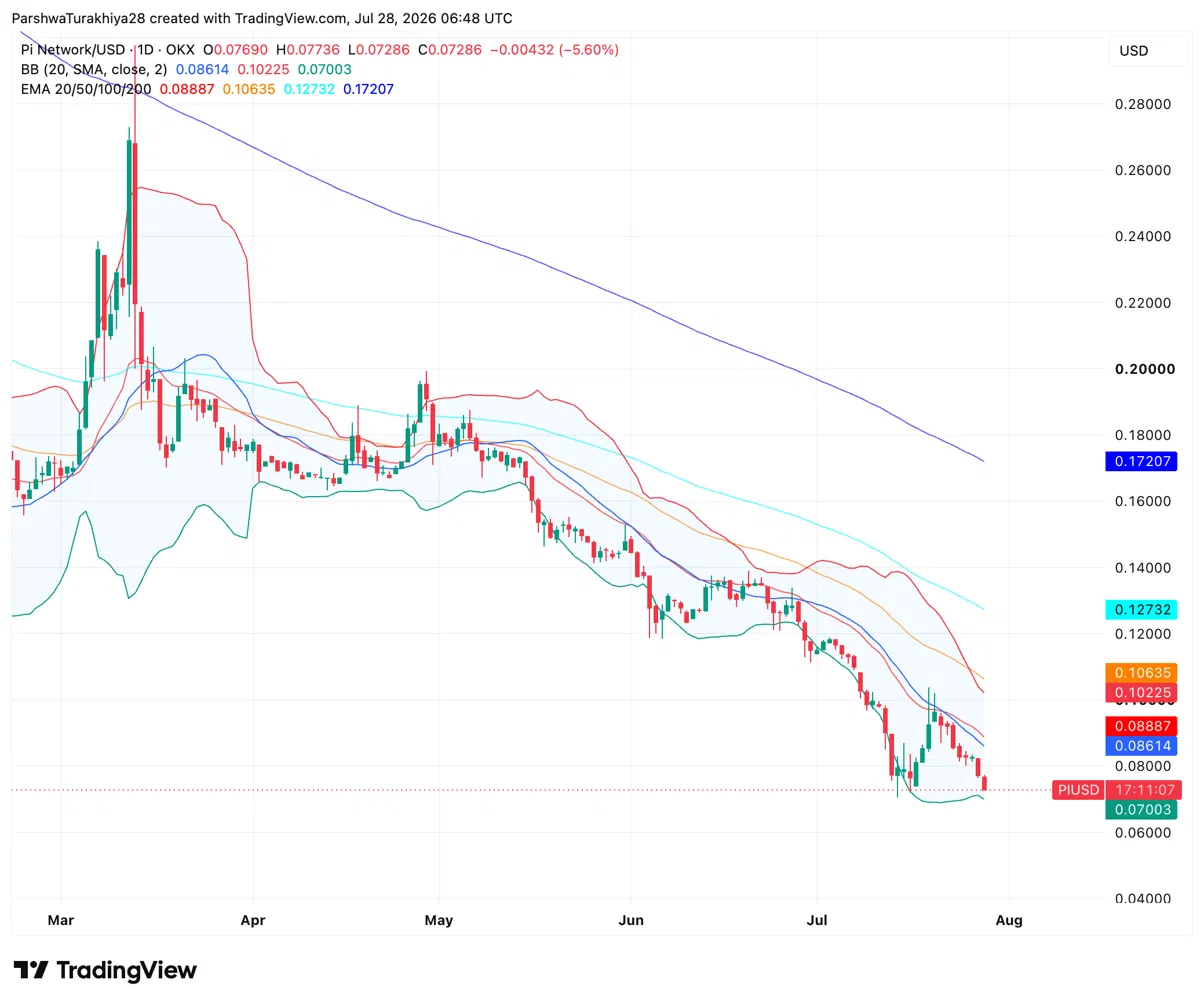
PI 1D Price Movement (Source: TradingView)

The daily chart shows PI at the lower Bollinger Band at $0.07003, which is also the last technical support before the price enters uncharted territory. The Bollinger middle line at $0.08614 and the 20-day EMA at $0.08887 are significantly higher, and all four EMAs continue to slope downward with no signs of flattening. The 50-day at $0.10635, 100-day at $0.12732, and 200-day at $0.17207 form a cumulative ceiling that lowers with each red session.

Related: Chainlink (LINK) Price Forecast for 2026, 2027, 2028, 2029, 2030-2050

Today's intraday low of $0.07286 is a new multi-month low. A daily close below $0.07003 at the lower Bollinger Band would confirm a breakdown to the all-time low with no historical support below. The upper Bollinger Band at $0.10225 marks the outer boundary of any recovery attempt, roughly 40% above the current price.

What Are the Key Support and Resistance Levels for PI Today?

Resistance
  • $0.08614 — Bollinger Middle Line, first ceiling for any bounce
  • $0.08887 — 20-day EMA, sloping down and increasing overhead pressure
  • $0.10225 — Upper Bollinger Band, outer boundary of a recovery attempt
  • $0.10635 — 50-day EMA, part of the cumulative downward-sloping EMA structure
Support
  • $0.07003 — Lower Bollinger Band, last technical floor before the all-time low
  • No established support below $0.07003

Why Is Pi Network Struggling Today?

#PiNetwork Tokenomics has some serious unanswered questions that are creating confusion and reducing investor confidence in $PI .

Total Supply: 100,000,000,000 Pi

🟣 Community Mining Rewards: 65,000,000,000 Pi

🟣 Ecosystem Development: 10,000,000,000 Pi

🟣 Liquidity Pool:... pic.twitter.com/W6yqkY2rWB

— MAHIDHAR CRYPTO (@Mahidhar_Crypto) July 27, 2026

Analyst Mahidhar Crypto published a widely-shared breakdown of Pi Network's token distribution, noting several unanswered questions about the total supply of 100 billion. The core team holds 20 billion PI, the ecosystem development fund holds 10 billion, and the liquidity pool holds 5 billion, leaving 65 billion allocated for community mining rewards.

So far, only 16.8 billion PI have been mined and migrated to the mainnet, representing roughly 16.8% of the total supply, meaning the vast majority of the token's potential circulation remains unlocked or unmined.

Mahidhar's thread argued that without clarity on what happens to the un-mined community allocations and without a burn mechanism, PI's long-term price trajectory points to $0.01. The Pi Core Team had not publicly responded to the thread at the time of publication. In a market already facing bearish sentiment, viral supply criticism without immediate official rebuttal creates precisely the kind of uncertainty that prompts marginal holders to sell into weakness.

Pi Network Ventures Backs $12 Million Physical AI Startup

We’re thrilled to announce a $12M Seed round, led by @hack_vc, with participation from @NomadCapital_io , @PiCoreTeam Ventures , @10kventure and top angel investors.

Physical AI has a data problem. Models need more than static datasets—they need diverse data that evolves with... pic.twitter.com/byx4JSC7fn

— Axis Robotics (@axisrobotics) July 27, 2026

Pi Network Ventures participated in a $12 million seed round for Axis Robotics alongside lead investor Hack VC, Nomad Capital, 10K Venture, and notable angel investors. Axis is building a data engine for physical AI robots, combining large-scale simulation, real-world egocentric data collection, and human-in-the-loop post-training to create a closed-loop workflow.

The company currently manages 100,000 active global participants, generating over 1,200 hours of simulation data and 20,000 hours of real-world data monthly. In the LIBERO-Plus benchmark, pre-training on the Axis dataset improved model success by 4.9 points and outperformed the baseline by 31.3 points in volume.

Related: Meme Coin Price Forecast: Dogecoin, Shiba Inu, MemeCore

The investment signals Pi Network Ventures positioning the ecosystem beyond crypto infrastructure into physical AI, though the direct impact on the PI price remains indirect at best due to current selling pressure driven by supply concerns.

Pi Network Price Forecast: Upside and Downside Targets

Bull Case — Target: $0.08614 (Bollinger Middle Line)

The lower Bollinger Band at $0.07003 holds as the daily close. The Pi Core Team responds to the Mahidhar Crypto thread with clarity on un-mined community allocations or a burn proposal, removing the primary short-term selling catalyst. The Axis Robotics investment draws attention to the ecosystem's broader ambitions. PI recovers towards the Bollinger middle line at $0.08614 as the technical low holds and the narrative shifts from supply concerns to ecosystem expansion.

Bear Case — Breakdown to ATL: Below $0.07003 with No Floor Below

PI closes below the lower Bollinger Band at $0.07003, confirming a breakdown to the all-time low. The Pi Core Team continues to not respond to the tokenomics thread, allowing the supply narrative to persist unchallenged. Lack of a burn mechanism and ~83.2B PI not yet in circulation accelerate selling. The price enters uncharted territory with no historical support levels below to create a bottom.

end-content

Perguntas relacionadas

QBased on the article, what is the key technical support level for PI price and why is it critical?

AThe key technical support level is $0.07003, which is the lower Bollinger Band. It is critical because it is described as the last technical floor before the price breaks down to its all-time low (ATL), entering uncharted territory with no established historical support below it.

QWhat is the main criticism regarding Pi Network's tokenomics, as mentioned in the article, and what is its potential impact?

AThe main criticism, highlighted by analyst Mahidhar Crypto, revolves around unclear token distribution and the lack of a burn mechanism for the unallocated or unmined portion of the total 100 billion PI supply. This creates uncertainty and reduces investor confidence, potentially pressuring the price downward, with some analyses suggesting it could lead to a price trajectory pointing to $0.01.

QHow does the article assess the direct impact of Pi Network Ventures' $12 million investment in Axis Robotics on the PI token price?

AThe article assesses the direct impact as 'indirect at best.' While the investment signals Pi Network's expansion ambitions into physical AI beyond crypto infrastructure, the immediate price pressure on PI is primarily driven by concerns over token supply and distribution, which outweigh the positive news of the investment.

QWhat are the conditions outlined in the article for a bullish price scenario for PI?

AThe bullish scenario requires: 1) The price holding above the lower Bollinger Band support at $0.07003. 2) The Pi Core Team publicly addressing the tokenomics criticism with clarity on unmined community allocations or proposing a burn mechanism. 3) The Axis Robotics investment shifting market narrative from supply concerns to ecosystem growth. The target in this case is a recovery to the Bollinger Band middle line at $0.08614.

QAccording to the bearish case presented, what would confirm a breakdown to a new all-time low for PI?

AA daily close below the lower Bollinger Band at $0.07003 would confirm a breakdown to a new all-time low. This scenario is exacerbated if the Pi Core Team remains silent on the tokenomics criticism, allowing supply concerns to persist, and with no burn mechanism for the ~83.2 billion PI not yet in circulation, leading to accelerated selling into price territory with no historical support levels.

Leituras Relacionadas

Bank of Korea Reveals Results of Tokenized Deposit Testing

The Bank of Korea has announced the results of its pilot test for tokenized deposits. Involving 28 central banks and international financial organizations, the project saw participation from major South Korean banks including KB Kookmin Bank, NH NongHyup Bank, Shinhan Bank, Woori Bank, and Hana Bank. Transactions, from payment orders to final settlement, were completed in real time, averaging just 80 seconds. The test involved 30 transactions across 17 different scenarios—such as corporate and interbank transfers—and was conducted in six currencies, including the Korean won, US dollar, and euro, with a total transaction value reaching approximately $995,000. The central bank reported that the platform operated stably throughout, despite being only partially connected to the existing banking infrastructure. Settlements using tokenized deposits were executed seamlessly, quickly, and transparently. An internal transfer of 20 million won (about $13,890) between NH NongHyup Bank and Shinhan Bank was also successfully processed via the Project Agora platform, which involved connecting to the Bank of Korea's CBDC test platform, Project Hangang. Additionally, KB Kookmin Bank and Japan's MUFG Bank tested cross-border payments using these deposit tokens—digital certificates issued by commercial banks within the pilot, not directly by the central bank. The Bank of Korea plans to continue testing payments with tokenized deposits. This follows last year's pledge by South Korean authorities to tighten regulations for won-based stablecoins, which will require approval from both the central bank and the Financial Services Commission.

cryptonews.ruHá 59m

Bank of Korea Reveals Results of Tokenized Deposit Testing

cryptonews.ruHá 59m

Trading

Spot
活动图片