10000 Hours of Human Data, Trains the World's First Whole-Body Mobile Manipulation Implicit World-Action Model

marsbitPublicado em 2026-07-15Última atualização em 2026-07-15

Resumo

"Being-M0.7" is the world's first latent world-action model for whole-body mobile manipulation in humanoid robots, developed by Zhi Zai Wu Jie (Beyond Being). Trained on over 10,000 hours of human-centric multimodal data, it aims to overcome key industry challenges: the high cost and scarcity of real robot demonstration data, the computational inefficiency of pixel-level video prediction models, and the lack of full-body coordination in existing approaches. The model is based on a Vision-Motion Mixture-of-Transformers (MoT) architecture, which allows training on a mixture of paired video-motion data, pure video data, and pure motion sequences. A key design is a unified motion representation that bridges human and robot morphology, enabling knowledge transfer from vast human behavioral data to specific robot control. After pre-training on human data, the model is adapted to a real robot (Unitree G1) using a small amount of teleoperated demonstration data via a lightweight "Action Expert" module. This process decouples low-frequency world planning from high-frequency motion control. The model was tested in four challenging real-world demos: fishing a toy fish from water (liquid interaction), retrieving an object using a mirror (visual reasoning), a multi-step pick-and-place task, and obstacle avoidance while carrying a box. In comparative tests against other models, Being-M0.7 showed stronger performance in tasks requiring indirect reasoning and full-body coordination. This...

Over the past two years, the competitive focus in the humanoid robot sector has been shifting from the hardware of the entire machine further to model capabilities.

Manufacturers have been releasing new products intensively, with videos of backflips, dancing, and marathon running frequently dominating social feeds. Behind the fanfare, however, the industry has gradually reached a consensus: what determines the upper limit of a humanoid robot's ability is no longer just its joints and motors. The capacity to understand the environment, predict changes, and coordinate the entire body to complete tasks is becoming the key to achieving generality.

World models, VLA, and humanoid robot foundation models have thus become some of the most important technical directions in this field over the past two years.

Amidst this excitement, three major challenges have remained.

First, the cost of collecting real-world demonstration data for humanoid robots is high. Collection requires synchronous recording of first-person video, proprioceptive data, and executable whole-body commands. Constrained by teleoperation difficulty, safety risks, hardware availability, and environmental diversity, it is difficult to accumulate large-scale, high-quality data in a short time.

Second, many existing world-action models follow the pixel-level video prediction approach, which is computationally expensive, with significant capacity consumed by image details weakly correlated with control. The robot's own rapid movement and viewpoint jitter further amplify visual prediction noise.

Third, many existing solutions still model upper-limb manipulation and lower-body locomotion separately, resulting in insufficient coordination between the upper and lower body and difficulty in supporting natural, fluid whole-body control.

Against this backdrop, Embodied Intelligence company Zhi Zai Wu Jie has released Being-M0.7. This is the world's first Latent World-Action Model (Latent WAM) for whole-body mobile manipulation of humanoid robots, and it is also the industry's first time extending the capabilities of latent world models from desktop dexterous manipulation to whole-body mobile manipulation.
  • Paper Link: https://research.beingbeyond.com/being-m07/being-m07.pdf
  • Project Page: https://research.beingbeyond.com/being-m07

It was pre-trained on over 10,000 hours of human-centric mixed-modal data, then adapted to a specific embodiment using a small amount of real-world demonstration data, and has successfully completed multiple challenging whole-body mobile manipulation tasks on a physical humanoid robot.

From Being-H to Being-M: A Continually Materializing Technical Path

Behind Being-M0.7 lies a technical path that Zhi Zai Wu Jie has steadfastly pursued for years.

This company is one of the earliest embodied intelligence firms globally to bet on the large-scale human video training path, concurrently developing two main model lines: general dexterous manipulation and general mobile dexterous manipulation. It is also the first team in China to launch a natively embodied implicit world-action model.

The core judgment of this path is that real-world robot demonstration data is expensive and scarce, making it difficult to scale continuously like internet text and video. In contrast, humans interact with the physical world from a first-person perspective daily. This vast amount of human behavioral data contains rich priors about scene evolution, object dynamics, and body coordination. Rather than waiting for robot data to slowly accumulate, it is better to first let models learn how the world works from human experience, and then transfer this knowledge to specific robot embodiments.

Being-H0.7, released in April this year, validated the feasibility of this judgment for dexterous manipulation. The model scaled training data to 200,000 hours of human video, achieved an overall first-place ranking globally in 6 international benchmarks, topping 4 of them, and became the first general embodied world model covering seven key dimensions: cross-embodiment, cross-scenario, continuous dynamics, fluids, deformable objects, physical laws, and contextual reasoning.
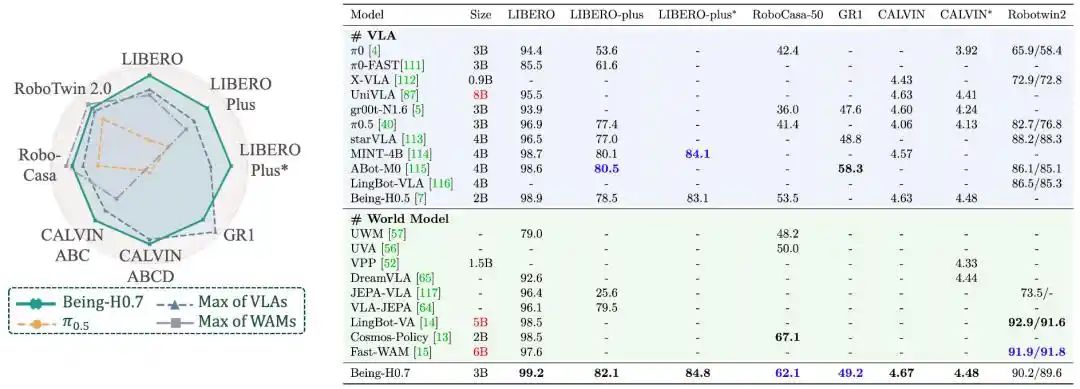
Being-M0.7 is the latest result of this implicit world-action model path.

If the Being-H series answers how hands manipulate the world, Being-M0.7 answers how the entire body coordinates locomotion and task execution in the world. Humanoid robot mobile manipulation (loco-manipulation) requires the model to simultaneously decide where to go, how to orient the body, how to coordinate arms and legs, and how to maintain posture stability. This is a problem highly coupled in both the temporal and body dimensions, and a critical hurdle that general-purpose humanoid robots must overcome.
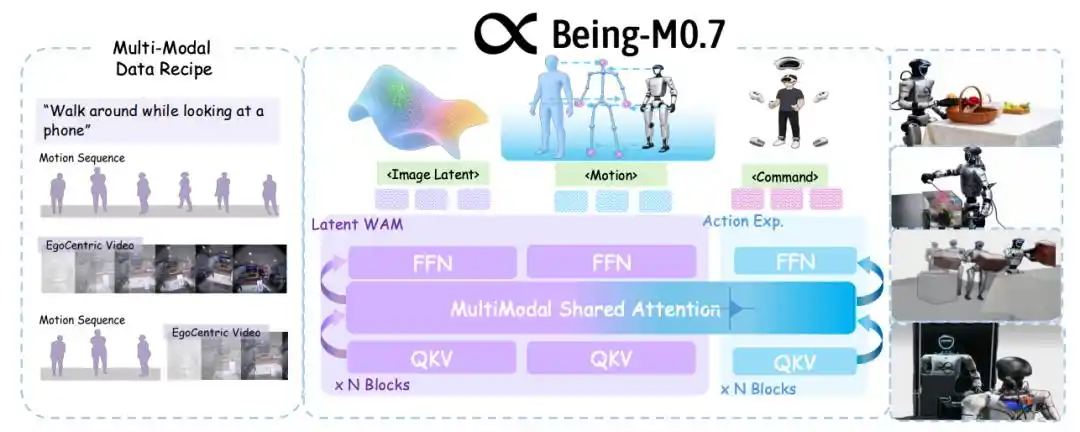
Being-M0.7 is an implicit world-action model. It is first pre-trained on first-person video and human motion data using a Mixture of Transformers (MoT) architecture; then, through action expert post-training, it is adapted for control on robot trajectory data from diverse whole-body manipulation tasks.

Unlike many world models relying on pixel-level video generation, Being-M0.7 predicts future environmental states in a latent space and couples them with a compact whole-body motion representation. Pixel-level prediction is computationally expensive, with much computational power wasted on appearance details weakly related to control. Severe self-motion and viewpoint jitter in the first-person perspective further fill predictions with noise. Latent space prediction focuses modeling capacity on semantic states, object layout, and scene evolution—structural elements truly relevant to control—retaining the essence of a world model anticipating the future while significantly reducing computational overhead.

How Does Physical Understanding Translate into Whole-Body Action?

Whether the model truly possesses whole-body mobile manipulation capabilities ultimately must be tested in real-world scenarios.

Zhi Zai Wu Jie released four real-world demos centered around Being-M0.7, covering four highly challenging scenarios: liquid interaction, mirror reasoning, long-horizon tasks, and obstacle avoidance with occlusion.

These tasks collectively examine one question: Can the robot, based on predictions of the environment and its future changes, continuously generate whole-body actions appropriate to the current scene?.

Fishing in a Fish Tank

The robot walks to an aquarium and uses a handheld net to scoop a toy fish from the water. Liquids have no fixed shape, flow, exert buoyancy and drag on immersed objects, and water surface refraction causes the visual position of underwater targets to shift. The robot must understand the interaction between water, net, and fish, coordinating its arm to complete a tool-based capture of a dynamic target while visual information is distorted by the water. This task precisely tests future state prediction, tool use, and motion coordination under uncertain object dynamics.

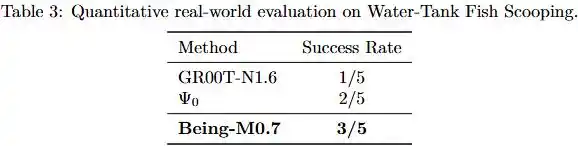
For the fish-scooping segment of the task, Being-M0.7 succeeded in 3 out of 5 tests. In comparison,

was 2/5, while GR00T-N1.6 was 1/5.
Mirror Object Retrieval

A box sits in front of the robot, open only on the back and sides. The item inside is completely invisible from the robot's own perspective; the only clue is the reflection in a mirror ahead. The robot needs to infer the hidden object's position in real 3D space based on the mirrored view, then approach the box and reach in to grab it. This requires the model to understand the spatial relationships and principles of mirror reflection among the mirror, box, and object, converting indirect visual evidence into executable actions under partially observable conditions.

In real-world comparative tests with

and GR00T-N1.6, under two distance settings of 0.5 meters and 1 meter, Being-M0.7 succeeded in 3 out of 5 and 1 out of 5 tests respectively, overall 4/10;

and GR00T both achieved an overall score of 1/10.
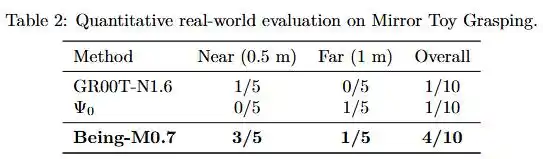
This result indicates that Being-M0.7 demonstrates stronger adaptability in partially observable tasks requiring indirect visual reasoning, whole-body approach, and fine grasping.

Mobile Object Transfer and Retrieval

The robot walks to a table, transfers a baguette from one basket to another, then picks up a bouquet from a basket and turns to leave. The task consists of multiple sub-tasks strung together. The robot needs to continuously switch between walking, grasping, transferring, turning, etc., while maintaining an ongoing understanding of the scene throughout. It tests not just single-grasp success rate, but also state maintenance in long-horizon tasks, object-level spatial reasoning, and whole-body synergy between locomotion and dexterous manipulation.

Box Carrying with Obstacle Avoidance

The robot walks forward carrying a box. When an obstacle appears ahead, it doesn't completely stop to re-plan, but adjusts its body orientation to sidestep through the narrow space between obstacles. Carrying the object partially occludes the first-person view and also alters the robot's load and center of gravity. The model needs to combine prior environmental information with real-time feedback to judge passable areas, adjust walking direction and whole-body posture, while maintaining its own balance and the stability of the carried object. Multi-directional movement, obstacle avoidance, and load-aware manipulation are unified into one closed-loop behavior here.

These demonstrations illustrate that the robot does not execute according to a fixed, open-loop trajectory, but rather continuously generates and corrects whole-body actions by combining current observations, real-time feedback, and predictions of the future.

MoT Architecture and Unified Motion Representation: Solving the Embodiment Data Scarcity Challenge

Supporting the above capabilities is a set of key designs in data and architecture for Being-M0.7.

Humanoid robots need to perform spatial perception via first-person visual information and also output future motion and control commands. High-quality human motion data typically requires motion capture equipment, while first-person paired data where vision and motion are strictly aligned is even scarcer.

If a model can only use data containing both vision and motion, the scale of trainable data would be severely limited. The problem Being-M0.7 solves is precisely how to let paired data, pure video data, and pure motion data all participate in training.

Zhi Zai Wu Jie's choice is the Vision-Motion MoT (Mixture-of-Transformers) architecture. Vision-Motion MoT retains separate modality-specific projection and processing modules for vision and motion, while enabling cross-modal interaction through shared multimodal attention. Visual state changes and continuous motion have different data distributions and need not be forced into identical parameter systems; when both modalities are present, they can exchange information within a shared context.

This allows the model to simultaneously handle three types of data.

For video-motion paired data, the model jointly learns future environmental states and motion trajectories; for pure video data, only the visual branch's training objective is computed; for pure motion data, only the motion branch is trained. Data from different sources jointly constrain the model through the same training objective, without needing to train multiple isolated single-modal systems separately.

From a probabilistic modeling perspective, paired data characterizes the joint relationship between vision and motion, while single-modal data provides marginal constraints for this joint distribution. Even data with incomplete modalities can be incorporated into the same training framework.
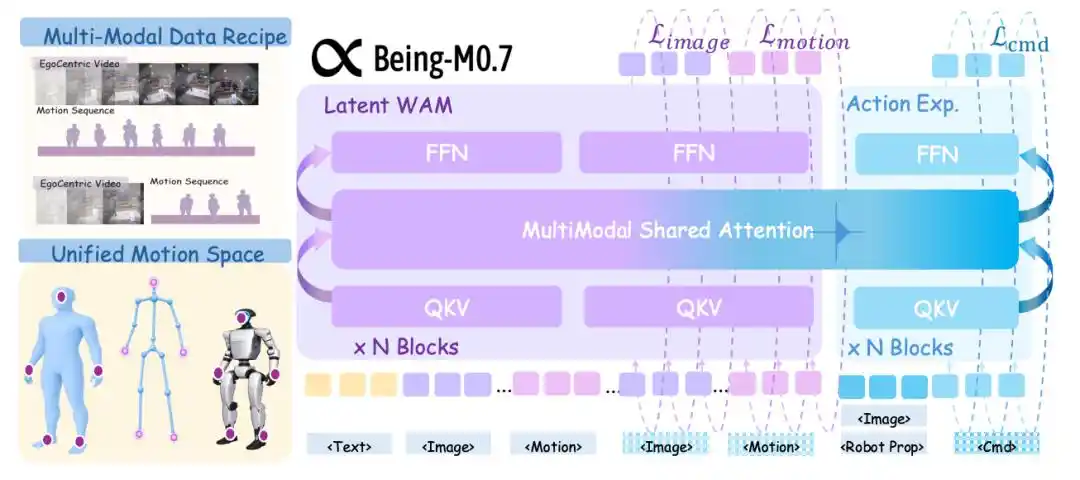
Overview of the Being-M0.7 training framework. Top Left: Pre-training data consists of video-motion paired data, pure video data, and pure motion data. Bottom Left: The research team constructed a unified motion representation shared between humans and humanoid robots, providing richer supervision signals and feedback for training and inference. Right: The overall model architecture of Being-M0.7.

Based on this architecture, the team built a mixed-modal pre-training dataset exceeding 10,000 hours, covering human first-person videos, first-person video-motion paired data, and pure human motion sequences.
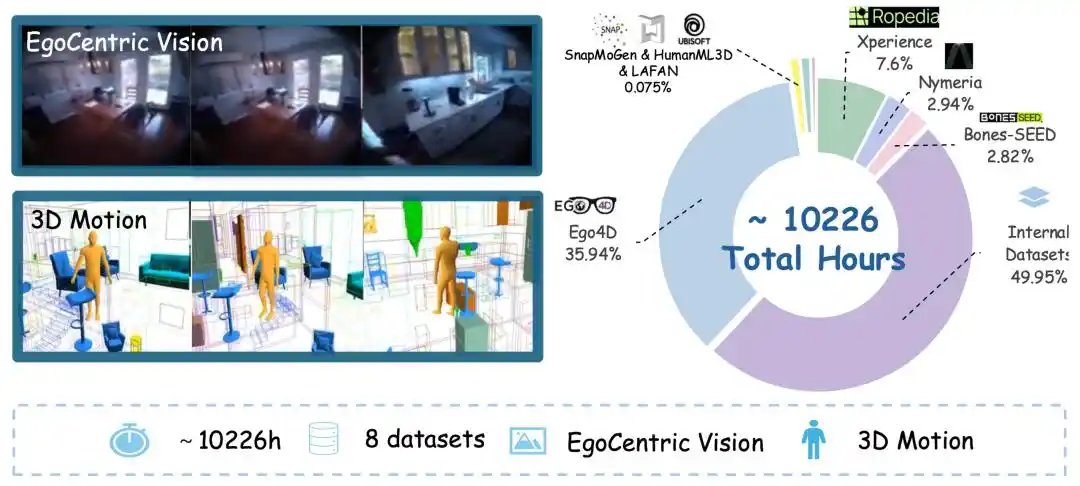
Being-M0.7's Data Recipe. The pre-training corpus is sourced from multiple external public datasets, including Ego4D, Xperience, Nymeria, Bones-SEED, SnapMoGen, HumanML3D, and Lafan1; it also includes internal datasets.

Another key design is the unified motion representation shared between humans and humanoid robots.

Being-M0.7 proposes a unified action representation that transforms human motion data from different sources into a unified representation with the head as the root node, naturally aligning it with first-person vision. Through standardization processes like unifying coordinate systems and removing initial orientation, it reduces distribution differences between datasets and improves cross-source consistency.

Furthermore, Being-M0.7 employs a compact motion representation that retains only the head, both hands, and both feet. While preserving key interaction and contact information, it effectively bridges the morphological gap between humans and robots. This representation not only provides richer supervision signals than action labels for robot post-training but also offers motion-level feedback during inference, supporting whole-body coordinated control.

During pre-training, the model maps images to latent space via a visual encoder and uses the compact unified motion representation. The model is trained with a Flow Matching objective to jointly predict future state changes and motion trajectories based on a short segment of visual-motion history and task instructions.

For real-world robot data collection, the team set up a whole-body teleoperation system based on PICO VR. An operator wears a PICO headset, two ankle trackers, and two handheld controllers. The VR system estimates the human pose in real-time, which is then converted into executable 29-degree-of-freedom whole-body control commands for the Unitree G1 via a whole-body motion controller. While the robot executes actions via teleoperation, it simultaneously records onboard RGB camera first-person view images, proprioception, and motion control commands. This serves as the post-training fine-tuning data for Being-M0.7 on specific tasks.
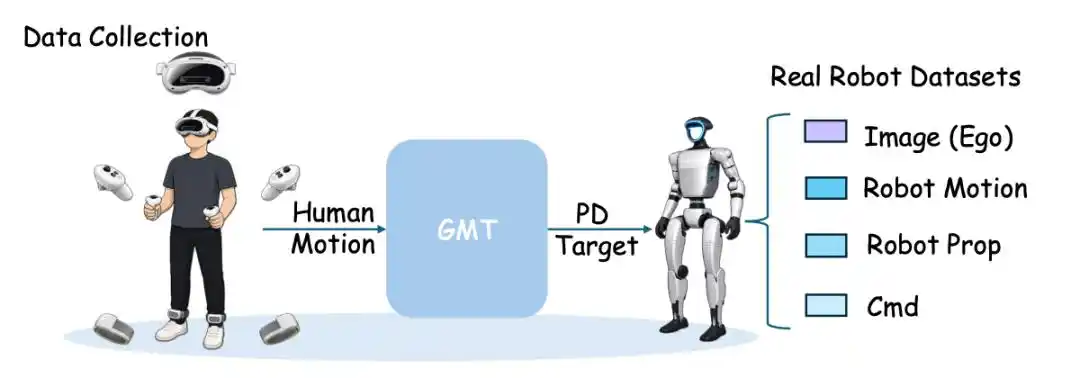
Being-M0.7 real-world robot data collection system. The operator provides whole-body motion commands via VR devices; the system converts human poses into robot control commands and synchronously collects first-person images, proprioception, and motion trajectories.

Since the model has already established visual-motion priors during pre-training, the real-world robot data no longer needs to teach all motion patterns from scratch; it primarily serves two purposes: first, to ground the pre-trained priors into the specific control space of the humanoid robot; second, to learn the low-level control commands and feedback mechanisms required by the real robot. This process is handled by a lightweight Action Expert. The Action Expert reads the intermediate hidden states of the Latent WAM as high-level planning context, then combines them with current visual observations, proprioceptive information, and execution progress to generate action chunks directly executable by the robot.

During inference, the model generates future video-motion plans at a low frequency and converts their intermediate hidden states into reusable policy caches (KV Cache). The unified motion representation not only fuses visual and proprioceptive feedback but also uses the robot's latest motion state to correct the predicted whole-body motion plan, enabling the policy to promptly respond to deviations in body and end-effector motion. The Action Expert then reuses the current KV Cache to continuously generate actions at a high frequency, seamlessly incorporating the latest robot feedback when the cache refreshes. This design decouples low-frequency world planning from high-frequency action control, ensuring real-time performance while keeping the robot consistently guided by both long-term planning and real-time feedback.

A Scalable Fusion Paradigm, Towards More General Embodied Intelligence

The significance of the Vision-Motion MoT architecture extends beyond solving the training problem for Being-M0.7 alone; it establishes a sustainable, extensible multimodal fusion paradigm.

The most direct change from this paradigm occurs at the data level.

Over 10,000 hours of mixed-modal data expand the sources of supervision signals available for training humanoid robot models from expensive, scarce real-world robot demonstrations to vast human behavioral data. Loosening the data bottleneck is a prerequisite for any Scaling Law to hold.

Simultaneously, Being-M0.7 also adjusts the sequence of model learning.

Before being adapted into robot-executable commands, the model first learns visual context, future dynamics, and humanoid kinematic structure from large-scale human-centric data. Subsequently, the Action Expert translates these predictions and motion priors into control commands for the specific robot. In other words, the model first builds the capability to predict future states and body motion, then learns how to act on a specific embodiment. This constitutes a key difference between it and traditional imitation learning schemes that learn action mappings directly from robot demonstrations. The latter often start from "see something, output some action," while Being-M0.7 inserts a layer of joint modeling of future state-motion before action generation.

Moreover, this architecture does not require all newly added data to have complete vision-motion pairing. After cleaning and processing, standalone human video and motion sequences can all be incorporated into the same model. As data scale expands further, this fusion paradigm has the potential to continuously extend the capability frontier.

Placed within the industry's coordinate system, the release of Being-M0.7 perhaps signifies a shift in the competitive logic of humanoid robots.

In recent years, industry attention has focused more on whose robot body is more agile and whose motion demos are more spectacular. As hardware performance continues to improve, whether models can understand scenes, predict changes, and generate coordinated whole-body actions, and whether there exists a scalable data system behind them, will increasingly become the key differentiator.

The development of large language models has already proven that scalable data and a training flywheel often determine how far a technical path can ultimately go. Embodied intelligence stands at a similar critical point: real-world robot data cannot grow rapidly like internet corpora; where else can robots obtain the experience needed for continuous evolution?

From Being-H to Being-M, Zhi Zai Wu Jie's judgment is to let robots first learn about the world from human behavior, then translate this knowledge into actions in the real physical world.

When understanding becomes the prerequisite for action, general-purpose humanoid robots truly step out of the lab narrative and begin their journey towards the physical world of myriad industries.

This article comes from the WeChat public account "Machine Heart" (ID: almosthuman2014), author: Yang Wen


Criptomoedas em alta

Perguntas relacionadas

QWhat is the core technological innovation of Being-M0.7 as presented in the article?

ABeing-M0.7 is presented as the world's first Latent World-Action Model for humanoid robot whole-body mobile manipulation. Its core innovation lies in predicting future environment states in a latent space and coupling them with compact whole-body motion representations, moving away from computationally expensive pixel-level video prediction. This allows the model to focus on semantically relevant structures for control.

QHow does the Being-M0.7 model address the challenge of scarce robot demonstration data for training?

ABeing-M0.7 addresses data scarcity by being pre-trained on over 10,000 hours of human-centric, mixed-modality data (including paired video-motion, pure video, and pure motion data) using a Vision-Motion Mixture of Transformers architecture. This allows it to learn world dynamics from human experience. It then adapts to a specific robot body using a smaller amount of real robot demonstration data via a lightweight Action Expert module.

QAccording to the article, what are the key advantages of using a latent world model over a pixel-level predictive model for humanoid robots?

AThe key advantages are reduced computational overhead and improved robustness. Pixel-level prediction consumes significant capacity on visual details less relevant to control, and the rapid self-motion and viewpoint jitter of humanoid robots amplify visual prediction noise. Latent space prediction focuses modeling power on semantic states, object layouts, and scene evolution, which are more directly related to control decisions.

QWhat specific capabilities did the real-world robot demos (like "Fish Tank Fishing" and "Mirror Fetch") aim to demonstrate?

AThe demos aimed to demonstrate the model's ability to perform complex whole-body mobile manipulation based on its understanding and prediction of the environment. Specifically: "Fish Tank Fishing" tested future state prediction, tool use, and action coordination under the uncertain dynamics of liquid objects. "Mirror Fetch" tested indirect visual reasoning, spatial understanding of reflections, and precise whole-body approach and grasping in partially observable conditions.

QWhat is the strategic significance of Zhizai Wujie's technological route from Being-H to Being-M, as described in the article?

AThe strategic significance is establishing a scalable path for embodied intelligence by leveraging vast, scalable human behavior data instead of waiting for scarce, expensive robot data to accumulate. The route posits that robots should first learn about the world's operation and body coordination from human experience (pre-training), and then transfer this knowledge to specific robot bodies (adaptation). This approach is seen as key to overcoming data bottlenecks and achieving more general-purpose humanoid robots.

Leituras Relacionadas

Robinhood Chain Launchpad Chaos: NOXA Shuts Down, Uniswap CCA Steps In?

Robinhood Chain, a blockchain focused on tokenized stocks, has seen unexpected early success driven by meme coin speculation. Two weeks after launch, its weekly DEX volume surpassed $3.1 billion, briefly exceeding Solana in daily meme trading. This frenzy centered on launchpads, tools allowing easy meme token creation. The leading platform, NOXA, generated massive fees ($7.66M in a week) and launched the chain's top meme, CASHCAT. However, on July 11, NOXA abruptly suspended new token launches, citing spam, copycat tokens, and infrastructure strain. It pivoted to a history-only interface, redistributing fees to creators. This move sparked "soft rug pull" fears and caused its launched tokens to drop sharply. NOXA's exit left a leadership vacuum among Robinhood's launchpads. Meanwhile, Uniswap officially launched its Continuous Clearing Auctions (CCA) mechanism on the chain. CCA uses a gradual, block-by-block auction to set a fair initial price and automatically creates a locked liquidity pool. Early CCA-launched memes like UNICORN and TRASH have seen high volatility. The situation highlights the trade-offs: CCA reduces front-running risk but may be less suited for fast-paced meme trading, while instant-launch platforms carry higher sniper risk. For Robinhood Chain, the meme-driven activity has successfully bootstrapped initial usage, testing its "meme-first, RWA-later" strategy as it aims to eventually host tokenized real-world assets.

Foresight NewsHá 46m

Robinhood Chain Launchpad Chaos: NOXA Shuts Down, Uniswap CCA Steps In?

Foresight NewsHá 46m

Trading

Spot

Artigos em Destaque

O que é $S$

Compreender o SPERO: Uma Visão Abrangente Introdução ao SPERO À medida que o panorama da inovação continua a evoluir, o surgimento de tecnologias web3 e projetos de criptomoeda desempenha um papel fundamental na formação do futuro digital. Um projeto que tem atraído atenção neste campo dinâmico é o SPERO, denotado como SPERO,$$s$. Este artigo tem como objetivo reunir e apresentar informações detalhadas sobre o SPERO, para ajudar entusiastas e investidores a compreender as suas bases, objetivos e inovações nos domínios web3 e cripto. O que é o SPERO,$$s$? O SPERO,$$s$ é um projeto único dentro do espaço cripto que procura aproveitar os princípios da descentralização e da tecnologia blockchain para criar um ecossistema que promove o envolvimento, a utilidade e a inclusão financeira. O projeto é concebido para facilitar interações peer-to-peer de novas maneiras, proporcionando aos utilizadores soluções e serviços financeiros inovadores. No seu núcleo, o SPERO,$$s$ visa capacitar indivíduos ao fornecer ferramentas e plataformas que melhoram a experiência do utilizador no espaço das criptomoedas. Isso inclui a possibilidade de métodos de transação mais flexíveis, a promoção de iniciativas impulsionadas pela comunidade e a criação de caminhos para oportunidades financeiras através de aplicações descentralizadas (dApps). A visão subjacente do SPERO,$$s$ gira em torno da inclusão, visando fechar lacunas dentro das finanças tradicionais enquanto aproveita os benefícios da tecnologia blockchain. Quem é o Criador do SPERO,$$s$? A identidade do criador do SPERO,$$s$ permanece algo obscura, uma vez que existem recursos publicamente disponíveis limitados que fornecem informações detalhadas sobre o(s) seu(s) fundador(es). Esta falta de transparência pode resultar do compromisso do projeto com a descentralização—uma ética que muitos projetos web3 partilham, priorizando contribuições coletivas em vez de reconhecimento individual. Ao centrar as discussões em torno da comunidade e dos seus objetivos coletivos, o SPERO,$$s$ incorpora a essência do empoderamento sem destacar indivíduos específicos. Assim, compreender a ética e a missão do SPERO é mais importante do que identificar um criador singular. Quem são os Investidores do SPERO,$$s$? O SPERO,$$s$ é apoiado por uma diversidade de investidores que vão desde capitalistas de risco a investidores-anjo dedicados a promover a inovação no setor cripto. O foco desses investidores geralmente alinha-se com a missão do SPERO—priorizando projetos que prometem avanço tecnológico social, inclusão financeira e governança descentralizada. Essas fundações de investidores estão tipicamente interessadas em projetos que não apenas oferecem produtos inovadores, mas que também contribuem positivamente para a comunidade blockchain e os seus ecossistemas. O apoio desses investidores reforça o SPERO,$$s$ como um concorrente notável no domínio em rápida evolução dos projetos cripto. Como Funciona o SPERO,$$s$? O SPERO,$$s$ emprega uma estrutura multifacetada que o distingue de projetos de criptomoeda convencionais. Aqui estão algumas das características-chave que sublinham a sua singularidade e inovação: Governança Descentralizada: O SPERO,$$s$ integra modelos de governança descentralizada, capacitando os utilizadores a participar ativamente nos processos de tomada de decisão sobre o futuro do projeto. Esta abordagem promove um sentido de propriedade e responsabilidade entre os membros da comunidade. Utilidade do Token: O SPERO,$$s$ utiliza o seu próprio token de criptomoeda, concebido para servir várias funções dentro do ecossistema. Esses tokens permitem transações, recompensas e a facilitação de serviços oferecidos na plataforma, melhorando o envolvimento e a utilidade gerais. Arquitetura em Camadas: A arquitetura técnica do SPERO,$$s$ suporta modularidade e escalabilidade, permitindo a integração contínua de funcionalidades e aplicações adicionais à medida que o projeto evolui. Esta adaptabilidade é fundamental para manter a relevância no panorama cripto em constante mudança. Envolvimento da Comunidade: O projeto enfatiza iniciativas impulsionadas pela comunidade, empregando mecanismos que incentivam a colaboração e o feedback. Ao nutrir uma comunidade forte, o SPERO,$$s$ pode melhor atender às necessidades dos utilizadores e adaptar-se às tendências do mercado. Foco na Inclusão: Ao oferecer taxas de transação baixas e interfaces amigáveis, o SPERO,$$s$ visa atrair uma base de utilizadores diversificada, incluindo indivíduos que anteriormente podem não ter participado no espaço cripto. Este compromisso com a inclusão alinha-se com a sua missão abrangente de empoderamento através da acessibilidade. Cronologia do SPERO,$$s$ Compreender a história de um projeto fornece insights cruciais sobre a sua trajetória de desenvolvimento e marcos. Abaixo está uma cronologia sugerida que mapeia eventos significativos na evolução do SPERO,$$s$: Fase de Conceituação e Ideação: As ideias iniciais que formam a base do SPERO,$$s$ foram concebidas, alinhando-se de perto com os princípios de descentralização e foco na comunidade dentro da indústria blockchain. Lançamento do Whitepaper do Projeto: Após a fase conceitual, um whitepaper abrangente detalhando a visão, os objetivos e a infraestrutura tecnológica do SPERO,$$s$ foi lançado para atrair o interesse e o feedback da comunidade. Construção da Comunidade e Primeiros Envolvimentos: Esforços ativos de divulgação foram feitos para construir uma comunidade de primeiros adotantes e investidores potenciais, facilitando discussões em torno dos objetivos do projeto e angariando apoio. Evento de Geração de Tokens: O SPERO,$$s$ realizou um evento de geração de tokens (TGE) para distribuir os seus tokens nativos a apoiantes iniciais e estabelecer liquidez inicial dentro do ecossistema. Lançamento da dApp Inicial: A primeira aplicação descentralizada (dApp) associada ao SPERO,$$s$ foi lançada, permitindo que os utilizadores interagissem com as funcionalidades principais da plataforma. Desenvolvimento Contínuo e Parcerias: Atualizações e melhorias contínuas nas ofertas do projeto, incluindo parcerias estratégicas com outros players no espaço blockchain, moldaram o SPERO,$$s$ em um jogador competitivo e em evolução no mercado cripto. Conclusão O SPERO,$$s$ é um testemunho do potencial do web3 e das criptomoedas para revolucionar os sistemas financeiros e capacitar indivíduos. Com um compromisso com a governança descentralizada, o envolvimento da comunidade e funcionalidades inovadoras, abre caminho para um panorama financeiro mais inclusivo. Como em qualquer investimento no espaço cripto em rápida evolução, potenciais investidores e utilizadores são incentivados a pesquisar minuciosamente e a envolver-se de forma ponderada com os desenvolvimentos em curso dentro do SPERO,$$s$. O projeto demonstra o espírito inovador da indústria cripto, convidando a uma exploração mais aprofundada das suas inúmeras possibilidades. Embora a jornada do SPERO,$$s$ ainda esteja a desenrolar-se, os seus princípios fundamentais podem, de facto, influenciar o futuro de como interagimos com a tecnologia, as finanças e uns com os outros em ecossistemas digitais interconectados.

92 Visualizações TotaisPublicado em {updateTime}Atualizado em 2024.12.17

O que é $S$

O que é AGENT S

Agent S: O Futuro da Interação Autónoma no Web3 Introdução No panorama em constante evolução do Web3 e das criptomoedas, as inovações estão constantemente a redefinir a forma como os indivíduos interagem com plataformas digitais. Um projeto pioneiro, o Agent S, promete revolucionar a interação humano-computador através do seu framework aberto e agente. Ao abrir caminho para interações autónomas, o Agent S visa simplificar tarefas complexas, oferecendo aplicações transformadoras em inteligência artificial (IA). Esta exploração detalhada irá aprofundar-se nas complexidades do projeto, nas suas características únicas e nas implicações para o domínio das criptomoedas. O que é o Agent S? O Agent S é um framework aberto e agente, especificamente concebido para abordar três desafios fundamentais na automação de tarefas computacionais: Aquisição de Conhecimento Específico de Domínio: O framework aprende inteligentemente a partir de várias fontes de conhecimento externas e experiências internas. Esta abordagem dupla capacita-o a construir um rico repositório de conhecimento específico de domínio, melhorando o seu desempenho na execução de tarefas. Planeamento ao Longo de Longos Horizontes de Tarefas: O Agent S emprega planeamento hierárquico aumentado por experiência, uma abordagem estratégica que facilita a decomposição e execução eficientes de tarefas intrincadas. Esta característica melhora significativamente a sua capacidade de gerir múltiplas subtarefas de forma eficiente e eficaz. Gestão de Interfaces Dinâmicas e Não Uniformes: O projeto introduz a Interface Agente-Computador (ACI), uma solução inovadora que melhora a interação entre agentes e utilizadores. Utilizando Modelos de Linguagem Multimodais de Grande Escala (MLLMs), o Agent S pode navegar e manipular diversas interfaces gráficas de utilizador de forma fluida. Através destas características pioneiras, o Agent S fornece um framework robusto que aborda as complexidades envolvidas na automação da interação humana com máquinas, preparando o terreno para uma infinidade de aplicações em IA e além. Quem é o Criador do Agent S? Embora o conceito de Agent S seja fundamentalmente inovador, informações específicas sobre o seu criador permanecem elusivas. O criador é atualmente desconhecido, o que destaca ou o estágio nascente do projeto ou a escolha estratégica de manter os membros fundadores em anonimato. Independentemente da anonimidade, o foco permanece nas capacidades e no potencial do framework. Quem são os Investidores do Agent S? Como o Agent S é relativamente novo no ecossistema criptográfico, informações detalhadas sobre os seus investidores e financiadores não estão explicitamente documentadas. A falta de informações disponíveis publicamente sobre as fundações de investimento ou organizações que apoiam o projeto levanta questões sobre a sua estrutura de financiamento e roteiro de desenvolvimento. Compreender o apoio é crucial para avaliar a sustentabilidade do projeto e o seu impacto potencial no mercado. Como Funciona o Agent S? No núcleo do Agent S reside uma tecnologia de ponta que lhe permite funcionar eficazmente em diversos ambientes. O seu modelo operacional é construído em torno de várias características-chave: Interação Humano-Computador Semelhante: O framework oferece planeamento avançado em IA, esforçando-se para tornar as interações com computadores mais intuitivas. Ao imitar o comportamento humano na execução de tarefas, promete elevar as experiências dos utilizadores. Memória Narrativa: Utilizada para aproveitar experiências de alto nível, o Agent S utiliza memória narrativa para acompanhar os históricos de tarefas, melhorando assim os seus processos de tomada de decisão. Memória Episódica: Esta característica fornece aos utilizadores orientações passo a passo, permitindo que o framework ofereça suporte contextual à medida que as tarefas se desenrolam. Suporte para OpenACI: Com a capacidade de funcionar localmente, o Agent S permite que os utilizadores mantenham o controlo sobre as suas interações e fluxos de trabalho, alinhando-se com a ética descentralizada do Web3. Fácil Integração com APIs Externas: A sua versatilidade e compatibilidade com várias plataformas de IA garantem que o Agent S possa integrar-se perfeitamente em ecossistemas tecnológicos existentes, tornando-o uma escolha apelativa para desenvolvedores e organizações. Estas funcionalidades contribuem coletivamente para a posição única do Agent S no espaço cripto, à medida que automatiza tarefas complexas e em múltiplos passos com mínima intervenção humana. À medida que o projeto evolui, as suas potenciais aplicações no Web3 podem redefinir a forma como as interações digitais se desenrolam. Cronologia do Agent S O desenvolvimento e os marcos do Agent S podem ser encapsulados numa cronologia que destaca os seus eventos significativos: 27 de Setembro de 2024: O conceito de Agent S foi lançado num artigo de pesquisa abrangente intitulado “Um Framework Agente Aberto que Usa Computadores como um Humano”, mostrando a base para o projeto. 10 de Outubro de 2024: O artigo de pesquisa foi disponibilizado publicamente no arXiv, oferecendo uma exploração aprofundada do framework e da sua avaliação de desempenho com base no benchmark OSWorld. 12 de Outubro de 2024: Uma apresentação em vídeo foi lançada, proporcionando uma visão visual das capacidades e características do Agent S, envolvendo ainda mais potenciais utilizadores e investidores. Estes marcos na cronologia não apenas ilustram o progresso do Agent S, mas também indicam o seu compromisso com a transparência e o envolvimento da comunidade. Pontos-Chave Sobre o Agent S À medida que o framework Agent S continua a evoluir, várias características-chave destacam-se, sublinhando a sua natureza inovadora e potencial: Framework Inovador: Concebido para proporcionar um uso intuitivo de computadores semelhante à interação humana, o Agent S traz uma abordagem nova à automação de tarefas. Interação Autónoma: A capacidade de interagir autonomamente com computadores através de GUI significa um avanço em direção a soluções computacionais mais inteligentes e eficientes. Automação de Tarefas Complexas: Com a sua metodologia robusta, pode automatizar tarefas complexas e em múltiplos passos, tornando os processos mais rápidos e menos propensos a erros. Melhoria Contínua: Os mecanismos de aprendizagem permitem que o Agent S melhore a partir de experiências passadas, aprimorando continuamente o seu desempenho e eficácia. Versatilidade: A sua adaptabilidade em diferentes ambientes operacionais, como OSWorld e WindowsAgentArena, garante que pode servir uma ampla gama de aplicações. À medida que o Agent S se posiciona no panorama do Web3 e das criptomoedas, o seu potencial para melhorar as capacidades de interação e automatizar processos significa um avanço significativo nas tecnologias de IA. Através do seu framework inovador, o Agent S exemplifica o futuro das interações digitais, prometendo uma experiência mais fluida e eficiente para os utilizadores em diversas indústrias. Conclusão O Agent S representa um ousado avanço na união da IA e do Web3, com a capacidade de redefinir a forma como interagimos com a tecnologia. Embora ainda esteja nas suas fases iniciais, as possibilidades para a sua aplicação são vastas e cativantes. Através do seu framework abrangente que aborda desafios críticos, o Agent S visa trazer interações autónomas para o primeiro plano da experiência digital. À medida que avançamos mais profundamente nos domínios das criptomoedas e da descentralização, projetos como o Agent S desempenharão, sem dúvida, um papel crucial na formação do futuro da tecnologia e da colaboração humano-computador.

706 Visualizações TotaisPublicado em {updateTime}Atualizado em 2025.01.14

O que é AGENT S

Como comprar S

Bem-vindo à HTX.com!Tornámos a compra de Sonic (S) simples e conveniente.Segue o nosso guia passo a passo para iniciar a tua jornada no mundo das criptos.Passo 1: cria a tua conta HTXUtiliza o teu e-mail ou número de telefone para te inscreveres numa conta gratuita na HTX.Desfruta de um processo de inscrição sem complicações e desbloqueia todas as funcionalidades.Obter a minha contaPasso 2: vai para Comprar Cripto e escolhe o teu método de pagamentoCartão de crédito/débito: usa o teu visa ou mastercard para comprar Sonic (S) instantaneamente.Saldo: usa os fundos da tua conta HTX para transacionar sem problemas.Terceiros: adicionamos métodos de pagamento populares, como Google Pay e Apple Pay, para aumentar a conveniência.P2P: transaciona diretamente com outros utilizadores na HTX.Mercado de balcão (OTC): oferecemos serviços personalizados e taxas de câmbio competitivas para os traders.Passo 3: armazena teu Sonic (S)Depois de comprar o teu Sonic (S), armazena-o na tua conta HTX.Alternativamente, podes enviá-lo para outro lugar através de transferência blockchain ou usá-lo para transacionar outras criptomoedas.Passo 4: transaciona Sonic (S)Transaciona facilmente Sonic (S) no mercado à vista da HTX.Acede simplesmente à tua conta, seleciona o teu par de trading, executa as tuas transações e monitoriza em tempo real.Oferecemos uma experiência de fácil utilização tanto para principiantes como para traders experientes.

1.3k Visualizações TotaisPublicado em {updateTime}Atualizado em 2026.06.02

Como comprar S

Discussões

Bem-vindo à Comunidade HTX. Aqui, pode manter-se informado sobre os mais recentes desenvolvimentos da plataforma e obter acesso a análises profissionais de mercado. As opiniões dos utilizadores sobre o preço de S (S) são apresentadas abaixo.

活动图片