The live price of Push Protocol (PUSH) is $0.01 USD and its current market capitalization is $-- USD.
Get real-time PUSH/USD updates on HTX. Stay informed with the latest data and market trends to make smart trading decisions. HTX, your trusted source for accurate cryptocurrency price information.
Push Protocol Key Stats
24h Volume (USD)
$--
Price Change Today
0.00%
Circulating Supply (PUSH)
90.23M
Sign up and trade to win rewards worth up to 1,500 USDT.Join Now
PUSH Price Performance
Track Push Protocol price movements with chart views spanning 1 day, 30 days, 60 days, 90 days, 1 year, and the period since it was listed on HTX.View more data for the Push Protocol prices
Time
Change
Change%
Highest Price
Lowest Price
No data
PUSH Market Information
Get the latest Push Protocol price details on HTX: 24-hour high and low, all-time high (ATH), and daily price change percentage.
24h Low
$0
24h High
$0
All-Time High
$0
Market Cap
$0.00
24h Volume (USD)
$--
Circulating Supply
--
What is PUSH?
Push is the communication protocol of web3. Push protocol enables cross-chain notifications and messaging for dapps, wallets, and services tied to wallet addresses in an open, gasless, and platform agnostic fashion. The open communication layer allows any crypto wallet / frontend to tap into the network and get the communication across.
It's super easy to buy PUSH on HTX. Simply click here to view a complete guide to buying Push Protocol with ease.
Real-Time PUSH Markets
View real-time Push Protocol prices on HTX's spot markets. Switch between spot and futures markets to instantly compare live prices and 24-hour price changes.
Based on the historical performance of Push Protocol, our prediction tool estimates that the price of Push Protocol (PUSH) could reach -- by --.
Predicted PUSH Price in --
Our most recent forecast indicates the price of Push Protocol (PUSH) will increase to -- by --, with a price change of --% and a cumulative ROI of approximately --%.
Buy your first PUSH on HTXSign Up
PUSH FAQs
QWhat is the Push Protocol (PUSH) price today?
AThe current price of Push Protocol (PUSH) is $0.01 USD.
QWhat is the Push Protocol (PUSH) market cap?
AThe current market capitalization of Push Protocol (PUSH) is $0.00 USD, calculated by multiplying its circulating supply by its current price.
QWhat is the Push Protocol (PUSH) circulating supply?
AThe current circulating supply of Push Protocol (PUSH) is -- PUSH.
QWhat is the Push Protocol (PUSH) all-time high?
AAs of 2026-08-08, the all-time high of Push Protocol (PUSH) is $0 USD.
QWhat is the Push Protocol (PUSH) 24h trading volume?
AThe 24-hour trading volume of Push Protocol (PUSH) is -- USD on HTX.
QCan I buy Push Protocol (PUSH) on HTX?
AYes, HTX offers industry-leading trading fees and deep liquidity, ensuring a smooth and secure Push Protocol (PUSH) purchase experience.
PayPal's second-quarter results included a $1.26 per share earnings, slightly below estimates, on revenue of $8.68 billion, which exceeded forecasts. The company reported an $81 million non-GAAP adjustment for strategic investments and crypto assets, which it excludes as they are not actively traded for operations. In its strategy, PayPal emphasized expanding into stablecoins, AI-driven agentic payments, and identity technologies using its existing payments infrastructure and risk management systems. Its PayPal World platform processed roughly $200 million in payment volume between Venmo and PayPal.
Global payments giant PayPal reported its second-quarter earnings, highlighting stablecoins and AI-driven payment tools as key strategic focuses, while also noting crypto assets affected its earnings. Q2 earnings were $1.26 per share, slightly below estimates of $1.28, but revenue of $8.68 billion exceeded expectations. The company recorded an $81 million adjustment related to gains and losses from strategic investments and crypto assets, which it excludes from its non-GAAP results as these are not actively traded. PayPal is expanding its efforts in areas like agentic payments, stablecoins, and biometric technologies, leveraging its existing payments network and infrastructure. Additionally, its PayPal World platform facilitated around $200 million in payment volume between Venmo and PayPal.
The U.S. push to reshore semiconductor manufacturing faces a core challenge: a significant talent shortage. While over $770 billion in investments are planned across 160 projects, a key hurdle is finding enough people to run the new fabs. According to industry projections, the U.S. could face a shortage of approximately 67,000 technicians, engineers, and computer scientists by 2030.
This shortage is multi-faceted. It includes not only high-level chip design engineers requiring advanced degrees but also a substantial need for technicians to operate and maintain fab equipment. Technician roles, while often requiring less formal education, are hard to fill due to factors like shift work, factory locations, and local community infrastructure. Conversely, for high-end engineers, the issue is less about salary—which is already competitive—and more about intense competition for specialized skills from other tech sectors and the long lead time to develop such expertise.
The geographic dispersion of new investments complicates recruitment, as fabs need large numbers of local, stable employees. In response, U.S. policy emphasizes building workforce development as critical infrastructure. Strategies include expanding community college programs for technician training, fostering industry-education partnerships, and pursuing immigration reforms for high-skilled talent, aiming to balance immediate needs with long-term domestic pipeline development.
For China, the key takeaway is the need to integrate talent supply planning with factory construction from the outset. This involves requiring companies to submit workforce plans, strengthening vocational education aligned with industry needs, and building supportive local ecosystems to retain talent. Ultimately, a sustainable semiconductor industry depends not just on building fabs, but on cultivating a continuous, local talent pipeline capable of keeping them running and advancing.
A group of nine U.S. senators has urged the Commodity Futures Trading Commission (CFTC) to restrict wildfire prediction contracts, arguing they allow traders to profit from disasters. In an August 3rd letter led by Sen. Jeff Merkley (D-Ore.), the lawmakers requested answers from CFTC Chair Rostin Behnam by August 14th.
The senators, representing states impacted by recent wildfires, expressed concern that betting on fires' duration, spread, or property damage trivializes community suffering and creates a perverse incentive for arson. They cited over $1.2 million in trading volume on contracts related to California's Palisades and Eaton fires on the Polymarket platform as a catalyst for their inquiry.
While acknowledging no confirmed cases of arson linked to such markets, the letter draws a parallel to insider trading risks. Polymarket defended its markets as sources of timely information for understanding evolving events, not causes of tragedy.
The senators questioned if the CFTC, currently developing new rules, plans to ban wildfire contracts as contrary to the public interest, given its authority to prohibit contracts on terrorism, assassination, or gambling. Although wildfires aren't explicitly mentioned in law, the lawmakers seek a preemptive move, warning it's only a matter of time before U.S.-based markets offer similar contracts. This follows a prior, broader request from Merkley in April to ban election and war-related contracts, which the CFTC did not adopt, instead proposing a case-by-case review process in June.
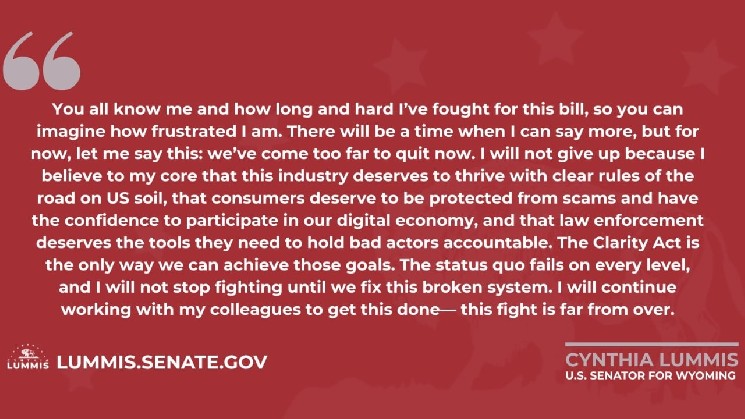
U.S. Senator Cynthia Lummis has expressed frustration over the stalled progress of the CLARITY Act, a comprehensive cryptocurrency regulatory bill. Despite over a year of negotiations and recent committee approval, a Senate vote has been delayed until September after the August recess. Lummis, a key advocate, argues that predictable federal rules are crucial for crypto businesses to operate and expand in the U.S., and are needed to protect consumers from fraud within the digital economy. The updated bill includes provisions for customer asset segregation in case of exchange bankruptcies. Lummis warns that failure to pass the legislation now could delay meaningful federal crypto regulation until 2030, leaving market participants in regulatory limbo. She vows to continue working with colleagues to advance the bill when the Senate reconvenes.
cryptonews.ru3小时前
Threads
Welcome to the HTX Community. Here, you can stay informed about the latest platform developments and gain access to professional market insights. Users' opinions on the price of Push Protocol (PUSH) are presented below.
Related Questions
Welcome to the Crypto FAQ. Users' questions and answers on Push Protocol (PUSH) are presented below.