The live price of Sleepless AI (AI) is $0.02 USD and its current market capitalization is $-- USD.
Get real-time AI/USD updates on HTX. Stay informed with the latest data and market trends to make smart trading decisions. HTX, your trusted source for accurate cryptocurrency price information.
Track Sleepless AI price movements with chart views spanning 1 day, 30 days, 60 days, 90 days, 1 year, and the period since it was listed on HTX.View more data for the Sleepless AI prices
Time
Change
Change%
Highest Price
Lowest Price
No data
AI Market Information
Get the latest Sleepless AI price details on HTX: 24-hour high and low, all-time high (ATH), and daily price change percentage.
24h Low
$0
24h High
$0
All-Time High
$0
Market Cap
$0.00
24h Volume (USD)
$--
Circulating Supply
--
What is AI?
Where AI meets affections Sleepless AI emerges as a groundbreaking Web3+AI gaming platform, ingeniously blending artificial intelligence and blockchain technology. At its core, Sleepless AI aims to revolutionize the gaming industry with its unique approach and the extensive expertise of its team. Our mission is to offer unparalleled emotional support and immersive gaming experiences through AI companion games. The project seeks to redefine the gaming landscape by seamlessly integrating advanced AI and blockchain technologies.
It's super easy to buy AI on HTX. Simply click here to view a complete guide to buying Sleepless AI with ease.
Real-Time AI Markets
View real-time Sleepless AI prices on HTX's spot markets. Switch between spot and futures markets to instantly compare live prices and 24-hour price changes.
Based on the historical performance of Sleepless AI, our prediction tool estimates that the price of Sleepless AI (AI) could reach -- by --.
Predicted AI Price in --
Our most recent forecast indicates the price of Sleepless AI (AI) will increase to -- by --, with a price change of --% and a cumulative ROI of approximately --%.
Buy your first AI on HTXSign Up
AI FAQs
QWhat is the Sleepless AI (AI) price today?
AThe current price of Sleepless AI (AI) is $0.02 USD.
QWhat is the Sleepless AI (AI) market cap?
AThe current market capitalization of Sleepless AI (AI) is $0.00 USD, calculated by multiplying its circulating supply by its current price.
QWhat is the Sleepless AI (AI) circulating supply?
AThe current circulating supply of Sleepless AI (AI) is -- AI.
QWhat is the Sleepless AI (AI) all-time high?
AAs of 2026-07-18, the all-time high of Sleepless AI (AI) is $0 USD.
QWhat is the Sleepless AI (AI) 24h trading volume?
AThe 24-hour trading volume of Sleepless AI (AI) is -- USD on HTX.
QCan I buy Sleepless AI (AI) on HTX?
AYes, HTX offers industry-leading trading fees and deep liquidity, ensuring a smooth and secure Sleepless AI (AI) purchase experience.
NVIDIA CEO Jensen Huang’s recent visit to Japan signals a strategic push to make the country a core hub for its global “physical AI” ecosystem. During his trip, NVIDIA announced partnerships with Japanese robotics giants Fanuc and Yaskawa Electric, and expanded its collaboration with Toyota across autonomous driving, factory simulation, and smart city applications. Huang emphasized that AI-driven robotics will become intelligent, adaptable, and accessible.
The visit also highlighted a historic reunion with former SEGA president Shoichiro Irimajiri, who helped save NVIDIA from bankruptcy in the 1990s with a critical investment. Now, SEGA plans to support NVIDIA’s RTX Spark platform for future game releases.
Behind the scenes, Huang hosted a dinner with key Japanese semiconductor and electronics supply chain leaders, including Kioxia, Shin-Etsu Chemical, Tokyo Electron, and Ajinomoto, underscoring Japan’s role in NVIDIA’s hardware roadmap.
Beyond robotics and automotive, NVIDIA is deepening ties across Japanese industries. In healthcare, companies like Eisai and Fujifilm are using NVIDIA’s BioNeMo and Blackwell platforms for AI-driven drug discovery and medical imaging. In finance, Mizuho Bank and SMFG are building AI factories powered by NVIDIA systems. In quantum computing, RIKEN’s supercomputers, equipped with Blackwell GPUs, are advancing research. Market speculation also points to a potential partnership with Japan’s state-backed “physical AI” consortium, Noetra.
Huang dismissed concerns about an AI bubble, stating demand remains strong and a decade of infrastructure building is needed. He framed Japan’s manufacturing expertise and automation needs as a natural fit for the physical AI era.
Gemini 3.5 Pro's launch has been delayed for months, according to a Bloomberg report. Hype had built after leaks suggested the AI model, codenamed 'Cappuccino', would feature a 2M-token context window and a 'Deep Think' mode, potentially surpassing rivals like GPT-4.5. However, internal sources reveal the model failed to meet strict standards, particularly in AI coding performance, despite a last-minute data update.
The report details internal challenges at Google: bureaucratic hurdles slow decision-making as multiple departments compete for resources and alignment. Furthermore, a cultural reluctance among some engineers to use AI-generated code, coupled with internal GPU shortages, hampered the development of this critical capability. This inefficiency and perceived lag behind competitors like OpenAI and Anthropic is reportedly causing talent drain.
Analysts suggest this isn't just a Google issue but part of a broader "next-gen giant model disappointment trap." As models scale, they face data bottlenecks, diminishing returns from compute scaling, and potential architectural limits. While OpenAI currently leads, the industry may be entering a platform period where explosive progress slows. Google's delay underscores the immense difficulty of advancing frontier AI models.
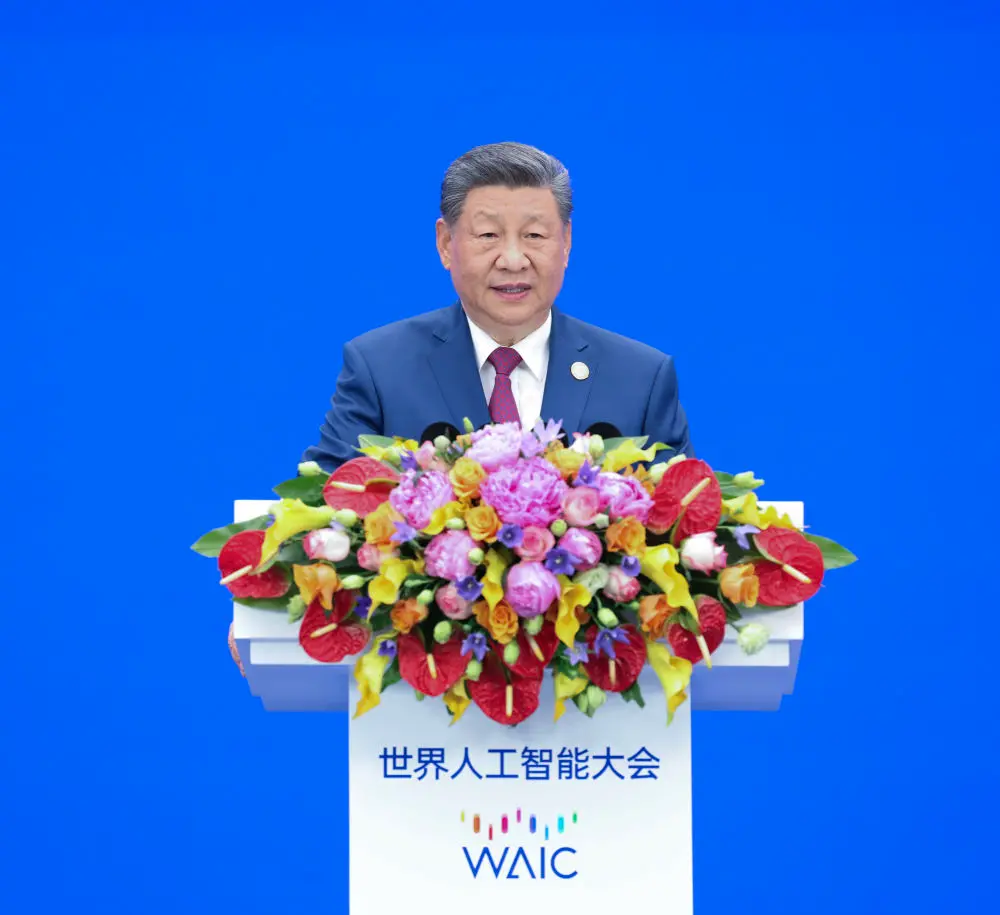
On July 17, 2026, Chinese President Xi Jinping delivered a keynote speech titled "Working Together to Build a Fair and Equitable Global Governance System on Artificial Intelligence" at the opening ceremony of the 2026 World Artificial Intelligence Conference and High-level Conference on Global AI Governance in Shanghai.
President Xi pointed out that the rapid development of AI, alongside the accelerated global changes, presents both significant opportunities and governance challenges. He raised critical questions for humanity regarding human-machine coexistence, safety, ethics, and bridging divides. China advocates for a people-oriented, benevolent approach to AI, making it a force for common prosperity and security, and jointly building a fair and reasonable global AI governance system.
Xi Jinping put forward a four-point proposal:
1. **Uphold Openness for Win-Win Cooperation and Drive Innovation:** Seize the historic opportunity by encouraging open-source collaboration and sharing to foster AI innovation, industry growth, and application, empowering all sectors.
2. **Enhance Risk Awareness and Ensure Security and Controllability:** Attach great importance to AI's inherent and derivative risks. Build systems for laws, technical monitoring, risk warning, and emergency response to safeguard security, prevent misuse, and ensure human control. Oppose the practice of politicizing national security in AI.
3. **Encourage Inclusiveness and Promote Cultural Exchange:** Shape AI's values with humanity's common values. Use AI to enhance understanding and tolerance between civilizations, fostering a garden of diverse cultures.
4. **Advocate Solidarity and Improve Global Governance:** Practice true multilateralism, leverage the UN's role, and strengthen coordination on AI development strategies, governance rules, and technical standards to form a widely accepted global governance framework. Assist Global South countries in capacity building to bridge the digital divide and avoid new historical inequities.
Xi highlighted that as a responsible major country, China, in its 15th Five-Year Plan period, is committed to being a provider of international public goods in AI, contributing Chinese solutions. China has promoted an "AI Plus" initiative, with its core intelligent economy exceeding RMB 10 trillion. To support global AI development, China will provide 5,000 AI training opportunities for developing countries, establish international AI application cooperation centers with regional organizations, and deploy its "Mazu" meteorological AI warning system in 30 countries. The establishment of the World Artificial Intelligence Cooperation Organization in Shanghai marks a significant milestone.
Leaders from Kazakhstan, Cambodia, Thailand, and the UN Secretary-General delivered speeches, commending China's contributions to global AI governance and echoing President Xi's proposals. They agreed that AI's opportunities and challenges are borderless, requiring cooperative, inclusive, and equitable international efforts to ensure a secure, prosperous future that leaves no country behind.
The conference issued a Chair's Statement. President Xi and his wife hosted a welcome banquet for international dignitaries on July 16. Senior Chinese officials attended the events.
As AI increasingly makes decisions on our behalf, a critical asymmetry emerges: the entities deploying these systems understand and refine their algorithms, while individuals merely endure the consequences. This article explores the three layers of this "algorithmic agency asymmetry." First, opacity shields system goals, incentives, and flaws, creating a "black box fallacy" where outputs seem objective. Second, algorithms amplify historical biases, repackaging past inequalities in a seemingly neutral, computational form. Third, recursive systems lead to "algorithmic drift," where users train the system and are simultaneously trained by it, shaping their own choices and behaviors.
This asymmetry has profound implications, extending into hiring, education, policing, and daily life. Users adapt to what the system rewards, but only see the end result—a score, recommendation, or price—without understanding the underlying logic or manipulated conditions.
To rebalance this power dynamic, the article proposes policy interventions: 1) Meaningful transparency and explainability for users affected by AI decisions. 2) Enforceable impact assessments before deploying high-risk systems. 3) Genuine human oversight with the power to challenge outputs. 4) Mandatory post-deployment monitoring and auditing. 5) Outright bans on manipulative or exploitative systems. Finally, fostering widespread "algorithmic literacy" is essential public infrastructure.
Ultimately, this asymmetry is a structural power imbalance. Good policy cannot eliminate it but can narrow the gap by making automated influence visible, contestable, auditable, and governable.
Live-action short dramas, originally a popular online format, are now attempting to enter the cinema. Several top IPs like "What a Good Girl" and "One Family, Same Class" have received approval for film adaptations. This shift is driven by several pressures within the short drama industry. After rapid growth fueled by low costs and platform support, the sector now faces a slowdown with fewer hits and reduced investment. A major disruptor is the explosive rise of AI-generated short dramas, which dominate new releases and challenge the traditional model with their speed and low cost. Platform policy changes, such as adjustments to revenue guarantees, have further squeezed producers.
In this context, film adaptation is seen as a potential new growth path. It offers a chance to extend a short-lived online hit into a longer-lasting IP asset, moving beyond the "fast production, fast consumption" cycle. Established short dramas bring pre-validated stories and emotional appeal to the table, potentially lowering the risk for film investors. However, significant challenges remain. Translating a fast-paced, fragmented viewing experience designed for phones into a compelling cinematic narrative is difficult. Past attempts by popular TV shows and variety programs to make films have often failed due to weak content. A short drama's massive online viewership does not guarantee box office success, as cinema requires a higher commitment of time and money from audiences. Ultimately, the success of these adaptations will depend not on their original popularity, but on their ability to tell complete, emotionally resonant stories that meet the standards of the theatrical market.
marsbit20小时前
Threads
Welcome to the HTX Community. Here, you can stay informed about the latest platform developments and gain access to professional market insights. Users' opinions on the price of Sleepless AI (AI) are presented below.
Related Questions
Welcome to the Crypto FAQ. Users' questions and answers on Sleepless AI (AI) are presented below.