XRP Bull-Bear Showdown Imminent: Downtrend Shows Cracks—Is This a Last Stand or the Final Drop?

金色财经Опубліковано о 2025-12-11Востаннє оновлено о 2025-12-11

Анотація

XRP remains constrained by a long-term bearish trend, but recent price movements suggest that selling pressure may be weakening. While the overall market structure is still defined by a steep descending red trendline, internal momentum is shifting. Bullish rallies are becoming stronger and more decisive, while bearish declines are losing intensity and duration—a sign that buyers are accumulating at lower levels. Key resistance lies near $2.48; a decisive break above this level could trigger a strong upward move as accumulated bullish energy is released. Important support is found in the $1.88–$1.95 zone, aligned with Fibonacci retracement levels. Failure to break above resistance, however, could lead to further downside toward the $1.40 region. In summary, XRP is at a critical juncture: either it breaks out into a new uptrend or remains trapped within the larger bearish structure. The outcome depends on whether it can sustainably overcome key resistance and convert it into support.

Article Source: WeChat Official Account Mama Encryption Talk

XRP remains constrained by a long-term downtrend, but recent price movements suggest that bears may be losing control. The upward moves are becoming stronger and more forceful, while the downward momentum is slowing, indicating that buyers are quietly entering the market. Once key resistance levels are breached, bulls may be preparing to launch a powerful counterattack.

Overall Bearish Structure: The Upper Limit of the Red Trendline

According to the latest XRP chart from MakroVision Research, the overall market structure remains in a downtrend, with the steep descending red trendline clearly outlining this trend. These trendlines continue to hinder every rebound attempt, keeping the overall technical picture unchanged and biased toward bearish.

Although the internal market structure has begun to show clear signs of improvement, short-term price movements indicate that upward moves are becoming more rapid, forceful, and distinct. Meanwhile, the momentum during downward phases is gradually weakening, with longer durations and reduced kinetic energy.

This shift is typical of waning selling pressure and increased buyer activity at lower levels. The market may still be below key resistance levels, but its internal dynamics are no longer as weak as before.
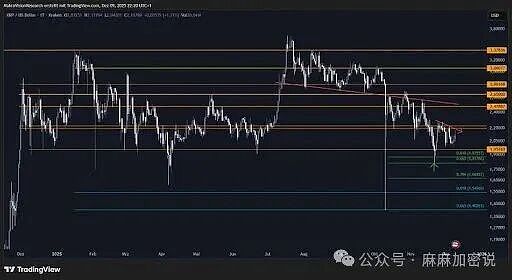
If XRP can decisively break through the red trendline near $2.48, it will unleash the upward potential that has been quietly accumulating. If it fails to break through, the token will technically remain under pressure, but the foundation for a potential reversal is clearly forming.

Key price levels to watch include the resistance zone at $2.20 to $2.22, the major breakout level at $2.48, and the support area around $1.95 to $1.88, which aligns with Fibonacci retracement levels and recent reaction points.

Dual-Track Conflict: Bearish Trend vs. Bullish Internal Structure

In summary, MakroVision Research points out that XRP is currently experiencing a dual-track movement. While the technical picture shows that the broader trend remains downward, its internal price structure is increasingly exhibiting bullish characteristics. This weakening of downward momentum makes the current chart dynamics exciting.

XRP's current fate hinges entirely on its ability to sustainably break through the aforementioned key resistance levels, particularly the $2.48 trendline. Analysts warn that if XRP successfully converts this major resistance level into support, the accumulated upward momentum could be rapidly unleashed, leading to a sharp price surge.

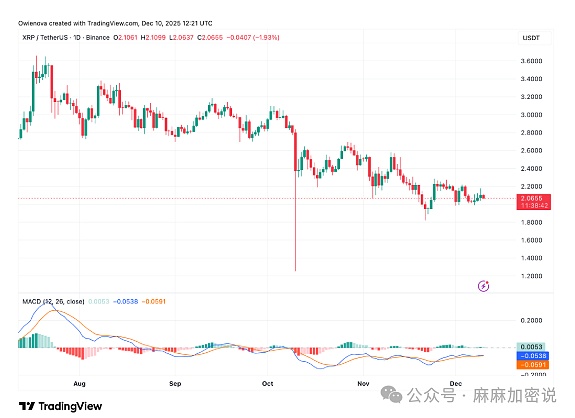
For now, the key question remains whether XRP can achieve a lasting trend reversal and leverage its internal strengths, or whether the overall bearish pressure will ultimately prevail, forcing prices lower toward the significant $1.4 low.
Пов'язані питання

QWhat is the main resistance level that XRP needs to break for a potential trend reversal according to the article?

AThe main resistance level that XRP needs to break is $2.48, which is the key trendline.

QWhat does the article suggest about the internal market structure of XRP despite the overall bearish trend?

AThe article suggests that the internal price structure is becoming increasingly bullish, with stronger rallies and weakening sell-offs, indicating that buyers are becoming more active.

QWhich price zone is mentioned as a support area for XRP in the analysis?

AThe support area mentioned is around $1.95 to $1.88, which aligns with Fibonacci retracement levels and recent reaction points.

QWhat could happen if XRP fails to break the key resistance at $2.48?

AIf XRP fails to break the $2.48 resistance, it will remain technically pressured, and the overall bearish pressure might push the price down further towards the $1.4 low.

QWhat is the 'dual-track conflict' described in the article regarding XRP's price action?

AThe 'dual-track conflict' refers to the situation where the overall market structure is still bearish (controlled by the descending red trendline), but the internal price structure is showing signs of strengthening bullish momentum.

Пов'язані матеріали

Bitcoin Mining Difficulty Drops for the Third Time in a Row. What Does This Mean?

Bitcoin mining difficulty has decreased for the third consecutive time, dropping by 0.74% to 148.2 trillion on December 11. This means miners now need to compute approximately 148 trillion hash functions on average to add a new block and earn the 3.125 BTC reward (around $281,000 at current rates). This prolonged decline in difficulty, last seen in 2024 after the halving event, reflects reduced mining activity. The global hashrate has fallen from its peak of 1.31 Zh/s on October 24 to 1.14 Zh/s, indicating some miners are switching off unprofitable equipment. According to Anton Gonterev, Commercial Director of Intelion, this adjustment reflects the market adapting to Bitcoin's lower price. Since reaching approximately $126,000 on October 6, Bitcoin's price has fallen 28% to $90,000. Despite this, mining difficulty is still over 40% higher than a year ago, indicating sustained structural demand for computational power and continued investor interest in mining. The current correction is seen as a normal industry dynamic where less efficient operators are gradually leaving the network. Mining is shifting towards players with modern equipment, stable infrastructure, and controlled project economics, particularly those with access to predictable, competitive energy prices. These efficient operators remain stable despite short-term fluctuations in Bitcoin's price or mining difficulty.

RBK-crypto1 год тому

Bitcoin Mining Difficulty Drops for the Third Time in a Row. What Does This Mean?

RBK-crypto1 год тому

Торгівля

Спот
Ф'ючерси
活动图片