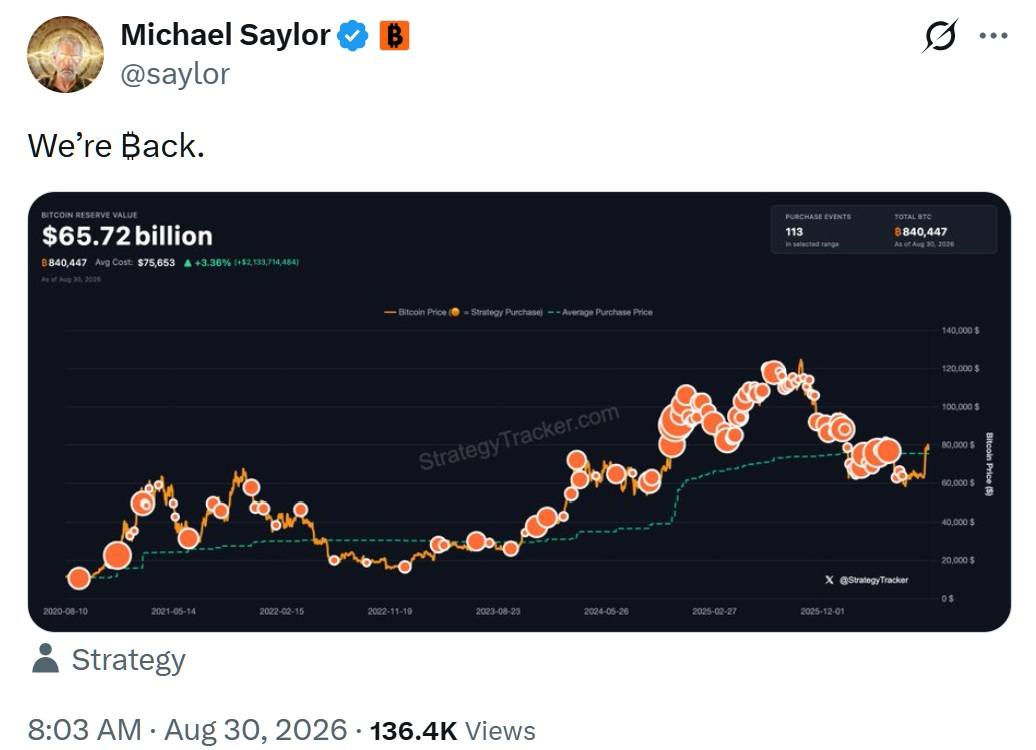
Speculation about the resumption of bitcoin purchases arose on Sunday after MicroStrategy Inc. (Nasdaq: MSTR) Executive Chairman Michael Saylor posted a chart of the company's assets without describing its future actions regarding treasury assets. Saylor shared this cryptic message on X on August 30, as investors awaited MicroStrategy's next report after two consecutive weeks without bitcoin transactions.
The attached chart showed that MicroStrategy owns 840,447 $BTC, with the reserve's value estimated at $65.72 billion. It also displayed the company's transactions compared to the market price of bitcoin and the average acquisition cost. The message itself consisted of two words, with Saylor replacing a character inside the last word with the bitcoin symbol, stating:
“We’re ₿ack.”
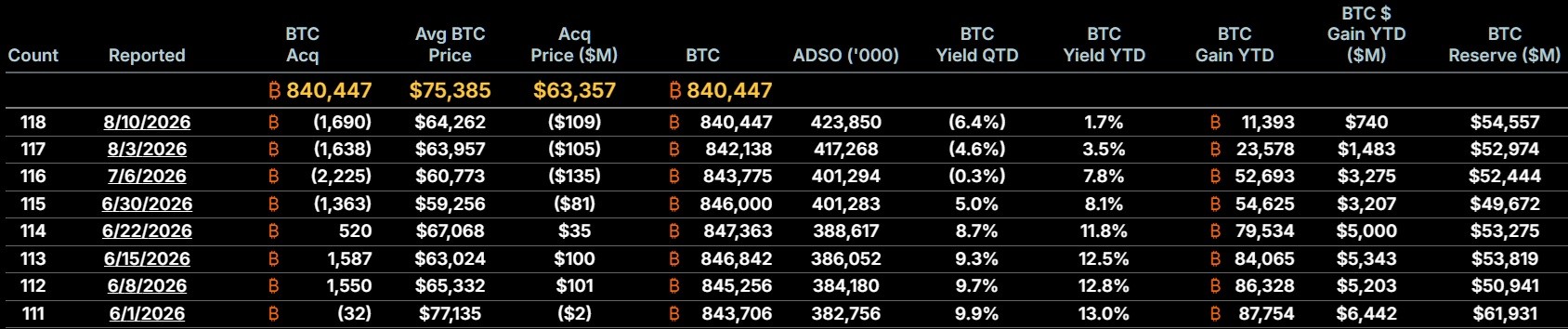
This post should be viewed more as a potential signal than as a transaction disclosure; to confirm whether the company's assets have changed, one must review its filings with regulators. In MicroStrategy's August 24 report filed with the U.S. Securities and Exchange Commission, it indicated the acquisition of 840,447 $BTC for $63.36 billion at an average price of $75,385 per bitcoin, including fees and expenses.
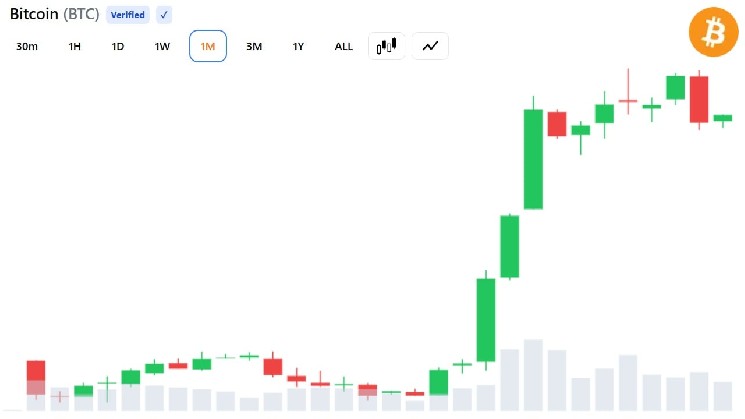
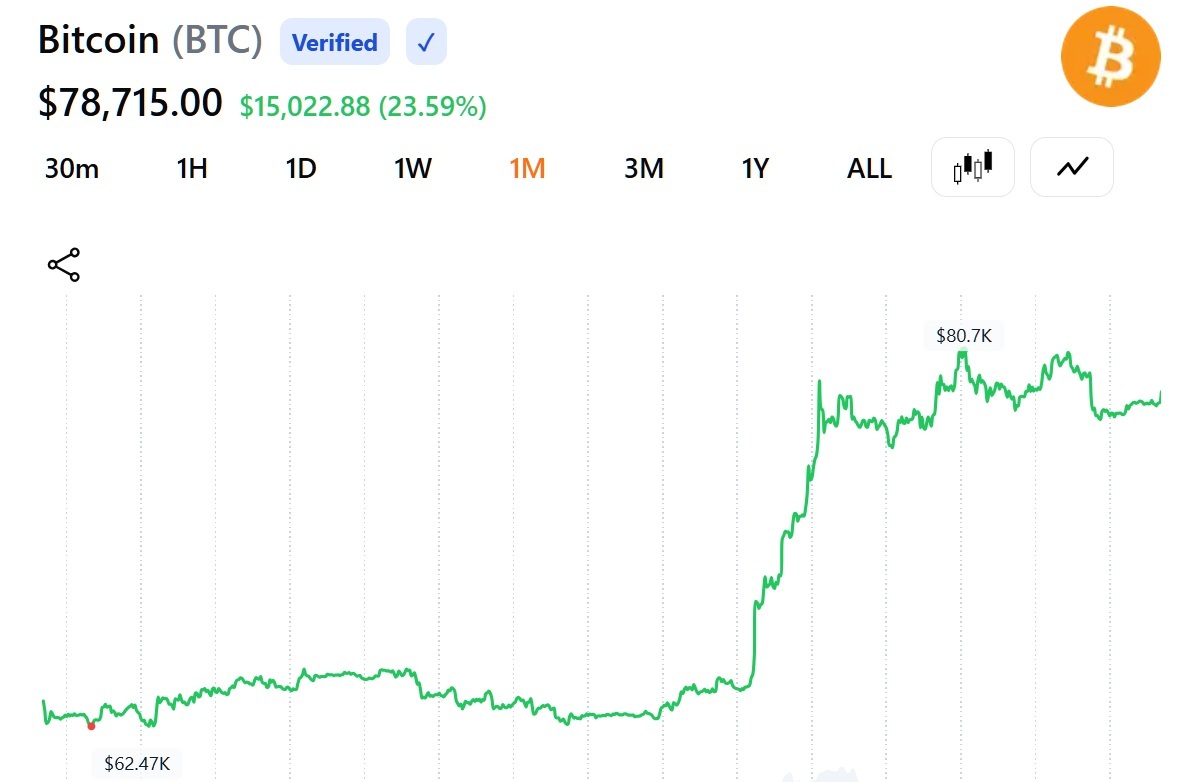
Saylor's post followed a sharp recovery in the bitcoin price, beginning on August 19, when $BTC rose from around $65,000 and surpassed $75,000 by August 21. On August 27, bitcoin reached around $81,000, and at the time of writing on August 30, it was trading around $79,000.
$6.69 Billion in Dollar Liquidity
MicroStrategy reported no bitcoin purchases or sales during the period from August 17 to 23, leaving its reserve unchanged for the second consecutive week. Instead, the company sold MSTR shares for approximately $2.01 billion, increased its restricted dollar reserve to $5.10 billion, formed a U.S. dollar cash balance of $1.59 billion, and repurchased STRC preferred shares for $136.4 million.
This capital reallocation paused bitcoin purchases while increasing total dollar liquidity to $6.69 billion. Unlike the U.S. dollar reserve, which is used to pay preferred share dividends and interest, the separate U.S. dollar cash account can be used to fund bitcoin acquisitions, security buybacks, convertible note redemptions, or further reserve increases.
MicroStrategy's official bitcoin ledger records all disclosed acquisition and sale transactions, including four sales totaling 6,916 $BTC made after the last purchase on June 22. The latest sale transaction was 1,690 $BTC for $108.6 million during August 3-9, reducing the company's asset volume to the current level of 840,447 $BTC.
The corporate bitcoin treasury holds $BTC as a company reserve asset, using cash, shares, debt, or other securities to finance its position. MicroStrategy pioneered this model in August 2020 and remains the largest publicly traded corporate holder of bitcoin, controlling approximately 4% of bitcoin's fixed supply of 21 million.
Saylor Expands His Bitcoin Message
New speculation around a transaction followed a series of more general statements by Saylor about bitcoin's role in global finance. He recently called for a "bitcoin reformation" beyond early ideological orthodoxy, arguing that institutional custody, banks, corporations, governments, and bitcoin-backed securities could expand access while preserving the possibility of direct ownership.
Saylor also characterized bitcoin's "deepest breakthrough" as economically valuable, digitally governed property. He stated that this capability could extend to individuals, families, companies, machines, and states, thus expanding his characterization of bitcoin from peer-to-peer electronic cash to digital property.
MicroStrategy's next report will reveal whether the phrase “We’re ₿ack” accompanied a new acquisition deal or signaled another treasury decision. At the beginning of the last reporting period, the company had $1.59 billion in flexible cash that the board of directors could allocate to bitcoin purchases, dividend payments, debt redemption, security buybacks, or other company treasury purposes.
end-content