Wall Street 'Withdraws' from Bitcoin Basis Arbitrage: CME Falls Out of Favor, the Golden Age of Arbitrage Comes to an End

marsbitPublished on 2026-01-22Last updated on 2026-01-22

Abstract

Wall Street is retreating from the once-lucrative Bitcoin basis trade, as narrowing spreads between spot and futures prices have made the strategy barely profitable. The cash-and-carry trade, which involved buying Bitcoin spot (often via ETFs) and selling futures to capture the premium, has seen annualized returns drop to around 5%, down from nearly 17% a year ago, barely covering funding and execution costs. This compression has led to a significant shift in market structure: CME's Bitcoin futures open interest has fallen below Binance's for the first time since 2023, indicating a withdrawal of hedge funds and large US accounts from this specific arbitrage strategy. While CME was the preferred venue for this institutional trade, Binance's dominance in perpetual futures has remained steady. The approval of spot Bitcoin ETFs initially fueled the trade's popularity but also accelerated its decline by attracting capital that quickly eroded the arbitrage opportunity. The market is now maturing, with participants shifting from simple leveraged directional bets to using options, hedges, and expressing views through diverse instruments like ETFs. This increased efficiency has naturally narrowed price disparities between venues. As the era of easy, high returns from basis trading ends, participants are expected to seek more complex strategies in decentralized markets and other crypto assets.

Original Title: Wall Street Pulls Back From Bitcoin』s Money-Spinning Basis Trade

Original Author: Sidhartha Shukla, Bloomberg

Original Compilation: Peggy, BlockBeats

Editor's Note: The once considered 'surefire' Bitcoin basis arbitrage is quietly losing its appeal: the open interest between CME and Binance is shifting, and the spread has narrowed to the point where it barely covers funding and execution costs.

On the surface, this is a squeeze in arbitrage opportunities; at a deeper level, the crypto derivatives market is maturing. Institutions no longer need to rely on 'arbitrage' for returns, and traders are shifting from leverage to options and hedging. The era of high returns through simple strategies is fading, and new competition will emerge in more complex and refined strategies.

Below is the original text:

The crypto derivatives market is undergoing a quiet yet significant change: one of the most stable and profitable trading strategies is showing signs of faltering.

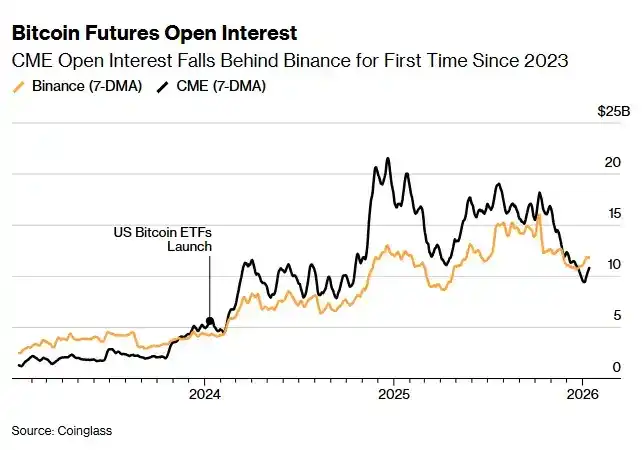
The 'cash-and-carry' trade, commonly used by institutions—buying Bitcoin spot while selling futures to profit from the spread—is collapsing. This not only signals a rapid compression of arbitrage opportunities but also releases a deeper message: the structure of the crypto market is changing. The open interest of Bitcoin futures on the Chicago Mercantile Exchange (CME) has fallen below that of Binance for the first time since 2023, further indicating that the highly profitable arbitrage opportunities of the past are being rapidly eroded as spreads narrow and market access becomes more efficient.

After the launch of spot Bitcoin ETFs in early 2024, CME once became the preferred venue for Wall Street trading desks to execute such strategies. This operation is highly similar to the 'basis trade' in traditional markets: buying Bitcoin spot through ETFs while selling futures contracts to profit from the spread between the two.

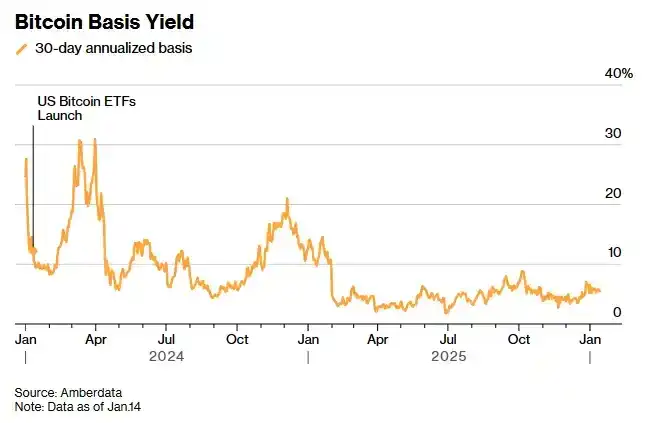
In the months following the ETF approval, the annualized return of this so-called 'delta-neutral strategy' often reached double digits, attracting billions of dollars in capital—capital that was indifferent to the direction of Bitcoin's price movement, focusing solely on capturing the returns. However, it was precisely the ETF that drove the rapid expansion of this trade that also sowed the seeds of its demise: as more trading desks rushed in, the arbitrage spread was quickly erased. Today, the returns from this trade are barely enough to cover funding costs.

According to data compiled by Amberdata, the current annualized return for a one-month period is hovering around 5%, near its lowest level in recent years. Greg Magadini, Director of Derivatives at Amberdata, noted that around this time last year, the basis was close to 17%, but has now fallen to about 4.7%, barely enough to cover the threshold of funding and execution costs. Meanwhile, the one-year U.S. Treasury yield is around 3.5%, making the trade increasingly less attractive.

Against the backdrop of narrowing spreads, the open interest of CME Bitcoin futures has fallen from a peak of over $21 billion to below $10 billion, according to data compiled by Coinglass. In contrast, Binance's open interest has remained relatively stable, at around $11 billion. James Harris, CEO of digital asset management firm Tesseract, stated that this change reflects more of a pullback by hedge funds and large U.S. accounts, rather than a broad retreat from crypto assets after Bitcoin prices peaked in October.

Exchanges like Binance are the primary venues for perpetual contracts. These contracts are settled, priced, and margin-calculated continuously, often updated multiple times a day. Perpetual contracts, commonly referred to as 'perps,' account for the largest share of crypto trading volume. Last year, CME also launched smaller-sized, longer-term futures contracts covering crypto assets and equity indices, offering futures positions close to the spot market, allowing investors to hold contracts for up to five years without frequent rollovers.

Harris of Tesseract noted that historically, CME has been the preferred venue for institutional capital and 'cash-and-carry' trades. He added that CME's open interest being overtaken by Binance is 'a significant signal that the market participation structure is shifting.' He described the current situation as a 'tactical reset,' driven by lower returns and thinning liquidity, rather than a loss of market confidence.

According to a statement from CME Group, 2025 is a key inflection point for the market: as regulatory frameworks become clearer and investor expectations for the sector improve, institutional capital is expanding from single bets on Bitcoin to tokens like Ethereum, Ripple's XRP, and Solana.

CME Group stated: 'Our average daily nominal open interest for Ethereum futures in 2024 was about $1 billion, and by 2025, this number has grown to nearly $5 billion.'

Although the Federal Reserve's interest rate cuts have reduced funding costs, this has not driven a sustained rebound in the crypto market since the collective crash of various tokens on October 10. Current borrowing demand is weak, decentralized finance (DeFi) yields are low, and traders are more inclined to use options and hedging tools rather than directly leveraging directional bets.

Le Shi, Managing Director of market maker Auros in Hong Kong, stated that as the market matures, traditional participants now have more channels to express directional views, from ETFs to direct access to exchanges. This increase in choice has narrowed the price differences between trading venues, naturally compressing the arbitrage opportunities that once drove the growth of CME's open interest.

Le said: 'There is a self-balancing effect here.' He believes that as market participants continue to flock to the lowest-cost trading venues, the basis narrows, and the motivation to engage in cash-and-carry trades diminishes accordingly.

On Wednesday, Bitcoin fell by 2.4% at one point to $87,188 before paring losses. This decline briefly erased all gains for the year.

Bohumil Vosalik, Chief Investment Officer of 319 Capital, stated that the era of nearly risk-free high returns may be over, forcing traders to turn to more complex strategies in decentralized markets. For high-frequency and arbitrage-focused institutions, this means they need to look elsewhere for opportunities.

Original Link

Related Questions

QWhat is the main reason for the decline in the profitability of Bitcoin basis trades according to the article?

AThe main reason is the rapid compression of arbitrage spreads due to increased market efficiency and massive inflows from Wall Street trading desks after the launch of spot Bitcoin ETFs, which has pushed returns down to levels that barely cover funding and execution costs.

QHow has the open interest in Bitcoin futures on CME changed compared to Binance, and what does this shift indicate?

AThe open interest in Bitcoin futures on CME has fallen below that of Binance for the first time since 2023, dropping from a peak of over $21 billion to under $10 billion. This shift indicates a tactical reset where hedge funds and large US accounts are pulling back from basis trades due to lower yields, rather than a broad retreat from crypto assets.

QWhat specific trading strategy used by institutions is discussed in the article, and how does it work?

AThe strategy discussed is the 'cash-and-carry' trade, also known as basis trade. It involves buying Bitcoin spot (often through ETFs) and simultaneously selling Bitcoin futures contracts to profit from the price difference (basis) between the spot and futures markets.

QWhat does the article suggest about the future of trading opportunities in the crypto derivatives market?

AThe article suggests that the era of easy, high returns from simple arbitrage strategies is ending. Future opportunities will require more complex and sophisticated strategies, as traders move towards options, hedging, and seeking alpha in decentralized markets.

QAccording to the article, what broader market development is contributing to the maturation of the crypto derivatives landscape?

AThe broader market development is the increasing clarity and improved regulatory framework, which has encouraged institutional capital to expand beyond Bitcoin into other tokens like Ethereum, XRP, and Solana, as evidenced by the growth in CME's Ethereum futures open interest.

Related Reads

Morning Post | Bitmine Plans to Raise $300 Million Through Preferred Stock Issuance; Polymarket Accuses Kalshi of Commercial Espionage

ChainCatcher's Daily Crypto Brief: Key developments from the past 24 hours include significant funding moves, regulatory actions, and market predictions. Bitmine announced a $300 million preferred stock fundraising. Polymarket accused rival prediction platform Kalshi of corporate espionage, citing numerous suspicious coincidences in product launches, a claim Kalshi strongly denied. The U.S. Department of Justice, in a joint "Disruption Week" anti-fraud operation with companies like Coinbase and Meta, froze over $3.8 million in cryptocurrency linked to scams. In infrastructure news, Macau completed its integration with the multi-central bank digital currency bridge, mBridge, aiming to build efficient cross-border payment channels. Cosmos Labs acquired the block explorer Mintscan. Market-wise, Geoffrey Kendrick, Standard Chartered's Head of Digital Assets Research, stated Bitcoin is nearing a bottom around $63,000, maintaining a year-end target of $100,000. He noted stability in U.S. spot Bitcoin ETF holdings. Ahead of SpaceX's anticipated IPO, internal insiders at Rocket Lab (RKLB) sold over $18.41 million in stock. In tokenization, Goldman Sachs partnered with Apex and Archax to launch a tokenized real estate fund. The meme token tracker GMGN reported the top trending tokens: on Ethereum, HEX, SHIB, LINK, PEPE, mUSD; on Solana, TROLL, swarms, WORLDCUP, neet, Buttcoin; and on Base, PEPE, toby, ODDS, ELSA, SKI.

链捕手12m ago

Morning Post | Bitmine Plans to Raise $300 Million Through Preferred Stock Issuance; Polymarket Accuses Kalshi of Commercial Espionage

链捕手12m ago

55TB to 28TB? The Rumor and Panic Behind Rubin's Memory Being Halved

Title: 55TB to 28TB? The Rumor and Panic Behind the Potential Halving of Rubin's Memory. On June 4th, a report from SemiAnalysis suggested NVIDIA's next-gen Vera Rubin NVL72 AI rack may ship with roughly 28TB of SOCAMM DRAM per rack instead of the anticipated 55TB, primarily using 96GB modules. This sparked a market panic, causing Micron's stock to drop over 10% on fears of halved memory demand. However, the article argues this panic is misguided for several key reasons. First, SOCAMM modules are socketed and upgradeable, not soldered. Lower initial configuration doesn't mean permanent demand loss. Second, the primary driver is a severe 2026 LPDDR5X supply shortage, not diminished need. NVIDIA is likely prioritizing rack shipments with available components. Third, with fixed total LPDDR5X supply, using less per rack could allow NVIDIA to ship *more* racks, not necessarily reducing overall memory orders. Micron's sharp drop was also attributed to a broader semiconductor sell-off triggered by Broadcom's earnings, with the SemiAnalysis report providing a convenient narrative for profit-taking after Micron's massive rally. In summary: the report on lower default configurations is likely accurate, but interpreting it as a demand collapse is wrong. The real risk for Micron lies in its reportedly minimal HBM4 share for Rubin, not in potentially flexible SOCAMM demand. The sell-off appears more like a correction amplified by coinciding negative catalysts.

marsbit29m ago

55TB to 28TB? The Rumor and Panic Behind Rubin's Memory Being Halved

marsbit29m ago

Exclusive from Yingke | Tang Wenbin's 'Yuanli Lingji' Merges with Logistics Robotics Company, and Secures Investment from Zhipu, SenseTime, Jieyue, and Others

Exclusive report: Embodied AI company "Yuanli Lingji" recently completed a new round of financing from major AI model firms including Zhipu AI, Stepfun, and SenseTime, alongside continued investments from industrial backers like Huaqin and SAIC Hengxu. Founded in March 2025 by Tang Wenbin, former co-founder and CTO of Megvii, Yuanli Lingji is a general-purpose embodied AI model company. In a notable move, the company has merged with logistics robotics firm "Atomix" (formerly known as Yuanli Juhe) through a share acquisition. Atomix, which originated from Megvii's logistics robotics business led by Tang in 2016 and was spun off in July 2024, has grown to become the world's second-largest supplier of pallet shuttle robots, with annual revenue nearing 1 billion RMB and over 500 projects globally for clients like Uniqlo and CATL. This merger aims to break the industry's "data deadlock" by combining Atomix's extensive real-world operational data from more than 20 countries with Yuanli Lingji's model training capabilities. The company's embodied AI model "DM0" utilizes a cross-domain training approach, integrating internet semantics, autonomous driving rules, and robotics data to achieve hardware-agnostic, precise manipulation even with a compact 2.4B parameter size. The collective investment from key AI players and the strategic merger signal a shift in the competitive landscape, as major model companies pivot from language tokens to physical actions ("from Token to Action"). The industry is entering a consolidation phase where hardware, AI models, data, and application scenarios converge to scale embodied intelligence, a trend mirrored by recent moves from giants like ByteDance and Skild AI.

marsbit37m ago

Exclusive from Yingke | Tang Wenbin's 'Yuanli Lingji' Merges with Logistics Robotics Company, and Secures Investment from Zhipu, SenseTime, Jieyue, and Others

marsbit37m ago

U.S. Stock Market Trends: Dow Hits New High, Nasdaq Falls, Whom Did Broadcom's Slap Wake Up?

U.S. Stocks Split: Dow Hits Record High as Nasdaq Slips; Broadcom's Plunge Sparks Rotation On June 4, the U.S. stock market saw a sharp divergence. The Dow Jones surged 875 points (+1.73%) to a record high of 51,561.93, while the Nasdaq Composite edged down 0.09%. The S&P 500 rose 0.41%. The primary catalyst was a sharp sell-off in AI-related chip stocks, led by Broadcom (AVGO). Despite reporting a 143% year-over-year jump in AI semiconductor revenue to $10.8 billion, the company's shares plunged about 14%. This was triggered by its maintained long-term AI revenue target, which failed to meet heightened expectations for a stock that had gained 55% this quarter and traded at a high P/E ratio. The slide dragged down the broader semiconductor sector and the technology板块. Conversely, money rotated into sectors like Healthcare (+3.14%), Financials (+2.67%), and Real Estate (+1.87%). UnitedHealth and Goldman Sachs were major contributors to the Dow's gains. The rotation was attributed to a search for value outside overheated tech names and a slight dip in Treasury yields. In other major news, SpaceX confirmed its IPO for June 12, targeting a record $75 billion raise at a ~$1.75 trillion valuation. Additionally, initial jobless claims rose to a four-month high, adding nuance to the labor market narrative ahead of the key May non-farm payrolls report. The day's action signaled that while the AI growth story remains intact, excessive valuations are prompting a market reassessment. Funds are moving, at least temporarily, from high-flying tech to more defensive and value-oriented sectors. The sustainability of this rotation hinges on upcoming economic data, particularly the jobs report, and the market's absorption of the massive SpaceX IPO.

marsbit40m ago

U.S. Stock Market Trends: Dow Hits New High, Nasdaq Falls, Whom Did Broadcom's Slap Wake Up?

marsbit40m ago

From 'Old Dogs' to 'New Darlings': How AI is Revaluing Old Infrastructure, from Dell to Nokia

"Old Dogs" Become AI's New Darlings: Revaluing Legacy Infrastructure The AI investment narrative is shifting. Beyond the spotlight on core chipmakers like Nvidia, a new wave of interest is rising for legacy tech companies—Dell, HPE, Nokia, Cisco, Corning, Western Digital—once labeled as slow-growth, outdated stories. This resurgence stems from AI's evolution from model development to real-world deployment, creating massive demand for physical infrastructure. As AI moves into data center construction and enterprise adoption, the focus turns to who can actually build and deliver complex systems. These established players hold decades of experience in supply chains, integration, networking, and enterprise delivery—assets now critical for scaling AI. The revaluation can be grouped into three key infrastructure areas: 1. **Servers & Integration (e.g., Dell, HPE):** They are becoming essential system integrators, transforming GPUs into full-scale AI servers with networking, power, and cooling, then delivering them to clients. Strong recent earnings and AI-specific revenue/order growth for Dell and HPE underscore this shift. 2. **Networking & Connectivity (e.g., Corning, Nokia, Cisco):** As AI clusters grow, high-speed data transfer becomes paramount. Corning benefits from fiber demand for data center links, Nokia is exploring AI-integrated wireless networks (AI-RAN), and Cisco sees surging orders for data center switches—all critical for efficient AI operations. 3. **Storage (e.g., Western Digital, Seagate):** The AI data explosion requires vast capacity. Beyond high-speed memory (HBM), there's growing need for high-capacity HDDs to store training data, logs, video, and cold/archival data cost-effectively. This revaluation, however, is not a blanket endorsement. True reassessment requires concrete proof: AI-driven orders and revenue growth, upward revisions to company guidance, and sustainable improvements in profit quality, not just top-line sales. In essence, AI is not turning all old tech firms into high-growth stocks; it is selectively re-pricing the "old assets" of companies that are mission-critical for building the new AI infrastructure, transforming their legacy capabilities into renewed growth engines.

marsbit49m ago

From 'Old Dogs' to 'New Darlings': How AI is Revaluing Old Infrastructure, from Dell to Nokia

marsbit49m ago

Trading

Spot
Futures
活动图片