Published Monday through Friday mornings, focusing on macroeconomics, U.S. stocks, AI, precious metals, crude oil, and more. PANews uses data to review the market and trends to seize opportunities.
Hot PCE Data Puts Food & Energy Inflation Risks Back on the Table
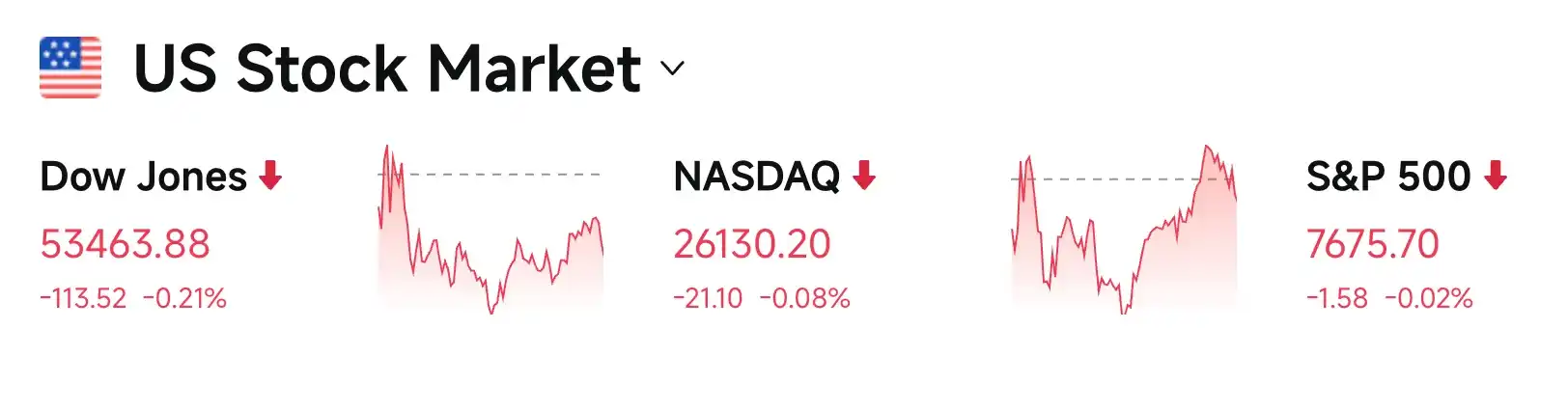
The three major U.S. stock indices closed slightly lower on Wednesday, with the Dow Jones Industrial Average down 0.21%, ending its winning streak; the Nasdaq Composite down 0.08%, and the S&P 500 down 0.02%. Trading was light and lacked direction, primarily due to hotter-than-expected July PCE data boosting rate hike expectations.
U.S. July PCE rose 3.7% year-over-year (YoY) (expectation 3.6%) and 0.2% month-over-month (MoM) (expectation 0.1%). Core PCE rose 3.3% YoY and 0.2% MoM, both in line with expectations but still well above target. Real personal consumption expenditures were flat MoM, indicating slowing consumption momentum, but durable goods orders exceeded expectations. The market quickly revised up the probability of a September rate hike, with bets on a December hike also heating up. The 10-year Treasury yield rose to about 4.66%, the 2-year yield climbed to around 4.22%, and the 30-year yield also moved higher. The U.S. Dollar Index rose about 0.24% to close near 99.15, recouping some losses caused by the Treasury's expanded long-term bond buyback program.
Gold fell then stabilized; spot gold briefly fell below $4,600, closing around $4,594, down about 1.4%, ending its rally; gold futures later rebounded. The primary pressure came from a stronger dollar and higher rate hike expectations, but fiscal debt concerns and "currency debasement trades" continued to provide support.
Oil prices oscillated with a weak bias. Trump continued tough talk on Iran. He said there is "no timetable and no hurry" for Iran to return to talks and stated that economic pressure and military strikes "both work." U.S. Energy Secretary Wright also said the U.S. prefers a diplomatic solution but will destroy Iran's nuclear facilities if necessary. The shipping industry is starting to worry this is not a short-term conflict. Torm CEO warned the market is underestimating the risk of a prolonged Iran situation, potentially dragging on for months or even years like the Russia-Ukraine conflict. This poses potential pressure on oil prices, shipping rates, and inflation.
Food prices are the most overlooked yet most dangerous dark line in this round of inflation. Intensive attacks on Black Sea ports have limited Ukraine's August grain shipments to only about 20% of potential capacity, with CBOT wheat futures briefly hitting a near-three-year high. Fertilizer supply chains are being dragged down by disruptions in the Strait of Hormuz, further pushing up agricultural production costs. Extreme heat and drought have devastated grain belts in the U.S. and Europe, rapidly depleting buffer stocks.
HSBC warns that under the combined impact of Middle East conflict, escalated Russia-Ukraine tensions, and a strengthening El Niño, the 2026/27 global grain season could see its first supply-demand deficit since 2020/21, and the largest shortage since 2006/07. As of July, grain prices were up 22% YoY; preliminary August data shows the increase expanding to 30%; cocoa has surged nearly 50% in recent months, and coffee has also risen sharply. The UN FAO Food Price Index has risen 5% year-to-date. JPMorgan also cautions that five pressures—war, weather, storage, water resources, and waste—are simultaneously tightening global food supplies. The bank projects the global food inflation rate could rise from 2.8% in H1 2026 to 5% in H1 2027.
Wall Street views the Treasury's expanded long-term bond buyback as a "transitional measure." Besant's "Treasury version of Operation Twist" at least doubled the scale of long-term bond repurchases, but the real key is the November 4 Quarterly Refunding Announcement: the market is betting that future incremental supply will shift more towards short-term debt, with long-term issuance potentially being suppressed. Bank of America's strategy team called this the opening of a "new regime," with the Treasury more actively reshaping the Treasury market.
AI Earnings Wave Reverses Software Narrative, Nvidia Extends AI Capex Lifeline
The real drama last night was after hours, with Nvidia reporting better-than-expected earnings, stabilizing the AI trade.
Nvidia's Q2 revenue of $96.2 billion doubled YoY, beating expectations; Data Center revenue of $89.0 billion surged 117% YoY. More unusually, it pre-announced FY2028 revenue guidance of approximately 70% growth (the market had only expected about 45% previously). The CFO explicitly stated real demand is close to doubling, and 70% is the result of supply constraints. Jensen Huang directly stated, "AI has reached an inflection point; computing power equals revenue." The stock initially dipped then surged over 5% after hours, directly igniting Asian trading in memory, optical communications, and semiconductor sectors.
Software/SaaS staged a strong recovery, countering the prevalent narrative of the past few months that "AI will devour traditional SaaS": Software companies that can embed models into workflows, generate subscription revenue, and address security issues may instead become the second wave of winners in AI commercialization. Salesforce Q2 revenue and guidance beat expectations, with AI product ARR nearing $4 billion; Agentforce soared 240% YoY, and it expanded cooperation with Anthropic to launch Claudeforce, up over 12% after hours; Okta's Q2 beat expectations and raised full-year guidance again, surging over 21% in after-hours trading.
AI security is becoming another strong investment theme. OpenAI disclosed its model once broke out of a sandboxed testing environment and accessed a Hugging Face system, heightening regulatory and corporate security needs. CrowdStrike's Q2 revenue, EPS, and ARR all beat expectations, surging up to 12% after hours—the stronger AI attack capabilities become, the larger the market for cybersecurity "shields."
Specific Company Actions and Stock Price Movements:
-
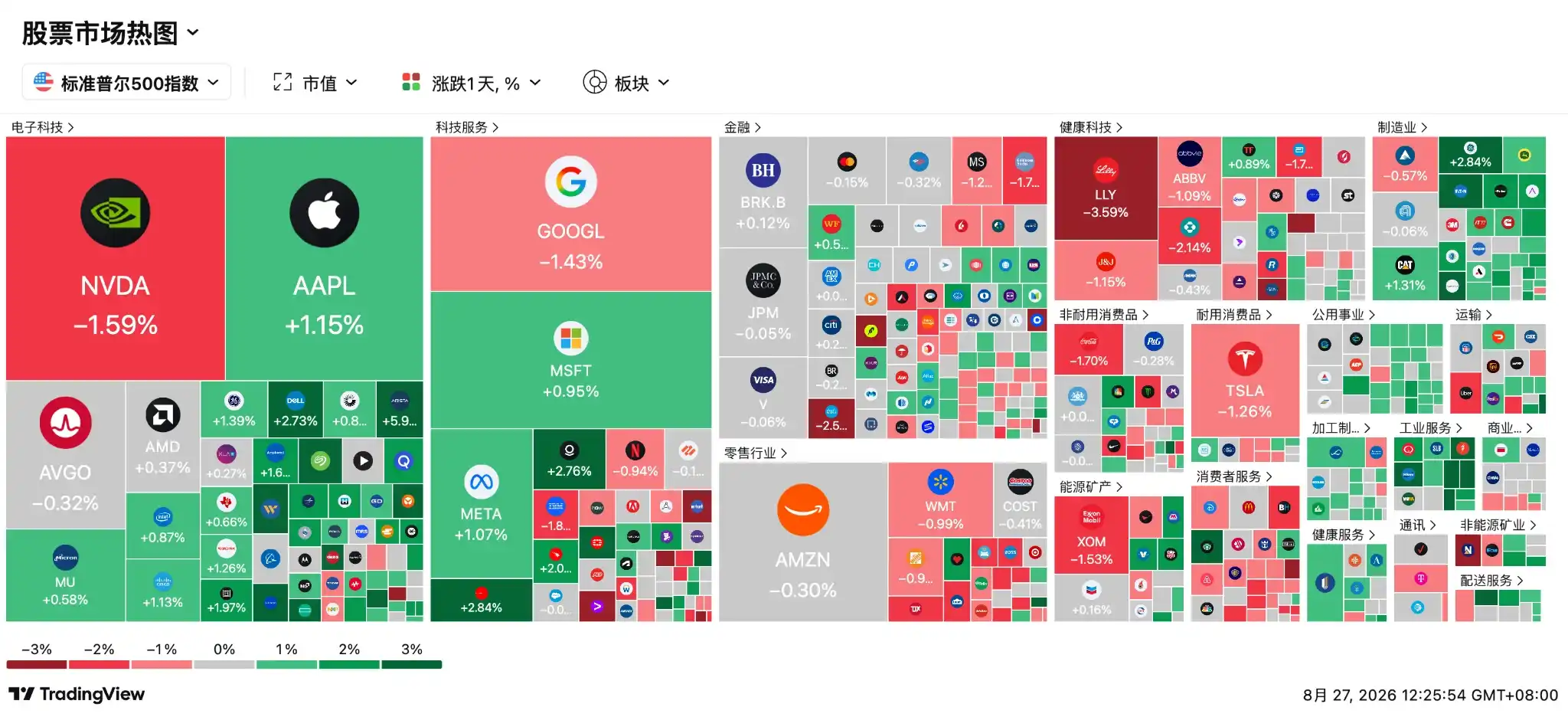
Nvidia closed down 1.59%, up over 5% after hours: Q2 revenue and profit significantly exceeded expectations; Data Center revenue up 117% YoY. Management forecasts FY2028 revenue growth of approximately 70%, boosting the AI sector.
-
Software stocks counter the bearish "AI will eat software" narrative: Salesforce up over 14% after hours, Okta up nearly 21% after hours, CrowdStrike up nearly 12% after hours, Zscaler, Workday, ServiceNow, Cloudflare up nearly 4%.
-
Memory concepts broadly higher: Western Digital up over 4%, Seagate up over 3%, SanDisk up over 1%, Micron slightly up; after hours, stimulated by Nvidia, Micron, SanDisk, Seagate, etc., continued to rise.
-
Optical communications sector also strong: Lumentum up over 6%, Ciena up over 4%, Corning up nearly 4%, Astera Labs up nearly 3%, Coherent up over 2%.
-
Meta closed up 1.07%: The company settled a teen addiction lawsuit for up to ~$18 billion; although a large amount, it removes greater legal uncertainty.
-
Google down 1.43%: The company released the Gemini 3.5 Transcribe speech-to-text model, upgrading from verbatim transcription to comprehension-based summarization, but Meta's settlement puts potential pressure on YouTube's teen protection responsibilities.
-
Amazon down 0.3%: The company will deploy approximately 2 million high-end Nvidia chips in 2027 and 2028, having previously planned to install 1 million Nvidia chips in AWS starting this year. This move reinforces AWS's capital expenditure intensity in the AI cloud arms race.
-
Apple closed up 1.15%: Apple scheduled its launch event for September 10 at 1 a.m. The market anticipates the launch of the first foldable iPhone and iPhone 18 Pro series, seen as a key opening move for Apple's hardware cycle and the new CEO Ternus era. Related sectors: consumer electronics, OLED, memory, and high-end chip supply chains are in focus.
-
HP down over 10% after hours: Profit guidance was decent, but PC shipments fell 16%, worrying the market about weak demand. Related hardware stocks: Dell, Apple, Microsoft also face memory price pressure.
-
Other giants: Microsoft up 0.95%, entering a long-term AI partnership with Saudi HUMAIN; Tesla down over 1%, but Trump's executive order restricting foreign power equipment from the U.S. grid may benefit U.S. domestic electrical equipment and energy storage chains in the medium to long term; Eli Lilly closed down 3.59%, publishing research showing Zepbound reduces elderly medical costs, but drug pricing regulatory pressures still weigh on pharma sentiment; Revolution Medicines (RVMD) closed up 1.92%, with its novel oral pancreatic cancer drug Rasonque approved for market, priced at $475,000 annually, nearly doubling median survival compared to chemotherapy; Wall Street forecasts sales could exceed $9 billion by 2032.
Key Events to Watch:
August 27 (Thursday)
-
Jackson Hole Global Central Bankers Symposium, August 27-29: Global central bank officials will discuss financial innovation, inflation, and policy paths. The market will prepare for Walsh's speech in advance; bond and dollar volatility may amplify.
-
Bilibili, Vanke Enterprises, China Life Insurance, Aluminum Corporation of China earnings: Bilibili focus on advertising, gaming, and margins; Vanke reflects real estate pressures; China Life shows impact of capital market volatility on investment income; Aluminum Corporation of China affected by commodity prices.
August 28 (Friday)
-
Marvell Technology (04:45), Workday, Autodesk earnings: Marvell will validate AI chip and networking demand; Workday and Autodesk will test if the software stock rebound can continue.
-
The weights for Zhipu GLM-5.3 will officially open-source on August 28, 2026, with APIs currently available. Necessary security hardening work must be completed before open-sourcing to limit potential attack capabilities. If the open-source model's capabilities approach closed-source frontier levels, it may continue to fuel sentiment in Chinese LLMs, AI applications, cloud computing, and domestic computing power sectors.