Vitalik Buterin’s Call for ‘Sovereign’ Stablecoins Meets Its Match in Bitcoin Hyper’s SVM Infrastructure

bitcoinistPublished on 2026-02-09Last updated on 2026-02-09

Abstract

Ethereum co-founder Vitalik Buterin has criticized DeFi's reliance on centralized stablecoins like USDC and Tether, advocating instead for algorithmic, governance-minimized alternatives. He argues that current models create a single point of failure, and that the future of on-chain stability depends on high-throughput infrastructure capable of handling real-time mechanisms. Bitcoin Hyper ($HYPER) is positioned as a key solution, integrating Solana Virtual Machine (SVM) speed with Bitcoin's security in a Layer 2 architecture. This aims to solve scalability issues, enabling high-frequency DeFi applications and algorithmic stablecoins with low-cost, rapid execution. The project has raised over $31M in its presale, attracting significant whale interest, indicating strong market demand for Bitcoin-based high-performance infrastructure.

Ethereum co-founder Vitalik Buterin just threw a wrench into the comfortable consensus of decentralized finance (DeFi). His target? The sector’s massive reliance on centralized stablecoins like $USDC and Tether. In recent commentary regarding the future of on-chain stability, Buterin argued that the industry’s heavy dependence on asset-backed models introduces a single point of failure that contradicts the core ethos of crypto.
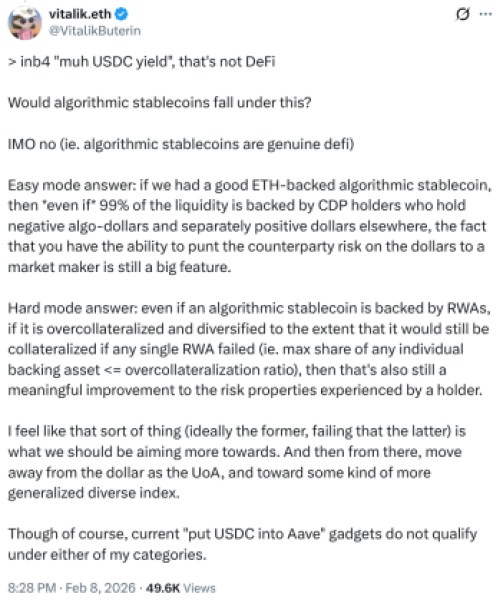
Instead, he advocates for ‘automated’ or algorithmic alternatives, mechanisms that maintain pegs through math and game theory rather than bank deposits.

That pivot matters. It signals a shift in how institutional capital views DeFi risk. The current model is efficient but fragile. Buterin’s proposed ‘governance-minimized’ future is resilient, sure, but it demands immense computational throughput to manage real-time liquidations and stability mechanisms. Right now, Ethereum struggles to support high-frequency algorithmic stability without pricing out users during volatility spikes. This suggests that the bottleneck for true DeFi innovation isn’t liquidity, but execution speed.

While the market digests what moving away from centralized reliance actually looks like, smart money is quietly rotating. They’re hunting for infrastructure capable of supporting this high-computational future. The focus isn’t just scaling transaction counts; it’s about fundamentally altering execution environments. Leading the pack? Bitcoin Hyper ($HYPER). It’s building the rails for this next generation of decentralized finance by merging Bitcoin’s security with the Solana Virtual Machine’s (SVM) speed.

Bitcoin Hyper Integrates SVM to Solve The ‘Trilemma’ of Scalable DeFi

While Ethereum developers debate theoretical frameworks, the necessary infrastructure is being built elsewhere. Bitcoin Hyper has staked its claim as a first-mover in the ‘Bitcoin Renaissance,’ planning to deploy a Layer 2 architecture that directly addresses the latency issues plaguing complex DeFi applications.

By integrating the Solana Virtual Machine (SVM), the protocol delivers transaction speeds that ostensibly outpace Solana itself. And the kicker? It does this while anchoring finality to the Bitcoin network.
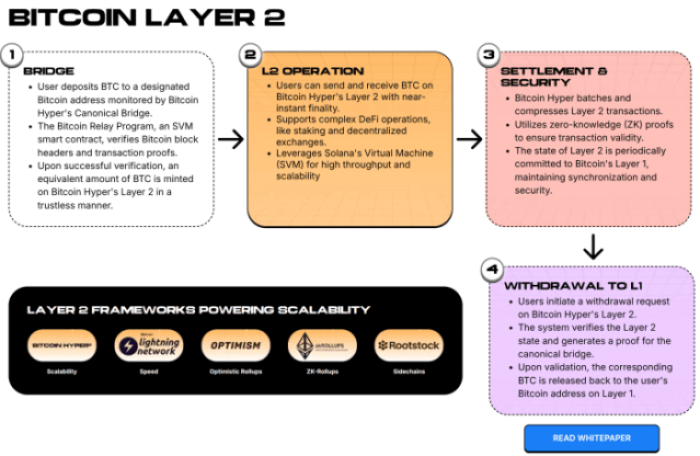
That architecture is critical for the ‘alternative models’ Buterin envisions. Algorithmic stablecoins and complex derivatives require sub-second state updates to prevent de-pegging events, a speed that the Ethereum Virtual Machine (EVM) often fails to deliver under load. Bitcoin Hyper’s modular approach separates the execution layer (SVM) from the settlement layer (Bitcoin), allowing for high-frequency trading and lending protocols to operate with low costs.

Using a decentralized Canonical Bridge, the project ensures that while execution is rapid, the underlying asset security remains tied to Bitcoin’s proof-of-work consensus. This mix of ‘Rust-based programmability’ and ‘Bitcoin hardness’ allows developers to build the sovereign financial tools Buterin describes, but on the world’s most secure blockchain rather than a congested general-purpose network.

EXPLORE THE $HYPER PRESALE

Whales Gather as Presale Capital Surges Past $31M

The market’s appetite for high-performance Bitcoin infrastructure is showing up in the capital flows surrounding Bitcoin Hyper’s early stages. Check the official presale page, and you’ll see the project has successfully raised over $31M. That figure underscores significant demand for Layer 2 solutions that go beyond simple payment channels. With tokens currently priced at $0.0136753, the valuation offers an interesting entry point relative to established L2s like Stacks or Optimism.

Deep-pocketed investors (whales) appear to be positioning themselves ahead of the token generation event (TGE). There have been multiple six-figure purchases throughout the presale, the largest hitting $500K. Now this doesn’t mean success, but it does show smart money sees potential and that’s reassuring.

This accumulation pattern often precedes broader retail interest, particularly when technical catalysts, such as the launch of mainnet staking with high APY incentives, are on the horizon. Bitcoin Hyper confirmed a 7-day vesting period for presale stakers, a mechanism designed to mitigate post-launch volatility while rewarding long-term participants.

If you’re tracking ‘smart money,’ the combination of massive presale volume and specific whale entries suggests a market segment betting heavily on the convergence of Bitcoin security and SVM speed.

GET YOUR $HYPER HERE

This article is for informational purposes only and does not constitute financial advice. Cryptocurrencies are volatile; invest only what you can afford to lose.


Related Questions

QWhat is Vitalik Buterin's main criticism of the current DeFi stablecoin model, and what alternative does he propose?

AVitalik Buterin criticizes the DeFi sector's heavy reliance on centralized, asset-backed stablecoins like USDC and Tether, arguing they create a single point of failure that contradicts crypto's core ethos. Instead, he advocates for 'automated' or algorithmic stablecoins that maintain their peg through math and game theory rather than bank deposits.

QAccording to the article, what is the primary bottleneck for true DeFi innovation, and which project is addressing it?

AThe article states that the primary bottleneck for true DeFi innovation is not liquidity, but execution speed. The project Bitcoin Hyper ($HYPER) is addressing this by building infrastructure that merges Bitcoin's security with the Solana Virtual Machine's (SVM) speed to support high-computational applications.

QHow does Bitcoin Hyper's architecture specifically solve the latency issues for complex DeFi applications?

ABitcoin Hyper uses a Layer 2 architecture that integrates the Solana Virtual Machine (SVM) for high-speed execution and anchors finality to the Bitcoin network for security. This modular approach separates the execution layer from the settlement layer, allowing for sub-second state updates required by algorithmic stablecoins and complex derivatives, all with low costs.

QWhat evidence does the article provide to show significant market interest in Bitcoin Hyper?

AThe article cites Bitcoin Hyper's successful presale, which has raised over $31 million. It also mentions multiple six-figure purchases from 'whales,' including a largest single purchase of $500K, indicating strong demand and smart money positioning itself ahead of the token generation event (TGE).

QWhat two key features does Bitcoin Hyper combine to allow developers to build 'sovereign financial tools'?

ABitcoin Hyper combines 'Rust-based programmability' from the Solana Virtual Machine (SVM) with the security and 'Bitcoin hardness' of the Bitcoin network's proof-of-work consensus. This allows developers to build the sovereign financial tools on a highly secure blockchain.

Related Reads

The Niche Consensus Among Elites: Has College Become an Expensive Waste?

**Summary:** A growing "anti-college" movement is gaining traction among elite circles in Silicon Valley, challenging the traditional value of a four-year university degree. Proponents argue that college has become an expensive, slow, and increasingly irrelevant waste of time, especially in the fast-paced tech world where opportunities pass by quickly. The movement is led by figures like billionaire Peter Thiel, who criticizes universities for high costs, ideological indoctrination, and stifling true innovation. His "Thiel Fellowship" pays young people to drop out and pursue ventures. Companies like Palantir Technologies (co-founded by Thiel) fuel this trend with programs like the "Meritocracy Fellowship," which offers high school graduates paid internships as an alternative to immediate college enrollment, promising a practical "Palantir Degree." Key drivers include: 1. **Economics:** Skyrocketing student debt versus the allure of immediate, high-paying tech jobs or startup funding. 2. **Technology:** AI and online tools lowering barriers to self-education and product development, making formal instruction seem inefficient. 3. **Culture:** A backlash against perceived "woke" ideology and DEI policies in universities, coupled with a belief that these institutions suppress meritocracy and masculine drive. The movement is notably male-dominated. Critics, like economist David Deming, warn against overgeneralizing from dropout success stories (survivorship bias). He emphasizes that genuine autodidacts are rare, corporate training is narrowly focused, and the "college wage premium" remains high for most people. University liberal arts education, he argues, builds adaptable problem-solving skills and broad perspectives. The debate highlights a deeper crisis in education. The core model of the modern university appears increasingly mismatched with the speed of the information age. The movement signals a shift in the locus of learning from institutional "education" to personal, active "learning" powered by the internet and AI. Ultimately, this may not mean the end of university, but rather a painful evolution. The future likely holds more hybrid, personalized, and lifelong learning pathways. The central question becomes: in a world changing faster than any curriculum, how do we best learn?

marsbit15m ago

The Niche Consensus Among Elites: Has College Become an Expensive Waste?

marsbit15m ago

From Subsidies to Token-Based Pricing to Price Cuts: Is OpenAI Sparking a Price War? Is the Inflection Point for Token Economics Nearing?

The commercialization of generative AI is facing a critical inflection point as a potential price war looms. According to The Wall Street Journal, OpenAI is considering a significant cut to its token fees to compete with rival Anthropic, signaling a shift from a growth-at-all-costs model focused on token consumption. This move comes as both companies, reportedly losing billions on compute, prepare for IPOs, and as enterprise customers face "bill shock" from switching to usage-based token billing. Reports indicate poor ROI, with one analysis finding only 18 cents of every dollar spent on AI tokens generates user-facing value. The industry's initial phases—from flat-rate subscriptions to aggressive subsidies—have given way to a reckoning with real costs. Analysts debate the future: some predict a bifurcation between premium, high-cost models for complex tasks and cheaper alternatives for routine work, while others believe overall spending will still rise as agentic AI increases tokens per task. Notably, Chinese model DeepSeek's low-cost API is gaining traction with U.S. enterprises, adding competitive pressure. The core challenge is redefining value beyond token volume ("tokenmaxxing") toward measurable productivity ("valuemaxxing"), as the entire AI value chain, from cloud providers to chipmakers, feels the ripple effects of unsustainable pricing.

marsbit19m ago

From Subsidies to Token-Based Pricing to Price Cuts: Is OpenAI Sparking a Price War? Is the Inflection Point for Token Economics Nearing?

marsbit19m ago

Trading

Spot
Futures

Hot Articles

Discussions

Welcome to the HTX Community. Here, you can stay informed about the latest platform developments and gain access to professional market insights. Users' opinions on the price of S (S) are presented below.

活动图片













