Vitalik Buterin Argues Merging DAOs and Prediction Markets Is Good for Creators as SUBBD Token Soars

bitcoinistОпубліковано о 2026-02-03Востаннє оновлено о 2026-02-03

Анотація

Ethereum co-founder Vitalik Buterin proposes merging DAOs with prediction markets, a concept he calls "info finance," to improve on-chain governance and content curation by using market-based truth-seeking mechanisms. This shift could benefit creators by replacing opaque Web2 algorithms with transparent, capital-backed systems. Meanwhile, SUBBD Token ($SUBBD) is highlighted as a practical implementation, combining AI tools and Web3 payments to reduce platform fees and empower creators. It has raised over $1.4M in its presale, offering staking rewards and aiming to disrupt the $85 billion creator economy by decentralizing monetization and operational workflows.

Ethereum co-founder Vitalik Buterin is at it again.

This time, he’s pivoting the crypto conversation toward the intersection of decentralized autonomous organizations (DAOs) and prediction markets, a concept he calls ‘info finance.’

In recent commentary on the evolution of on-chain governance, Buterin suggested that prediction markets offer a truth-seeking mechanism that standard DAO voting lacks. By requiring participants to have ‘skin in the game,’ these markets can filter noise from signal.
That distinction matters because the current creator economy is bloated with intermediaries.

When Buterin talks about merging these technologies, the implication for creators is profound: a shift away from opaque Web2 algorithms toward transparent, market-driven curation. Instead of a platform like YouTube or TikTok deciding which creators gain visibility based on black-box ad metrics, a prediction-market-based DAO could surface high-quality content based on crowd sentiment backed by capital.

It’s a move from attention farming to value verification.

But let’s be real, theoretical governance models are only half the equation. The other half is infrastructure that actually empowers creators to bypass rent-seeking platforms today.

While Ethereum’s architect sketches out the future of on-chain coordination, new challengers are already dismantling the Web2 monopoly on content monetization. Leading this charge is SUBBD Token ($SUBBD), a project specifically engineered to disrupt the $85 billion creator economy by mixing AI tools with permissionless payments.

Get your $SUBBD here.

AI-Driven Tools Lower Barriers in The $85 Billion Creator Economy

The structural weakness of the legacy creator economy isn’t just governance, it’s extraction. Platforms routinely snatch cuts ranging from 20% to 50% of a creator’s earnings. Vitalik’s vision of “info finance” attacks the curation layer, but SUBBD Token ($SUBBD) attacks the operational layer.

By merging Web3 infrastructure with advanced AI, the platform offers a tangible solution to the friction that stifles independent creators.

The project distinguishes itself through utility that goes beyond simple transactions. SUBBD provides an AI Personal Assistant for automated interactions and proprietary AI Voice Cloning technology, allowing creators to scale their output without burning out.
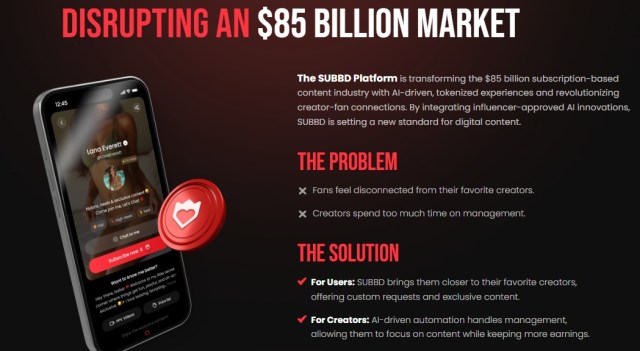
This is critical. In a market where consistency is currency, AI tools that optimize workflow are just as valuable as the payment rails themselves.

Plus, the platform introduces a governance model where the $SUBBD token dictates feature rollouts. This aligns with the broader industry trend of moving control back to the users, mirroring the ethos of Buterin’s DAO-centric proposals. By removing the 70% revenue cuts common in Web2, the project effectively redistributes value from the platform back to the talent.

Check out the SUBBD whitepaper for more details.

You can buy $SUBBD here.

Presale Data Shows Demand for Decentralized Content Platforms

Market sentiment is shifting toward utility-driven assets, and the capital flows prove it. According to official reporting, SUBBD Token ($SUBBD) has raised over $1.4M in its ongoing presale. This level of early-stage liquidity indicates strong investor appetite for projects that bridge the gap between AI technology and crypto-economic incentives.
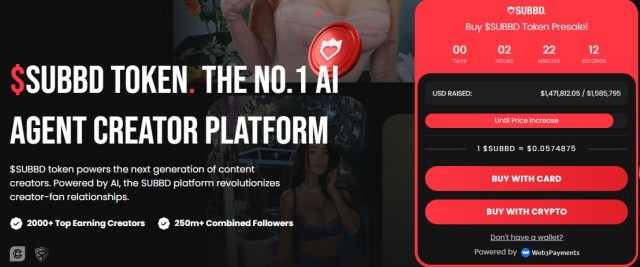
Smart money is watching the entry price carefully. With tokens currently priced at $0.05749, the valuation allows for accessible entry before potential listing volatility kicks in. Unlike meme coins driven purely by hype cycles, this capital raise appears underpinned by a clear revenue model and a staking protocol designed to lock up supply.

The protocol offers a fixed 20% APY for the first year of staking. This incentivizes long-term holding, stabilizing the token economy while the platform scales its user base. For investors, the combination of high-yield staking and exclusive access to ‘HoneyHive’ benefits, such as beta access and XP multipliers, creates a dual value proposition: immediate yield and future utility.

As the creator economy continues to expand, platforms that offer financial sovereignty combined with operational AI tools are positioned to capture significant market share.

Visit the official site to view the presale.

The content provided here is for informational purposes only and does not constitute financial advice. Crypto assets are high-risk investments. Always conduct independent due diligence before investing.


Пов'язані питання

QWhat does Vitalik Buterin call the concept of merging DAOs and prediction markets, and what is its purpose?

AVitalik Buterin calls the concept 'info finance.' Its purpose is to provide a truth-seeking mechanism for on-chain governance by requiring participants to have 'skin in the game,' which can filter noise from signal and shift content curation from opaque Web2 algorithms to transparent, market-driven systems.

QHow does SUBBD Token ($SUBBD) aim to disrupt the creator economy according to the article?

ASUBBD Token ($SUBBD) aims to disrupt the $85 billion creator economy by merging Web3 infrastructure with advanced AI tools, such as an AI Personal Assistant and AI Voice Cloning technology, to lower operational barriers, remove high platform revenue cuts (up to 70%), and provide permissionless payments, thereby redistributing value from platforms back to creators.

QWhat are some key features of the SUBBD platform mentioned in the article?

AKey features of the SUBBD platform include AI-driven tools like an AI Personal Assistant for automated interactions, proprietary AI Voice Cloning technology, a governance model where the $SUBBD token dictates feature rollouts, and a staking protocol offering a fixed 20% APY for the first year to incentivize long-term holding.

QWhat does the presale data for SUBBD Token ($SUBBD) indicate about investor sentiment?

AThe presale data, which shows that SUBBD Token has raised over $1.4M, indicates strong investor appetite for utility-driven projects that bridge AI technology with crypto-economic incentives. This reflects a market shift towards assets with clear revenue models and practical applications, rather than those driven purely by hype.

QHow does the article contrast Vitalik Buterin's vision with the approach of SUBBD Token?

AThe article contrasts Vitalik Buterin's vision, which focuses on improving the curation layer of the creator economy through 'info finance' and prediction-market-based DAOs, with SUBBD Token's approach, which targets the operational layer by providing AI tools and Web3 infrastructure to reduce friction, eliminate high platform fees, and empower creators directly.

Пов'язані матеріали

The Verdict in Choi Tae-won's Divorce Case: Revealing the Inheritance Undercurrent Behind SK Hynix's Trillion-Won Empire

SK Group Chairman Chey Tae-won's high-profile divorce case, involving a record 1.38 trillion won settlement, has drawn attention to the succession plans for Korea's second-largest conglomerate, especially its crown jewel, SK hynix. Unlike traditional chaebol scripts centered on the eldest son, Chey's three children from his marriage to former President Roh Tae-woo's daughter, Roh Soh-yeong, are carving distinct, non-traditional paths. Eldest daughter Chey Yun-jung (b. 1989) is seen as the most evident successor. With a scientific and consulting background, she holds executive roles at SK bioscience and SK Inc.'s growth support department, focusing on future strategy and biopharma. Her marriage is to an AI infrastructure entrepreneur, not a traditional business alliance. Second daughter Chey Min-jung (b. 1991) took a unique route, voluntarily serving as a South Korean naval officer, including an anti-piracy deployment. She later worked on policy and strategy for SK hynix in Washington D.C. before co-founding an AI-driven healthcare startup. She married a former U.S. Marine Corps officer, connecting her to U.S. defense and policy circles—networks crucial for a global semiconductor giant. The only son, Chey In-geun (b. 1995), who studied physics like his father, worked briefly at SK E&S before joining McKinsey. Despite fitting the traditional "heir" profile as the eldest son, he remains silent and holds no public position or shares in SK, suggesting the old succession playbook is obsolete. As SK hynix's valuation soars, becoming a geopolitical asset in the AI era, the heirs' legitimacy is no longer automatic. They must prove themselves in fields like AI biotech, global policy, and strategic consulting. Their marriages also reflect new elite networks in tech and defense, not old political alliances. Their inheritance is the complex challenge of navigating a globalized, tech-driven world, not just a corporate throne.

marsbit9 год тому

The Verdict in Choi Tae-won's Divorce Case: Revealing the Inheritance Undercurrent Behind SK Hynix's Trillion-Won Empire

marsbit9 год тому

From OpenSea to OpenRouter: Is Alex Atallah Repeating His 'Exit at the Peak' Playbook?

From OpenSea to OpenRouter: Is Alex Atallah Repeating His "Exit at the Peak" Playbook? According to the Wall Street Journal, payments giant Stripe is in talks to acquire the AI model aggregation platform OpenRouter in a potential deal valuing the company near $100 billion. This would mark founder Alex Atallah's second creation of a company reaching a $100 billion valuation, following his co-founding of NFT marketplace OpenSea. OpenRouter, founded just over three years ago, has grown rapidly by acting as a unified gateway for developers to access over 400 AI models. It currently has about 10 million users and processes over 200 trillion tokens monthly. While the platform's annualized revenue is around $50 million, its valuation has skyrocketed from $1.3 billion in March 2026. The potential acquisition by Stripe, a company OpenRouter's founder once likened it to, represents a major expansion into AI infrastructure for the payments leader. This move echoes Atallah's previous timing with OpenSea, where he departed before the NFT market's significant downturn. For OpenRouter, selling now may be strategic. Despite its scale, its business model—charging a 5-5.5% fee on AI inference calls—faces pressure from competition, open-source models, and potential price wars among model providers, limiting its profitability narrative for an IPO. A key asset for potential acquirers like Stripe is OpenRouter's vast repository of real-world AI usage data, which offers unique insights into model performance and developer preferences that are difficult to replicate. Whether this potential deal signifies a new valuation benchmark for AI infrastructure or another market peak signal remains to be seen.

链捕手10 год тому

From OpenSea to OpenRouter: Is Alex Atallah Repeating His 'Exit at the Peak' Playbook?

链捕手10 год тому

Торгівля

Спот
活动图片




