Valuation at $1.25 Billion Post-SPAC Listing, Securitize to Issue "Real Equity" On-Chain Stocks

marsbitPublished on 2025-12-19Last updated on 2025-12-19

Abstract

Securitize, a leading RWA (Real World Assets) platform, plans to launch native on-chain equity products by Q1 2026. Unlike synthetic or beneficiary tokenized stock models, Securitize will issue legally recognized shares directly on the blockchain, recorded on the issuer’s official cap table. Token holders will possess full shareholder rights, including dividends and voting. Valuing at $1.25 billion post-SPAC merger (ticker: SECZ), Securitize has already tokenized over $3 billion in assets through partnerships with major institutions like BlackRock (notably its $1.7B BUIDL fund), Apollo, KKR, and VanEck. Its investor base includes Coinbase, Morgan Stanley, BlackRock, and ARK Invest. The company aims to bridge TradFi and DeFi through compliant, regulated digital securities infrastructure, positioning itself as a key player in the institutional adoption of on-chain finance.

Author | DingDang (@XiaMiPP)
On December 17, the RWA platform Securitize announced plans to launch native on-chain stock products in the coming months, targeting the first quarter of 2026. Unlike most "stock tokenization" solutions on the market, Securitize will directly issue real, regulated shares on the blockchain, simultaneously recording them in the issuer's official share register; its tokens represent full shareholder rights, including dividends, proxy voting, and more.

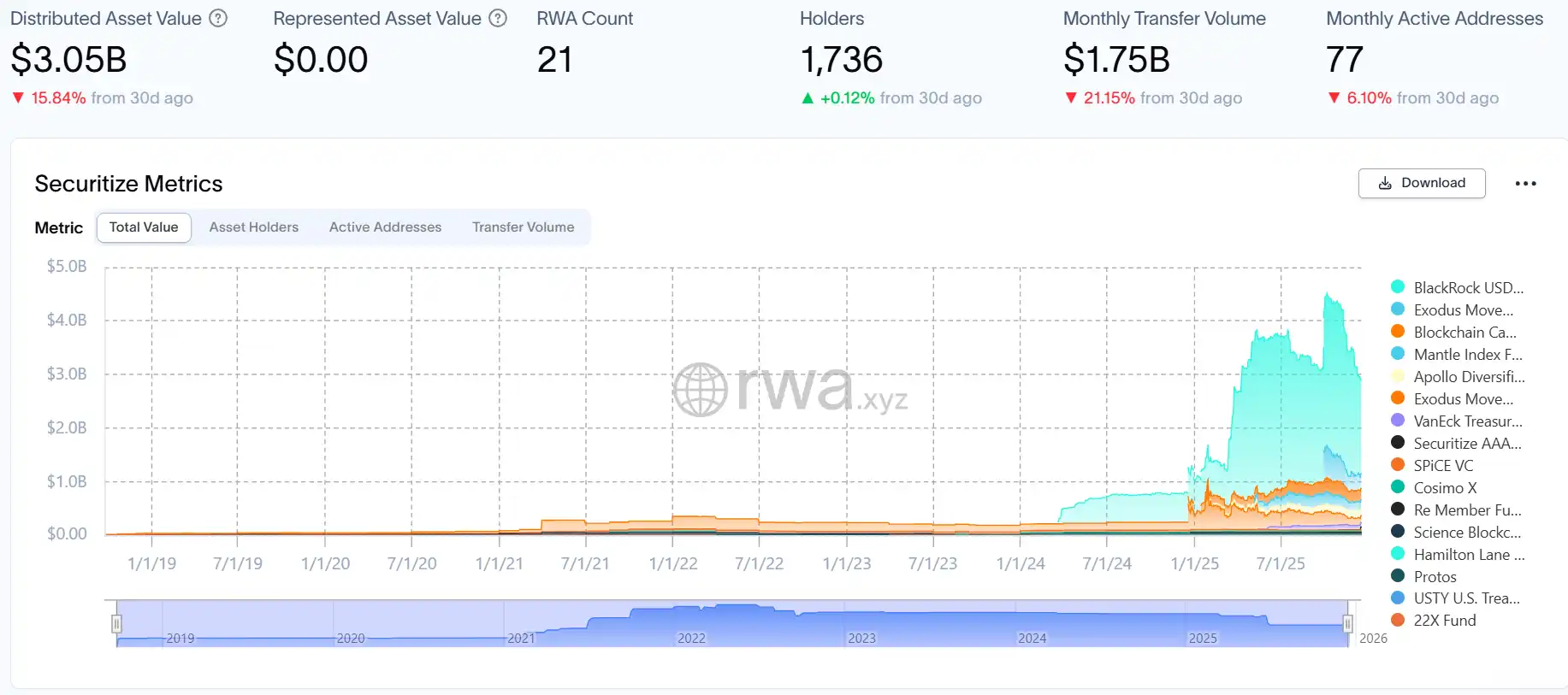
On October 28 this year, Securitize disclosed that it would go public through a SPAC merger, with a post-merger valuation estimated at $1.25 billion and a stock ticker of SECZ. As a key player in the tokenized money market fund space, Securitize has partnered with traditional asset management institutions such as BlackRock, Apollo, KKR, Hamilton Lane, and VanEck, with cumulative tokenized assets exceeding $3 billion.

Amid the ongoing hype around the RWA narrative, Securitize, with its frequent moves, has become a market focus. Odaily Planet Daily will analyze it from a business perspective to help readers gain a deeper understanding of the company's layout and prospects.

Native On-Chain Stocks: Not "Price Mapping," but Legally Recognized Shares

To understand the importance of Securitize's product approach, it must first be placed within the overall structure of the current stock tokenization track. Most existing stock tokenization platforms can be broadly categorized into two mainstream models.

The first is the synthetic model. Early examples like Mirror Protocol and Synthetix fall into this category, where tokens track stock prices through derivative structures or oracle mechanisms, providing only price exposure without involving any real shares. Such products lack shareholder rights, carry counterparty risk and pricing deviations, and are essentially derivatives rather than equity.

The second is the beneficial interest model. For example, MSX typically involves the platform or a third-party custodian holding the real shares (usually 1:1 backed), issuing tokens that represent beneficial interests or claims to these shares. Holders gain economic exposure (such as price movements, possibly including dividend pass-through) but are not direct legal owners; the official share register records the custodian, not the token holder.

Different from these two paths, Securitize is attempting a third model—the native on-chain stock model. What Securitize plans to issue will be shares recognized in law as real stock, directly natively issued on the blockchain and simultaneously recorded in the issuing company's official share register. Token holders possess full shareholder rights, including dividends, proxy voting, etc. More crucially, Securitize itself, as an SEC-registered transfer agent, ensures that token holders are the direct legal owners, not holding indirectly via an intermediary or SPV. In other words, these assets are neither price trackers nor "IOUs" from a custodian.

However, it is undeniable that the complexity of the native on-chain stock model is significantly higher than that of synthetic or beneficial interest schemes. It must not only solve the problems of on-chain issuance and instant settlement but also simultaneously comply with securities regulations, corporate law, transfer agent systems, and a series of traditional financial rules, achieving seamless integration with existing financial infrastructure. In practical terms, this means higher compliance costs, longer development cycles, and each step being exposed to regulatory and institutional friction.

In contrast, the advantages of synthetic or beneficial interest schemes are obvious: faster implementation, lighter structure, lower costs, and easier compatibility with 24/7 trading and DeFi. The path chosen by Securitize aims not to "circumvent regulation" but to attempt, within the system, to truly eliminate the long-standing structural gap between the traditional financial system and the on-chain system.

It is under this choice that Securitize's position in the RWA track becomes clearer.

Securitize is Becoming One of the "Standard Answers" for RWA Infrastructure

Securitize was founded in November 2017 by Carlos Domingo and Jamie Finn, headquartered in San Francisco, California, USA. The company focuses on using blockchain technology to transform traditional financial assets (such as stocks, funds, bonds, private equity, etc.) into compliant digital securities.

This positioning directly determined Securitize's partners and business form. Securitize's most well-known case is providing tokenization services for BlackRock's BUIDL money market fund. To date, the fund size has exceeded $1.7 billion, making it the largest tokenized money fund product in the current RWA market.

In addition, Securitize has partnered with several traditional asset management institutions such as Apollo, KKR, Hamilton Lane, and VanEck. Official data shows that its cumulative tokenized assets have exceeded $3 billion. If the early days of RWA were more about "conceptual feasibility," then Securitize's business has begun to enter the verification stage of "institutional feasibility."
This "bridge" positioning is also clearly reflected in Securitize's financing and shareholder structure.

Public information shows that Securitize has raised approximately $122 million to $147 million through multiple rounds of private equity financing. Early investors mostly came from the crypto industry itself, including Coinbase, Ripple, etc. As the RWA narrative gradually clarified, its shareholder structure also changed significantly, with traditional financial giants such as Morgan Stanley and BlackRock entering one after another. The number of investors exceeds 50, and it has also received significant holdings from Cathie Wood's ARK Invest.

This process from "crypto circle recognition" to "Wall Street endorsement" is not accidental but a natural result of its business path and institutional choices.

Under This Logic, Moving Towards the Capital Market is Not Surprising

Securitize announced on October 28 that it would go public through a merger with the special purpose acquisition company (SPAC) Cantor Equity Partners II, Inc. After the transaction is completed, the company's valuation is expected to reach $1.25 billion, and it plans to trade under the ticker symbol SECZ.

Cantor Equity Partners II, Inc. (NSDQ:CEPT) is sponsored by a company under the financial services giant Cantor Fitzgerald, with its head being Brandon Lutnick, son of the U.S. Secretary of Commerce. Notably, Twenty One, the third-largest bitcoin reserve company, also went public through a merger with another SPAC under Cantor Fitzgerald, showing the group's continued layout in the crypto asset space.

To support the listing and public market operations, Securitize has also strengthened its compliance and governance capabilities, announcing the appointment of former PayPal digital assets legal head Jerome Roche as General Counsel, preparing for future continuous disclosure and regulatory communication on Nasdaq.

Conclusion

Returning to Securitize itself, as a leading project in the RWA track, the market's earliest expectation for it might have been just when it would issue a token. But judging from today's progress, this expectation itself might just be the inertial thinking of the crypto market.

What Securitize is ultimately moving towards is not a narrative stage centered around a token, but a larger structure composed of capital markets and regulatory systems. But this choice itself is not surprising. Because from the beginning, the role it has played has been closer to a bridge connecting TradFi and DeFi.

In this sense, Securitize's development path may reflect the profound transformation that the RWA narrative is undergoing, moving from imagination to reality, from concept to institution. How far this path can go depends not only on the expansion speed of a single company but also on whether the traditional financial system is truly willing to reserve a realistic space for "native on-chain assets."


Related Questions

QWhat is the key difference between Securitize's planned on-chain stock product and existing stock tokenization models?

ASecuritize's native on-chain stock represents a direct, legally recognized share of ownership recorded on the company's official cap table, granting holders full shareholder rights like dividends and voting. This differs from synthetic models (which are just price-tracking derivatives) and beneficial interest models (where a custodian holds the real shares and issues an IOU token).

QWhat major traditional asset management firms has Securitize partnered with for its tokenization services?

ASecuritize has partnered with major traditional asset managers including BlackRock, Apollo, KKR, Hamilton Lane, and VanEck.

QHow is Securitize planning to become a publicly traded company and what is its expected valuation?

ASecuritize is planning to go public through a merger with a Special Purpose Acquisition Company (SPAC) called Cantor Equity Partners II, Inc. The combined company is expected to have a valuation of $1.25 billion and trade under the ticker symbol SECZ.

QWhat is the estimated total value of assets that Securitize has tokenized so far?

ASecuritize has cumulatively tokenized assets worth over $3 billion.

QWhat specific, large-scale product is Securitize most known for in the RWA market?

ASecuritize is best known for providing the tokenization services for BlackRock's USD Institutional Digital Liquidity Fund (BUIDL), which, with over $1.7 billion in assets, is the largest tokenized money market fund in the RWA market.

Related Reads

Kraken Changed Its Vote at the Last Minute, Solana's Inflation Policy Narrowsly Passes by 0.33 Percent

Kraken’s last-minute vote reversal secured the passage of SGP-0002, a pivotal Solana governance proposal to accelerate the network’s annual inflation reduction from 15% to 30%. The final vote tally was 67.001%, narrowly exceeding the required 66.667% supermajority by just 0.334 percentage points. This change will bring Solana’s terminal inflation rate of 1.5% forward to around 2029, reducing future SOL issuance over six years by approximately 18.9 million tokens (about 2.6% of current supply). The vote, the first major test of Solana’s new on-chain governance system, saw intense drama. The Kraken 2 validator, controlling about 8.9 million staked SOL, switched from support to opposition hours before the deadline, pushing the "yes" vote below the passing threshold. A flurry of lobbying, including direct outreach by Helius CEO Mert Mumtaz, ensued. Kraken ultimately flipped back to supporting the proposal, and JitoSOL holders used the "staker override" mechanism to bypass opposing validators and vote directly with their stake. While SGP-0002 passed, a companion proposal (SGP-0003) to restructure transaction fees failed, indicating community willingness to adjust token supply but hesitance to change fee economics. The approved proposal now moves to a technical implementation phase, requiring client teams to code and activate the change. The event highlighted both the power of large validators and the resilience of Solana’s governance mechanisms, marking a significant, albeit messy, step in decentralized monetary policy management.

marsbit7m ago

Kraken Changed Its Vote at the Last Minute, Solana's Inflation Policy Narrowsly Passes by 0.33 Percent

marsbit7m ago

Trading Volume Surges 10 Times in a Month, Who's Driving UNI's Soaring Price?

The article discusses the recent surge in the price of UNI, the governance token of Uniswap, which reached a high above $5.4 on August 31, marking a three-month increase of over 100%. The resurgence is attributed primarily to two key developments. First, Uniswap was designated as the primary Automated Market Maker (AMM) on the newly launched Robinhood Chain. Data shows Uniswap generated $4.29 million in fees in 24 hours on this chain and facilitated a tenfold increase in stock token trading volume over a month, reaching approximately $130 million daily. Second, a fundamental change in UNI's tokenomics, approved in December 2025, activated a "fee switch" mechanism. A portion of protocol fees is now directed to a "TokenJar" contract. Arbitrage bots can destroy an equivalent value of UNI tokens to claim these fees, creating a perpetual buy-and-burn pressure. This mechanism has led to the burning of over 110 million UNI tokens (worth $630 million), with recent daily burns exceeding $400,000 in value, nearly half contributed by activity on Robinhood Chain. The symbiotic relationship is highlighted: Uniswap gains a substantial new source of on-chain revenue to fuel its token deflation, while Robinhood Chain leverages Uniswap's deep liquidity and decentralized infrastructure for its stock token offerings. This integration represents a deeper convergence of traditional and decentralized finance.

marsbit22m ago

Trading Volume Surges 10 Times in a Month, Who's Driving UNI's Soaring Price?

marsbit22m ago

Marvell: Can't Compare to NVIDIA, Can't Meet Expectations, Overvaluation Gets Squeezed First?

Marvell Technology (MRVL.O) reported its Q2 FY2027 earnings (ending July 2026) after market close on August 27. Key points include: The company raised its full-year revenue outlook for FY2027 to $12 billion (from $11.5B) and for FY2028 to $18 billion (from $16.5B). However, these upward revisions were only slightly above market expectations and significantly trailed NVIDIA's recent explosive guidance. The Data Center segment, accounting for 79% of revenue, grew 19% quarter-over-quarter to $2.17 billion, primarily driven by connectivity products. For FY2028, management forecasts over 60% growth for this segment, again below NVIDIA's >70% outlook. A major disappointment for investors was the lack of an upward revision to the Custom ASIC business guidance, despite Marvell's recent partnership agreement with Google. The market had anticipated potential gains from Google's TPU orders, but the maintained guidance for "over 100% growth" in FY2028 (with no specific target for FY2027) led to concerns that the Google deal may be a less favorable "framework agreement" where Marvell holds a weaker negotiating position. Adjusted gross margin was flat at 58.3%. Q3 revenue guidance is $3.15 billion, slightly above consensus. Overall, the report was largely in line with expectations, but the subsequent stock decline is attributed to growth forecasts that failed to meet heightened market expectations (particularly versus NVIDIA) and lingering uncertainty around the tangible benefits of the Google ASIC partnership. High valuation faces near-term pressure, but expectations for >50% growth in the coming years and long-term ASIC opportunity may provide support.

marsbit1h ago

Marvell: Can't Compare to NVIDIA, Can't Meet Expectations, Overvaluation Gets Squeezed First?

marsbit1h ago

US Stock Market Trend (August 31st): Kashkari's Hawkish Remarks Weigh on Chip Stocks, US-Iran Weekend Strikes Boost Oil Prices

U.S. stock markets ended lower on Friday following hawkish remarks from Federal Reserve Chair Wash at the Jackson Hole symposium, which sharply increased the probability of a September rate hike from 35% to nearly 60%. Major indexes fell: the S&P 500 dropped 0.25%, the Nasdaq declined 0.52%, and the Dow was essentially flat. This shift in interest rate expectations pressured rate-sensitive assets, leading to significant declines in chip stocks. The Philadelphia Semiconductor Index fell 3.47%, with Nvidia dropping 4.57%, erasing about half its post-earnings gains. Geopolitical tensions also escalated over the weekend as the U.S. and Iran exchanged military strikes, raising concerns over the security of oil transit through the Strait of Hormuz. This pushed oil prices up over 2% in early Asian trading on Monday, reintroducing a geopolitical risk premium. In other energy news, former President Trump announced a landmark 25-year oil deal with Venezuela, aiming to significantly increase the country's oil production. However, this long-term supply boost was overshadowed in the short term by the Middle East conflict and the dominant market focus on interest rates. The core market narrative for the coming week revolves around the interplay between re-priced hawkish rate expectations and escalating geopolitical risks. Key areas to watch include the trajectory of Treasury yields, the evolution of U.S.-Iran tensions and its impact on oil prices, and whether the sell-off in high-valuation tech and semiconductor stocks stabilizes or continues under the pressure of higher rates.

marsbit1h ago

US Stock Market Trend (August 31st): Kashkari's Hawkish Remarks Weigh on Chip Stocks, US-Iran Weekend Strikes Boost Oil Prices

marsbit1h ago

Trading

Spot
活动图片