Upbit hack puts Binance’s emergency freeze policy under scrutiny

cointelegraphPublished on 2025-12-12Last updated on 2025-12-12

Abstract

According to a KBS report, Binance froze only a small portion of funds linked to the November 27 hack of South Korean exchange Upbit. Police requested a freeze of approximately $370,000 in SOL tokens, but Binance blocked only about $55,000 after a 15-hour delay, citing the need for additional verification. The hack resulted in $36 million in unauthorized withdrawals. An expert emphasized the importance of rapid freezes to limit damage and suggested a global hotline between exchanges could improve responses. Both Upbit and Binance stated they are cooperating with authorities, who are actively investigating the incident.

According to South Korean broadcaster KBS, Binance reportedly froze only a portion of funds that police said were linked to a hack on local crypto exchange Upbit, one of South Korea’s largest exchanges, on Nov. 27.

KBS reported Friday that investigators requested Binance freeze approximately 470 million Korean won (approximately $370,000) in Solana (SOL) tokens believed to be associated with the incident. However, the exchange ultimately blocked about $55,000 (roughly 17% of the requested amount) after a delay of about 15 hours.

According to the report, Binance cited the need for additional verification when responding to the police request.

As a result of the hack, Upbit suffered unauthorized withdrawals of Solana‐based assets valued at roughly $36 million, prompting a formal police probe and efforts by the exchange to track and freeze stolen funds across multiple platforms.

The importance of rapid initial freezes

KBS quoted Cho Jae‐woo, director of Hansung University’s Blockchain Research Institute, as saying that rapid initial freezes can be important for limiting damage in hacking cases. However, exchanges often refer to litigation risks as “an excuse” for being resistant to such requests. He added that establishing a global hotline between exchanges with the emergency freeze authority could help to mitigate the damage.

Binance froze 17% of stolen funds from Upbit. Source: KBS

The incident draws attention to how major centralized exchanges respond in practice when foreign law enforcement agencies request freezes on assets suspected of being tied to hacking incidents.

Related: South Korea to impose bank-level liability on crypto exchanges after Upbit hack: Report

An Upbit spokesperson told Cointelegraph that they could not comment on the incident reported by KBS; however, they stressed that local law enforcement is “actively investigating” to identify the attackers.

“Upbit is working closely with the authorities, and we have additionally asked major global exchanges to freeze any assets detected from the related wallets.”

In a statement shared with Cointelegraph, a Binance spokesperson said that they could not comment as a matter of policy, but confirmed their commitment to “cooperating with relevant authorities and partners wherever appropriate.”

Binance responds to all law enforcement requests exclusively through an official channel, the spokesperson said, and works closely with agencies worldwide to support investigations into illicit activity.

Upbit said that it would provide further updates as they become available.

Related: South Korea targets sub-$680 crypto transfers in sweeping AML crackdown

Trending Cryptos

Related Reads

ECB's Schnabel says central bank money 'should move to blockchain'

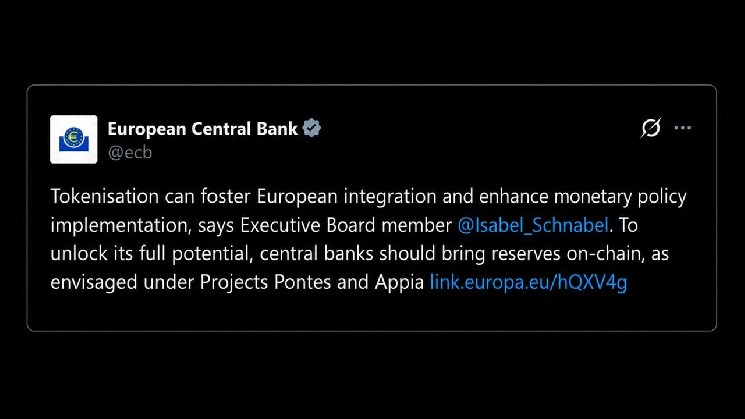
ECB Executive Board member Isabel Schnabel stated that central bank money "must move onto the blockchain." She argued that stablecoins lack the independent ability to scale liquidity during financial stress—a gap only a central bank can fill. Her proposed solution involves tokenization, which she says can make transactions faster, safer, and more programmable, but only if the safest asset (central bank money) is on the same "rails" as other tokenized assets. This marks a notable shift for the Eurosystem, which had previously viewed Distributed Ledger Technology (DLT) mainly as a tool for regulating stablecoins and crypto, not as infrastructure to adopt directly. The first step is Project Pontes, launching in September. It will initially synchronize the ECB’s existing TARGET services with private DLT platforms. Eventually, it aims to enable settlement finality on a Eurosystem-managed DLT platform with smart contract functionality and 24/7 operation. The long-term strategy is Project Appia, tasked with developing the architecture, standards, and legal framework for a genuine European tokenized asset market by 2028. Trials have already processed around €1.6 billion, and since March 2026, the ECB accepts DLT-based assets as collateral. While not directly impacting Bitcoin's price, these developments signal that a major G7 central bank is preparing to settle transactions on-chain, lending legitimacy to the underlying infrastructure of crypto markets. The ECB's move to avoid "disintermediation" by private tokenization shows that debates in central bank boardrooms are now aligning with discussions long followed in the crypto space.

cryptonews.ru1h ago

ECB's Schnabel says central bank money 'should move to blockchain'

cryptonews.ru1h ago

Ripple Labs Warns of a New Challenge for Blockchains

Ripple Labs is preparing the XRP Ledger for quantum threats but now emphasizes a broader challenge: ensuring financial infrastructure can adapt simultaneously to quantum computing and artificial intelligence. Senior Director of Engineering Ayo Akinyele states the goal is not merely anticipating a "Q-Day" but building infrastructure capable of preemptively adopting new security mechanisms without network disruption. The shift to post-quantum cryptography involves more than swapping algorithms; it requires flexible infrastructure, improved key management, and clear upgrade paths. Financial systems were not designed with quantum computers in mind, necessitating a rethink of transaction, identity, asset, and data protection. This is underscored by significant investments, such as the $2 billion U.S.-IBM quantum factory initiative and a 2030 U.S. government mandate for post-quantum cryptography adoption. AI introduces distinct risks by driving automation and autonomous economic activity, increasing demand for an always-on, internet-oriented payment infrastructure. AI agents could soon conduct transactions independently, creating new security requirements. Ripple Labs advocates for proactive, orderly preparation rather than a crisis-driven transition, having outlined a four-phase strategy aiming for a full XRP Ledger transition by 2028, now expanded to address both quantum and AI-driven challenges.

cryptonews.ru1h ago

Ripple Labs Warns of a New Challenge for Blockchains

cryptonews.ru1h ago

Trading

Spot

Hot Articles

Discussions

Welcome to the HTX Community. Here, you can stay informed about the latest platform developments and gain access to professional market insights. Users' opinions on the price of S (S) are presented below.

活动图片