The star company in the humanoid robotics field, Unitree Technology, is set to officially list on the STAR Market on August 19, 2026.
The company has priced its IPO at 150.80 yuan per share, corresponding to a post-issue total market capitalization of approximately 60.993 billion yuan. The issuance price-to-earnings (P/E) ratio is as high as 219 times, significantly exceeding the industry average P/E ratio of about 38 times for general equipment manufacturing.
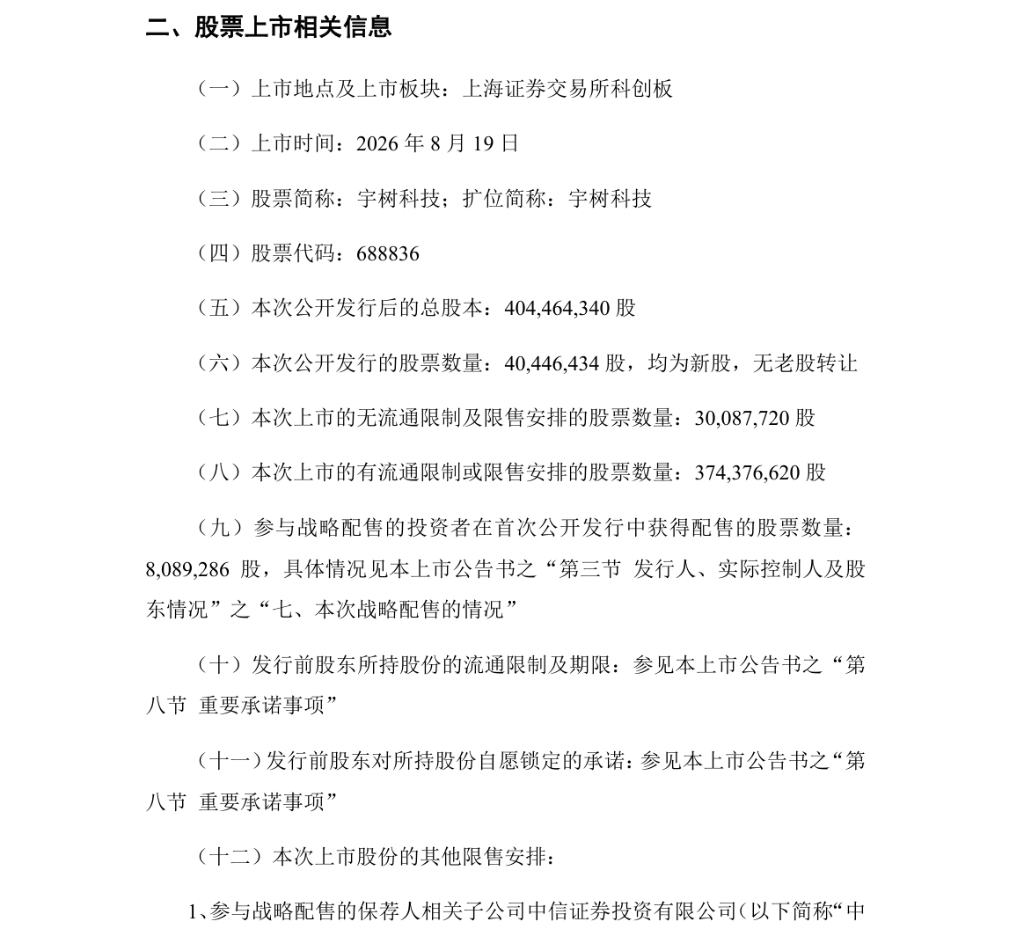
In the early stage of listing, the number of unrestricted tradable shares is only 30,087,700 shares, accounting for 7.44% of the total shares. The online lottery winning rate of 0.0181% has hit a historical low for the STAR Market. According to derivatives market data, the current estimated opening market capitalization is about $41.66 billion, which is approximately 360% higher than its IPO valuation.
The company's core business is the research, development, production, and sales of humanoid robots and quadruped robots. It is steered by its founder, Chairman, and Chief Technology Officer Wang Xingxing. Through a special voting rights arrangement, he will control approximately 65.31% of the company's voting rights after listing.
The company disclosed that as the revenue base has increased significantly and industry enthusiasm has moderated, its year-on-year revenue growth rate for the first quarter of 2026 dropped to 68.49%, while non-GAAP net profit declined by 52.55% year-on-year, primarily due to rapid increases in R&D and sales expenses. For the first half of 2026, the company's revenue grew 48.54% year-on-year to 1.152 billion yuan, but non-GAAP net profit fell 19.34% year-on-year.
Notably, on the eve of its listing, the company launched a new humanoid robot product named 'Superman' on August 17. A demonstration video showed it achieving a standing high jump of 2 meters and a top speed of 12.66 m/s, both indicators surpassing human records, further fueling market excitement.
Issuance Overview: Market Cap Exceeds 60 Billion, Low Free Float Ratio
In this IPO, Unitree Technology publicly issued 40,446,400 shares, accounting for 10% of the post-issue total shares, raising total funds of approximately 6.099 billion yuan. After deducting issuance expenses, the net proceeds amount to about 5.917 billion yuan.
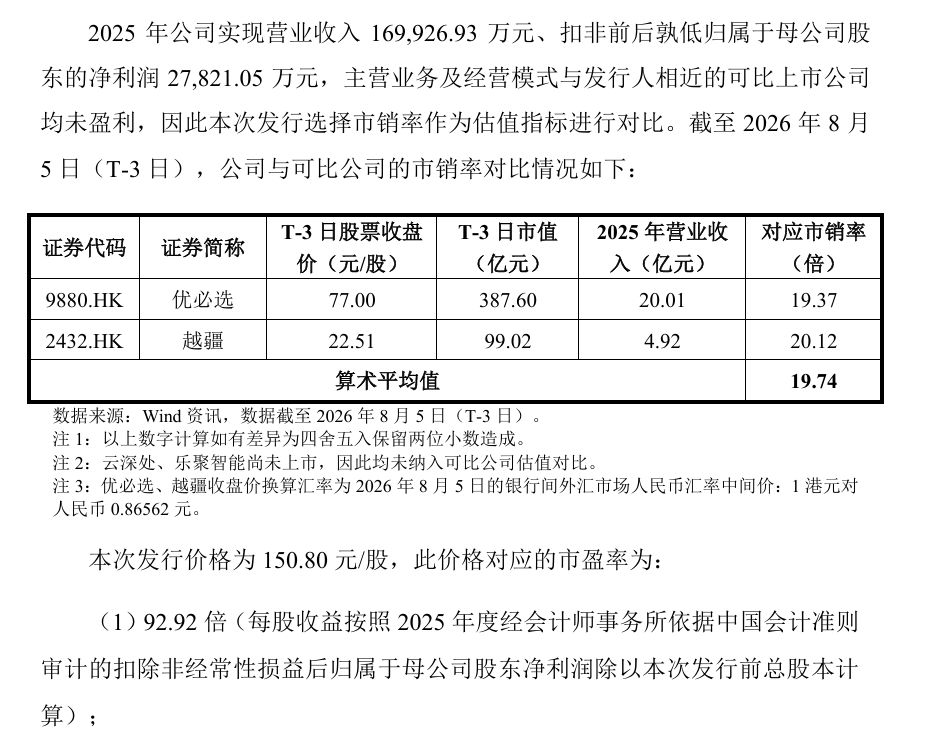
The issue price of 150.80 yuan per share corresponds to a diluted P/E ratio of 219.23 times and a price-to-sales (P/S) ratio of 35.89 times, both significantly higher than comparable listed companies. The prospectus shows that using Ubtech and JAKA as comparable references, the arithmetic average 2025 P/S ratio for these peers was only about 4.92 times, while Unitree's P/S ratio premium exceeds sevenfold.
The total funds raised are approximately 6.099 billion yuan. After deducting issuance expenses (excluding VAT) of 182,173,100 yuan, the net proceeds are about 5.917 billion yuan. Among the issuance expenses, underwriting and sponsorship fees are about 144,993,200 yuan, audit and capital verification fees are 18,283,000 yuan, and legal fees are 11,000,000 yuan. The lead underwriter and sponsor is CITIC Securities Co., Ltd.
The total share capital post-issuance is approximately 404 million shares, of which only 30,087,720 shares are unrestricted tradable shares in the initial listing period, accounting for about 7.44% of the total share capital. A large number of shares are subject to lock-up periods. The lock-up period for shares held by the controlling shareholder and actual controller Wang Xingxing is 36 months. The employee持股 platform Shanghai Yuyi has the same 36-month lock-up period. Most financial investors have a 12-month lock-up period.
Ownership Structure: Dual-Class Voting Rights Concentrated, Strategic Investors Like DeepSeek, Tencent Appear
Wang Xingxing holds approximately 31.29% of the company's shares post-issuance through direct shareholding and indirect shareholding via the employee持股 platform Shanghai Yuyi. However, by virtue of the special voting rights arrangement (Class A shares have 10 votes per share), his total controlled voting rights proportion reaches approximately 65.31%, giving him decisive influence over shareholder meeting resolutions. The company's listing announcement warns that this mechanism may, under certain circumstances, pose risks of harming the interests of minority shareholders.
The pre-issuance roster of institutional shareholders shows that Ningbo Sequoia holds about 5.59%, while institutions like Astrend IV, Matrix Partners China I, and Jinshi Growth each hold between 3% and 4%.
The strategic placement for this IPO introduced several strategically significant institutional investors. Hangzhou DeepSeek Artificial Intelligence Basic Technology Research Co., Ltd. (DeepSeek) was allotted 933,399 shares with a 36-month lock-up period. Shanghai Qishan Investment Co., Ltd. (associated with Tencent Technology) was allotted 903,290 shares, with a lock-up period subject to the later of 36 months from the date Tencent Technology first acquired the issuer's shares or 12 months from the listing date. Additionally, the National Council for Social Security Fund, CNPC Kunlun Capital, China Southern Power Grid Industry Finance Holding, Tianyi Capital Holding, etc., also participated in the strategic placement, each receiving approximately 900,000 shares with a 12-month lock-up period.
Performance Trajectory: High-Speed Growth Momentum Moderates
Unitree Technology's financial data over the past two years showed explosive growth. The company's two-year compound annual growth rate (CAGR) for operating revenue from 2023 to 2025 reached 226.78%, surging from approximately 159 million yuan in 2023 to about 1.699 billion yuan in 2025. Over the same period, the gross margin of its main business improved from 44.22% to 60.13%, and non-GAAP net profit attributable to the parent company also grew from a loss of about 18.02 million yuan to a profit of approximately 591 million yuan.
However, growth has moderated since entering 2026. In the first quarter of 2026, the company's year-on-year revenue growth rate dropped to 68.49%, and non-GAAP net profit declined by 52.55% year-on-year. The company attributed this to rapid increases in period expenses.
For the first half of 2026, the company achieved revenue of approximately 1.152 billion yuan, a year-on-year increase of 48.54%, but non-GAAP net profit was about 244 million yuan, a decrease of 19.34% year-on-year. The interim report shows that R&D expenses increased by about 82.04 million yuan year-on-year, and sales expenses also rose significantly. The company partly attributed the latter to brand promotion activities leveraging platforms like the 2026 CCTV Spring Festival Gala.
The prospectus notes that potential causes for the above declining trends include: gradual moderation of industry enthusiasm, increasingly fierce market competition, downward pressure on product prices, and uncertainties surrounding the commercialization progress of general-purpose robots.