Uniswap noted that its founder, Hayden Adams, believes tokenization will change the way liquidity is provided in both cryptocurrency and traditional markets, while automated market makers (AMMs) are still in their early stages.
This is significant given that automated market makers handle billions of dollars in transactions daily and could play a crucial role in processing tokenized real-world assets transferred to public blockchains.
Automated Market Makers (AMMs) enable decentralized exchanges to provide pooled user deposits and set prices without using an order book to match buyers and sellers. According to a working paper published by the Bank for International Settlements (BIS) in November 2024, AMM-based decentralized exchanges process over $10 billion in digital assets daily.
If real-world assets (RWA) are to move on-chain, these markets will also require robust liquidity. Automated Market Makers (AMMs) are one of the few solutions capable of providing liquidity at scale.
Tokenized Assets Are Already Entering Global Markets
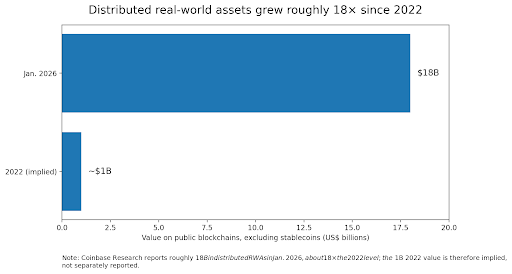
According to Coinbase Research, approximately $18 billion in "distributed" risk-weighted assets (RWA), excluding stablecoins, were on public blockchains as of January 2026—an 18-fold increase from 2022. A large portion of this amount comprises tokenized U.S. Treasury bonds. According to Coinbase data, BlackRock's BUIDL fund holds over $2 billion of such bonds, representing nearly 25% of the total tokenized Treasury bond volume.
Regulatory frameworks are also becoming much more DeFi-friendly. Coinbase points out that with the passage of the 2025 GENIUS Act and the SEC reform led by Paul Atkins, conditions for digital assets and tokenized financial assets in the U.S. have become more favorable. In Europe, MiCA exists alongside the DLT Pilot Regime, while Singapore's Project Guardian and the UAE's VARA framework are fostering tokenization hubs in Asia.
Market infrastructure is improving. On July 15, the Depository Trust & Clearing Corporation (DTCC) announced the conversion of assets held in its depository into tokens to be used in real trading operations involving over 30 traditional and digital market firms. DTCC plans to launch its tokenization service in October 2026.
Why AMMs Are Still Searching for Early-Stage Models
The "early stages" aspect of Adams's argument stems from the current functioning of AMMs.
According to the BIS study, a small group of sophisticated participants provided between 65% and 85% of the liquidity on Uniswap V3. Orders from these participants acted like typical buyers or sellers and generated significantly higher profits than retail liquidity providers.
Despite automated market makers democratizing the market-making process, liquidity has consolidated in the hands of specialists, similar to traditional financial markets.
Furthermore, tokenization itself does not guarantee liquidity. As Cryptopolitan notes in its article "Why Tokenized Assets Are Not Liquid Yet," tokenizing an asset means it is transferable, but it does not mean it is easy to trade.
On-chain markets still require market makers willing to provide two-sided quotes and hold inventory. Many tokenized funds, as well as bonds, remain available only to accredited investors and individual issuers, with secondary trading possible only on a limited volume of tokens.
The Regulatory Question Hanging Over On-Chain Trading
The question of whether automated market makers are legitimate venues for listing tokenized securities remains far from clear.
In a March 30, 2026, letter to the SEC's crypto task force, the Securities Industry and Financial Markets Association (SIFMA) argued that regulators should focus on the protocol's functions rather than the absence of decentralization, and that functions such as order routing, execution, pricing, and settlement could well fall under securities laws.
SIFMA expressed concerns about slippage, incentives for liquidity providers, pseudonymous trading, and limited oversight over potential market manipulation.
This is a critical issue because its resolution will define the future development of tokenized asset markets. The launch of DTCC's own spot trading service in October 2026 indicates that the SEC's approach to automated market makers (AMMs) will determine whether Adams's proposed market-making innovation is realized on a public blockchain or within a regulated exchange.