Trust Wallet taps Revolut for crypto purchases in Europe

cointelegraphPublished on 2025-12-11Last updated on 2025-12-11

Abstract

Trust Wallet, owned by Binance co-founder Changpeng Zhao, has partnered with Revolut to enable direct crypto purchases for users in Europe. The integration allows buying Bitcoin, Ether, and Solana with a minimum purchase of €10 and a daily cap of €23,000. While stablecoins like USDC are not yet supported, the feature supports multiple fiat currencies with zero transaction fees. However, funding a Revolut account may incur charges. The move follows Revolut’s recent regulatory approval under MiCA and its $75 billion valuation.

Trust Wallet, the self-custodial crypto wallet owned by Binance co-founder Changpeng “CZ” Zhao, has partnered with European fintech unicorn and digital banking giant Revolut to introduce a new way to purchase crypto assets on its platform.

Trust Wallet users can now buy Bitcoin (BTC), Ether (ETH) and Solana (SOL) with Revolut through a direct integration, the company announced on Thursday.

With a minimum purchase starting at 10 euros ($12) and capped at 23,000 euros ($26,950) daily and per transaction, Trust Wallet’s new buy option is expected to provide a faster and easier way to access crypto from Europe.

In October, Revolut scored regulatory approval from the Cyprus Securities and Exchange Commission to offer crypto services across 30 European Economic Area markets in compliance with the European Union’s Markets in Crypto-Assets Regulation (MiCA) framework.

Stablecoins like USDC not supported, for now

The integration will initially support only three crypto assets, but the companies said they expect to add stablecoins such as Circle’s USDC (USDC) at a later stage.

The feature enables zero-fee crypto purchases using multiple fiat currencies supported by Revolut, including the euro, the British pound, as well as the Czech koruna, Danish Krone, Polish Złoty and others.
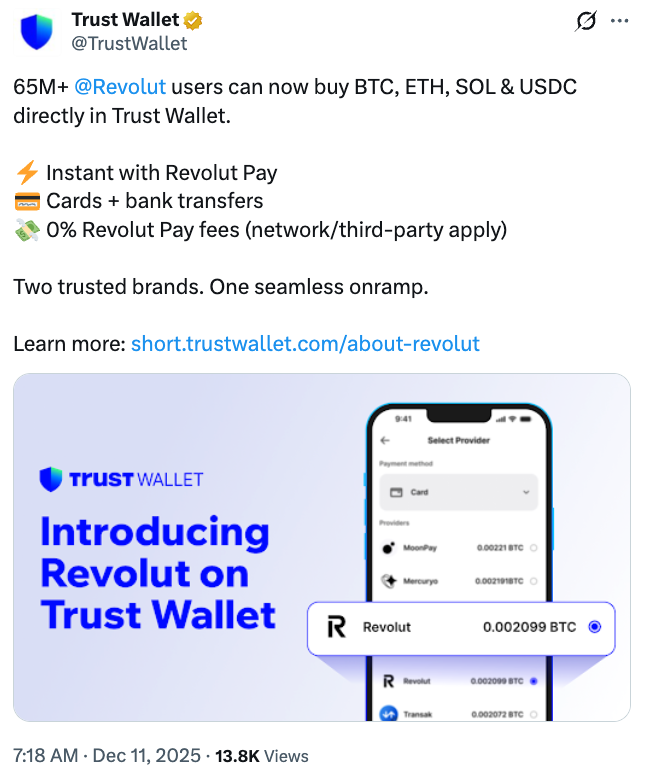
Source: Trust Wallet

While Revolut–Trust Wallet crypto purchases are offered with zero fees, adding money to a Revolut account is not free of charge in many cases, including via bank transfers, card top-ups and cash deposits. Cash deposits are subject to a 1.5% fee and are limited to $3,000 per calendar month, according to Revolut’s FAQs.

Related: Crypto self-custody is a fundamental right, says SEC’s Hester Peirce

The integration came shortly after Revolut secured a $75 billion company valuation after completing a private share sale in late November. “This makes us Europe’s most valuable private company and in the top 10 of the world’s most valuable private companies,” Revolut said in a post on X.

CZ-backed Trust Wallet has been actively tapping into trending market sectors, including prediction markets and real-world asset tokenization, expanding access to these offerings for self-custody users.

Cointelegraph contacted Revolut and Trust Wallet for comment on the integration, but had not received a response by publication.

Related Reads

MiCA is coming for DeFi vaults, but regulation will be difficult

The European Commission is exploring whether to extend the Markets in Crypto-Assets (MiCA) regulation to cover decentralized finance (DeFi) lending and borrowing, including lending vaults. These vaults, which channel billions into on-chain credit markets, present significant regulatory challenges because their decentralized structure doesn't map neatly onto existing financial frameworks. Their legal status is currently based on non-binding interpretations that they fall outside MiCA and EU fund rules. The article uses Morpho's decentralized lending protocol as an example, illustrating how responsibilities are divided among various participants (owner, curator, allocator, sentinel), making it difficult to identify a single "provider" to regulate. Experts warn that broadly categorizing "DeFi lending" could inadvertently capture vastly different structures. They argue that any regulatory approach should focus on the specific structure and control mechanisms of a vault, rather than using decentralization as a simple dividing line, and that DeFi lending may require a dedicated, carefully crafted framework distinct from traditional finance. The Commission's consultation closes on September 30, 2026. The core challenge for regulators is not just whether to regulate DeFi lending, but how to design rules that distinguish between different forms of on-chain lending and the entities that control them.

cointelegraph51m ago

MiCA is coming for DeFi vaults, but regulation will be difficult

cointelegraph51m ago

Grayscale Report: Financial Privacy in the AI Era, Why Zcash Should Not Be Overlooked?

Title: Grayscale Report: Financial Privacy in the AI Era – Why Zcash Should Not Be Overlooked The article argues that privacy is a fundamental, not niche, attribute of functional money. It highlights that technological shifts, like the rise of AI and stablecoins, are driving a new wave of public focus on financial privacy. Zcash, a decentralized digital currency similar to Bitcoin but with built-in privacy via zero-knowledge proofs, is positioned to address this need. Unlike transparent blockchains, Zcash offers users the option to conduct "shielded" transactions that hide sender, receiver, and amount while remaining verifiable. The report details Zcash's evolution, noting key upgrades that improved usability and security. It points to rising on-chain usage of privacy features as evidence of real demand. Currently, ZEC holds a minimal share (~0.4%) of the total crypto market cap. Grayscale suggests this reflects a market assumption that privacy is a marginal concern. The investment thesis hinges on a potential market re-evaluation: if privacy is recognized as a core monetary feature in an era of enhanced surveillance, Zcash's current valuation represents significant upside potential. Key risks discussed include regulatory challenges, historical trusted setup concerns for older pools (mitigated by newer protocols), quantum computing threats, and execution risks associated with future technical upgrades. The conclusion is that while the future scale of private digital currency is uncertain, the market currently prices in little chance of its value increasing substantially, presenting a potential opportunity for investors.

marsbit3h ago

Grayscale Report: Financial Privacy in the AI Era, Why Zcash Should Not Be Overlooked?

marsbit3h ago

Trading

Spot
活动图片