Trump’s views on interest rates will hold ‘no weight’ at Fed: Hassett

cointelegraphPublished on 2025-12-15Last updated on 2025-12-15

Abstract

Kevin Hassett, a leading candidate to become the next Federal Reserve chair, stated that President Trump’s views on interest rates would hold "no weight" in the Fed’s decisions, emphasizing the institution's independence. Trump has indicated the selection is between "two Kevins"—Hassett and former Fed governor Kevin Warsh—though recent comments caused Hassett's prediction market odds to drop from 85% to 50%. Trump’s preference for a chair who would consult him on rate-setting contrasts with the Fed's traditional independence. Despite a recent 25-basis-point rate cut, crypto markets remained flat. Trump has expressed a desire for further cuts in 2026, which could potentially benefit crypto.

Kevin Hassett, one of the frontrunners to replace the current chair of the US Federal Reserve, has downplayed concerns that US President Donald Trump could sway the Fed, asserting that Trump’s views will hold “no weight” on agency decisions.

With an announcement of the new Fed chair expected in mid-January, some hold concerns that Trump is looking to spread his influence across the agency by replacing the majority of people in charge at the FOMC.

Speaking with CBS News’ Face the Nation on Sunday, Hassett emphasized that the Fed’s role is to remain “independent” and let the 12 Board of Governors in the Federal Market Committee (FOMC) have the final say.

“No, no, he would have no weight. It’s just his opinion matters if it’s good, you know, if it’s based on data,” he said, adding:

“And then if you go to the committee and you say, well, the president made this argument and that’s a really sound argument, I think, what do you think? If they reject it, then they’ll vote in a different way.”
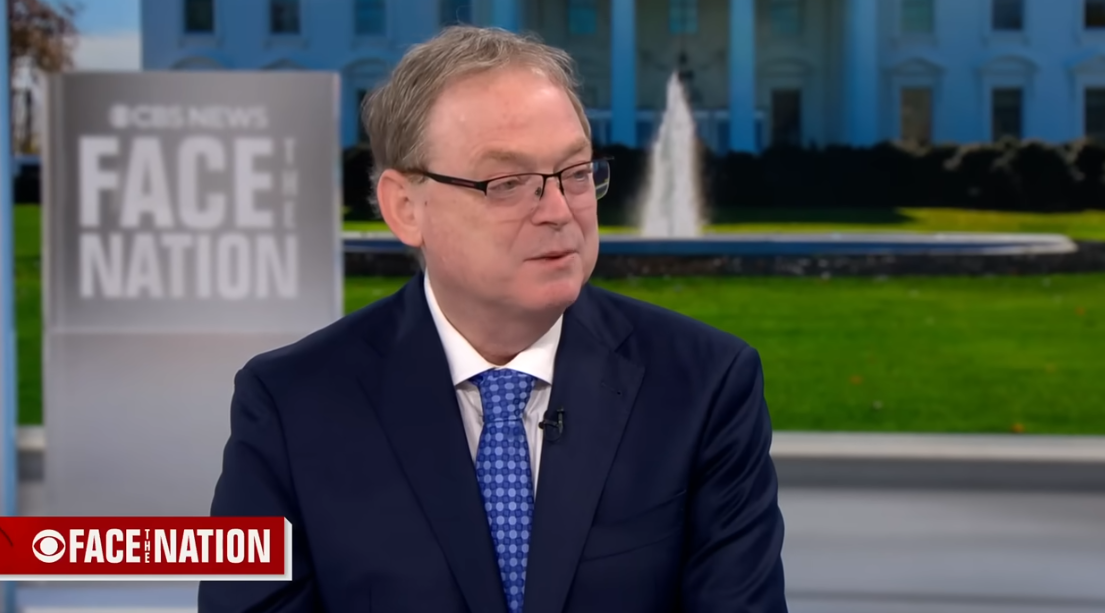
Hassett speaking on the Fed and Trump. Source: Face The Nation

Race for fed chair may be down to ‘two Kevins’

On Friday, Trump indicated the race for the next Fed chair is being led by two out of four finalists being interviewed — former Fed governor Kevin Warsh and Hassett.

In an interview with The Wall Street Journal on Friday, Trump said Warsh was at the top of his list.

“Yes, I think he is,” he said, adding, “I think you have Kevin and Kevin. They’re both—I think the two Kevins are great,” he said.

At the start of this month, odds on prediction markets such as Kalshi and Polymarket had Hassett at an 85% chance of becoming the next Fed chair; however, the odds have now dropped significantly following Trump's latest comments.

At the time of writing, Hassett still leads on Kalshi odds at 50%, with Warsh in second at 39%.

Related: Who’s Kevin Hassett, Trump’s reported crypto-friendly pick for the Fed?

During the WSJ interview, Trump also said the next Fed chair should consult him for advice on setting interest rates.

“Typically, that’s not done anymore. It used to be done routinely. It should be done,” he said.

“I don’t think he should do exactly what we say. But certainly we’re—I’m a smart voice and should be listened to,” Trump added.

Crypto market flat despite Fed cutting rates

Last Wednesday, the Fed slashed interest rates by 25 basis points to a target range of 3.5% to 3.75%; however, it hasn’t been a boon for crypto markets, with prices remaining flat.

Comments from current Fed chair Jerome Powell suggest that while the Fed isn’t being hawkish, it’s remaining cautious.

“In the near term, risks to inflation are tilted to the upside and risks to employment to the downside, a challenging situation. There is no risk-free path for policy,” Powell said at the Wednesday FOMC meeting.

With the next chair, Trump has indicated he wants further interest rate cuts in 2026, which could spur bullish action in crypto markets.

“He thinks you have to lower interest rates,” Trump said of Warsh while speaking to the WSJ.

“And so does everybody else that I’ve talked to,” he added.

Magazine: Meet the onchain crypto detectives fighting crime better than the cops

Related Reads

The Gold Buy-on-the-Dip Guide: Watch Interest Rates, Not Just War

"Gold Buying Guide: Focus on Interest Rates, Not Just War" Four months ago, gold buyers likely didn't anticipate buying at a peak that even a war couldn't sustain. After hitting a record high of $5,596 on January 29, gold entered a bear market just 91 days later, its fastest decline since 2008. A key trigger was the Fed's hawkish shift, highlighting that monetary policy, not geopolitics, is the primary driver. The article argues that the traditional "buy gold in turmoil" script has changed. While the US-Iran conflict initially boosted prices, the sustained rally in oil prices heightened inflation fears, forcing central banks to maintain or consider tighter policy. Since gold yields no interest, higher rates increase its opportunity cost, eroding its appeal. This dynamic was evident when gold fell sharply on May 18 despite positive peace talks, as lower oil prices eased inflation and thus rate hike pressures. The recent sell-off is also part of a broader market deleveraging. Correlations between gold, Nasdaq, and Bitcoin spiked as leveraged investors sold liquid assets to cover losses, creating a synchronized downturn. Historically, gold bottoms align with policy shifts, not conflict resolutions. The 2008 and 2022 bear markets ended with shifts to extreme easing and peak inflation expectations, respectively. For potential buyers, the author suggests monitoring three signals: 1) Peak interest rate hike expectations, 2) Reopening of the Strait of Hormuz (to ease oil/inflation pressure), and 3) A return to net inflows for Gold ETFs, indicating the end of forced selling. While predicting the exact bottom is impossible, the author's personal strategy involves scaling into a position across price levels like $4000, $3700, and $3500, committing no more than 30% of the intended total allocation initially, and adding the remainder only if key signals emerge. The core conclusion: In turbulent times, watching interest rates is more crucial than watching wars.

marsbit6m ago

The Gold Buy-on-the-Dip Guide: Watch Interest Rates, Not Just War

marsbit6m ago

Recent On-Chain Review: No Clear Narrative Under U.S. Stock Market Pressure, Just Hype

This article analyzes the current state of the Solana meme coin and community token ecosystem, highlighting a market caught between two dominant forces: attention-based PvP and a gradual return to community-centric projects. The first part explores the "Attention PvP" dynamic, where success is driven by celebrity endorsements, viral events, and speed. Examples include $JOTCHUA, which surged after its meme creator's social media activity, and $WORLDCUP, which outperformed a similar Base chain project ($PITCH) largely due to influencer support. The recent "pump.fun GO" feature, allowing bounty tasks for token promotion, is critiqued for fostering sensationalist and often negative stunts—like people getting token tickers tattooed on their bodies for rewards—reminiscent of old internet shock content. In contrast, the article points to a resurgence of organic, community-driven tokens that survive market volatility through strong holder bases and shared ideology, not just hype. Influencer Ansem is cited, arguing that durable meme coins rely on communities willing to endure losses and promote their core message daily. Examples given are older tokens like $neet (anti-work ethos), $troll, $buttcoin, and $triplet, which have maintained relative price stability. A prime example of this community-build model is the new project $KINS, the token for the browser-based MMORPG Kintara. Its success stems not from advanced graphics but from consistently delivering updates, fostering player trust, and creating genuine engagement (e.g., in-game economies, events, property auctions). It has attracted a growing player base and even notable KOLs as participants, demonstrating that sustainable growth can come from building trust rather than orchestrating pumps. The article concludes by questioning whether the market is ultimately a game of mutual trust or mutual deception, expressing hope that such reflection might lead to a healthier ecosystem.

marsbit6m ago

Recent On-Chain Review: No Clear Narrative Under U.S. Stock Market Pressure, Just Hype

marsbit6m ago

On-Chain Scene on Opening Day: $20 Billion Already Staked, How Do On-Chain Contracts Know Who Wins?

On the opening day of the 2026 World Cup, over $2 billion had already been wagered on just the "tournament winner" contracts on platforms like Polymarket and Kalshi. This article explores how these blockchain-based prediction markets actually function once the games begin. It breaks down the massive volume and explains how single-game and tournament-long contracts are priced, with values moving between 1-99 cents to reflect implied probabilities. A key mechanism highlighted is "elimination zeroing," where a team's "champion yes" contract immediately settles to zero once they are mathematically eliminated. The core technical question answered is: how does a smart contract "know" who won a real-world match? The answer lies in oracles. The article details two primary paradigms: UMA's "optimistic oracle" (used by most of Polymarket), which allows a challenge period after a proposed result, and Chainlink's multi-source data aggregation (used by FIFA partners like ADI Predictstreet), which automates settlement with minimal dispute windows. Finally, the article injects a note of caution, citing research estimating that a significant portion of historical trading volume on these platforms might be "wash trading" to inflate numbers. It concludes by contrasting the legal status of these "event contracts" under CFTC rules in the U.S. versus traditional, state-regulated sports betting. As the tournament progresses, the real-time operation of this multi-billion dollar machine—its settlements, eliminations, and underlying mechanisms—becomes a story as compelling as the football itself.

marsbit21m ago

On-Chain Scene on Opening Day: $20 Billion Already Staked, How Do On-Chain Contracts Know Who Wins?

marsbit21m ago

Sequoia Dialogue with Jensen Huang: Computing Model Undergoes a 60-Year Transformation; You Won't Be Replaced by AI, But You Will Be Dimensionality-Reduced by 'Those Who Master AI'

NVIDIA founder and CEO Jensen Huang, in a conversation with Sequoia Capital's Konstantine Buhler, argues that we are witnessing the most significant computing shift in 60 years—from retrieval-based to generative computing. Instead of just storing and retrieving data, future systems will generate highly personalized content (text, images, video) on demand, powered by massive "AI factories." Huang envisions a global "intelligence network" that will envelop the planet, following the historical patterns of energy and communication grids. He outlines a five-layer investment framework: 1) Energy, 2) Chips/Computers, 3) Infrastructure (data centers), 4) AI Models, and 5) Applications. He predicts this ecosystem will reach a scale of $20 trillion annually. Crucially, Huang pushes back against fears of AI-driven job loss. He distinguishes between specific "tasks" (e.g., typing, analyzing images) and overall "jobs" (e.g., CEO, radiologist). While AI automates tasks, it increases efficiency and demand for the higher-value problem-solving aspects of professions, thus creating more jobs and "up-leveling" careers. The real risk, he asserts, is not being replaced by AI, but being outperformed by someone who effectively leverages it. He urges everyone to embrace AI as a tool for augmented capability and innovation.

marsbit1h ago

Sequoia Dialogue with Jensen Huang: Computing Model Undergoes a 60-Year Transformation; You Won't Be Replaced by AI, But You Will Be Dimensionality-Reduced by 'Those Who Master AI'

marsbit1h ago

Trading

Spot
Futures

Hot Articles

Discussions

Welcome to the HTX Community. Here, you can stay informed about the latest platform developments and gain access to professional market insights. Users' opinions on the price of S (S) are presented below.

活动图片














