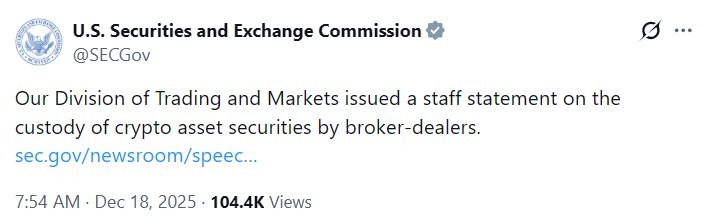
La Division des Marchés et du Trading de la Securities and Exchange Commission (SEC) américaine a détaillé mercredi comment les courtiers peuvent détenir des actions et obligations tokenisées selon les règles existantes de protection des clients, indiquant ainsi que les titres cryptographiques basés sur la blockchain seront intégrés dans les garanties traditionnelles des titres plutôt que traités comme une nouvelle catégorie.
La division a déclaré qu'elle n'émettrait pas d'objection si les courtiers se considèrent en possession de titres cryptographiques selon les règles existantes de protection des clients, à condition qu'ils respectent un ensemble de conditions opérationnelles, de sécurité et de gouvernance. Cela s'applique uniquement aux titres cryptographiques, y compris les actions ou obligations tokenisées.
Bien que cette déclaration ne soit pas une règle, elle apporte une clarification sur la manière dont les régulateurs américains s'attendent à ce que les titres tokenisés s'intègrent dans les garanties traditionnelles du marché.
Les orientations suggèrent que les titres tokenisés ne sont pas traités comme une nouvelle classe d'actifs avec des règles uniques. Au lieu de cela, ils sont placés dans les cadres existants des courtiers, même s'ils sont réglés sur des réseaux blockchain.
La finance traditionnelle sur une blockchain : Règles de garde pour les titres tokenisés
Au cœur de la déclaration se trouve la Règle 15c3-3, la règle de protection des consommateurs du régulateur. Celle-ci exige que les courtiers maintiennent le contrôle ou la possession physique des titres entièrement payés de leurs clients.
La division a déclaré que les titres cryptographiques enregistrés sur des blockchains peuvent satisfaire aux exigences de « possession physique » dans certaines circonstances. Cela signifie que les courtiers doivent conserver un contrôle exclusif sur les clés privées utilisées pour accéder aux actifs et les transférer.
Bien qu'étant sur une blockchain, les clients et les tiers, y compris les affiliés, ne devraient pas avoir la capacité de déplacer le titre sans l'autorisation du courtier.
La déclaration trace une frontière claire entre les titres tokenisés et les modèles d'auto-garde natifs de la crypto. Elle priorise la protection du client par rapport à l'éthos sans permission de la crypto.
Les courtiers doivent se préparer à des scénarios tels que les attaques à 51%, les hard forks, les airdrops et autres perturbations. Ils doivent également maintenir des plans qui tiennent compte de la saisie, du gel ou des restrictions de transfert en vertu d'ordres légaux.
Les orientations renforcent l'idée que, quelles que soient les technologies utilisées pour émettre ou régler des actions ou obligations tokenisées, celles-ci sont censées se comporter d'abord comme des titres.
Négocier des titres tokenisés dans les cadres de marché réglementés
Dans une déclaration distincte publiée le même jour, la commissaire de la SEC Hester Peirce a souligné les défis liés à la négociation qui subsistent pour les titres cryptographiques.
Peirce a soulevé des questions portant sur les bourses de valeurs nationales et les systèmes de trading alternatifs qui facilitent la négociation de titres cryptographiques, y compris les paires où un actif est un titre et l'autre ne l'est pas.
Ces questions reflètent une pression croissante pour régler les actifs basés sur la blockchain avec des règles de structure de marché conçues à l'origine pour les actions traditionnelles.
La demande de Peirce soulève la question de savoir si les cadres existants et les exigences connexes en matière de divulgation et de reporting imposent des coûts qui l'emportent sur leurs avantages lorsqu'ils sont appliqués aux plateformes de trading de crypto.
En relation : La Fed américaine retire l'orientation bloquant ses banques de s'engager avec la crypto
Les plateformes se lancent dans les actions tokenisées
Ces déclarations interviennent alors que les plateformes cryptographiques et les institutions de trading ont de plus en plus commencé à tokeniser des titres.
Le 30 novembre, le responsable de la stratégie des actifs numériques du Nasdaq, Matt Savarese, a déclaré que la bourse prévoyait d'aller vite sur les actions tokenisées. Il a déclaré que la bourse prévoyait de travailler avec la SEC aussi rapidement que possible pour rendre cette fonctionnalité disponible sur la plateforme de trading.
Mardi, Securitize, qui se concentre sur la tokenisation de titres, a annoncé qu'elle prévoyait de lancer une négociation conforme sur la blockchain pour les actions tokenisées. La société a déclaré que cela serait présenté dans une interface de type swap familière aux utilisateurs de la finance décentralisée (DeFi).
Jeudi, l'exchange crypto Coinbase a lancé une fonctionnalité de trading d'actions dans le cadre de sa volonté de devenir un « exchange universel ».
Magazine : Les Coréens « pumpent » les alts après le piratage d'Upbit, flambée du minage de BTC en Chine : Asia Express







