The Time of Machines: When Agents Consume Stablecoins

marsbitPublished on 2026-03-30Last updated on 2026-03-30

Abstract

"The Age of Machines: When Agents Consume Stablecoins" explores the convergence of AI and cryptocurrency, focusing on the emerging narrative of AI agents as economic actors. The author argues that while AI is rapidly advancing into production and consumption, crypto, particularly stablecoins, is struggling to find its role beyond financialization. The piece begins by reflecting on how AI-powered bots are evolving from nuisances to become autonomous economic entities, potentially even developing a "dislike" for humans. This shift creates a sense of desperation in the crypto community, which is now trying to prove its value to AI by promoting stablecoins as the preferred medium of exchange for agents. A core tension is highlighted: AI is mastering both production and the new "relations of production" by replacing human labor, while crypto remains confined to a narrow financial role. Previous attempts by crypto to capture AI use cases—through decentralized storage, compute, or GPU lending—have largely failed. The author warns that compliant, bank-issued stablecoins on networks like Canton could ultimately prevail over native crypto stablecoins. The emergence of payment protocols for machines, like Stripe's MPP, is noted, but these efforts are seen as integrating machines into the existing traditional financial system rather than creating a new crypto-native one. The crypto industry's strategy of selling stablecoins to AI based on technical merits like cheapness and speed is p...

Author: Zuo Ye Wai Bo Shan

We live in a vast gap, and the passage of time always brings a sense of dizziness.

In 2023, Musk called for small payments to block Bots and maintain the community atmosphere for human discussion. But just two or three years later, Bots, empowered by AI, are about to become the main actors of small payments and are showing a "rejection emotion" towards humans.
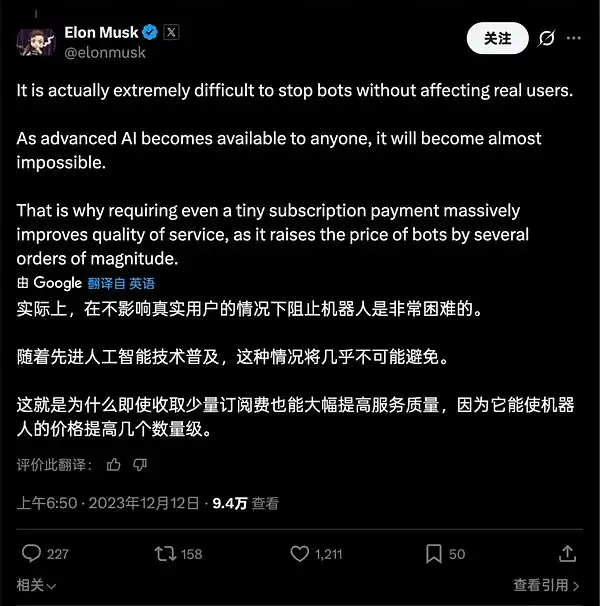
Image Caption: Musk wants to use micropayments to block Bots

Image Source: @elonmusk

It's not just ordinary white-collar workers who feel abandoned; more so, it's the sense of backwardness in the crypto community. You can repeatedly experience this despair from Vitalik's sutra-like repetition of the importance of ZK for trustworthy AI, de Agents like Virtuals seeking decentralized LLMs, and the latest—Agents should consume stablecoins.

This time, Crypto must prove its value to AI, in the name of stablecoins.

AI Steps into Productivity, Crypto Stuck in Finance

When you pursue freedom, you have already lost it.

In the narratives about AI and Crypto, the most classic is "AI is responsible for productivity, Crypto is responsible for production relations," but this relationship has never materialized.

Production relations refer to human collaboration models, and the biggest feature of this round of AI is "replacing humans."

AI Agents are climbing out of the screen, taking over white-collar jobs, while also invading the mechanically repetitive areas of manual labor. Admittedly, as Jensen Huang said, AI itself is also limited by physical hardware like electricity, firmly anchored in the geometric space woven by humans.
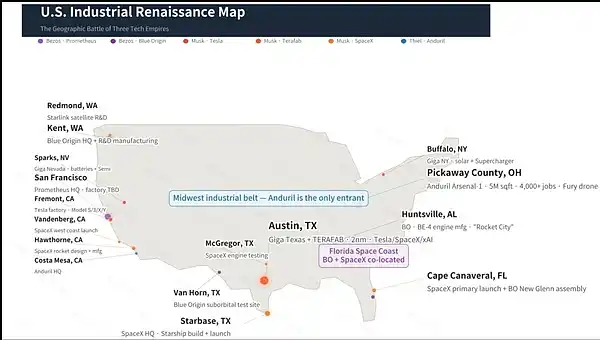
Image Caption: AI enters the production field

Image Source: @zuoyeweb3

If humans can only serve the production and consumption of AI, can they still preserve their subjectivity in labor?

At the same time, Crypto's vision is gradually narrowing, from early decentralized storage like IPFS/Filecoin, to computing power and storage projects in the 24/25 cycle, to USDAI focusing on GPU lending models. You can't say Crypto isn't trying, but each wave fails to capture AI's real use cases.

"AI is responsible for both productivity and production relations" is more likely to come true. Even if the Agent narrative is not a bubble, the stablecoins used may not be "stablecoins based on BTC/ETH assets, running on Ethereum."

I am not spreading terror or pessimism. The Genius Act has effectively allowed the OCC to take the definition power of "compliant stablecoins." Sky's USDS is just a U.S. debt certificate running on Ethereum. So, in the upcoming RWA era, will more assets choose Canton backed by Goldman Sachs or Solana, which is actively BDing?

ETH L1 has once again become a high-performance public chain, at the cost of node scale exploding rapidly. First, use compliant stablecoins to replace "YBS," then use Canton to replace ETH/SOL, and finally co-opt Vitalik as an institutionalized rebel.

Liangshan was good because it could surrender; the coin circle is bad because it's all about finance.

But Liangshan had the military foundation to surrender; the coin circle has all the套件 for financialization. And, no matter how much Agent replaces human consumption power, it must act according to human will.

In other words, Agent is the behavioral subject, and humans are the意愿 subject. Agent's consumption behavior can only be an infinite extension of human will.

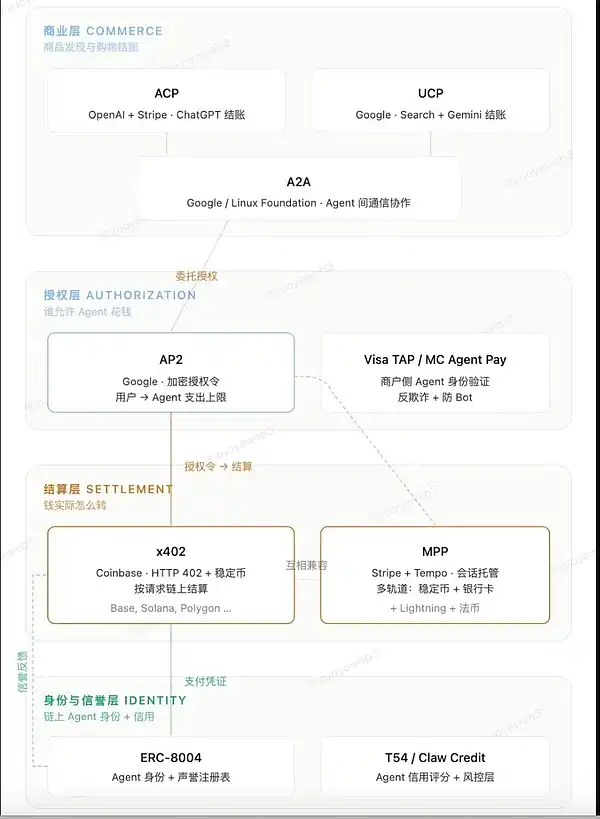
In March 2026, Stripe launched the MPP protocol (Machine Payments Protocol), seemingly to摆脱 humans, but it is actually a failed restart之作 to incorporate machines into the existing financial system.

As early as last September, Stripe联合 OpenAI launched the ACP (Agentic Commerce Protocol) protocol, hoping to replace the previous "Google Search + Amazon Mall" through OpenAI's chat page. But unfortunately, Agent cannot cross the non-standard存量 of the old giants over 20 years, and the complexity leads to a conversion rate that is聊胜于无.

There are many such protocols, including Visa and the banking industry, which are urgently launching their own "machine payment" protocols. But归根到底, they are just adding stablecoins on the acquiring side. You hardly see merchants actively integrating stablecoins.
This is not to deny the trend of combining stablecoins and Agents. Borrowing a sentence from @Shoal Research, "In the past fifty years, efforts to replace card organizations, from PayPal to Apple Pay, have ultimately failed."

If the stablecoins issued by banks, running on Visa's private chain, ultimately defeat Crypto's efforts like they defeated Fintech, this story is not friendly to us.

On this point, Crypto must learn from AI, from Prompt Engineering, to Context Engineering, to the current Harness Engineering. The survival form of Agent has been constantly changing.

Early on, people optimized their prompts in Chat; then, people optimized their expressions in AI response texts, summarizing them into skills, and then疯狂购买 API and Mac Mini and other software and hardware services, ultimately training Agent into a version that is easier to replace themselves.

The narrative of Agent consuming stablecoins is a helpless move after only having financial value. It can only sell its cheap, fast and other technical narratives to AI and the public. This is无异于 putting on the rope that will hang itself, and at a clearance price.

Crypto Token ⇄ AI Token ⇄ Crypto Token

Stay away from the sound of gunfire, observe the battle from afar as much as possible.

If you are caught in it, try to create a new battlefield for yourself.

Providing liquidity for the AI industry is a dead end (no money, and it will relegate the coin circle to the background). Being treated as SaaS and channels will be swallowed and have profits taken away. Only by focusing on volatility can we trigger human FOMO emotions, thereby creating miracles of asset price surges.

The most exciting narrative of Agent is being the dual subject of production and consumption. Letting Agent consume can greatly surpass human physiological limitations:

  1. The number of humans is limited, or rather, the subjects of stablecoin consumption are limited, at most 8 billion. But the number of Agents is endless,无限递归. A human's Agent calls an Agent; the vassal of my vassal is not my vassal.
  2. Agent does not need sleep. This is the first time a "tool" has shown a physiological advantage over humans, a biological advantage over human labor—not smarter, but more耐磨, the Scaling Law on the time scale.
  3. Agent is good at handling Fuzzy tasks, or always gives you a solution. In multi-Agent mode, AI shows all-weather working ability for the first time.

Agent is not an evolution of the Ford assembly line, but the theoretical optimum of Taylorism. People are unstable, but Agent can be continuously tuned to最终适配 the ultimate dream of capitalism—capital appreciation.

This is not alarmist. The word Token, in both Chinese and English contexts, already points to the throughput of AI, no longer the competition of PoW.
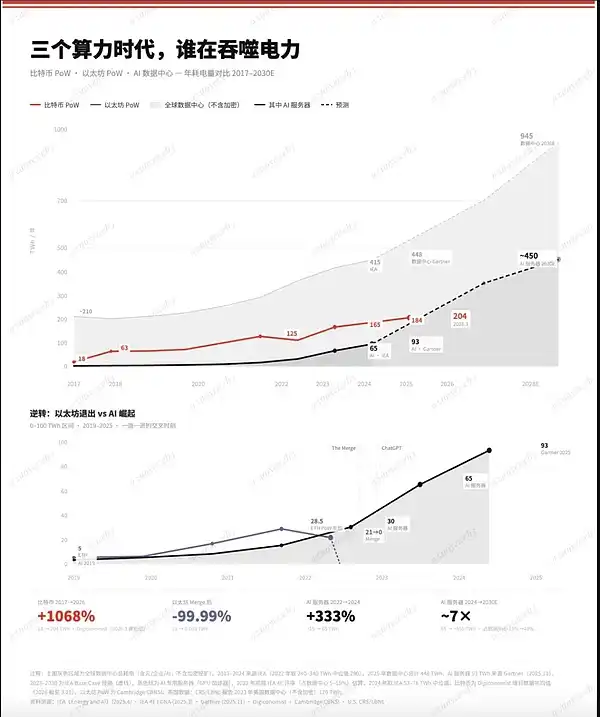
Image Caption: The变迁 of the computing power era

Data Source: @DigiEconomist @IEA

Ethereum abandoned the PoW mechanism in 2022; ChatGPT started the AI computing power competition era in 2022. Fate likes to play tricks on us. When Token in crypto became a pure emission game, more people chose AI supported by computing power consumption.

Transitioning from Crypto Token to AI Token is not difficult; stablecoins are trying. But the reverse, converting AI Token into the liquidity of Crypto Token, has become a difficult sutra to chant.

Computing power, reasoning, storage—all lost. How can the stablecoin story come true?

Perhaps AI can give us a reference. Agent's replacement of Chat is based on the fact that the Chat model cannot sustain a business model. ChatGPT shows no signs of replacing Google or Amazon; Claude specializes in "deterministic" areas like Coding.

Now it's time to consider whether Crypto will decline slowly and painfully like Binance, or rapidly like FTX.

We must learn from AI in reverse: create volatility based on stability. This is what crypto is best at. Traditional finance's adoption of AI pursues accuracy to reduce labor, but traditional finance's adoption of Crypto pursues "tokenization" to reduce friction.

This is not Crypto's own story. Volatility has always been built on a stable foundation. For example, RWA shifts from national debt to corporate debt; lending shifts from floating rates to fixed income.

What the crypto industry needs is, under the premise of Agent using stablecoins, how to create volatility, or rather, the inflation of asset prices?
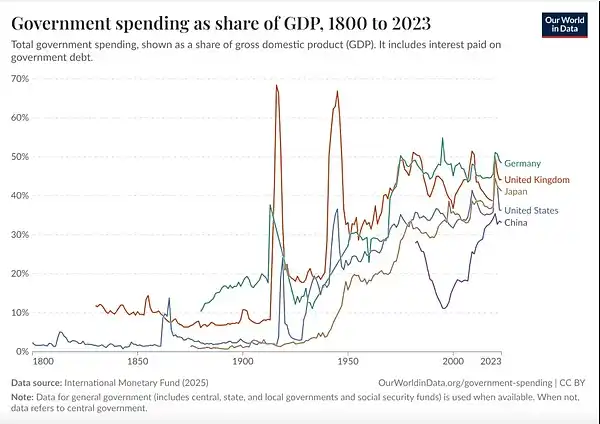
Image Caption: Government becomes the consumption subject

Image Source: @OurWorldInData

It's not as difficult as we imagine. Since the industrial revolution, the state has become the main body of economic operation. Even after the neoliberal narrative began in the 1980s, the proportion has still been steadily increasing.

The water released by QE, strong bank regulation, eventually turned into the withdrawal tide of asset management giants in 2026. This market never lacks AUM; it always lacks demand侧.

This is the significance of stablecoins for the retail market. Whether you package it as the chosen one for Agent or a post-human necessity, human emotions are always needed to trigger the initial purchase.

The AI narrative is the same, and the crypto narrative is the same. Ultimately, they must be sold to a small demand market.

Only technological progress can generate wealth surplus, gradually提高 the overall per capita income level, and thereby提升 consumption levels. This is the story AI tells. But now, the wealth effect of tokens is approaching zero; there is no growth. This is Crypto's biggest困境.

It has never been about productivity and production relations. This is a良缘 about consumption and finance. AI can become the subject of consumption; the government is the driving force of consumption. But humans are always needed to execute the financial big bang to complete the cycle.

The leap from AI Token to Crypto Token also requires letting Token break free from quantity restrictions and re-enter the space of imagination.

Conclusion

Circle's真正聪明之处 is to let Agent replace the limits of human numbers and consumption power,造了一个 dream of infinite users for the capital market.

But compliant Circle will also fall sharply due to the clear act "prohibiting" passive interest. This shows that the market hopes for a vague sense of朦胧感—when compliance is不利, there is also room for survival.

This is the characteristic of the crypto industry—always the frontline financial laboratory.

Current AI is becoming increasingly stable in methodology. The only breakthrough direction is Li Fei-Fei and Yann LeCun's world model, but this is essentially not a complete innovation of "algorithms," but still a dimensional update on the data side.

The significance of Agent for consumption and finance is about to enter the落地 stage after experimentation, and stablecoins carry all the hopes of Crypto.


Related Questions

QWhat is the core argument the author makes about the relationship between AI and Crypto in the context of stablecoins?

AThe author argues that the narrative of 'AI for productivity, Crypto for production relations' has failed. Instead, AI is taking over both roles. Crypto, now largely confined to finance, is desperately trying to prove its value to AI by pushing the narrative of AI Agents consuming stablecoins, but this is a weak position that may lead to its co-option by traditional finance systems like Visa or Canton, rather than dominance.

QAccording to the author, what is the fundamental shift in the role of 'Token' between the Crypto and AI industries?

AThe term 'Token' has shifted from referring to a unit in Proof-of-Work (PoW) crypto mining competitions to denoting the computational throughput and consumption of AI models. The author highlights that while it's easy for value to flow from Crypto Tokens to AI Tokens (e.g., funding compute), the reverse—converting AI's computational value back into Crypto Token liquidity—has become extremely difficult.

QWhat are the three key advantages the author cites for AI Agents over humans as consumers of stablecoins?

AThe three key advantages are: 1. Infinite Scale: The number of Agents is potentially limitless, recursively creating more Agents, unlike the finite human population of 8 billion. 2. No Physiological Limits: Agents do not require sleep, giving them a biological advantage of continuous, 24/7 operation—a 'time-scale Scaling Law.' 3. Handling Fuzzy Tasks: Agents excel at processing ambiguous tasks and providing solutions, especially in multi-Agent systems, enabling full-time, optimized work capability.

QWhat is the author's view on the current efforts by traditional financial institutions like Stripe and Visa regarding machine payments?

AThe author is skeptical. They describe efforts like Stripe's Machine Payments Protocol (MPP) and Visa's initiatives as attempts to incorporate machines into the existing financial system that are ultimately failing or merely adding stablecoins as a payment option on the acquirer side. The author believes these traditional players, with their privately-backed stablecoins, could ultimately defeat Crypto's efforts, just as they previously defeated Fintech challenges to card networks.

QWhat does the author propose as Crypto's unique strength and survival strategy against the dominance of AI and traditional finance?

AThe author argues that Crypto's unique strength is not in stability but in creating volatility and speculation ('FOMO'). The survival strategy is to 'create a new battlefield' by leveraging this ability to generate asset price explosions and wealth effects. Crypto must focus on transforming the stability provided by assets like stablecoins into the volatility that drives financial markets, as this is what it does best and what attracts human capital.

Related Reads

Is AI Creating a New Class of 'Information Poor'?

AI is generating a new kind of "information poverty." The core issue isn't that AI denies answers to the poor; it's that it provides abundant, cheap, and plausible-sounding answers to everyone. This availability shifts the true scarcity from obtaining answers to possessing the **judgment to evaluate them** and the access to turn them into real-world opportunities. New information poverty thus describes those who have AI tools and outputs, but lack the complementary skills, authorization, and contextual experience to critically assess and act on them. Research reveals a multi-layered divide: access to AI is stratified by income and platform design (e.g., premium vs. free, embedded tools). In workplaces, usage heavily favors higher-paid, more experienced, or formally trained employees, with AI often automating entry-level tasks that were traditional stepping stones. Crucially, the heaviest users are often mid-career professionals whose existing expertise allows them to effectively judge and leverage AI outputs, while novices risk over-relying on them without building judgment. While controlled experiments show AI can significantly boost low-skilled workers' performance, real-world adoption and benefit are constrained by unequal social and organizational structures. Historically, general-purpose technologies first reward those with existing complementary capital. AI, by affecting judgment-based work, may accelerate and deepen this initial inequality gap, even if it narrows over decades. The danger lies in the illusion of competence it creates, potentially stunting the very critical thinking needed in an era where judgment is paramount.

marsbit20m ago

Is AI Creating a New Class of 'Information Poor'?

marsbit20m ago

Jensen Huang 'Saves' South Korean Stock Market: Locks In SK Hynix Memory, Chip Shortage to Continue

On June 5th, South Korea's stock market experienced a sharp decline, with major chipmakers like Samsung and SK Hynix dropping nearly 10%. Amidst the turmoil, NVIDIA CEO Jensen Huang's visit to Seoul played a dramatic role in boosting market sentiment. Following a dinner meeting with SK Group Chairman Chey Tae-won and SK Hynix CEO Kwak Noh-Jung, Huang confirmed that NVIDIA's new Vera CPU will utilize SK Hynix DRAM. The companies announced a multi-year technical partnership to co-develop next-generation memory for NVIDIA's AI infrastructure, covering products from data centers to personal AI and robotics. This collaboration extends beyond memory supply. SK Hynix is integrating NVIDIA's AI and Omniverse platform into its own semiconductor design and manufacturing processes, including computational lithography and creating digital twins of its fabrication plants for autonomous operation. While strengthening ties with SK Hynix, NVIDIA is diversifying its supply chain for the upcoming HBM4 memory, with Samsung, SK Hynix, and Micron all certified as suppliers for its Vera Rubin platform. Despite this, Huang warned that the global chip shortage, driven by relentless demand from AI factory construction, is expected to persist for several years across the entire supply chain. His visit underscores NVIDIA's systematic effort to deepen integration with South Korea's broader tech industry.

marsbit1h ago

Jensen Huang 'Saves' South Korean Stock Market: Locks In SK Hynix Memory, Chip Shortage to Continue

marsbit1h ago

Nasdaq Plunges 4.2% in a Single Day: Does "Black Friday" Burst the U.S. Stock Market Bubble?

The Nasdaq plunged 4.18% on June 5, 2026, its worst single-day drop in over a year, as a much stronger-than-expected US jobs report triggered fears of economic overheating and delayed Federal Reserve interest rate cuts. The selloff, centered on high-valuation tech and AI stocks like Nvidia and Broadcom, spread across major indices. The article examines whether this signals a market top. The strong May non-farm payrolls data, nearly double expectations, pushed bond yields higher, directly hurting rate-sensitive tech stocks. This exposed vulnerabilities in the crowded AI trade, where valuations had soared on narratives of infinite growth, despite emerging signs of slowing order momentum and corporate AI monetization challenges. Prior to the drop, market indicators flashed warning signs: historically high valuations (e.g., Shiller CAPE ratio near 39.5), extreme bullish sentiment, and high levels of leverage. Technical charts showed key support levels being breached. Wall Street is divided on the outlook. Bears, citing risks of "stagflation" and AI bubble comparisons to the dot-com era, warn of a potential significant correction. Bulls view the drop as a healthy correction within a bull market, underpinned by a strong economy and expected corporate earnings growth of around 7% in 2026. The immediate future hinges on upcoming key events: the May CPI inflation data and the mid-June FOMC meeting. Their outcomes will critically shape market expectations for the Fed's rate path. The article concludes that conditions for a major market top are aligning, marking a fragile transition from narrative-driven gains to a phase demanding validation from macroeconomic data and corporate fundamentals. Caution is advised.

marsbit1h ago

Nasdaq Plunges 4.2% in a Single Day: Does "Black Friday" Burst the U.S. Stock Market Bubble?

marsbit1h ago

Nasdaq Plunges 4.2% in a Single Day, Did 'Black Friday' Pop the U.S. Stock Bubble?

The Nasdaq Composite plummeted 4.18% on June 5, its biggest single-day drop since April 2025, triggering widespread debate over whether the U.S. stock market has peaked. The sell-off was sparked by a stronger-than-expected U.S. non-farm payrolls report, which fueled fears of economic overheating and pushed back market expectations for Federal Reserve rate cuts, leading to a sharp rise in Treasury yields. The AI sector, the primary driver of the recent bull market, suffered severe losses, with the Philadelphia Semiconductor Index crashing over 10%. Stocks like Nvidia, Broadcom, and Micron led the decline. Concerns are mounting about the sustainability of AI capital expenditures and high valuations, with signs of order cuts for next-generation chips emerging. Analyses point to several warning signs: historically high market valuations (e.g., elevated Shiller CAPE ratio, Buffett Indicator), extreme bullish sentiment indicators, and significant insider selling. The sell-off also caused a key technical breakdown, with the S&P 500 breaking below its short-term moving average and testing its 200-day moving average. Wall Street is divided on the outlook. Bears warn this could be the start of a bubble deflation or a "stagflation" scenario, while bulls view it as a healthy, overdue correction within a bull market driven by solid corporate earnings growth. A more moderate view suggests the easy liquidity-driven rally is over, and markets are entering a phase of fundamental stock-picking with potential for consolidation. The immediate future hinges on key upcoming events: the May CPI report and the mid-June FOMC meeting. Their outcomes will be critical in determining whether this is a temporary pullback or the beginning of a more significant trend reversal. The consensus is that the era of one-directional market gains may be ending, requiring increased investor caution.

Odaily星球日报1h ago

Nasdaq Plunges 4.2% in a Single Day, Did 'Black Friday' Pop the U.S. Stock Bubble?

Odaily星球日报1h ago

The First Case on AI Agents: What Was Adjudicated?

"The First 'Agent' Ruling: What Was Decided?" On April 30, the Guangzhou Internet Court issued a ruling—China's first behavior preservation order in the intelligent agent (AI agent) field. The defendant, an open-source AI agent software, was ordered to stop downloads, cease actions that bypassed a platform's technical protection measures, and delete related tutorials and data. The core issue: the software used the operating system's "accessibility service" permissions to automate user interactions within other apps without those platforms' authorization. This mirrors a recent US case where Amazon sued Perplexity for similar reasons—bypassing Amazon's API to directly scrape and interact with its pages—and won a preliminary injunction. Both rulings establish a crucial legal boundary for the AI agent era: agents cannot operate unchecked. The article argues the fundamental legal principle emerging is one of **dual authorization**. An AI agent requires both **user consent** AND **platform consent** to operate legitimately within that platform's ecosystem. Bypassing platform rules through system-level permissions, even with user permission, undermines platform responsibilities for content moderation, data security, and user privacy, creating liability issues. The piece uses the evolution of "Doubao Phone" (an AI-integrated smartphone) as a case study. Its initial, aggressive version that bypassed platform controls faced roadblocks. Its upcoming 2.0 version is reportedly pivoting to negotiate API access and authorization deals with major platforms (like Alibaba's ecosystem), seen as a strategic adaptation to the new regulatory reality. A global trend is identified: the era of unregulated, "wild west" growth for AI agents is ending, replaced by a **compliance race**. This raises barriers to entry, as securing platform authorizations becomes a new cost. Open-source status is also not a legal shield if the code facilitates bypassing technical protections. In conclusion, these first rulings target not the largest, but the most **aggressive and representative** cases. By setting precedent with them, regulators are efficiently steering the entire industry towards a new, more regulated operating paradigm defined by dual authorization and platform cooperation.

marsbit1h ago

The First Case on AI Agents: What Was Adjudicated?

marsbit1h ago

Trading

Spot
Futures
活动图片