The Secret Behind BTC's Rise: MSTR's New Flywheel - STRC

marsbitPublished on 2026-03-17Last updated on 2026-03-17

Abstract

BTC's recent strength amid market volatility may be linked to the high trading volume of MicroStrategy’s (MSTR) preferred stock, STRC, which reached up to $750 million in daily volume last week. This activity could have generated an estimated $700 million in net Bitcoin buying pressure. STRC functions as a perpetual, equity-like instrument with a fixed 11.5% annual dividend, designed to anchor around $100 through mechanisms like dynamic dividend adjustments, ATM (at-the-market) offerings, and a $101 redemption option. When STRC trades at or above $100, MSTR issues new shares via its ATM program, using the proceeds to buy Bitcoin. Due to MSTR’s target leverage ratio of 33%, each dollar raised through STRC issuance results in approximately $3 worth of Bitcoin purchases. Key constraints include the requirement that STRC trades near $100 to trigger issuance, MSTR’s mNAV (market net asset value) must remain above 1x to avoid equity dilution, and the strategy fundamentally depends on long-term Bitcoin appreciation. If Bitcoin enters a prolonged bear market, MSTR could face challenges covering dividends, potentially forcing BTC sales. In summary, STRC acts as a structured financial tool that converts market demand into Bitcoin acquisitions, reinforcing MicroStrategy’s role as a Bitcoin-focused financial company rather than a simple holding entity.

Author: CJ_Blockchain

BTC has maintained absolute strength in a macro-fluctuating market, and the active trading of STRC may be one of the reasons for its strength.

Last week, the average daily trading volume of MSTR's preferred stock STRC exceeded $300 million, with a single-day peak reaching $750 million. It has almost become the most liquid preferred stock in the U.S. stock market.

According to STRC's mechanism, last week's trading volume may have brought about approximately $700 million in potential net buying pressure for BTC.

This article aims to introduce the basic situation of STRC, its operational mechanism, why it brings buying pressure to BTC, and potential risks.

1. What is STRC Preferred Stock?

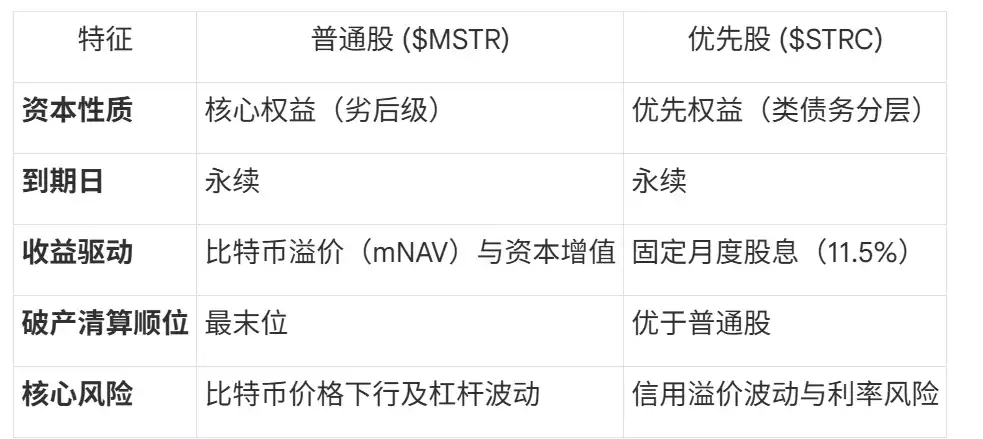
From a financial structure perspective, STRC is a "debt-like" equity instrument issued to external investors. It decomposes Bitcoin's extreme volatility into a credit product with fixed cash flow attributes through layering.

Four Core Features of STRC:

  • Short-Term High-Yield Credit: Positioned as a short-term high-yield instrument, it offers competitive monthly dividends (current annualized interest rate of 11.5%).

  • Perpetual Structure: No fixed maturity date, the company avoids the "principal repayment" pressure of traditional bonds, making it permanent capital.

  • Capital Structure Priority: Higher priority in the liquidation order than common stock ($MSTR), providing a safety cushion for debt-oriented investors.

  • No Default Risk: Legally classified as equity, dividend payments are not mandatory, avoiding bankruptcy triggers due to temporary cash flow shortages.

MSTR vs. STRC
2. Price Anchoring Mechanism: STRC's Anchoring and Liquidity Absorption

Strategy Company uses a series of financial leverages to lock STRC's market price around $100, thereby establishing a stable financing window.

Key Price Control Tools:

  • Dynamic Dividend Adjustment: Strategy uses reflexive interest rate adjustments. If STRC's price falls below $99, the company increases dividends (by 25-50 bps) to stimulate buying; conversely, it lowers rates to curb excessive demand, bringing yields back to market equilibrium.

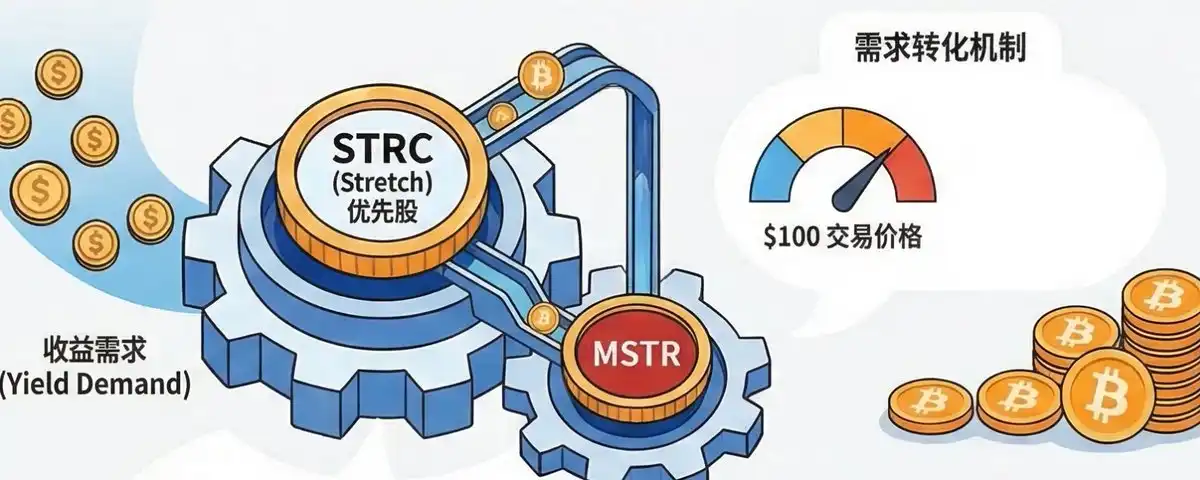
  • ATM (At-The-Market Offering): When STRC's price > $100, Strategy issues additional STRC at $100 and sells it on the market, absorbing surplus demand while converting excess funds into BTC purchasing power.

  • Redemption Clause: The company reserves the right to redeem STRC at $101. This clause psychologically and financially limits investors' motivation to buy at a premium, ensuring the price does not deviate from par value.

  • Tax Efficiency Optimization: STRC dividends have a "return of capital" nature, allowing holders to enjoy tax deferral benefits. This structural design reduces investors' selling frequency and enhances the stability of the $100 price anchor.

Strategy is committed to anchoring STRC's price within the narrow range of $99-$100, using this as the cornerstone for large-scale conversion into Bitcoin purchasing power.

3. Structured BTC Appreciation Flywheel: Converting Trading Volume into Purchasing Power

When the STRC price fluctuates between 99-101, trading volume is converted into BTC purchasing power as follows:

  • Issuing STRC to Meet Excess Demand: When the STRC price reaches $100 (par value), the company issues and sells new shares through the STRC ATM program to meet "excess demand" beyond the current market cap. For example, if STRC's trading volume at $100 is $100 million on a given day, and assuming 30% corresponds to new share issuance, the company sells $30 million worth of STRC and immediately buys $30 million worth of BTC.

  • Balancing Leverage Ratio: Issuing more STRC effectively increases the company's debt. MSTR's current target leverage ratio is around 33%, meaning for every $1 increase in debt, the treasury must hold an additional $3 in BTC. Therefore, with a $30 million debt increase in the above scenario, Strategy needs to add an additional $60 million in BTC.

  • Issuing Common Stock MSTR to Fill the Gap: To acquire this additional $60 million in BTC and maintain stable leverage, the company uses the ATM on its common stock MSTR, issuing and selling $60 million worth of new MSTR shares, then using the proceeds to buy $60 million worth of BTC.

Conclusion: According to this mechanism, every $1 of STRC issued roughly translates to an increase of $3 in BTC in the treasury. Therefore, a daily STRC trading volume of $100 million at par value not only generates $30 million in new STRC but ultimately leads the company to purchase up to $90 million worth of BTC.

Of course, the core factors here are the time and volume STRC traded above $100 during the week; the 30% figure is an assumption for ease of understanding. The actual figure depends on the announcement MSTR releases next week.

This flywheel mechanism cannot spin forever; there are currently three core constraints:

  • STRC Price Must Reach $100: MSTR is only a seller of STRC at $100. If STRC's price is strictly below $100, new share issuance is not triggered, and no new BTC purchasing power is generated.

  • Common Stock mNAV Must Be Greater Than 1x: Strategy's core long-term goal is to increase the Bitcoin-per-share ratio. Selling common stock MSTR to buy BTC increases bps only if MSTR's mNAV is above 1x; if mNAV falls below 1, selling MSTR for BTC would cause dilution, and the company would avoid using the ATM for MSTR. If there is extreme demand for STRC but mNAV is below 1x, the company can only suppress excess demand by lowering STRC's dividend rate.

  • BTC's Long-Term Price Performance (The Fundamental Risk): The entire strategy relies on the long-term expectation of BTC's price appreciation (e.g., annual returns above 20%). If BTC enters a prolonged bear market, STRC could trade below par and sustain a discount, and MSTR's mNAV could fall below 1, cutting off the path to issuing common stock to pay dividends. In such an extreme scenario, Strategy could only rely on its existing dollar reserves (currently sufficient for about 28 months) to pay dividends; if the dollar reserves are depleted, the company would be forced to gradually sell its BTC holdings.

4. Conclusion

Saylor emphasized last year that Strategy is not simply a "DAT" company but a structured finance company backed by Bitcoin. He is not just a simple BTC believer but a financial genius.

Every time BTC falls, Strategy and Saylor himself face the most criticism. Some worry about Strategy blowing up, others worry that Strategy is buying too much, affecting BTC's decentralization.

But Saylor doesn't care; he just wants to buy BTC by any means necessary.

Related Questions

QWhat is STRC and what are its key features?

ASTRC is a type of 'debt-like' equity instrument issued by MicroStrategy. Its four core features are: 1) Short-term high-yield credit with a competitive monthly dividend (currently 11.5% annualized); 2) A perpetual structure with no fixed maturity date; 3) Priority in the capital structure over common stock ($MSTR); 4) No default risk, as it is legally equity and dividend payments are not mandatory.

QHow does MicroStrategy anchor the price of STRC around $100?

AMicroStrategy uses several key tools to anchor STRC price: 1) Dynamic dividend adjustment: It raises the dividend if the price falls below $99 and lowers it to suppress excessive demand above that level. 2) ATM (At-The-Market) offering: It issues and sells new STRC shares at $100 when the price is above that to absorb surplus demand. 3) Redemption clause: The company reserves the right to redeem STRC at $101, limiting investor incentive to buy at a premium. 4) Tax efficiency: The dividend's 'return of capital' nature provides tax deferral, reducing selling frequency.

QAccording to the article, how does STRC trading volume translate into buying pressure for Bitcoin?

AThe mechanism converts STRC trading volume into BTC buying pressure in three steps: 1) When STRC trades at $100, MicroStrategy issues new shares via its offering to meet excess demand. 2) To maintain its target leverage ratio of ~33%, for every $1 of new STRC (liability) issued, the company must hold $3 of BTC in its treasury. 3) To acquire the additional BTC needed to maintain this ratio, the company issues and sells new common stock ($MSTR) and uses the proceeds to buy more BTC. The article estimates that $1 of STRC issuance can ultimately lead to ~$3 of BTC purchases.

QWhat are the three main constraints on this 'flywheel' mechanism described in the article?

AThe three core constraints are: 1) The STRC price must be at or above $100 for the ATM issuance to be activated. 2) The common stock's mNAV (market Net Asset Value) must be greater than 1x for issuing $MSTR to be accretive; if it falls below 1, the company would avoid selling shares. 3) The long-term price performance of Bitcoin is the fundamental risk. A prolonged bear market could cause STRC to trade at a discount and the mNAV to fall below 1, potentially forcing the company to use its dollar reserves and eventually sell BTC to pay dividends.

QHow does the article characterize MicroStrategy's CEO, Michael Saylor, and his strategy?

AThe article characterizes Michael Saylor not merely as a Bitcoin believer but as a 'financial genius.' It states that his company, MicroStrategy, is not a simple 'DAT' (Digital Asset Treasury) company but a structured finance company built around Bitcoin. The strategy involves using financial engineering (through instruments like STRC) to continuously acquire more BTC, a goal he pursues relentlessly despite criticism during market downturns or concerns about Bitcoin's decentralization.

Related Reads

Retail Ecology Dwindles, ZKsync Bets on Bank Pilots for a Breakthrough

Amidst declining retail activity, ZKsync is pivoting to target institutional banking as its primary growth strategy. The article explores this shift, contrasting it with the competitive "survival of the fittest" narrative by highlighting a cooperative model inspired by naturalist Peter Kropotkin. ZKsync is developing infrastructure like its private, permissioned Prividium suite for banks (e.g., Deutsche Bank's use case via Memento), enabling private transactions with public verifiability via zero-knowledge proofs. This appeals to institutions needing privacy, compliance, and Ethereum-based settlement security, unlike fully private chains (e.g., JPMorgan's Kinaxis) or consortium models (e.g., R3 Corda). However, this strategic focus has coincided with a steep decline in its public DeFi ecosystem, evidenced by plunging TVL and the departure of major protocols like Aave due to low fees. The network's future now hinges on banking adoption, with upcoming pilots like the Cari Network involving regional banks holding over $600 billion in deposits. A significant challenge is balancing this institutional focus with ZKsync's decentralized governance. Banks must operate on a network where rules and fees (denominated in the volatile ZK token) can be changed via community vote, and where a Security Council holds emergency control—a stark contrast to the predictable, contract-bound environments of traditional finance. The coming 18 months will test whether ZKsync can successfully onboard traditional banks onto a dynamically governed public chain or if institutions will ultimately revert to proprietary solutions.

Foresight News15m ago

Retail Ecology Dwindles, ZKsync Bets on Bank Pilots for a Breakthrough

Foresight News15m ago

The Recursive AI Anthropic Warned About: Tian Yuandong's New Company Has Just Taken the "First Step"

Anthropic recently highlighted the rapid progress toward "recursive self-improvement," where AI systems autonomously design and train their successors. In response, Recursive Superintelligence, a new company co-founded by former Meta researcher Tian Yuan Dong, has publicly demonstrated its first step toward automating AI research. The company released a system designed to autonomously execute the full AI research cycle: generating ideas, implementing code, running experiments, and learning from results. It validated this approach by achieving state-of-the-art results on three diverse benchmarks: 1. **NanoChat Autoresearch:** Optimizing a small language model's validation loss under a fixed 5-minute GPU budget, improving upon the community's best result. 2. **NanoGPT Speedrun:** Reducing the time to train a GPT model to a specific loss on 8 H100 GPUs from 79.7 seconds to 77.5 seconds, beating a highly optimized, human-driven community effort. 3. **SOL-ExecBench:** Improving the overall score on NVIDIA's suite of 235 GPU kernel optimization tasks by 18%, closing the gap to the hardware limit. The system discovered novel optimizations in this highly specialized domain without direct human expertise. Recursive's system operates as a general framework, capable of parallel exploration and cross-task knowledge transfer while incorporating safeguards against reward hacking. The company, backed by $650M in funding and a star-studded team including Richard Socher and Alexey Dosovitskiy, aims to create AI that recursively enhances its own research capabilities. This development represents an early but concrete move toward a new paradigm where AI accelerates its own advancement. It occurs alongside Anthropic's warnings about the need for industry coordination and potential pauses when recursive self-improvement thresholds are reached, highlighting the dual trajectory of rapid technical progress and growing calls for careful stewardship.

marsbit23m ago

The Recursive AI Anthropic Warned About: Tian Yuandong's New Company Has Just Taken the "First Step"

marsbit23m ago

The Gold Buy-on-the-Dip Guide: Watch Interest Rates, Not Just War

"Gold Buying Guide: Focus on Interest Rates, Not Just War" Four months ago, gold buyers likely didn't anticipate buying at a peak that even a war couldn't sustain. After hitting a record high of $5,596 on January 29, gold entered a bear market just 91 days later, its fastest decline since 2008. A key trigger was the Fed's hawkish shift, highlighting that monetary policy, not geopolitics, is the primary driver. The article argues that the traditional "buy gold in turmoil" script has changed. While the US-Iran conflict initially boosted prices, the sustained rally in oil prices heightened inflation fears, forcing central banks to maintain or consider tighter policy. Since gold yields no interest, higher rates increase its opportunity cost, eroding its appeal. This dynamic was evident when gold fell sharply on May 18 despite positive peace talks, as lower oil prices eased inflation and thus rate hike pressures. The recent sell-off is also part of a broader market deleveraging. Correlations between gold, Nasdaq, and Bitcoin spiked as leveraged investors sold liquid assets to cover losses, creating a synchronized downturn. Historically, gold bottoms align with policy shifts, not conflict resolutions. The 2008 and 2022 bear markets ended with shifts to extreme easing and peak inflation expectations, respectively. For potential buyers, the author suggests monitoring three signals: 1) Peak interest rate hike expectations, 2) Reopening of the Strait of Hormuz (to ease oil/inflation pressure), and 3) A return to net inflows for Gold ETFs, indicating the end of forced selling. While predicting the exact bottom is impossible, the author's personal strategy involves scaling into a position across price levels like $4000, $3700, and $3500, committing no more than 30% of the intended total allocation initially, and adding the remainder only if key signals emerge. The core conclusion: In turbulent times, watching interest rates is more crucial than watching wars.

marsbit29m ago

The Gold Buy-on-the-Dip Guide: Watch Interest Rates, Not Just War

marsbit29m ago

Recent On-Chain Review: No Clear Narrative Under U.S. Stock Market Pressure, Just Hype

This article analyzes the current state of the Solana meme coin and community token ecosystem, highlighting a market caught between two dominant forces: attention-based PvP and a gradual return to community-centric projects. The first part explores the "Attention PvP" dynamic, where success is driven by celebrity endorsements, viral events, and speed. Examples include $JOTCHUA, which surged after its meme creator's social media activity, and $WORLDCUP, which outperformed a similar Base chain project ($PITCH) largely due to influencer support. The recent "pump.fun GO" feature, allowing bounty tasks for token promotion, is critiqued for fostering sensationalist and often negative stunts—like people getting token tickers tattooed on their bodies for rewards—reminiscent of old internet shock content. In contrast, the article points to a resurgence of organic, community-driven tokens that survive market volatility through strong holder bases and shared ideology, not just hype. Influencer Ansem is cited, arguing that durable meme coins rely on communities willing to endure losses and promote their core message daily. Examples given are older tokens like $neet (anti-work ethos), $troll, $buttcoin, and $triplet, which have maintained relative price stability. A prime example of this community-build model is the new project $KINS, the token for the browser-based MMORPG Kintara. Its success stems not from advanced graphics but from consistently delivering updates, fostering player trust, and creating genuine engagement (e.g., in-game economies, events, property auctions). It has attracted a growing player base and even notable KOLs as participants, demonstrating that sustainable growth can come from building trust rather than orchestrating pumps. The article concludes by questioning whether the market is ultimately a game of mutual trust or mutual deception, expressing hope that such reflection might lead to a healthier ecosystem.

marsbit29m ago

Recent On-Chain Review: No Clear Narrative Under U.S. Stock Market Pressure, Just Hype

marsbit29m ago

Trading

Spot
Futures

Hot Articles

Discussions

Welcome to the HTX Community. Here, you can stay informed about the latest platform developments and gain access to professional market insights. Users' opinions on the price of S (S) are presented below.

活动图片