The Governance Struggle Behind the Power Play of Aave DAO and Aave Labs

marsbit2025-12-15 tarihinde yayınlandı2025-12-15 tarihinde güncellendi

Özet

The article details a governance conflict between Aave DAO and Aave Labs, centering on a dispute over revenue generated by the frontend. The controversy began when Aave Labs replaced the integrated ParaSwap with CoW Swap on its frontend and directed the resulting fees to its private address, rather than to the DAO treasury. An anonymous DAO member, EzR3aL, publicly criticized this move, accusing Labs of privatizing protocol value. Aave DAO represents the protocol layer, governed by $AAVE token holders who vote on proposals. Aave Labs is the development team responsible for building and maintaining the frontend, brand, and product partnerships. The core issue is whether Aave is a decentralized protocol owned by the DAO or a project built and controlled by Labs, and how this distinction affects revenue rights. DAO supporters argue that all value generated should benefit token holders, while Labs contends that frontend-related income rightfully belongs to them. The situation highlights a broader industry-wide governance dilemma: the tension between decentralized community control and the need for a centralized, efficient team to drive development and maintain market position. The article suggests that a potential compromise, such as transparent revenue-sharing agreements, may be necessary. It concludes that how Aave resolves this conflict could set a precedent for other DeFi projects facing similar governance challenges.

Author: Chen Mo cmDeFi

The recent heated dispute between Aave DAO and Aave Labs over governance power at the protocol and product layers reflects the broader governance challenges across the industry. Here’s a breakdown of the issue. Who truly owns Aave?

1/6 · The Origin

Aave Labs replaced the frontend integration of ParaSwap with CoW Swap, and the resulting fees were directed to a private address of Labs. An anonymous DAO member, EzR3aL, exposed this on the governance forum, accusing Labs of "privatizing" protocol value. Labs' stance is that this belongs to frontend and product layer revenue, which rightfully belongs to Labs, and is unrelated to the protocol core.

2/6 · First, Let's Break Down Who Aave DAO and Aave Labs Are

  • DAO represents the Protocol (protocol layer)
  • Labs represents the Project (product layer)

The core dispute is whether Aave is a Protocol (managed by the DAO) or a Project (built by Labs)? And the implications for revenue rights.

Aave DAO is straightforward to understand. It is a unique type of governance organization in the Crypto world, composed of $AAVE token holders who exercise power through voting within the DAO. Almost 90%+ of crypto projects follow this structure; the term "governance token" originates from this. Its primary power is to vote on project proposals, deciding whether to implement certain updates and developments, as well as the future direction of the project.

Aave Labs is a development team responsible for building, updating, and maintaining the protocol (e.g., frontend interfaces, mobile apps). Typically, they also maintain the Aave brand and IP, so on social media and in the market, Aave Labs is often defaulted to being Aave. Its founders are also quite influential on social media.

Generally, Aave Labs and Aave DAO need to collaborate. For instance, Labs leads the development of many plans, optimizations of certain features, and even version upgrades like V3 and V4. These proposals are led by Aave Labs but ultimately decided by DAO vote. Usually, when their interests align, they have a mutually supportive relationship, together forming Aave.

3/6 · What Core Resources Do They Respectively Control?

Once conflicts of interest emerge, these two roles can be separated, as they are inherently independent entities. Let’s look at the core resources and power each holds:

Aave DAO controls the underlying core. For example, the smart contracts; treasury control is in the hands of the DAO. Although Labs can propose development plans, they require a DAO vote to be implemented. So it is the Protocol; the upper layer can be any product that operates. Theoretically, multiple frontend products can be built on top of one Protocol—Aave, Bave, Cave, etc.

Aave Labs controls the frontend, brand, product marketing, and partnerships. So it interacts directly with users and represents a quality product.

Therefore, supporters of Labs generally believe that the CoW Swap integration is purely a frontend behavior, unrelated to Aave's underlying architecture. Labs could even unilaterally decide not to integrate it, so any revenue generated should naturally belong to Labs. Conversely, DAO supporters view this as a form of appropriation because, with the existence of the AAVE governance token, all benefits should优先 flow to AAVE holders or remain in the treasury for the DAO to decide. Additionally, previously, ParaSwap revenue consistently flowed into the DAO. The new CoW Swap integration changed this status, further leading the DAO to see this as a grab.

Both sides have their arguments.

4/6 · Governance Dilemma

This highlights a rather awkward governance and power dilemma. From the perspective of $AAVE holders, they typically side with the DAO, because revenue entering the treasury benefits token holders. Although Labs has corresponding annual expenses, these can be reimbursed through the DAO. If a separate channel for profit can be opened, it seems community power is gradually being eroded.

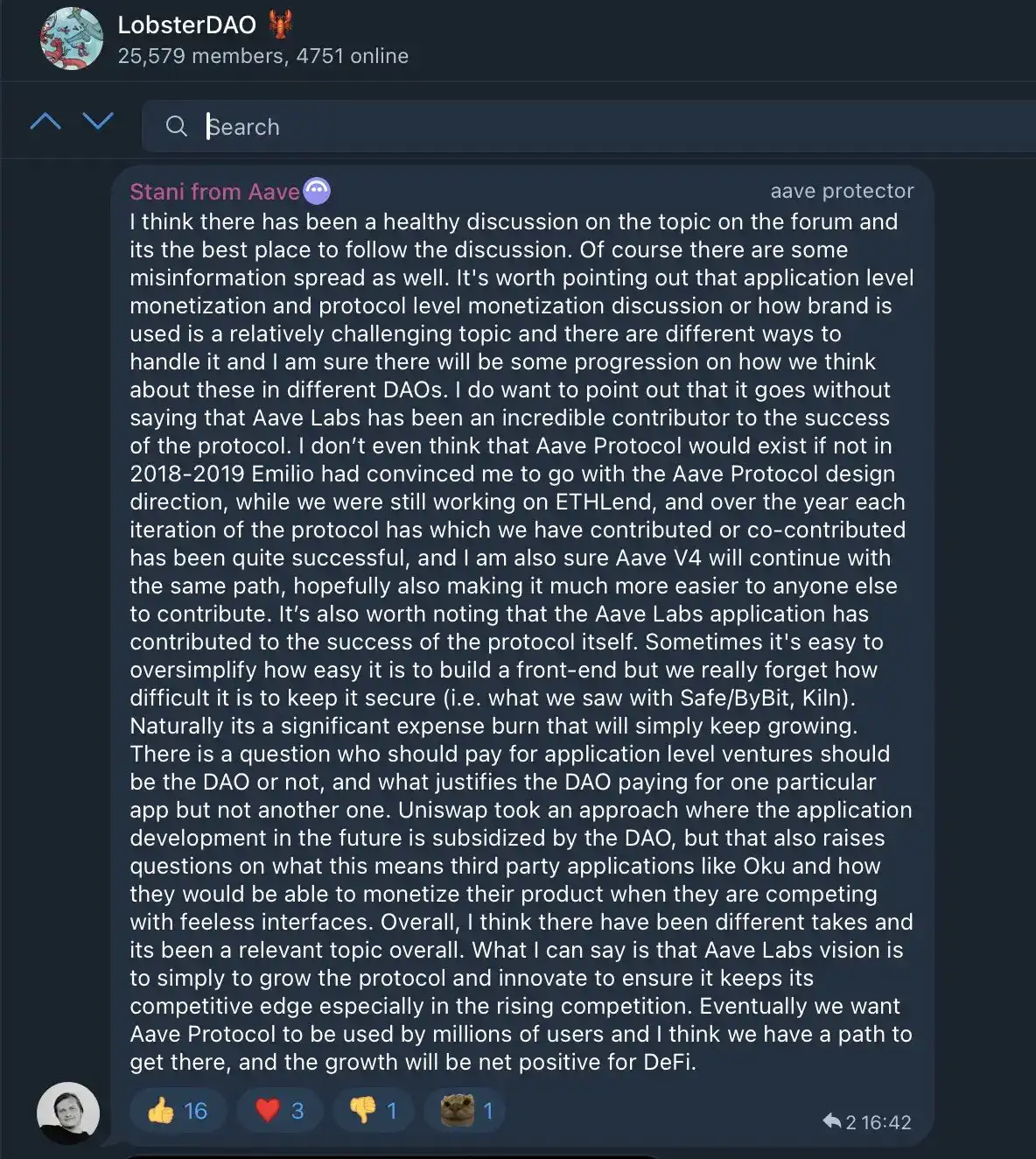
But from Aave Labs' perspective, although the theoretical core control lies with the DAO, and proposals ultimately require a vote to be implemented, from the first version of Aave to now, Labs has played a role in unifying and leading the overall situation, making huge contributions to the project's growth. As Stani said, "If it weren't for Emilio convincing me to adopt the Aave protocol design direction back in 2018-2019, when we were still working on ETHLend, I think the Aave protocol might not have existed at all."

Who is the true owner of Aave?
5/6 · Power Struggle

This governance dilemma exists in most projects. Governance tokens are bought with real money. Ideally, these holders collectively decide the project's future. When the team no longer holds voting power, they could even forcibly replace Labs.

But the reality is far from ideal. Even for projects with a certain market share, when internal team problems and disputes arise, the aftermath often leads to a loss of market position. Sushi is a good example. The DAO can exercise power, and the project can change hands. Although, thanks to smart contract design, even if a project undergoes a major reshuffle, the product functionality can remain perfectly stable. However, judging from past cases, the outcome of splits is usually not good.

The core issue here is that, for now, a DAO is a decentralized organization by nature. Although it has voting power, it struggles to operate efficiently. The community may include independent developers, VCs, and large holders. Once each role begins to exercise its power fully, a proposal can undergo multiple rounds of formulation, modification, and博弈 from the start. The success of a project requires a professional team and continuity. A DAO can hire a new team, but it may be difficult to quickly transition and iterate, easily losing market position. Therefore, the existence of Labs, on the surface,更像 the entity that can "control" the protocol (in collaboration with the DAO).

Personally, I lean towards the two parties eventually reaching a solution to balance the distribution of interests. But currently, everything is under discussion, and no governance vote has appeared. The potential risk behind this is that even if a reconciliation is ultimately reached, this incident has already exposed a divergence in expectations between the founding team and token holders.

Long-term, I remain optimistic about Aave's development because it is one of the few DeFi projects that has been market-verified with a strong moat. The矛盾 of governance power is a problem the entire industry needs to face. How Aave handles this incident may become a benchmark case for the industry in the future.

6/6 · Voices and Discussion

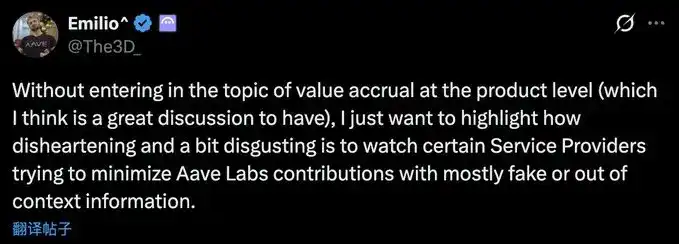
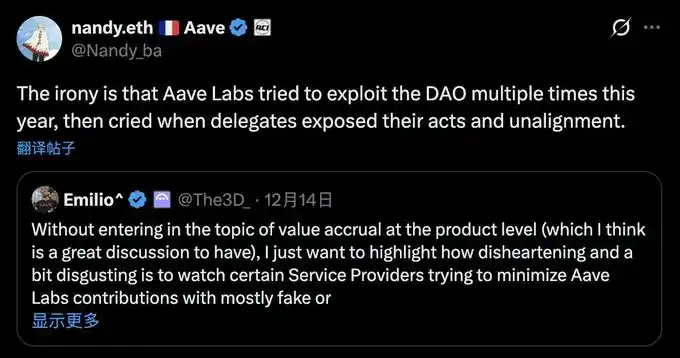
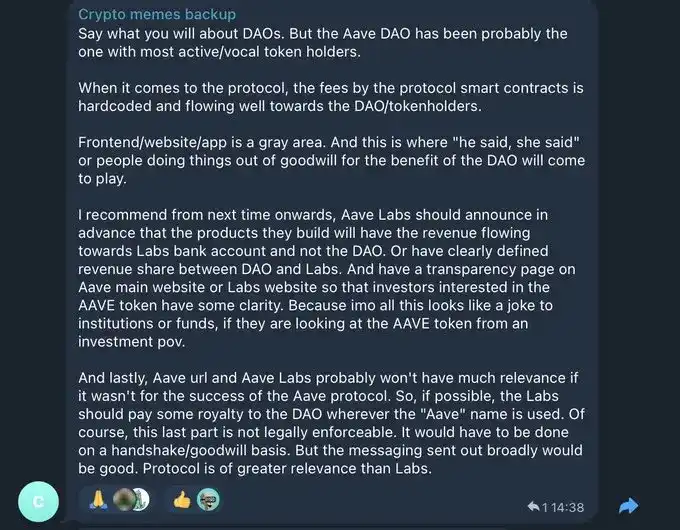
Arguments. Emilio believes someone is maliciously贬低 the contributions and value of Aave Labs. ACI team members pointed out that Aave Labs has repeatedly tried to exploit the DAO and been exposed.
Community suggestions for Labs:

  • Labs should announce in advance that revenue from products they build will flow to Labs, not the DAO.
  • Or clearly define a revenue-sharing ratio between the DAO and Labs.
  • Establish a transparent page on the Aave main website or Labs website providing clear information to help investors interested in the $AAVE token (especially institutions or funds) make judgments.

Although the DAO model is controversial, Aave DAO token holders are among the most active and vocal groups, demonstrating the community's vitality. The frontend, website, and application are focal points of controversy, where "each sticks to their own argument" situations easily arise, lacking clear definition.
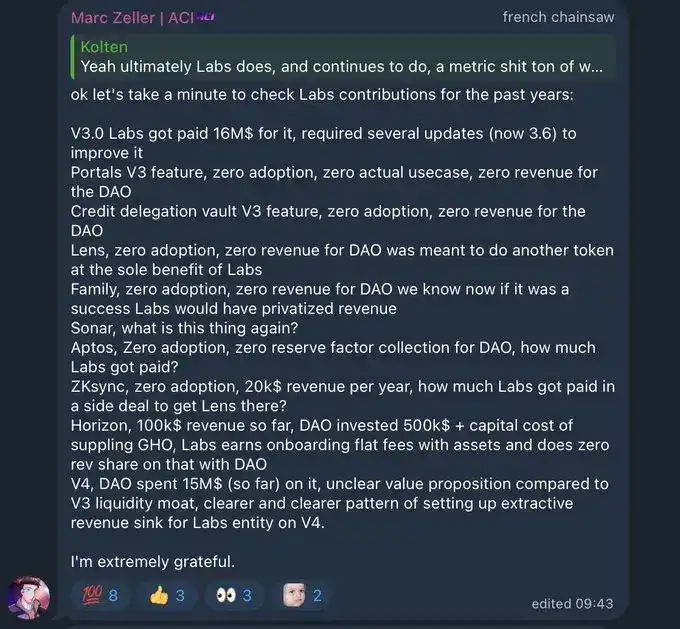
Some of Zeller's accusations against Labs for extracting protocol value:

The listed projects (Portals, Credit Delegation Vault, Lens, etc.) indeed indicate that many of Aave Labs' exploratory initiatives have not directly translated into protocol revenue or significant adoption rates.

It also mentions the V4 version. The DAO has spent $15 million so far. Compared to the liquidity moat of V3, the value proposition is unclear, raising concerns about whether this is a new trap for extracting revenue.

Failure is inevitable in the process of innovation. Not every feature or product can succeed. The DAO is, to some extent, investing in Aave Labs' R&D capability. My understanding is that Zeller is not否定 the contribution but calling for higher standards of accountability, transparency, and value alignment.
Recommended Reading:

Why Isn't Asia's Largest Bitcoin Treasury Company Metaplanet Buying the Dip?

Multicoin Capital: The Era of FinTech 4.0 Has Arrived

a16z's Heavily Funded Web3 Unicorn Farcaster Forced to Pivot, Is Web3 Social a False Proposition?


İlgili Sorular

QWhat was the initial event that sparked the governance conflict between Aave DAO and Aave Labs?

AAave Labs replaced the frontend integration from ParaSwap to CoW Swap, and the fees generated from this new integration were directed to a private address controlled by Labs instead of the DAO treasury.

QWhat is the core dispute regarding the nature of Aave, as described in the article?

AThe core dispute is whether Aave is a Protocol (managed by the DAO) or a Project (built by Labs), and how this definition impacts the rights to revenue generated from its ecosystem.

QAccording to the article, what key resources does Aave DAO control versus Aave Labs?

AAave DAO controls the core protocol layer, including the smart contracts and the treasury. Aave Labs controls the frontend, brand, product marketing, and partnerships.

QWhat is one of the major governance dilemmas highlighted in the Aave case?

AA major dilemma is the tension between the ideal of decentralized governance by token holders (DAO) and the practical need for a centralized, efficient, and continuous development team (Labs) to maintain and grow the project.

QWhat was a community suggestion for Aave Labs to improve transparency and align interests?

AA community suggestion was for Labs to clearly announce in advance when product revenues will flow to Labs instead of the DAO, or to define a clear revenue-sharing ratio between DAO and Labs.

İlgili Okumalar

Google and Amazon Simultaneously Invest Heavily in a Competitor: The Most Absurd Business Logic of the AI Era Is Becoming Reality

In a span of four days, Amazon announced an additional $25 billion investment, and Google pledged up to $40 billion—both direct competitors pouring over $65 billion into the same AI startup, Anthropic. Rather than a typical venture capital move, this signals the latest escalation in the cloud wars. The core of the deal is not equity but compute pre-orders: Anthropic must spend the majority of these funds on AWS and Google Cloud services and chips, effectively locking in massive future compute consumption. This reflects a shift in cloud market dynamics—enterprises now choose cloud providers based on which hosts the best AI models, not just price or stability. With OpenAI deeply tied to Microsoft, Anthropic’s Claude has become the only viable strategic asset for Google and Amazon to remain competitive. Anthropic’s annualized revenue has surged to $30 billion, and it is expanding into verticals like biotech, positioning itself as a cross-industry AI infrastructure layer. However, this funding comes with constraints: Anthropic’s independence is challenged as it balances two rival investors, its safety-first narrative faces pressure from regulatory scrutiny, and its path to IPO introduces new financial pressures. Globally, this accelerates a "tri-polar" closed-loop structure in AI infrastructure, with Microsoft-OpenAI, Google-Anthropic, and Amazon-Anthropic forming exclusive model-cloud alliances. In contrast, China’s landscape differs—investments like Alibaba and Tencent backing open-source model firm DeepSeek reflect a more decoupled approach, though closed-source models from major cloud providers still dominate. The $65 billion bet is ultimately about securing a seat at the table in an AI-defined future—where missing the model layer means losing the cloud war.

marsbit1 saat önce

Google and Amazon Simultaneously Invest Heavily in a Competitor: The Most Absurd Business Logic of the AI Era Is Becoming Reality

marsbit1 saat önce

Computing Power Constrained, Why Did DeepSeek-V4 Open Source?

DeepSeek-V4 has been released as a preview open-source model, featuring 1 million tokens of context length as a baseline capability—previously a premium feature locked behind enterprise paywalls by major overseas AI firms. The official announcement, however, openly acknowledges computational constraints, particularly limited service throughput for the high-end DeepSeek-V4-Pro version due to restricted high-end computing power. Rather than competing on pure scale, DeepSeek adopts a pragmatic approach that balances algorithmic innovation with hardware realities in China’s AI ecosystem. The V4-Pro model uses a highly sparse architecture with 1.6T total parameters but only activates 49B during inference. It performs strongly in agentic coding, knowledge-intensive tasks, and STEM reasoning, competing closely with top-tier closed models like Gemini Pro 3.1 and Claude Opus 4.6 in certain scenarios. A key strategic product is the Flash edition, with 284B total parameters but only 13B activated—making it cost-effective and accessible for mid- and low-tier hardware, including domestic AI chips from Huawei (Ascend), Cambricon, and Hygon. This design supports broader adoption across developers and SMEs while stimulating China's domestic semiconductor ecosystem. Despite facing talent outflow and intense competition in user traffic—with rivals like Doubao and Qianwen leading in monthly active users—DeepSeek has maintained technical momentum. The release also comes amid reports of a new funding round targeting a valuation exceeding $10 billion, potentially setting a new record in China’s LLM sector. Ultimately, DeepSeek-V4 represents a shift toward open yet realistic infrastructure development in the constrained compute landscape of Chinese AI, emphasizing engineering efficiency and domestic hardware compatibility over pure model scale.

marsbit1 saat önce

Computing Power Constrained, Why Did DeepSeek-V4 Open Source?

marsbit1 saat önce

İşlemler

Spot
Futures

Popüler Makaleler

DAO Nasıl Satın Alınır

HTX.com’a hoş geldiniz! DAO Maker (DAO) satın alma işlemlerini basit ve kullanışlı bir hâle getirdik. Adım adım açıkladığımız rehberimizi takip ederek kripto yolculuğunuza başlayın. 1. Adım: HTX Hesabınızı OluşturunHTX'te ücretsiz bir hesap açmak için e-posta adresinizi veya telefon numaranızı kullanın. Sorunsuzca kaydolun ve tüm özelliklerin kilidini açın. Hesabımı Aç2. Adım: Kripto Satın Al Bölümüne Gidin ve Ödeme Yönteminizi SeçinKredi/Banka Kartı: Visa veya Mastercard'ınızı kullanarak anında DAO Maker (DAO) satın alın.Bakiye: Sorunsuz bir şekilde işlem yapmak için HTX hesap bakiyenizdeki fonları kullanın.Üçüncü Taraflar: Kullanımı kolaylaştırmak için Google Pay ve Apple Pay gibi popüler ödeme yöntemlerini ekledik.P2P: HTX'teki diğer kullanıcılarla doğrudan işlem yapın.Borsa Dışı (OTC): Yatırımcılar için kişiye özel hizmetler ve rekabetçi döviz kurları sunuyoruz.3. Adım: DAO Maker (DAO) Varlıklarınızı SaklayınDAO Maker (DAO) satın aldıktan sonra HTX hesabınızda saklayın. Alternatif olarak, blok zinciri transferi yoluyla başka bir yere gönderebilir veya diğer kripto para birimlerini takas etmek için kullanabilirsiniz.4. Adım: DAO Maker (DAO) Varlıklarınızla İşlem YapınHTX'in spot piyasasında DAO Maker (DAO) ile kolayca işlemler yapın.Hesabınıza erişin, işlem çiftinizi seçin, işlemlerinizi gerçekleştirin ve gerçek zamanlı olarak izleyin. Hem yeni başlayanlar hem de deneyimli yatırımcılar için kullanıcı dostu bir deneyim sunuyoruz.

145 Toplam GörüntülenmeYayınlanma 2024.12.11Güncellenme 2025.03.21

DAO Nasıl Satın Alınır

Tartışmalar

HTX Topluluğuna hoş geldiniz. Burada, en son platform gelişmeleri hakkında bilgi sahibi olabilir ve profesyonel piyasa görüşlerine erişebilirsiniz. Kullanıcıların DAO (DAO) fiyatı hakkındaki görüşleri aşağıda sunulmaktadır.

活动图片