The Art of Speculation: When Coin Launches Become a Mind-Reading Game Centered on Leaders' Social Dynamics

比推Published on 2026-01-08Last updated on 2026-01-08

Abstract

The article "The Art of Reading Between the Lines: When Coin Listings Become a Game of Guessing Leaders' Social Cues" critiques the culture of speculation and sycophancy in the cryptocurrency space, particularly around Binance’s listing process. It draws a parallel to a Shandong dining custom where the fish head is pointed toward the guest of honor as a sign of respect—a tacit social rule that requires intuition rather than explicit instruction. The piece centers on a recent event where He Yi, Binance’s co-founder, posted a cryptic New Year’s tweet saying “我踏马来了” (roughly: “Here the f*ck I come”). Shortly after, a community-created meme token with the same name was listed on Binance Alpha, despite He Yi’s earlier statements against favoritism and “insider coins.” The author argues that this reflects a deeper cultural issue: the shift from merit-based innovation to a system where success depends on interpreting the subtle hints of influential figures. Unlike traditional industries where technical skill or product quality drive progress, the crypto industry often prioritizes access to information, relationships, and the ability to please key decision-makers. The piece suggests that this “Shandong mindset”—where insiders learn to “read the room” rather than challenge or create—undermines transparency and rewards those who excel at flattery rather than genuine contribution. While He Yi may not have directly endorsed the token, the very fact that her social media activity can t...

Author: Kuli, Shenchao TechFlow

Original Title: Where the Fish Head Faces He Yi: Crypto Has Its Shandong-Style Politics Too


There's a rule at Shandong banquets: when the fish is served, the head must face the seat of honor.

Whoever it faces is the main guest and must drink first. This isn't written down anywhere, but everyone in Shandong knows it. No one teaches you; you just learn it.

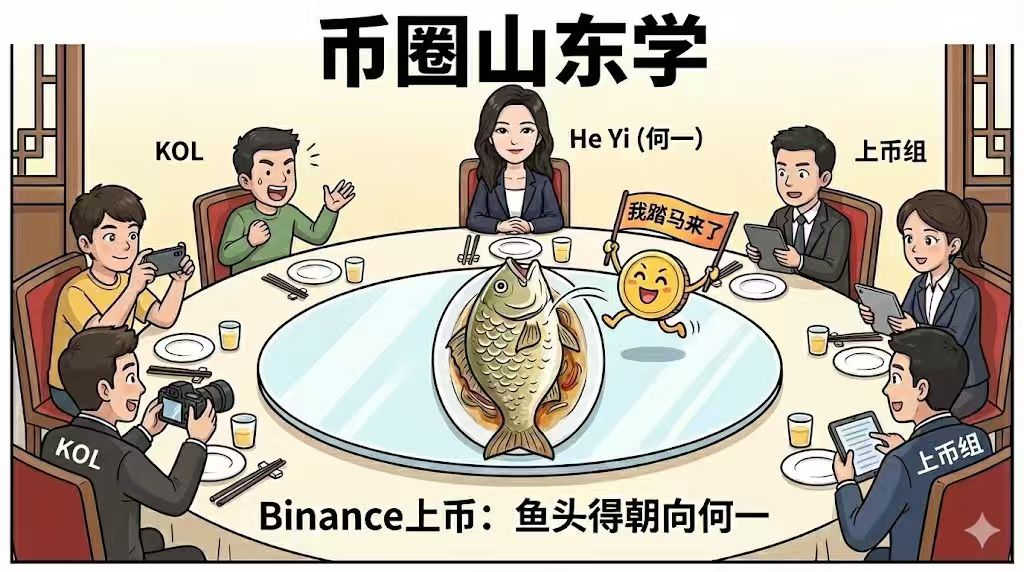
Recently, someone drew a picture called "Crypto Shandong-Style Politics." A group of people sit around a table eating fish, with He Yi in the seat of honor, flanked by KOLs, the listing team, and social media editors.

Caption: For a Binance listing, the fish head must face He Yi.
On January 1st, He Yi posted a New Year's tweet. Riding a white horse by the seaside, caption in four characters:

我踏马来了 (Wǒ tà mǎ lái le - I've f*cking arrived).

A fine New Year's greeting. "Tà mǎ" (踏马), the Year of the Horse, with a bit of playful homophonic wordplay.

Today, Binance Alpha listed a new token called "我踏马来了" (I've F*cking Arrived). It was community-made, with no direct connection to He Yi.

But look at this chain: First Sister tweets, the community creates a token, Alpha lists it.

No one needs to give any orders in the middle.

Last year, Binance was hounded by accusations of "BFF coins," alleging shady listing practices and利益输送 (interest conveyance/corruption). He Yi responded several times, saying they were reflecting, adjusting, and even created Alpha as a screening pool.

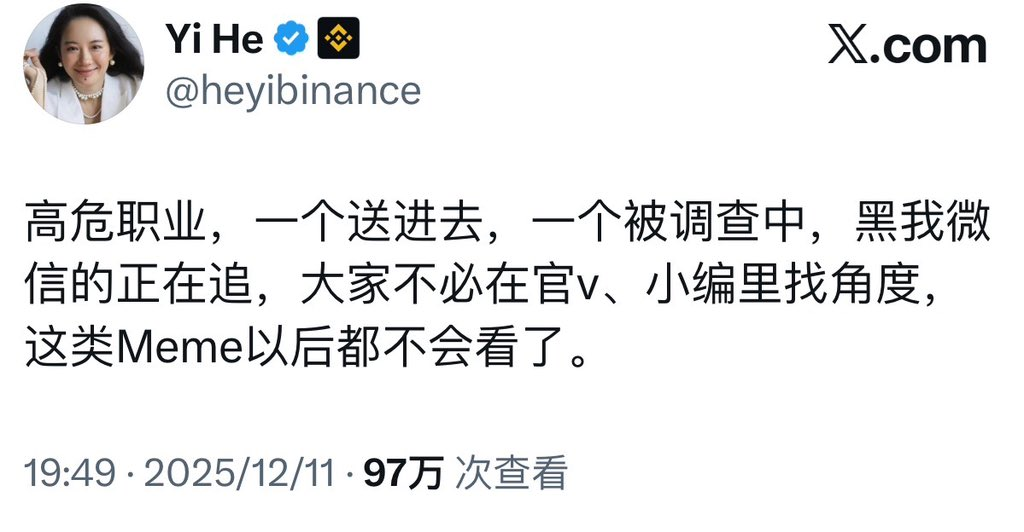
In December, she also tweeted saying, don't try to find angles in our official tweets about various Memes; we won't pay attention to this kind of thing anymore.

28 days later, her New Year's tweet became a new token on Alpha.
What was the problem with BFF coins? It was about backdoor deals, favoritism,利益输送 (interest conveyance/corruption).

These require evidence, a paper trail, a specific "BFF."

But "I've F*cking Arrived" doesn't need any of that.

No backdoor, no favoritism, no利益输送. First Sister posted a picture, and the people below just started moving on their own.

This perhaps touches on the essence of Shandong-style politics: the leader doesn't need to speak; you have to figure it out yourself.

Someone in the community commented that Alpha is now just a tool for currying favor, its purpose is to make First Sister happy.

Crude wording, but it describes a certain atmosphere.

When a platform's direction starts revolving around someone's social media activity, when "which coin to list" becomes "guess what she likes," rules cease to matter.

What matters is揣摩 (speculation/reading intentions).

Some put it more harshly: If you want to know if an industry has a future, ask one question—In this industry, do people who are good at flattery succeed more easily than people who are good at doing the work?

If the answer is "yes," then this industry is on the decline.

In crypto, this trick really works. And the most successful ones, everyone knows which direction the flattery should be aimed.

The core resources in the AI circle are technology and products; you have to deliver. Jensen Huang won't allocate you GPUs just because you call him daddy every day.

The core resources in the crypto circle are listing power, traffic, and who knows the news first. These things aren't in the code; they're in people's hands.

Things in people's hands must be obtained through human methods.

The more Shandong-style politics prevails, the more it relies on connections and information asymmetry, not innovation and technology.

He Yi might not even know about this. A small MEME worth a few million market cap isn't enough to bother the Co-CEO.

But that's precisely the problem.

She doesn't need to know. The fish head will turn by itself.

This is really much more efficient than BFF coins.

BFF coins at least required a BFF. Shandong-style politics only requires an atmosphere.

And those who see through this set of rules and implement them thoroughly are, in a way, also talented.

After all, in this society, people laugh at the poor, not the prostitute. (笑贫不笑娼 - A saying criticizing societal values that scorn poverty but overlook the means of acquiring wealth).


Twitter:https://twitter.com/BitpushNewsCN

BitPush TG Discussion Group:https://t.me/BitPushCommunity

BitPush TG Channel: https://t.me/bitpush

Original link:https://www.bitpush.news/articles/7601064

Related Questions

QWhat is the core argument of the article 'The Art of Speculation: When Coin Listings Become a Mind-Reading Game Around a Leader's Social Media'?

AThe article argues that in the crypto space, especially around Binance, the process of token listings has shifted from being based on innovation and technology to a culture of揣摩 (speculation/guessing) where community members and projects try to interpret the social media posts of leaders like He Yi to gain favor, rather than relying on formal rules or merit.

QWhat is 'Shandong Study' (山东学) as described in the article, and how does it relate to Binance's token listing process?

A'Shandong Study' is a metaphor derived from a Shandong dining custom where the fish head is pointed towards the guest of honor. In the context of Binance, it symbolizes a culture where participants automatically align their actions (like creating and listing tokens) to please or anticipate the preferences of leader He Yi, without any explicit instruction, mimicking the unspoken rule of the dining tradition.

QHow does the article contrast the 'Shandong Study' phenomenon with the previous '闺蜜币' (close-friend coin) controversy at Binance?

AThe '闺蜜币' controversy involved allegations of explicit favoritism, backdoor deals, and利益输送 (benefit transfer) through personal connections. In contrast, the 'Shandong Study' phenomenon requires no direct orders or concrete relationships; it operates through an implicit atmosphere where community members spontaneously act to please the leader based on social media cues, making it more efficient and less traceable than the 'close-friend coin' issue.

QAccording to the article, what does the success of the meme token '我踏马来了' (I'm Coming on Horseback) demonstrate about the current state of the crypto industry?

AThe success of '我踏马来了'—a token created and listed on Binance Alpha simply because it was inspired by He Yi's tweet—demonstrates that in the crypto industry, success can be driven by揣摩 (speculating on) and catering to the preferences of influential leaders rather than technological innovation or product merit, indicating a reliance on人际关系 (relationships) and information asymmetry.

QWhat critical question does the article suggest asking to determine if an industry has a future, and what is the implied answer for the crypto space based on the examples given?

AThe article suggests asking: 'In this industry, do people who are good at flattery succeed more easily than those who are good at doing actual work?' The implied answer for the crypto space is 'yes,' as the examples show that tokens gaining traction through揣摩 (speculation) and alignment with leaders' social media are successful, suggesting the industry may be declining if this culture persists.

Related Reads

Low Investment Isn't Apple's Immunity Pass

While Meta and Google face investor scrutiny over ballooning AI capital expenditures, Apple's minimal AI investment has paradoxically become a strength. Its market cap recently reclaimed the global top spot, surpassing $5 trillion. The irony is deep: Apple's own AI efforts have lagged, with "Apple Intelligence" delayed and core talent lost, forcing reliance on partners like Google Gemini and Alibaba's Qianwen. Its Q3 FY2026 (Q2 CY) earnings initially seemed stellar. Revenue hit $109.4B (up 16% YoY), with iPhone and Mac sales, growing 22% and 29% respectively, driving most of the growth. However, the stock fell over 8% post-earnings. The primary concern was a weaker Q4 revenue growth forecast of 9-11%, below expectations, due to looming supply chain constraints. Apple is feeling the indirect cost of the AI boom. Soaring memory and chip prices, fueled by massive data center investments from Microsoft, Amazon, and others, are forcing Apple to raise Mac and iPad prices significantly. The upcoming iPhone launch is also expected to see substantial price hikes. Despite avoiding heavy AI infrastructure spending—its capital expenditures are actually down 28%—Apple cannot escape the industry-wide supply and cost pressures. While Apple's operating cash flow remains robust, its substantial R&D spending (up 32% YoY) has yet to yield major AI breakthroughs. As Tim Cook prepares to step down as CEO, Apple faces a challenging transition: balancing its premium hardware success against the strategic and cost pressures of the AI era it has so far cautiously navigated.

marsbit18m ago

Low Investment Isn't Apple's Immunity Pass

marsbit18m ago

PA Graphics Explanation | One Chart to Understand the Major Web3 Events in August 2026

**PANews Crypto Calendar: Key Web3 Events in August 2026** PANews introduces its revamped crypto calendar, featuring comprehensive coverage, flexible filtering, and easy export options. The market in August will be shaped by multiple key events across macroeconomics, regulation, tokenomics, and project developments: * **Macro & Policy:** Key US economic data releases (July Non-Farm Payrolls, CPI), the Federal Reserve meeting minutes, and the Jackson Hole Economic Symposium will be in focus. On the regulatory front, the US Senate plans to release a new draft of the *CLARITY Act*, while the EU's expanded crypto ban against Belarus comes into effect. * **Token Unlocks:** Significant token unlocks are scheduled for assets including ENA, AVAX, CONX, ZRO, and KAITO, which may influence market volatility. * **Project Updates & Shutdowns:** Several services, including Exchange Art, Ctrl Wallet, Zapper, NFTfi, and Summer.fi, are set to cease operations or undergo major adjustments. Users are advised to manage their assets accordingly. * **Corporate Activity:** Q2 earnings reports from companies like SpaceX, Circle, and Nvidia are due. Unitree Robotics will initiate its IPO subscription on the STAR Market, and Moonshot AI plans to begin a Pre-IPO financing round. * **Industry Events:** Major conferences such as Bitcoin Asia 2026 and the 2026 Digital Expo will take place. The overarching market narrative for August will revolve around macroeconomic expectations, regulatory developments, token unlock schedules, and ongoing industry consolidation.

marsbit29m ago

PA Graphics Explanation | One Chart to Understand the Major Web3 Events in August 2026

marsbit29m ago

Wall Street's Most Famous 'Cassandra' Now Has His Sights Set on Nvidia

Michael Burry, the famed "Big Short" investor, has once again captured Wall Street's attention with a series of short positions against major tech and semiconductor stocks, most notably Nvidia. In late June and July, through his "Cassandra Unchained" newsletter, Burry disclosed short bets against Nvidia, Tesla, Applied Materials, Caterpillar, the SOXX semiconductor ETF, and later, Micron Technology. His core thesis revolves around potential distortions in the AI infrastructure boom, specifically questioning whether extended depreciation schedules (e.g., 6 years vs. a realistic 2-3 years for AI chips) by cloud giants like Microsoft and Google artificially inflate profits. He also raises concerns about possible "off-balance-sheet circular financing," where chip demand might be propped up by vendor-backed funding to clients. Nvidia's stock experienced volatility following these disclosures, briefly dipping but largely holding near Burry's reported entry points, leaving his positions roughly flat or slightly underwater as of late July. This move is part of a pattern for Burry, whose track record since his legendary 2008 bet is mixed. He has faced notable losses, such as on Tesla in 2021, while scoring on broader market turns like the 2020 pandemic crash. His methodology focuses intensely on free cash flow and scrutinizing original financial documents to spot overvaluation and structural risks, but it often struggles with timing the market. The article contrasts Burry's stance with other prominent investors. Steve Eisman, another "Big Short" figure, is not shorting Nvidia, citing strong fundamentals but expressing nervousness about sustainability. Jim Chanos agrees with the broad "accounting mismatch" concern—comparing it to the dot-com bubble—but targets financial leverage in private equity firms rather than the chip stocks themselves. While Nvidia's short interest remains relatively low at 1.3-1.4% of float, the massive stock size means absolute short losses have been significant, exceeding $5 billion earlier this year. The piece concludes that for ordinary investors, the key takeaway is not replicating specific short bets but learning from the critical frameworks these investors use: questioning rosy accounting, identifying structural vulnerabilities, and maintaining skepticism during market euphoria, even if pinpointing the exact catalyst for a downturn remains elusive.

marsbit54m ago

Wall Street's Most Famous 'Cassandra' Now Has His Sights Set on Nvidia

marsbit54m ago

Weekly Selection丨Epic Stock Market Volatility, Changxin Tech's IPO Reshapes Storage Landscape, Saylor Aims to Re-Anchor STRC Around September 8th

PANews Weekly Digest: Market Turmoil, Tech Breakthroughs, and Crypto Developments. The week saw significant volatility across global markets. South Korea's KOSPI index experienced extreme turbulence, including multiple trading halts, largely driven by sharp declines in AI hardware stocks like SK Hynix. In contrast, China's Changxin Xinqiao (CXC) achieved a landmark IPO with a market cap surpassing 4 trillion yuan, marking a major success for the domestic DRAM industry after a decade of losses. In the crypto and Web3 space, several key narratives emerged. AI is driving demand for new infrastructure, with projects like AI agent wallets and programmable payments gaining traction, attracting interest from firms like Coinbase. The Bitcoin mining sector is pivoting, with companies like MARA focusing on energy management as electricity becomes a core AI-era asset. Meanwhile, the RWA (Real World Assets) sector faces a "utilization puzzle," with hundreds of billions in on-chain assets remaining dormant. Notable market movements included a historic single-day surge of over 17% for the KOSPI index and a significant migration of $16.5 billion in staked ETH within the Lido ecosystem. Michael Saylor announced a target to re-peg the STRC stablecoin around September 8th. Other highlights include discussions on Ethereum's ambitious 2030 roadmap for scaling and privacy, analysis showing high protocol revenues not always translating to token price gains, and warnings from Citi about potential extreme commodity price shocks by late 2026.

marsbit59m ago

Weekly Selection丨Epic Stock Market Volatility, Changxin Tech's IPO Reshapes Storage Landscape, Saylor Aims to Re-Anchor STRC Around September 8th

marsbit59m ago

When the Market Begins to Question AI Capex: A Full Analysis of Q2 Earnings Reports from Five Tech Giants

In late July 2026, five major US tech giants—Alphabet, Intel, Microsoft, Meta, and Apple—released their Q2 earnings reports. While all companies exceeded revenue and profit expectations, driven by strong AI-related business growth, investor reactions diverged sharply due to concerns over escalating AI capital expenditures (capex) and their impact on free cash flow. Alphabet reported strong revenue growth and a surging cloud business, but its stock fell after announcing a doubled year-on-year capex and negative quarterly free cash flow for the first time. Intel posted its strongest revenue growth in over 15 years, but its stock experienced volatile trading after significantly raising its full-year capex guidance. Microsoft saw its stock surge after beating estimates and, crucially, lowering its capex forecast while projecting positive free cash flow. Meta faced the most severe sell-off as its profits declined despite revenue beats, with free cash flow plunging over 90% and its capex guidance raised. Apple reported record June-quarter results, but its stock plummeted after providing Q4 revenue guidance that fell short of expectations, citing supply chain constraints and forex headwinds. The overall takeaway is that the market's focus has shifted from validating AI demand to scrutinizing the timeline for returns on massive AI investments. Companies demonstrating a clearer path to managing capex and preserving free cash flow, like Microsoft, were rewarded, while those signaling continued aggressive spending faced investor skepticism.

Odaily星球日报1h ago

When the Market Begins to Question AI Capex: A Full Analysis of Q2 Earnings Reports from Five Tech Giants

Odaily星球日报1h ago

Trading

Spot
活动图片