Tether's Gold-Backed Stablecoin XAUT Receives Shariah Certification for Access to Islamic Finance

cryptonews.ruPublished on 2026-07-28Last updated on 2026-07-28

Abstract

Tether's gold-backed stablecoin XAUt has received Shariah certification from Amanah Advisors. This certification confirms the digital asset's compliance with Islamic financial principles, including being fully backed by physical gold, avoiding interest and leverage, and ensuring transparency of reserves. The approval is expected to expand access to the token for Islamic financial institutions and investors seeking Shariah-compliant exposure to physical gold. Each XAUt token represents one troy ounce of physical gold held in Swiss vaults. As of March 31, Tether reported over 707,000 troy ounces of gold backing the stablecoin, valued at more than $3.3 billion. On-chain data indicates the token's value has grown significantly, from $700 million in July 2025 to approximately $2.5 billion currently. Tether anticipates this certification will facilitate the adoption of XAUt in regions with strong Islamic finance sectors, such as the Gulf countries, as well as in South Asia and parts of Africa, where gold is considered a reliable store of value.

Tether's gold-backed stablecoin $XAUt has received Shariah certification from Amanah Advisors. This could expand access to the token for Islamic financial institutions and investors who wish to invest in physical gold in accordance with Shariah principles.

The new certificate confirms that the digital asset's structure fully complies with key principles of Islamic finance, including being fully backed by physical gold, the absence of interest and leverage, and transparency of reserves.

Recall that, according to Tether, each $XAUt represents one troy ounce of physical gold stored in Swiss vaults. As of March 31, the stablecoins were backed by more than 707,000 troy ounces of physical gold worth over $3.3 billion. According to RWA.xyz, the value of the token's on-chain assets has grown from $700 million in July 2025 to the current $2.5 billion.

Tether expects that this latest certification will help $XAUt spread to various regions, including Gulf countries with well-developed Islamic financial structures, South Asia, and parts of Africa where gold remains a reliable savings asset.

end-content

Trending Cryptos

Related Questions

QWhat is the nature of Tether's XAUt stablecoin that received Shariah certification?

AXAUt is a gold-backed stablecoin, where each token represents one troy ounce of physical gold stored in Swiss vaults.

QWhich firm provided the Shariah certification for Tether's XAUt stablecoin?

AThe Shariah certification was provided by Amanah Advisors.

QWhat key principles of Islamic finance does the new certification confirm XAUt complies with?

AThe certification confirms compliance with principles including full backing by physical gold, the absence of interest (riba) and leverage, and transparency of reserves.

QAs of March 31st, what was the reported value of the physical gold backing the XAUt stablecoins?

AAs of March 31st, the stablecoins were backed by over 707,000 troy ounces of physical gold, valued at over $3.3 billion.

QWhich regions does Tether hope to expand into with the help of this Shariah certification for XAUt?

ATether aims to expand into regions including the Gulf countries (with developed Islamic financial structures), South Asia, and parts of Africa where gold is a reliable savings asset.

Related Reads

Strive Executive: Rethinking the Bitcoin Price Flywheel

In this article, the author discusses the future trajectory of Bitcoin's price, moving beyond the traditional "power law" model that has described its long-term price appreciation with diminishing returns. The core argument is that Bitcoin is maturing, evidenced by declining volatility and shallower market drawdowns. This maturation, often seen as leading to permanently lower returns, is framed as a precursor to a new, potentially explosive phase. The author draws an analogy to metal fatigue, where cracks propagate in three stages: initial irregular formation, a predictable middle phase describable by a power law (Paris' law), and a final rapid acceleration leading to fracture. Similarly, Bitcoin's monetization is seen in three phases: 1) Discovery (high volatility/returns), 2) Maturation (declining volatility/returns, improving risk-adjusted metrics), and 3) System-driven monetization. The key insight is that Phase 2 sets the stage for Phase 3. Lower volatility makes Bitcoin a more attractive asset for large-scale capital allocation (due to improved Sharpe ratios) and, crucially, a higher-quality collateral for loans. As perceived credit risk falls, the financial system can safely extend more dollar-denominated credit against Bitcoin holdings. This creates a self-reinforcing "flywheel": lower volatility → more capital allocation & cheaper credit → increased demand for fixed-supply Bitcoin → price rise → higher collateral value enabling more credit → continued price pressure. The conclusion posits that even if Bitcoin adoption eventually plateaus (reaching an S-curve saturation), the expansion of capital and credit chasing a fixed supply could cause its USD price to re-accelerate, breaking above the long-term power-law trajectory and entering the "third region" of rapid, system-driven monetization.

marsbit5h ago

Strive Executive: Rethinking the Bitcoin Price Flywheel

marsbit5h ago

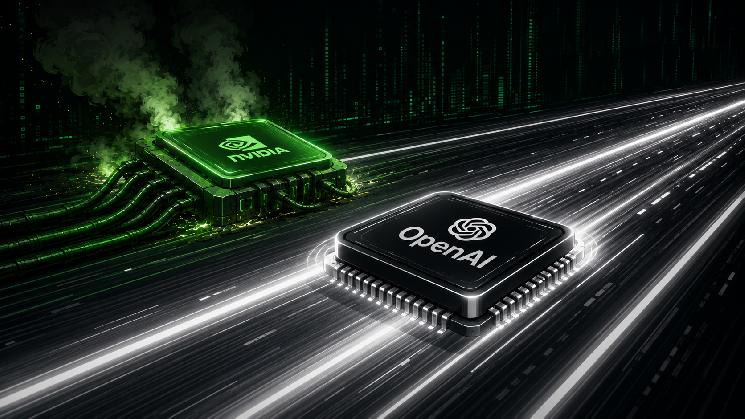
OpenAI Reveals Its Own Jalapeño Chip: Accelerator 1.5–2 Times More Efficient Than Nvidia

On August 25, 2026, OpenAI unveiled initial test results for its proprietary inference accelerator, the Jalapeño. Benchmarks on SemiAnalysis's InferenceX platform showed that systems using Jalapeño delivered 1.5–1.9 times more computations per watt at peak throughput and reduced latency by 1.7–3.6 times compared to systems based on Nvidia's GB200 and GB300, tested on models like GPT-OSS-120B. Designed specifically for OpenAI's own workloads, the 700W-rated chip was developed in nine months with partners Broadcom (silicon/network) and Celestica (boards/racks). It's the first in a planned multi-year platform. Deployment is slated for late 2026, backed by an OpenAI-Broadcom agreement to deploy 10 GW of custom accelerators through 2029. This move shifts a major portion of OpenAI's daily inference, crucial for services like ChatGPT and its API, away from Nvidia's universal GPUs. By controlling this hardware architecture, OpenAI aims to directly reduce the per-query cost of its massive service traffic, converting what was previously supplier profit (noting Nvidia's high margins) into internal savings and computational capacity. While OpenAI will still rely on external suppliers for training cutting-edge models and for parts of inference, Jalapeño represents a strategic industry trend where hyperscalers design custom chips once inference volume becomes predictable. However, this specialization risks future inflexibility if AI architectures shift and creates dependency on its manufacturing partners.

cryptonews.ru6h ago

OpenAI Reveals Its Own Jalapeño Chip: Accelerator 1.5–2 Times More Efficient Than Nvidia

cryptonews.ru6h ago

Trading

Spot

Hot Articles

Discussions

Welcome to the HTX Community. Here, you can stay informed about the latest platform developments and gain access to professional market insights. Users' opinions on the price of XAUT (XAUT) are presented below.

活动图片