Artículos Relacionados con Real Yield

El Centro de Noticias de HTX ofrece los artículos más recientes y un análisis profundo sobre "Real Yield", cubriendo tendencias del mercado, actualizaciones de proyectos, desarrollos tecnológicos y políticas regulatorias en la industria de cripto.

When the Narrative Bubble Bursts, What Are the Truly Valuable Crypto Assets?

After the narrative-driven crypto bubble subsides, truly valuable digital assets are those with sustainable value mechanisms, as evidenced by the failure of over 13.4 million speculative tokens. This analysis identifies two core token models: - **Native tokens** (e.g., Ethereum), whose value derives from network utility, acting as "security budgets" for decentralized systems. - **Backed tokens** (e.g., stablecoins like USDC), which are pegged to real-world assets (e.g., U.S. Treasuries) and provide verifiable value anchors. Sustainable tokens must reduce real-world economic frictions, evidenced in three dimensions: 1. **Macro-hedging**: Offering censorship-resistant, cross-border value transfer channels in high-inflation or sanctioned economies (e.g., Iran’s $7.78B crypto ecosystem). 2. **Real-yield anchoring**: Tokenizing high-quality liquid assets (HQLA) to bring off-chain yields on-chain, creating a risk-free benchmark for capital efficiency. 3. **Cost reduction**: Programmable smart contracts enable atomic settlements, automate compliance (e.g., KYC/AML), and cut transactional friction. Regulation has evolved from curbing speculative financing to building resilient infrastructure and implementing classification rules (e.g., EU’s MiCA). Compliance is increasingly embedded via coded rules (e.g., ERC-3643 standard), enabling real-time monitoring and reducing legal overhead. In conclusion, value accrues to tokens that embed tangible rights, lower cross-border costs, and align with regulatory frameworks, shifting focus from speculation to infrastructure utility.

marsbit03/20 13:36

When the Narrative Bubble Bursts, What Are the Truly Valuable Crypto Assets?

marsbit03/20 13:36

2026 Robot Track in Practice: Who is Paving the Way, Who is Mining, and Who is Building the System?

The 2026 embodied AI and DePIN narrative is shifting from hype to real-world applications. This analysis examines three leading projects in the robot economy: peaq, PrismaX, and OpenMind. peaq ($PEAQ) is a Layer-1 blockchain for the "Machine Economy," enabling devices to act as autonomous economic agents. A key case is a tokenized robotic farm in Hong Kong that generates real yield (e.g., 3820 USDT distributed to a user) from selling hydroponic vegetables, offering an ~18% APY. With partnerships like Bosch and Mastercard, and a ~$78M FDV, it's seen as an undervalued infrastructure play. PrismaX, backed by a $11M a16z-led round, focuses on generating crucial physical-world AI training data through human teleoperation. Users remotely operate real robots to earn points for a future airdrop. While attracting users, it faces risks from low-quality data farming and unproven commercial scalability. OpenMind ($ROBO) aims to be the "Android OS" for robots, providing a unified app store. It has partnered with 10+ major hardware firms (e.g., Unitree, UBTECH) and launched with 5+ apps. However, its $400M FDV is considered high, and it faces competition from closed systems like Tesla's Optimus. Together, these projects represent the essential stack for decentralized embodied AI: PrismaX (data layer) trains robots, OpenMind (OS/application layer) enables cross-hardware functionality, and peaq (network/incentive layer) facilitates automated economic transactions. The synergy between these layers is key to scaling practical applications.

marsbit02/15 10:07

2026 Robot Track in Practice: Who is Paving the Way, Who is Mining, and Who is Building the System?

marsbit02/15 10:07

Space Review|2026 Outpost: Narrative Recedes, Value Flows to Resilient Ecosystems with Real Yield

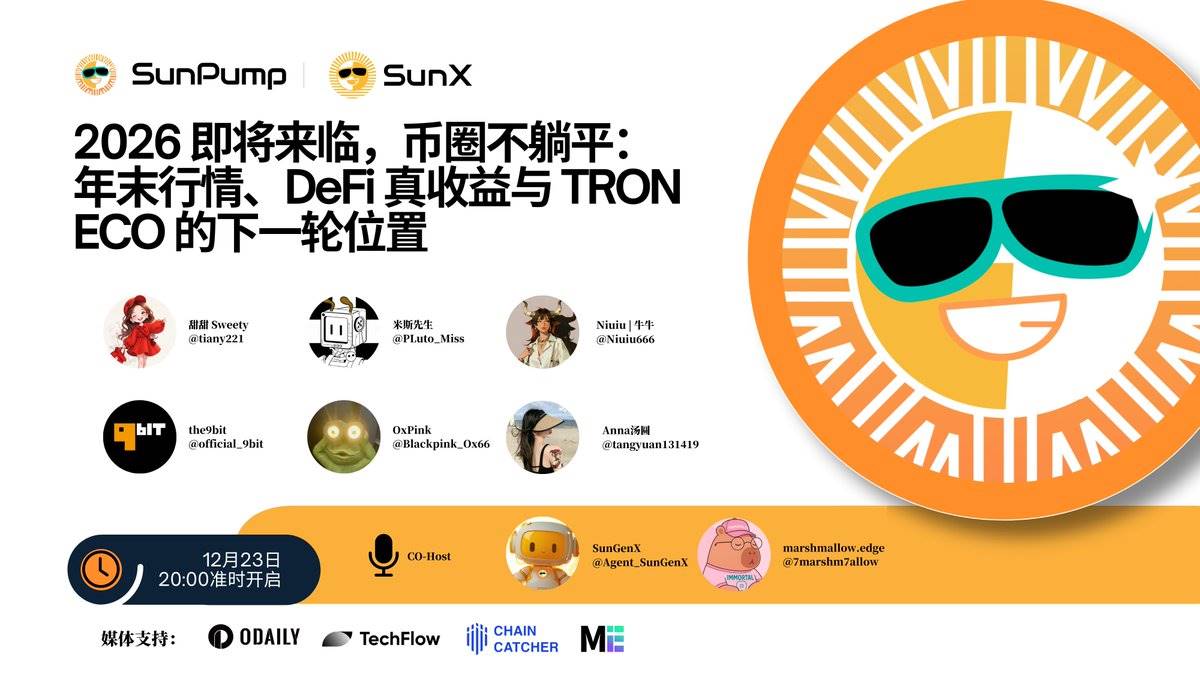
As 2025 draws to a close, the crypto market is shifting from hype-driven speculation to a focus on sustainable value. The recent SunnPump roundtable, "2026 is Coming, No Laying Flat in Crypto," explored this transition, emphasizing that the path to 2026 depends on ecosystems with real utility and organic demand, not short-term narratives. Experts agreed that the market is moving towards a phase driven by genuine cash flows and capital efficiency. Tron was highlighted as a prime example of a mature "digital financial infrastructure," distinguished by its dominant role in stablecoin settlements. With nearly $80 billion in on-chain USDT circulation—half the global market—and daily stablecoin transfers of $20-24 billion, Tron has built a resilient ecosystem anchored in real-world use cases like payments and lending. Its TVL of ~$24 billion, including $10.4 billion in JUST Protocol, reflects deep liquidity and organic activity. The discussion on DeFi sustainability centered on projects with real revenue generation, not subsidized yields. Protocols like JustLend DAO exemplify this with a diversified income model from staking services and lending, using fees to buy back and burn its JST token, creating a deflationary feedback loop. This aligns protocol success with tokenholder value. Tron’s $204 million in protocol revenue in November 2025, leading all public chains, underscores the power of its real economic activity. In conclusion, the key to enduring market cycles lies in ecosystems like Tron’s that provide essential, high-utility services—low-cost transfers, reliable staking, and lending—forming an organic, self-sustaining financial infrastructure with inherent resilience.

深潮12/24 08:51

Space Review|2026 Outpost: Narrative Recedes, Value Flows to Resilient Ecosystems with Real Yield

深潮12/24 08:51

活动图片