# Capital Efficiency Articoli collegati

Il Centro Notizie HTX fornisce gli articoli più recenti e le analisi più approfondite su "Capital Efficiency", coprendo tendenze di mercato, aggiornamenti sui progetti, sviluppi tecnologici e politiche normative nel settore crypto.

After Tokenizing Assets, How to Exit?

After tokenization, a key unresolved issue is providing holders with a reliable exit mechanism, as underlying asset settlement (taking days to months) lags far behind on-chain token settlement. Three primary models for instant liquidity have emerged, differing in their capital structure and efficiency: 1. **Balance Sheet Model (e.g., Grove Basin):** A single, well-capitalized entity (like Sky) provides immediate liquidity from its own reserves. This offers simplicity and deep initial liquidity but is constrained by that single balance sheet's capacity and risk appetite, limiting scalability. 2. **Dedicated Vault Model (e.g., Upshift Clear):** Independent liquidity providers (LPs) fund separate vaults for each supported asset. This decentralizes capital sources but isolates liquidity and capital, which becomes inefficient as the number of tokenized assets grows. 3. **Shared Liquidity Layer Model (Symbiotic Liquid Lane):** Independent capital providers fund shared vaults that can support multiple tokenized assets simultaneously. Capital remains productive between redemptions (e.g., earning yield in DeFi markets). Exits are settled via a competitive RFQ market where market makers bid. The article argues that the shared layer model offers superior capital efficiency and scalability. It transforms exit liquidity from an asset-specific patch into shared market infrastructure, allowing liquidity capacity to grow with overall market participation rather than being fragmented per asset. This is particularly valuable for longer-duration assets like private credit, where reliable T+0 exits can significantly enhance their utility in DeFi.

链捕手06/16 05:55

After Tokenizing Assets, How to Exit?

链捕手06/16 05:55

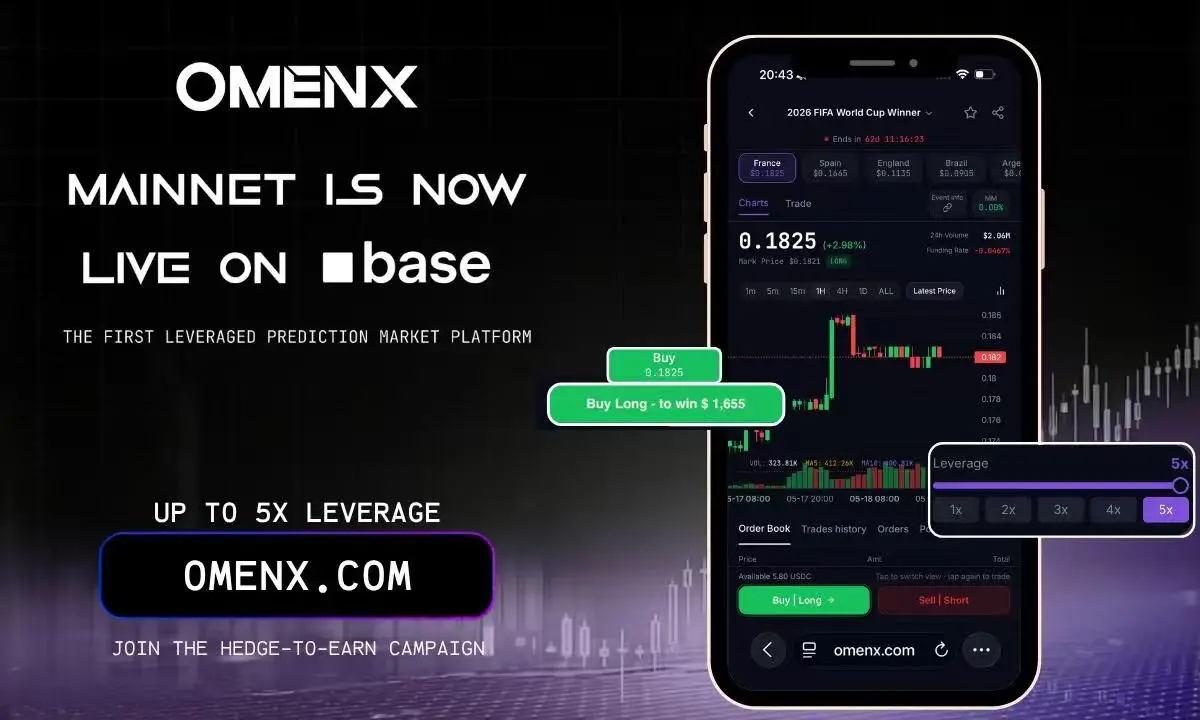
Base Native Leveraged Prediction Market OmenX Officially Launches on Mainnet

Base-native leveraged prediction market platform OmenX has officially launched on mainnet. It currently supports up to 5x leverage, with plans to increase to 10x based on platform liquidity and market conditions. Unlike traditional prediction markets where users fully collateralize YES/NO positions and wait for settlement, OmenX aims to create a trading platform-like experience. Users can open leveraged positions on event outcomes, and actively trade, adjust, or hedge these positions before the event concludes for greater capital efficiency. Alongside the mainnet launch, OmenX introduced a "Hedge-to-Earn" campaign targeting existing users of other prediction markets (initially Polymarket). This initiative allows users to claim incentives or hedging benefits on OmenX based on their existing positions, aiming to introduce them to leveraged trading and active risk management. OmenX positions itself as a derivatives trading platform for prediction market assets. The team believes that as platforms like Polymarket mainstream prediction markets, event outcomes are becoming a new tradable asset class. The next phase of demand will focus on leverage, liquidity, and advanced trading tools. Post-launch, OmenX plans to expand supported market types, optimize liquidity, and develop APIs and additional trading tools. The team is also in discussions with investors and partners to secure resources for further development.

链捕手05/19 13:35

Base Native Leveraged Prediction Market OmenX Officially Launches on Mainnet

链捕手05/19 13:35

Understanding the Key Issues of Tokenization in One Article

The core of tokenization lies in eliminating friction in financial infrastructure, not speculative digital assets. The true value is in near-instant settlement (T+0 vs. traditional T+2), 24/7 liquidity, fractional ownership, and the disintermediation of financial processes. Tokenization represents real-world assets (real estate, bonds, private equity) as digital tokens on a blockchain, functioning as programmable digital deeds that enable self-custody and automated ownership tracking. It addresses four key problems: 1) Settlement Speed: Atomic, near-instant settlement replaces multi-day processes. 2) Liquidity: Enables secondary markets for historically illiquid assets. 3) Fractional Ownership: Drastically lowers investment minimums by automating administrative overhead. 4) Disintermediation: Replaces trust-based functions of custodians and clearinghouses with self-executing smart contracts. This is not about cryptocurrency speculation. Major institutions like J.P. Morgan (Onyx), BlackRock (BUIDL), and Goldman Sachs are building the infrastructure, focusing on reliable asset management. Significant hurdles remain, including uncertain legal frameworks, lack of different blockchain platforms, and resistance from intermediaries protecting their revenue streams. Tokenization doesn't create a frictionless utopia but fundamentally reshapes the cost structure and efficiency of global financial infrastructure, representing its largest reorganization since the advent of electronic trading.

marsbit04/16 08:40

Understanding the Key Issues of Tokenization in One Article

marsbit04/16 08:40

Don't Just Focus on Trading Volume, Learn to Understand the 'True and False Prosperity' of Perpetual Contracts

Title: Look Beyond Trading Volume: Understanding the Real Growth of Perpetual Contracts Perpetual contracts (perps) have become a dominant force in crypto trading, with their volume now accounting for about 75% of decentralized exchange activity, up from 44% in February 2025. This surge occurred even as the total crypto market cap fell nearly 40% between August 2025 and February 2026, indicating a shift towards derivatives for speculation and hedging during volatility. However, volume alone can be misleading. It may reflect high-frequency, incentive-driven activity rather than meaningful capital deployment. A more nuanced view comes from combining volume with Open Interest (OI)—the total value of outstanding contracts. While cumulative perps volume doubled in the past six months to $14 trillion (exceeding the previous four years' total), OI grew by about 50%, from $13B to ~$18B before settling at $13B. The OI/Volume ratio, a measure of capital efficiency, rose from 0.33x to 0.49x over the past year. This growth wasn’t linear: it peaked at ~0.72x from June to mid-October 2025, then dropped to ~0.38x after a major liquidation event in October wiped out $19B in leveraged positions. At the platform level, Hyperliquid leads in capital efficiency with an OI/7-day volume ratio over 45% and a take rate of 3.2 bps, effectively converting trading activity into sustained positions and fee revenue. Aster follows with a 34% ratio but a lower take rate of 1.6 bps, prioritizing capital retention over revenue. edgeX and Lighter both show 21% efficiency, with edgeX matching Hyperliquid’s take rate. The key insight is that true growth in perps markets is signaled not just by volume but by rising OI/Volume ratio, reflecting patient capital and confidence in these platforms. Sustainable success will come from optimizing conviction and value capture, not just incentivized trading volume.

marsbit02/23 08:10

Don't Just Focus on Trading Volume, Learn to Understand the 'True and False Prosperity' of Perpetual Contracts

marsbit02/23 08:10

活动图片