Strategy Opens Path to Bitcoin Sale — Michael Saylor Explains Why It Makes Sense

cryptonews.ruPublished on 2026-07-28Last updated on 2026-07-28

Abstract

Michael Saylor, Executive Chairman of Strategy Inc. (NASDAQ: MSTR), outlined the company's potential funding sources for future buybacks of its Series A Variable Rate Perpetual Preferred Stock (STRC). These buybacks could be financed through the sale of Bitcoin or MSTR shares, depending on market conditions. This strategy is seen as attractive when STRC trades significantly below its $100 par value, allowing the company to repurchase shares at a discount and reduce future dividend obligations. Strategy aims to maintain STRC trading near its $100 par value with high liquidity and low volatility. The company, adhering to its digital credit capital concept, will not issue new STRC shares below par. In the week ending July 26, Strategy repurchased approximately $25 million worth of STRC shares at an average price of $86.52 per share, taking advantage of the discount. Strategy has increased its USD reserve to a record $3.75 billion, but this reserve is reserved exclusively for preferred stock dividends and debt repayment. Therefore, future STRC buybacks will be funded separately, primarily through the issuance of MSTR common stock or the sale of Bitcoin when deemed economically justified by management. This approach provides flexibility to execute discounted buybacks without impacting funds earmarked for dividends and debt.

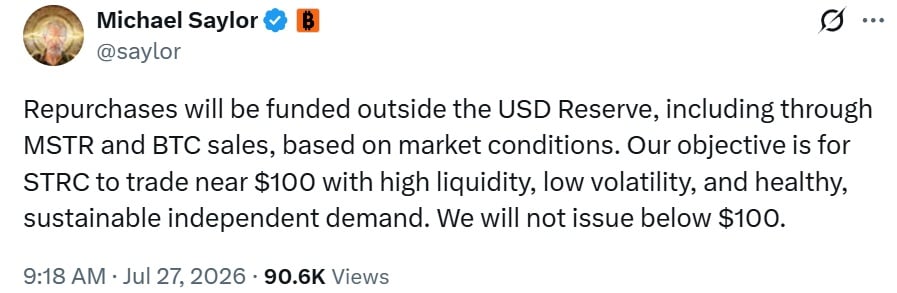
Michael Saylor, Executive Chairman of Strategy Inc. (Nasdaq: MSTR), stated in a July 27th post on X that future share repurchases of STRC could be funded through sales of Bitcoin or MSTR shares, depending on market conditions. STRC are Strategy's Series A Variable-Rate Perpetual Preferred Shares with a $100 liquidation preference, whose dividend rate is reviewed monthly by management.

Selling Bitcoin could become an attractive financing option when the price of STRC is trading significantly below $100, allowing the company to repurchase the preferred shares at a discount.

Saylor stated that the company aims to maintain STRC trading at a level close to its $100 liquidation preference, with high liquidity, low volatility, and stable independent demand. As part of Strategy's digital hybrid capital concept, the company does not intend to issue additional STRC shares below $100.
Discount Repurchases Dictate Purchase Pace

During the week ended July 26, the company repurchased 288,930 STRC shares for approximately $25 million at an average price of $86.52 per share, as reported by the company on July 27.

Saylor presented Strategy as a regular and disciplined buyer when the price is below $100, with repurchase volumes increasing at larger discounts and tapering as STRC approaches its stated preference. Under the repurchase authorization for preferred securities, approximately $975 million remains available, providing management with significant capacity for future transactions. At the latest average purchase price, the company acquired each STRC share at a $13.48 discount to its stated preference before accounting for future dividend savings.

Strategy's President & CEO, Phong Le, explained:

"At prices below $100 per share, repurchasing STRC shares represents an attractive capital investment as it allows for the reduction of future preferred dividend obligations at a discount."

"We intend to adjust purchase volumes based on both price and liquidity — increasing them at larger discounts and decreasing them as the market price of STRC shares approaches the $100 per share mark — while allowing independent market demand to form a healthy and sustainable market," he added.

In the terms of the STRC shares and the dividend policy, the current annualized dividend rate is stated as 12%, along with factors management considers during monthly assessments.

U.S. Dollar Reserve Remains Separate from Repurchase Program

Additionally, Strategy increased its U.S. dollar reserve by $525 million through the sale of MSTR common shares, bringing its balance to a record $3.75 billion. This reserve covers approximately 25 months of expected preferred dividend payments and, per a policy approved by Strategy's board of directors, remains designated exclusively for preferred dividend payments and debt obligations.

This restriction means future STRC repurchases will be funded from other sources, including the sale of MSTR shares and, as noted by Saylor, the sale of Bitcoin when justified by market conditions.

Instead of using the U.S. dollar reserve, Strategy now has two primary channels to fund STRC share repurchases: issuance of MSTR shares and sale of Bitcoin when management deems it economically sensible. This flexibility allows the company to repurchase preferred shares at a discount without impacting funds reserved for dividend payments and debt obligations.

end-content

Related Questions

QWhat two primary funding sources can Strategy Inc. use for future STRC share buybacks, according to Michael Saylor?

AAccording to Michael Saylor, the two primary funding sources for future STRC share buybacks are the sale of MSTR common stock and the sale of Bitcoin, when deemed economically justified by management.

QWhat is the stated goal of Strategy Inc. regarding the trading price of its STRC preferred shares?

AThe stated goal is for the STRC preferred shares to trade close to their $100 par value, with high liquidity, low volatility, and sustained independent demand.

QHow does Strategy Inc. plan to adjust its STRC buyback volume in relation to the share price?

AStrategy plans to adjust buyback volumes based on price and liquidity: increasing purchases when the discount to the $100 par value is significant and scaling back as the market price approaches the $100 per share mark.

QWhat is the purpose of Strategy's separate USD reserve, and how much does it currently hold?

AThe separate USD reserve is intended exclusively for paying dividends on the preferred shares and repaying debt obligations. As reported, it currently holds a record $3.75 billion.

QWhy does buying back STRC shares at a discount below $100 represent an attractive capital investment for Strategy?

ABuying back STRC shares below $100 is attractive because it allows the company to retire preferred shares at a discount, thereby reducing future dividend payment obligations.

Related Reads

Robinhood Crypto Chief Reveals: 'Barbell' Customer Acquisition Strategy with Meme + Tokenized U.S. Stocks, Each Business Line Already Generates Billions in Revenue

Robinhood's Crypto Strategy: Leveraging Memes and Tokenized Stocks as a Dual-Pronged User Acquisition Strategy Robinhood Crypto GM Johann Kerbrat outlines the platform's "barbell" strategy for its new chain, launched three weeks ago. This approach targets two distinct user bases simultaneously: meme coin traders and those seeking exposure to tokenized real-world assets (RWAs), particularly U.S. stocks. The chain, built on Arbitrum technology, prioritizes accessibility and aims to onboard Robinhood's 27 million funded accounts. The vision is to fuse DeFi's benefits (like 24/7 trading and yield) with CeFi's user-friendly experience, eliminating wallet complexities. Key products like "Robinhood Earn" (for stablecoin yields) and tokenized stocks (available in 120+ countries) exemplify this hybrid model. Kerbrat downplays direct competition with Coinbase's Base, emphasizing growing the overall market for tokenized assets instead. Future plans include expanding RWA offerings to international stocks and private markets, positioning Robinhood's app as a comprehensive "super app" for diverse financial needs, from trading and banking to financial education. While all business lines currently generate significant revenue, the chain's immediate focus is on optimizing user adoption over maximizing direct revenue from transaction fees.

marsbit48m ago

Robinhood Crypto Chief Reveals: 'Barbell' Customer Acquisition Strategy with Meme + Tokenized U.S. Stocks, Each Business Line Already Generates Billions in Revenue

marsbit48m ago

Trading

Spot
活动图片