Solana’s Low Fees Create Strong Competition for Base, BNB, and Polygon and Fuel SUBBD Token

bitcoinistPublished on 2026-02-10Last updated on 2026-02-10

Abstract

Solana's consistently low transaction fees, often below $0.001, are creating intense competitive pressure on rival blockchains like Base, BNB Chain, and Polygon. This cost efficiency is driving retail liquidity toward Solana and shifting market demand toward low-friction utility platforms. A key beneficiary of this trend is SUBBD Token ($SUBBD), which leverages AI and Web3 infrastructure to disrupt the $191 billion creator economy. SUBBD addresses the high commission fees (up to 70%) on Web2 platforms by offering AI-driven tools for content creators, including voice cloning and automated assistants, enabling better monetization and workflow efficiency. The project has raised over $1.47 million in its ongoing presale, signaling strong interest in the convergence of AI and crypto for content monetization.

Trusted Editorial content, reviewed by leading industry experts and seasoned editors. Ad Disclosure

Quick Facts:

  • ➡️ Solana’s sub-cent transaction fees are forcing competitors like Base and Polygon to accelerate efficiency upgrades to retain retail liquidity.
  • ➡️ The market demand for low friction is shifting from DeFi trading to the $191B creator economy, where Web2 platforms charge up to 70% fees.
  • ➡️ SUBBD Token leverages AI and Web3 infrastructure to minimize platform fees and automate creator workflows, having raised over $1.47M in its ongoing presale.
  • ➡️ The convergence of AI tools (voice cloning, assistants) with crypto payments represents the next evolution of digital content monetization.

The battle for blockchain dominance isn’t just about theoretical throughput anymore; it’s about the tangible reality of user costs. And right now, Solana is dictating the pace.

Recent on-chain data shows that Solana’s average transaction fee remains consistently below $0.001, often hovering near $0.00025 for non-priority transactions. That creates immense pressure on competing ecosystems like Base, BNB Chain, and Polygon. It’s essentially forcing a ‘race to the bottom’ regarding cost efficiency.

Sure, Base (Coinbase’s Layer-2) saw fees drop significantly following the Ethereum Dencun upgrade. But network congestion can still spike costs to $0.05 or higher during peak retail activity.

Similarly, while BNB Chain and Polygon are cheap compared to Ethereum mainnet, they often struggle to match the sub-cent consistency of Solana’s monolithic architecture. Why does this matter? Because retail liquidity flows where friction is lowest. If a user can swap a token for a fraction of a penny on Solana versus paying five to ten cents elsewhere, those aggregate savings drive volume.

But the demand for reduced friction extends beyond simple token swaps. We’re seeing a capital rotation toward utility-driven platforms that solve ‘fee fatigue’ in other sectors, particularly the digital content economy. Just as traders flock to Solana to escape DeFi gas fees, content creators are hunting for alternatives to Web2 platforms that charge exorbitant commission rates.

This search for economic efficiency is driving interest toward decentralized apps merging AI utility with better monetization. That’s creating a serious tailwind for new entrants like SUBBD Token ($SUBBD).

Read more about $SUBBD here.

AI-Driven Monetization And The Fight Against 70% Fees

The disconnect between creator output and income retention has hit a wall. Legacy Web2 platforms frequently deduct between 20% and 70% of a creator’s earnings.

That’s a ‘platform tax’ making blockchain gas fees look negligible by comparison. SUBBD Token ($SUBBD) aims to disrupt this $191B industry by applying crypto’s low-friction philosophy to content monetization.

Operating as an ERC-20 token on Ethereum, SUBBD uses EVM-compatible smart contracts to replace intermediaries with code. But it’s not just a payment rail. The platform integrates proprietary AI models, including automated personal assistants, voice cloning, and object recognition, to streamline workflows.

The project offers a tech stack allowing influencers to create ‘AI versions’ of themselves to interact with fans 24/7. It effectively solves the scalability problem for humans (who, unlike bots, need sleep).

From a tokenomics perspective, integrating AI represents a major shift. By allowing creators to token-gate exclusive content and use AI tools for optimization, SUBBD lowers the barrier to entry while raising the revenue ceiling. Of course, the risk is execution; the platform must ensure its AI tools are intuitive enough for non-crypto natives.

But the value proposition is clear: creators keep more of what they earn, mirroring the efficiency users seek in high-performance blockchains.

Check out the $SUBBD presale here.

Presale Data Signals Appetite For Creator Economy Disruption

Traders are watching the SUBBD Token presale as a gauge for sentiment on the AI-Web3 convergence.

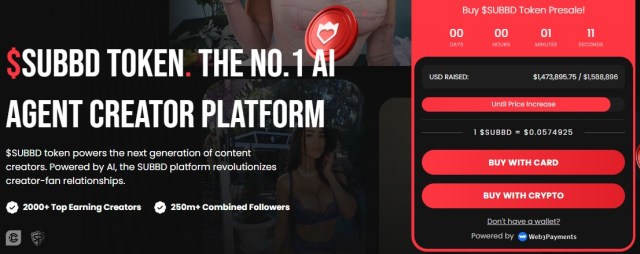
According to live data, the project has raised exactly $1.47M, a sign of steady accumulation despite broader market volatility. With tokens priced at $0.057495, early participants are positioning themselves before the platform fully deploys its mainnet features.
The staking architecture seems designed to encourage long-term holding rather than mercenary capital rotation. SUBBD offers a fixed 20% APY for the first year to users who lock their tokens. But it’s not just about yield.

Staking unlocks tangible utility: access to exclusive livestreams, ‘behind the scenes’ (BTS) drops, and XP multipliers that enhance platform standing. This gamified approach to liquidity retention suggests the team is prioritizing community stability over short-term hype.

In previous market cycles, utility tokens launching with functional ecosystems, rather than just roadmap promises, have tended to outperform during recovery phases. With the presale progressing, the focus shifts to the rollout of the ‘HoneyHive’ governance features and onboarding the first cohort of AI-driven influencers.

For investors tired of high-fee structures in both DeFi and Web2, SUBBD presents a logic-driven alternative.

Buy $SUBBD here.

This article is for informational purposes only and does not constitute financial advice. Cryptocurrencies are high-risk assets. Always perform your own due diligence before investing. The views expressed here are those of the author and do not necessarily reflect the official policy of any financial institution.

Editorial Process for bitcoinist is centered on delivering thoroughly researched, accurate, and unbiased content. We uphold strict sourcing standards, and each page undergoes diligent review by our team of top technology experts and seasoned editors. This process ensures the integrity, relevance, and value of our content for our readers.

patrubogdan

Follow

Full Profile

Related Posts

AI Can’t Save the Market Alone, But It Can Transform It: How SUBBD Token Redefines Content Economics

Russian Lawmaker Predicts Bitcoin Collapse While Smart Money Rotates into Layer 2 Utility

Chainlink Founder Sergey Nazarov Identifies 3 Trends That Will Define the Cryptosphere as Hyper Token Soars

Bitcoin Demand Plunges Per CryptoQuant, Yet Maxi Doge Endures

Crypto Markets Catch A Breather As Outflows Begin To Slow: Analysts

SUBBD Token’s Massive Projected Impact on the Content Creation Market in 2026

Related Questions

QWhat is the average transaction fee on the Solana network, and how does it compare to competitors like Base and Polygon?

ASolana's average transaction fee remains consistently below $0.001, often near $0.00025 for non-priority transactions. This is significantly lower than competitors; Base can see fees spike to $0.05 or higher during congestion, and while BNB Chain and Polygon are cheaper than Ethereum, they struggle to match Solana's sub-cent consistency.

QWhat problem does SUBBD Token aim to solve in the digital content economy?

ASUBBD Token aims to disrupt the $191B digital content economy by addressing the exorbitant commission fees (20-70%) charged by legacy Web2 platforms. It uses crypto's low-friction philosophy and AI tools to allow creators to keep more of their earnings and automate workflows.

QWhat are some of the AI features integrated into the SUBBD platform?

AThe SUBBD platform integrates proprietary AI models, including automated personal assistants, voice cloning, and object recognition. It allows creators to make 'AI versions' of themselves to interact with fans 24/7, solving the scalability problem for human creators.

QHow much capital has the SUBBD Token presale raised, and what is the current token price?

AThe SUBBD Token presale has raised $1.47 million. The tokens are currently priced at $0.057495 in its ongoing presale.

QWhat staking rewards does SUBBD offer, and what utility do stakers gain?

ASUBBT offers a fixed 20% APY for the first year to users who lock their tokens. Staking also unlocks tangible utility, including access to exclusive livestreams, 'behind the scenes' content drops, and XP multipliers that enhance a user's standing on the platform.

Related Reads

Anthropic's IPO Launch: Commercial Miracle or Valuation Bubble?

Anthropic has confidentially filed for an IPO, led by Morgan Stanley and Goldman Sachs, potentially going public by October. Following its latest $650 billion funding round, its pre-IPO valuation stands at $965 billion, with projections reaching up to $2 trillion at listing, which would make it the highest-valued private company ever. The article, written by Fu Sheng, addresses skepticism that this represents an AI bubble akin to the 2000 dot-com crash. It argues the current situation differs fundamentally. Unlike the internet bubble era, which relied on speculative narratives with little revenue, Anthropic's valuation is backed by unprecedented, measurable financial performance. Key data points include: * **Revenue Growth:** ARR skyrocketed from $10 billion in early 2025 to $470 billion by May 2026, targeting $100 billion by year-end—a growth curve unmatched in business history. * **Profitability:** It achieved operating profitability in Q2 2026 with an estimated $5.6 billion profit. * **Efficiency:** With ~3,000 employees and ~$470 billion ARR, its revenue per employee exceeds $10 million. Products like Claude Code, launched less than a year ago, already generate $25 billion in annualized revenue. * **Enterprise Adoption:** It boasts a strong enterprise client base, with 8 of the Fortune 10 and over 1,000 large firms spending over $1 million annually on Claude. The valuation is framed using a traditional SaaS model (e.g., a 10x Price-to-Sales multiple on $100 billion revenue). The author contends the core question for analysts has shifted from "How big could this be?" to "How much is it earning and will earn next quarter?" The discussion extends beyond Anthropic to a broader paradigm shift: the transition from a "carbon-based" to a "silicon-based" economy. Companies are increasingly prioritizing investment in compute and AI capabilities over human resources, as these directly scale productivity and competitive advantage. Anthropic's IPO is thus positioned not just as a corporate milestone, but as a price anchor for this new economic era.

链捕手1h ago

Anthropic's IPO Launch: Commercial Miracle or Valuation Bubble?

链捕手1h ago

Near Returns to the AI Stage: Transformation into a Public Chain Due to 'Payroll Difficulties,' Agent and Privacy Emerge as New Growth Narratives

NEAR Returns to AI Origins: From Payroll Struggles to Blockchain, Now Focusing on AI Agents and Privacy NEAR Protocol's journey began not with grand blockchain ambitions, but from a practical hurdle: its AI startup founders, including Transformer paper co-author Illia Polosukhin, couldn't efficiently pay international developers in 2017. This led them to pivot and build a high-performance, scalable blockchain. After years navigating various crypto narratives like sharding and cross-chain interoperability, NEAR is now leveraging its AI roots to re-enter the AI arena. A key driver is its "NEAR Intents" layer, which abstracts complex cross-chain transactions. Users simply state their goal (e.g., swap BTC for ETH), and a solver network finds the optimal route. This system has processed over $20B in cross-chain volume, generating significant fee revenue. A major growth area is private transactions via "Confidential Intents/Swaps," which hide trade details until settlement to protect against MEV and front-running. Remarkably, private swaps recently accounted for over 40% of NEAR's transaction volume, highlighting strong demand but also potential regulatory scrutiny. With its AI-founder pedigree, NEAR is positioning itself at the intersection of blockchain, AI agents, and privacy, aiming to become infrastructure for the emerging agent economy while navigating the challenges of its rapid adoption.

marsbit4h ago

Near Returns to the AI Stage: Transformation into a Public Chain Due to 'Payroll Difficulties,' Agent and Privacy Emerge as New Growth Narratives

marsbit4h ago

From Ethereum to AI's 'CROPS': What Exactly is This Set of 'Slow Variables' That Vitalik Repeatedly Emphasizes?

In recent discussions, Vitalik Buterin has frequently emphasized the concept of "CROPS," a framework defining core values for Ethereum's development. CROPS stands for Censorship Resistance, Capture Resistance, Open Source, Privacy, and Security. Initially outlined in the Ethereum Foundation's "EF Mandate," it represents a commitment to user sovereignty, ensuring that the network resists external control, remains open, protects privacy, and prioritizes security. The relevance of CROPS extends beyond Ethereum's foundational principles, becoming crucial in the context of AI integration. As AI agents begin handling wallet operations and automated transactions, the risk increases that users may cede control over their digital assets, privacy, and intentions to centralized AI service providers. A "CROPS AI" would therefore emphasize local execution where possible, privacy-preserving remote model calls (e.g., using zero-knowledge proofs), and transparent, verifiable processes to maintain user agency. Vitalik highlights a significant convergence between "CROPS Ethereum access layer" and "CROPS AI." Both address the same fundamental challenge: how users can access powerful services—be it blockchain data via RPCs or AI models—without exposing sensitive information or relinquishing ultimate control. This intersection points toward a future digital entry point that is more private, secure, and user-controlled. Ultimately, CROPS is not merely an abstract ideal but a practical guidepost. It steers development—from protocol resilience and wallet design to AI agent safety—towards a future where users retain self-sovereignty even as digital systems grow more complex and powerful. In an era of accelerating AI adoption, these "slow variables" of censorship resistance, openness, privacy, and security may define Ethereum's enduring value.

marsbit4h ago

From Ethereum to AI's 'CROPS': What Exactly is This Set of 'Slow Variables' That Vitalik Repeatedly Emphasizes?

marsbit4h ago

Trading

Spot
Futures

Hot Articles

Discussions

Welcome to the HTX Community. Here, you can stay informed about the latest platform developments and gain access to professional market insights. Users' opinions on the price of SOL (SOL) are presented below.

活动图片














