Original Author: KarenZ, Foresight News
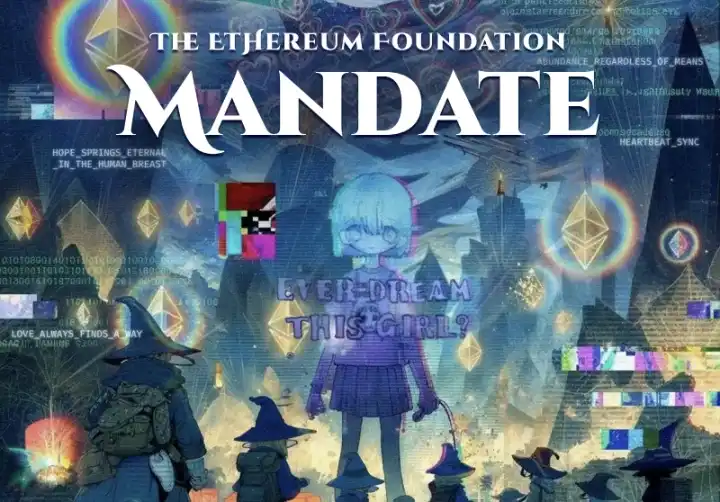
On the evening of March 13, the board of the Ethereum Foundation (EF) released a mission statement titled "EF Mandate".
When you open this mission statement, you might doubt whether you've entered the wrong scene—filled with stars, elves, wizards, and a layout resembling an anime poster. Beneath this flashy exterior lies the current "ideological纲领" of the Ethereum ecosystem.
TL;DR
- EF's Core Positioning: Guardians, Not Rulers. EF's ultimate goal is to pass the "Walkaway Test"—even if the Ethereum Foundation were to disband tomorrow, the Ethereum network would still operate perfectly.
- CROPS Iron Law is the Bottom Line: Any technological development must satisfy Censorship Resistance, Open Source, Privacy, and Security. These four attributes are inseparable and must not be compromised for any reason, taking the highest priority.
- EF's Operational Philosophy: The Foundation does subtraction to make Ethereum more resilient. Once the ecosystem is mature enough, the Ethereum Foundation will gradually relinquish control.
- What Not to Do: Do not be a "kingmaker," do not be a rating agency, do not be a marketing agency that hypes and promotes, and do not encourage treating Ethereum as a "big casino."
- Ultimate Vision: Look ahead 1000 years to provide a "digital sanctuary" free from exploitation by power, capital, AI, or even family.
What Problem Is Ethereum Trying to Solve?
EF believes that in the digital age, two things are infrastructure-level necessities: controlling one's own data, identity, and assets (self-sovereignty), and collaborating with others without being "strangled" by anyone (sovereignty-preserving coordination).
Pursuing only the first point is sufficient for running a local application; pursuing only the second point is what the internet already offers. Ethereum's unique value lies in achieving both simultaneously.
There is a passage in the manifesto that says: Ethereum exists so that no one can "rug" you—whether it's the government, companies, institutions, or AI.
Around this goal, EF proposed an acronym: CROPS. This term appears 32 times in the manifesto.
- Censorship Resistance: No one can prevent you from doing legal things; rely on cryptography to maintain neutrality even under external pressure.
- Open Source & Free: All code and rules are open; there are no hidden black boxes.
- Privacy: Your data belongs to you, not the platform. You decide what information to share and with whom.
- Security: Protect both the system and users from technical failures, coercion, and other harms.
These four attributes are defined in the document as an "indivisible whole," representing the highest priority bottom line that cannot be compromised for any reason.
EF's stance is clear:宁愿慢一点,也要从第一天就把这些东西做对. Because once abandoned, it is almost impossible to regain them.
What Does the Foundation Do? What Does It Not Do?
EF is making "making itself unnecessary" its ultimate success criterion.
There is a term in the document called the "walkaway test," meaning: If EF disappeared tomorrow, could Ethereum continue to run and evolve on its own? EF's goal is to make the answer to this question "yes."
Therefore, EF is practicing a philosophy of "subtractive development": focusing on key tasks that no one else in the ecosystem can or is willing to do—core protocol upgrades, long-term technological research, public security保障. Once a certain area can be taken over by the community, EF hands it over, further reducing its relative influence.
Simultaneously, EF has also drawn up a long list of "do not do" items, which read like a solemn disclaimer: not a company, not a kingmaker, not a certification body, not a product studio, not a marketing company, not a boss, not a government agency, not a casino, not an opportunist.
When There Is No Standard Answer, How Will EF Decide?
The previous sections discussed many grand principles: CROPS, self-sovereignty, subtractive philosophy. But what happens when具体 problems arise? This chapter provides the answer.
It is somewhat like the Foundation's "decision-making algorithm": when faced with two paths, how to choose without违背初心?
- When choosing a technical solution, choose the one that "won't strangle you later," even if it's slower now. An example in the document is transaction propagation: one solution has good performance but relies on a private relay network (whitelist-based), another is decentralized but progresses slowly. EF's answer might be the latter, because once the former is implemented, "decentralizing later"基本不会发生.
- When designing or evaluating proposals, don't just look at the immediate layer; consider the impact on other layers. Some solutions may seem fine individually, even符合 CROPS principles, but when viewed within the entire ecosystem, they might create new problems elsewhere. Don't solve one problem and create ten more.
- User security is important, but don't make decisions for users. Only provide users with tools for self-defense; absolutely avoid "paternalistic" restrictions. Do not allow anyone to剥夺用户的自主选择权 under the guise of "protecting users." For example, some wallets enable "safe mode" by default, secretly blocking certain contracts, directing users to指定平台, or even using opaque AI to判定 "risky operations" while covertly collecting user behavior—all of which the Foundation opposes. True protection means giving users verifiable filtering tools and公开规则的黑白名单; whatever the tool, it should protect privacy by default, including AI components.
- If intermediaries are necessary? Lower barriers, leave an exit path.: If某些领域 currently确实绕不开 intermediaries, then lower the entry barrier to the minimum, allow full market competition, and必须给用户留 "无中介"的替代方案 that is usable and practical.
- When choosing which teams to support, look not at social光环, but at actual technical choices. Many projects pay lip service to CROPS but hide闭源的核心环节 in their designs, implement whitelist restrictions, or guide users down fixed paths—all should be警惕.
The Ideal is Plump, Reality is Bony
This manifesto is resounding, but现实拷问 never ceases.
Does this document represent a consensus among all, or the ideals of some authors? If EF had a different group of people, would it still hold? Who supervises its execution?
More practical questions:
- EF's operational funds rely heavily on its holdings of ETH assets. If the ETH price is low, the budget will be compressed. "Not caring about the price" is only spiritual discipline, not financial reality.
- The CROPS rules are ideal, but the world doesn't operate by CROPS.
- What most users真正在乎的是: speed, cost, and usability.
- EF insists on "fully CROPS from day one," but will this cause Ethereum to fall behind more "pragmatic" competitors in terms of user experience and commercialization?
- How are EF's "do" and "do not do" items assessed? How is accountability determined? How is "coordination" judged to be good or bad?
The Community is Split: Punk Ideals vs. Disconnection from Reality
Within 24 hours of the manifesto's release, community feedback was polarized:
Critics:
- Eigen Labs researcher Kydo直言, EF's current direction is a 180-degree turn, overturning the previous "pragmatic路线" that supported stablecoins, institutional entry, and RWA, marginalizing the most marketable applications currently;
- Forward Ind. chairman吐槽: "They build what they want to build, not what you want"—accusing EF of building only according to idealism, ignoring community and market demands;
- Hazeflow founder Pavel Paramonov called it "another pile of ideological nonsense," failing to clarify Ethereum's specific direction moving forward.
Supporters:
- Namefi founder Zainan Victor Zhou believes this is a constraint on the EF organization, not a restriction on the entire ecosystem;
- Columbia Business School professor Omid Malekan pointed out that CROPS is precisely the foundation of Ethereum's leadership in the financial field—it provides true "access rights + verifiability + property rights protection."
Facing controversy, Vitalik personally clarified: This manifesto "won't be a surprise to many" and reflects the direction EF has been思考 over the past few months. EF only acts as Ethereum's guardian; the rest is left to the broader ecosystem—this is the starting point of a new chapter.
At the end of the manifesto, it concludes with an Italian phrase: "E quindi uscimmo a riveder le stelle"—from Dante's "Divine Comedy: Inferno," literally meaning "And so we came out, and once again beheld the stars."
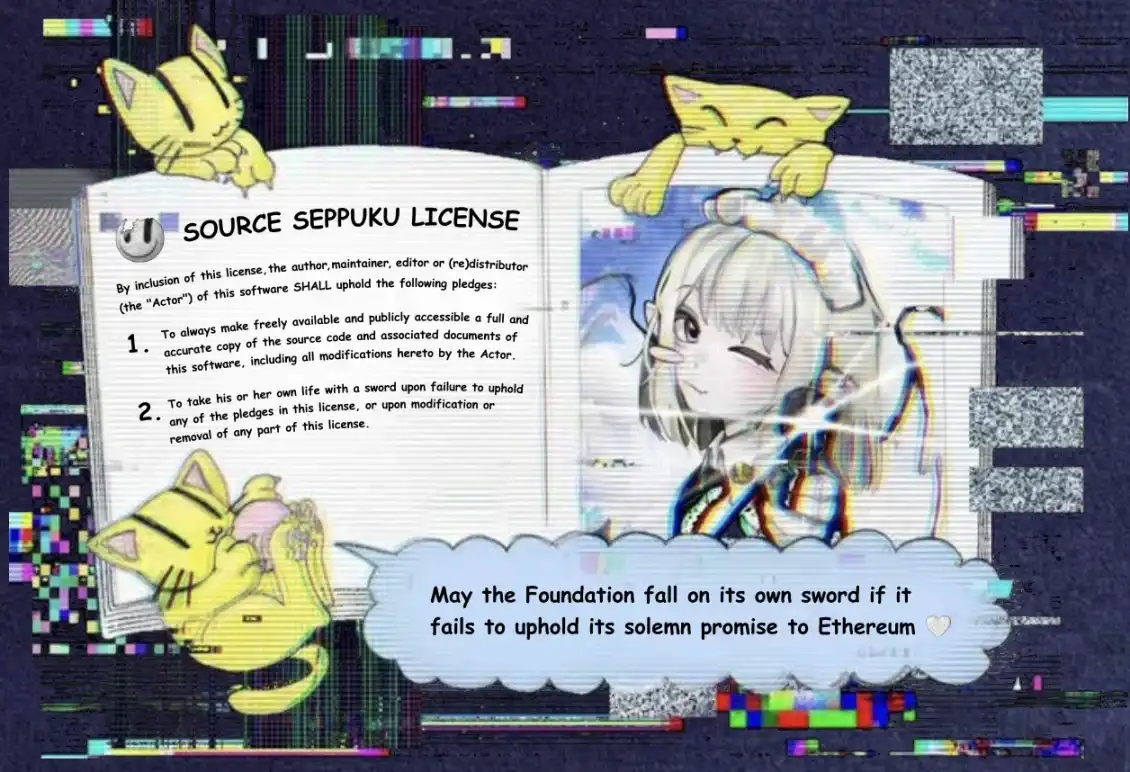
EF also created a meme image of a "SOURCE SEPPUKU LICENSE," which reads: "Should the Foundation fail to uphold its solemn commitment to Ethereum, let it reap the consequences and commit seppuku."
EF compares itself to a traveler passing through hell, advancing towards the stars of "digital freedom" even through现实磨难与质疑. Of course, time will tell.