Sam Bankman-Fried Appeals Conviction While Crypto Security Braces for the Quantum Era with $BMIC

bitcoinistPublished on 2026-02-11Last updated on 2026-02-11

Abstract

Sam Bankman-Fried, founder of FTX, has appealed his fraud conviction and 25-year sentence, reopening a major case that highlighted a catastrophic breakdown of trust in crypto. As the industry grapples with this legacy, attention is shifting toward next-generation security solutions. A key emerging threat is quantum computing, which risks breaking current encryption standards. The article highlights $BMIC as a project built to address this with a post-quantum cryptographic security stack, including quantum-resistant wallets, staking, and payments. Having raised over $446K in its presale, BMIC represents a growing investor focus on preemptive security rather than reactive fixes, positioning itself as a potential new standard in crypto infrastructure.

Sam Bankman-Fried, the disgraced founder of FTX, is officially appealing his conviction and 25-year prison sentence. The legal filing reopens one of the biggest fraud cases in crypto history, and for an industry still grappling with the fallout, it’s like pouring salt in a very old wound.
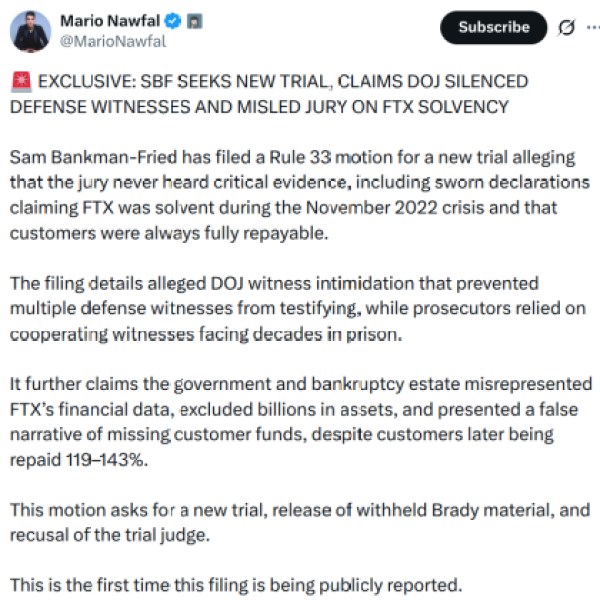
SBF’s appeal challenges various trial decisions, from witness testimony to alleged conflicts of interest. But let’s be clear: the FTX saga was never about tech failing. It was a catastrophic breakdown of trust.

Billions in user funds vanished not because of a sophisticated hack, but due to internal fraud and shockingly poor custody. That collapse forced a painful but necessary conversation across the market: How do we actually secure digital assets?

While the courts wrestle with crypto’s ghosts, innovators are already building for the future. We’re now seeing a clear shift in investor focus toward projects that prioritize provable, next-gen security over pure hype. That’s where the real story is.

The Quantum Threat and BMIC’s Future-Proof Solution

But what most market coverage misses is that while the industry defends against today’s threats, a far bigger one looms: quantum computing. State-sponsored and corporate labs are racing to build machines capable of shattering the encryption that protects everything from bank accounts to crypto wallets.

It’s a threat (one many still dismiss) known as the ‘harvest now, decrypt later’ attack, stealing encrypted data today with the plan to unlock it once quantum computers are powerful enough. For crypto, this isn’t just a problem; it’s an existential risk.

This is the exact problem BMIC ($BMIC) was engineered to solve. It isn’t just another DeFi protocol or meme coin; it’s a foundational security layer built for the quantum age. The project delivers a full stack of financial tools, wallet, staking, and payments, all shielded by post-quantum cryptography (PQC).
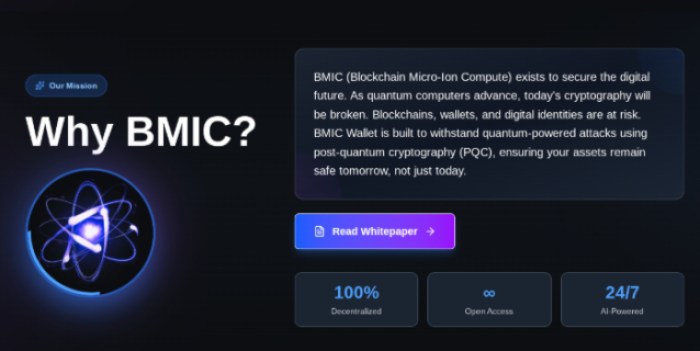
While traditional wallets expose public keys during transactions, BMIC uses ERC-4337 smart accounts and a Zero Public-Key Exposure model to protect users from both current and future threats. It even integrates an AI-enhanced threat detection system to proactively neutralize suspicious activity.

The key difference here is a shift from reactive security to preemptive protection. So, is your portfolio truly safe if its core cryptography has a known expiration date?

LEARN MORE ABOUT BMIC AND ITS QUANTUM STACK

A New Security Standard Attracting Early Investment

If history has taught us anything, it’s that after a major market failure like FTX, capital flows toward infrastructure that promises to prevent the next crisis. We’re seeing that play out right now. The early traction for the BMIC presale seems to prove the point, having already raised over $446K, with tokens currently priced at just $0.049474.

Frankly, this doesn’t look like speculative froth; it looks like a calculated investment in a long-term solution. It’s why we picked $BMIC as a best new cryptocurrency.

The project’s utility is centered on its native token, $BMIC, which powers the whole ecosystem. It’s used for staking on the quantum-secure network, participating in governance, and fueling its ‘Burn-to-Compute’ model for access to advanced security features.

The ripple effect of a successful quantum-proof platform could be immense, potentially setting a new security standard for the entire industry. The risk? As always, it comes down to execution and adoption. But in a market still scarred by FTX, a project building decentralized, future-proof security is a compelling story.

buy your $BMIC here

This article is for informational purposes only and does not constitute financial advice. All investments carry risks, and readers should conduct their own due diligence.


Related Questions

QWhat is Sam Bankman-Fried appealing and why is this significant for the crypto industry?

ASam Bankman-Fried is appealing his conviction and 25-year prison sentence for his role in the FTX fraud case. This is significant because it reopens one of the largest fraud cases in crypto history, forcing the industry to confront the catastrophic breakdown of trust and the need for better security measures.

QAccording to the article, what is the 'existential risk' facing cryptocurrency that many still dismiss?

AThe existential risk is the threat posed by quantum computing, specifically through 'harvest now, decrypt later' attacks, where encrypted data is stolen today with the intention of decrypting it once quantum computers become powerful enough to break current encryption standards.

QWhat specific problem does the BMIC ($BMIC) project claim to solve?

ABMIC ($BMIC) is engineered to provide a foundational security layer for the quantum age. It uses post-quantum cryptography (PQC) to protect a full stack of financial tools, including its wallet, staking, and payments system, from both current threats and future quantum attacks.

QHow does BMIC's security model differ from traditional crypto wallets?

AUnlike traditional wallets that expose public keys during transactions, BMIC uses ERC-4337 smart accounts and a Zero Public-Key Exposure model to protect users. It also integrates an AI-enhanced threat detection system for proactive security, shifting from a reactive to a preemptive protection model.

QWhat evidence does the article provide to suggest that BMIC is attracting serious investment rather than speculative interest?

AThe article points to the BMIC presale having raised over $446K as evidence of calculated, long-term investment. It states this early traction indicates capital is flowing toward infrastructure that promises to prevent future crises, like the FTX collapse, rather than mere speculative froth.

Related Reads

TechFlow Intelligence Bureau: KelpDAO Attack Causes Nearly $300 Million Loss, Triggers Aave Withdrawal Wave, RAVE Crashes 95% in a Single Day

China's AI firm DeepSeek is seeking external funding for the first time, with a valuation exceeding $10 billion, signaling intensifying competition and high R&D costs in the domestic large model sector. Meanwhile, OpenAI CEO Sam Altman faces scrutiny over potential conflicts of interest between his personal investments and OpenAI’s business ahead of a possible IPO. In Web3, KelpDAO suffered a $294 million attack due to forged cross-chain messages on LayerZero, leading to massive withdrawals from Aave and a resulting 18% drop in AAVE tokens. Separately, RAVE cryptocurrency collapsed by 95% in a single day amid suspected insider manipulation. Geopolitically, Iran is now demanding Bitcoin payments for transit through the Strait of Hormuz, reflecting both internal governmental discord and the growing adoption of crypto in tense regions. In semiconductors, Nvidia CEO Jensen Huang showed rare public frustration over questions regarding chip sales to China, while the industry faces renewed price hikes. Tesla continues expanding its Robotaxi service, and a Chinese humanoid robot outperformed humans in a half-marathon, marking a milestone in robotics. Despite Middle East tensions and market uncertainties, U.S. stocks continue to rise, prompting discussions about market optimism versus risk blindness. Overall, today’s developments highlight systemic vulnerabilities—in tech, finance, and geopolitics—while also showcasing innovation in crises.

marsbit5h ago

TechFlow Intelligence Bureau: KelpDAO Attack Causes Nearly $300 Million Loss, Triggers Aave Withdrawal Wave, RAVE Crashes 95% in a Single Day

marsbit5h ago

Trading

Spot
Futures

Hot Articles

Ethena: Building a New Era of Web3‑Native Digital Dollars

Ethena is an Ethereum‑based synthetic dollar protocol that delivers crypto‑native monetary solutions, including USDe, a synthetic dollar, and sUSDe, a globally accessible U.S. dollar savings asset.

52.4k Total ViewsPublished 2026.03.16Updated 2026.03.16

Ethena: Building a New Era of Web3‑Native Digital Dollars

Discussions

Welcome to the HTX Community. Here, you can stay informed about the latest platform developments and gain access to professional market insights. Users' opinions on the price of ERA (ERA) are presented below.

活动图片