Reuters Investigation: Trump Family's Crypto Empire Cashed Out $2.3 Billion, Investors Incurred Nearly Equal Losses

marsbitPublished on 2026-06-10Last updated on 2026-06-10

Abstract

Reuters Investigation: Trump Family's Crypto Empire Reportedly Cashed Out $2.3 Billion. A Reuters investigation reveals that from November 2024 to April 2026, entities linked to former US President Donald Trump earned approximately $2.3 billion in pretax revenue from four cryptocurrency projects. These projects are World Liberty Financial, the TRUMP meme coin, ALT5 Sigma (renamed AI Financial Corp.), and American Bitcoin. The revenue, derived largely from token sale royalties, founder allocations, and equity stakes, reportedly eclipsed the $2.1 billion profit posted by Coinbase during the same period. It also far exceeded earnings from major industry players like BlackRock's Bitcoin ETF business and top miner IREN. The report highlights an asymmetrical risk model where the Trump family allegedly invested minimal personal capital. However, over one million retail and public market investors are estimated to have absorbed nearly equivalent losses of about $2.25 billion. For instance, the TRUMP meme coin has lost around 98% of its value from its peak, and public companies like ALT5 Sigma and American Bitcoin have seen their stock prices collapse after raising funds linked to these ventures. The core leverage for these projects is identified as brand licensing and political influence rather than traditional business infrastructure.

Author: Claude, Deep Tide TechFlow

Deep Tide Intro: A Reuters investigation shows that between November 2024 and April 2026, the Trump family derived approximately $2.3 billion in pre-tax income from four crypto projects: World Liberty Financial, the TRUMP memecoin, ALT5 Sigma, and American Bitcoin, surpassing Coinbase's $2.1 billion profit during the same period. Over 1 million retail and secondary market investors suffered equivalent losses of about $2.25 billion.

A detailed investigative report published by Reuters on June 9 places the Trump family's crypto business empire under a precise financial microscope.

According to Reuters' cross-analysis based on on-chain data, corporate filings, public disclosures, and investor interviews, four crypto projects linked to the U.S. President collectively generated roughly $2.3 billion in pre-tax income from after the November 2024 election until April 2026.

This figure exceeds Coinbase's $2.1 billion profit during the same period and far outstrips the earnings of major industry players like BlackRock's Bitcoin ETF business (~$109 million) and the largest listed miner, IREN (~$127 million).

The data also reveals a near-zero-sum financial picture: the $2.3 billion gained by the Trump family almost perfectly mirrors the approximately $2.25 billion in net losses borne by retail and public market investors.

Asymmetric Risk Structure: Family Invested Minimal Personal Capital

The core finding of the Reuters investigation lies in the business model itself. Unlike Coinbase or BlackRock, which compete based on trading infrastructure, liquidity depth, and assets under management, the Trump family's crypto projects employed a highly asymmetric risk structure: the family invested minimal personal capital but reaped enormous upside through revenue-sharing from token sales, founder token allocations, and equity arrangements.

Among the four projects, World Liberty Financial contributed the largest share. The project began selling its governance token in October 2024, with Trump's two sons, Donald Trump Jr. and Eric Trump, participating in roadshows as core promoters. The project party signed a revenue-sharing agreement with DT Marks DEFI LLC, an entity linked to the Trump family, entitling it to 75% of token sale revenue after deducting costs. Reuters estimates that through this structure alone, the family received about $987 million in income.

The TRUMP memecoin was the second-largest revenue source. Launched on the Solana blockchain just before Trump's second inauguration, on-chain analysis shows total revenue exceeded $1.2 billion, with roughly $616 million attributed to the family.

Investors Incurred Equal Losses on the Mirror Side

The flip side of the family's gains is systematic investor losses.

Buyers of World Liberty Financial tokens incurred cumulative losses of approximately $674 million by the end of April. A significant portion of early holdings remained locked, with their pre-unlock book value close to zero. Investors in the TRUMP memecoin fared even worse. The token hit an all-time high of around $74.27 in January 2025; by June 9, its price had plummeted to about $1.65, a drop of roughly 98%. Reuters estimates losses for token holders exceed $700 million. A California investor told Reuters she invested $2,000 after seeing Trump's promotion; by the end of May, her holdings were worth less than $120.
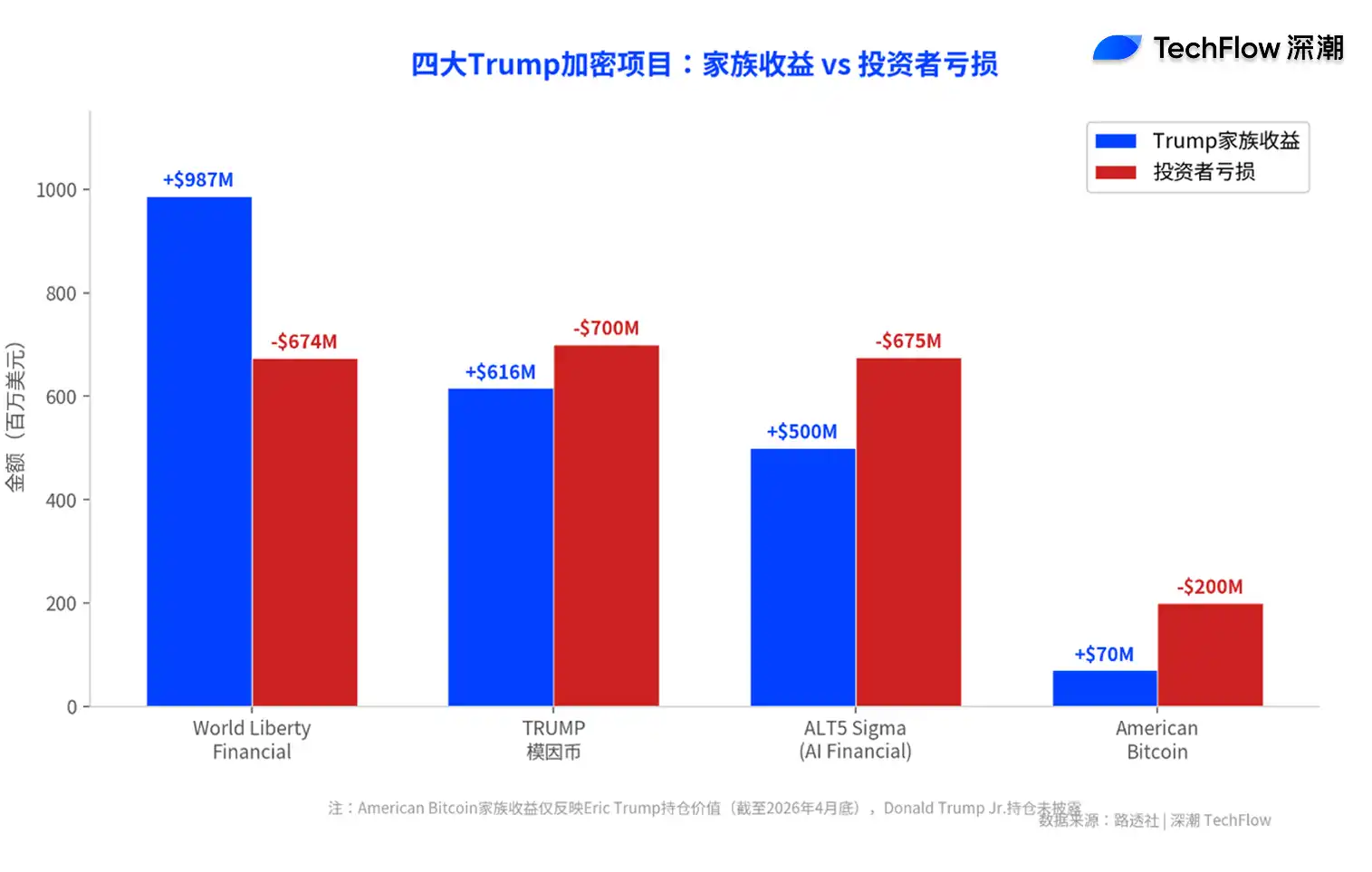
Investors through public company channels also suffered heavy losses. ALT5 Sigma (later renamed AI Financial Corp.) raised $750 million through a share issuance, with $717 million used to purchase World Liberty tokens, and over $500 million flowing to the Trump family via revenue sharing. The company's stock price fell from over $9 in August 2025 to about $0.75 by the end of April 2026, resulting in investor losses of roughly $675 million. American Bitcoin's stock price dropped from its $11 IPO price in September 2025 to about $1.15 by the end of April, causing investor losses exceeding $200 million. Both Eric Trump and Donald Trump Jr. received equity stakes without contributing capital, with Eric Trump's holdings still valued at over $70 million at the end of April.

Trump Crypto Revenue Exceeds Coinbase, Crushes Major Industry Players

Reuters' comparative data puts this scale into sharper perspective. During the same window from November 2024 to April 2026:

Coinbase revenue was approximately $2.1 billion; IREN (the largest listed Bitcoin miner by market cap) revenue was about $127 million; BlackRock's Bitcoin ETF business (IBIT) revenue was around $109 million; Circle (issuer of USDC) incurred a loss of $14 million; Galaxy Digital incurred a loss of $430 million.

The Trump family's $2.3 billion exceeds the totals for all the aforementioned companies. These companies built their commercial moats over years of technological accumulation, licensing/compliance, and market development. The core leverage for the Trump projects was brand licensing and political influence.


Related Questions

QAccording to the Reuters investigation, how much pretax revenue did projects linked to the Trump family generate from November 2024 to April 2026?

AAccording to the Reuters investigation, projects linked to the Trump family generated approximately $2.3 billion in pretax revenue from November 2024 to April 2026.

QWhat is the core finding of the Reuters report regarding the business model of the Trump family's crypto projects?

AThe core finding is that the business model employed a highly asymmetrical risk structure: the family invested very little of its own capital but captured enormous upside through mechanisms like token sale revenue sharing, founder token allocations, and equity arrangements.

QWhich two projects were the largest sources of revenue for the Trump family, according to the report?

AAccording to the report, World Liberty Financial was the largest source, providing an estimated $987 million, and the TRUMP memecoin was the second largest, providing approximately $616 million to the family.

QWhat was the approximate total net loss suffered by retail and secondary market investors in these projects?

ARetail and secondary market investors suffered approximately $2.25 billion in net losses, an amount nearly equal to the family's gains.

QHow did the Trump family's crypto revenue during this period compare to the profits of major industry players like Coinbase?

AThe Trump family's $2.3 billion in revenue exceeded the $2.1 billion profit reported by Coinbase during the same period, and also far surpassed the revenue of other major players like BlackRock's Bitcoin ETF business (~$109 million) and IREN (~$127 million).

Related Reads

How to Do Research Well: Deliberately Practice the Real Skills That Matter

No one truly teaches you how to do research. You're often given a desk, a pre-selected problem, and vague instructions to "create something new." Consequently, many people reverse-engineer the job based on visible outputs—papers, posts, announcements—learning only how to *appear* like a researcher rather than how to *become* one. True research capability is built from stacking small, trainable skills, nearly all of which can be developed through deliberate practice. **Pick Your Own Problem:** Most researchers absorb problems from advisors or trends, lacking the underlying reasoning. Choosing a problem you genuinely care about, as John Schulman advises, leads to original work. Develop "taste" like a muscle: predict experiment outcomes, guess paper results from methods, and track which findings remain important over time. **Upgrade Your Inputs:** Relying on shared reading lists (arXiv hot lists, filtered group chats) leads to unoriginal conclusions. Undervalued old literature often holds crucial insights (e.g., MoE, LSTM, backpropagation). Richard Sutton's "The Bitter Lesson" or Claude Shannon's 1952 talk on creative thinking are more predictive than lengthy modern surveys. Breadth matters as much as depth: draw from neuroscience, mechanism design, hardware knowledge, and honest statistics. Read papers directly, especially appendices and limitations sections. **Write Everything Down:** As Paul Graham noted, writing exposes flaws in seemingly mature ideas. Writing is the cheapest defense against self-deception. Following Feynman's principle, Darwin programmatically wrote down facts contradicting his theory to combat memory bias. Maintain a detailed log of hypotheses, setups, predictions, results, and updated understandings. Reviewing past logs fosters essential humility.

marsbit1h ago

How to Do Research Well: Deliberately Practice the Real Skills That Matter

marsbit1h ago

Following US Ban on Fable 5, Zhipu AI's Stock Soars 47%

On June 15th, shares of Zhipu AI surged dramatically on the Hong Kong stock market, peaking at a 47.6% gain before closing 32.82% higher. This sharp increase was directly triggered by two recent industry events. On June 12th, Anthropic announced it was suspending global access to its latest flagship models, Claude Fable 5 and Claude Mythos 5, to comply with a U.S. government export control order. The next day, Zhipu AI announced it would open access to its latest open-source flagship model, GLM-5.2, under the permissive MIT license. The Anthropic incident highlighted a critical issue beyond raw model capability: the risk of sudden, unpredictable loss of access to advanced AI models, especially for developers and enterprises deeply integrated with them. This has shifted industry and market focus toward factors like stability, sustainable access, and controllability. Zhipu's move, promoting "frontier intelligence for all," positions its openly available model as a reliable and accessible alternative. The GLM-5.2 model emphasizes "Long Horizon Task" capabilities with a 1M context window, targeting complex, multi-step coding and engineering workflows where maintaining context is crucial. Analysts note this event exposes the risk of dependency on closed-source models subject to single jurisdictional controls, potentially accelerating a shift toward domestic base models and localized deployments. The market's reaction signals a new valuation dimension in AI: providers who can offer stable, long-term, and sustainably accessible AI capabilities are gaining strategic importance.

marsbit1h ago

Following US Ban on Fable 5, Zhipu AI's Stock Soars 47%

marsbit1h ago

Fully Entering the AI Era: Alipay Bets on Conversation, WeChat Holds Fast to Social

In May 2026, Alipay announced over 300 million AI payment transactions. Shortly after, WeChat opened its mini-programs for AI integration, sparking controversy by requiring developer source code access. This highlights their diverging approaches to AI integration. Alipay is testing "Project Treasure," an optional AI-native interface replacing traditional app grids with a conversational window. Users can command complex tasks (e.g., "book a ride and order coffee") handled end-to-end by AI. This shift follows an abandoned standalone AI app, focusing instead on enhancing its existing user base. For unmodified mini-programs, Alipay's AI uses "screen-reading" to simulate user interactions, bypassing the need for developer overhaul. It also introduced "Token Pay" for micro-transactions and "AI Wallets" for autonomous agent spending. WeChat, prioritizing its core social function, is taking an embedded approach. Its AI agent will operate within existing contexts like group chats and official accounts, assisting without a separate interface. To enable this, WeChat offers developers two paths: granting source code access for direct AI control ("Automatic Mode") or manually encapsulating services into standardized "Skills." Both place significant burden on developers. Key differences emerge in handling legacy services: WeChat demands developer cooperation (code or labor), while Alipay's screen-reading offers immediate, if potentially less stable, compatibility. Alipay's 3 billion AI transactions demonstrate user acceptance of AI-driven commercial actions. The divergent strategies may reshape mini-program ecosystems—Alipay passively "AI-fying" services, WeChat potentially favoring resource-rich developers—and set competing technical standards. Ultimately, the competition centers on where users entrust the command to "help me get things done."

marsbit1h ago

Fully Entering the AI Era: Alipay Bets on Conversation, WeChat Holds Fast to Social

marsbit1h ago

Trading

Spot
Futures

Hot Articles

Discussions

Welcome to the HTX Community. Here, you can stay informed about the latest platform developments and gain access to professional market insights. Users' opinions on the price of S (S) are presented below.

活动图片













