Prediction Market Competition Heats Up, Hyperliquid Enters the Fray with 'Outcomes'

marsbitPublicado a 2026-02-03Actualizado a 2026-02-03

Resumen

Hyperliquid, a leading crypto derivatives exchange, has announced the test launch of "Outcomes," a new prediction market feature, causing its native token HYPE to surge over 10%. Unlike traditional prediction markets, Outcomes is designed with three core mechanisms: full collateralization (eliminating liquidation risk), non-linear settlement (enabling complex strategies similar to options), and native integration with Hyperliquid’s chain and margin system. This move positions Hyperliquid against established players like Polymarket (focused on social sentiment), Kalshi (compliant markets), and Coinbase (consumer-facing products). Hyperliquid aims to integrate prediction markets directly into its financial ecosystem, allowing users to combine derivatives and prediction positions within a unified margin account. With a highly efficient core team of 11 members generating over $1 billion in annualized revenue per person, Hyperliquid is expanding rapidly. While some analysts note that even capturing all of Polymarket’s volume would only add ~5% to Hyperliquid’s revenue, the platform’s current $7 billion valuation is considered undervalued compared to Polymarket’s $10 billion valuation. Outcomes is seen as a key step in building a comprehensive on-chain Wall Street, though it remains in testnet with no mainnet release date announced.

Original Author: Seed.eth, Bitpush News

Hyperliquid, firmly holding the top spot in the crypto derivatives track, is now attempting to extend its reach into another trillion-dollar market on the brink of explosion: the prediction market.

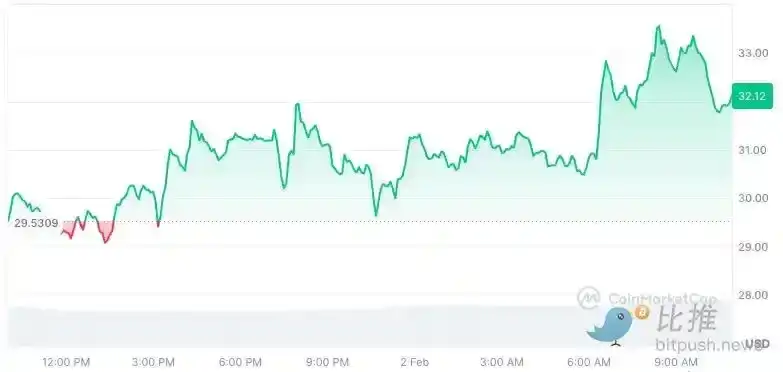
Today, Hyperliquid officially announced the testing of a new feature called 'Outcomes'. This news directly ignited excitement in the secondary market, with its native token HYPE recording a gain of over 10% within 24 hours, breaking through the $30 mark.
At a time when Polymarket dominates on-chain traffic and Kalshi, in partnership with Coinbase, captures the compliant market, Hyperliquid's entry is far from simple 'bandwagoning'. Instead, it leverages the absolute advantage of its native underlying performance to redefine the rules of the game.

What is Outcomes
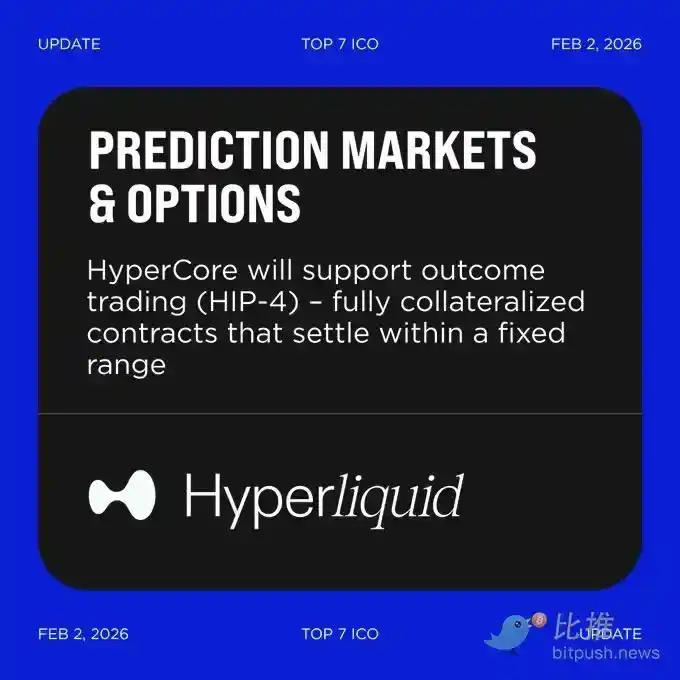
According to the official HIP-4 proposal, Outcomes (Result Contracts) are not a simple betting interface. Their design hinges on the following three core logics:

1. Full Collateralization, No Liquidation Risk

Unlike leveraged perpetual contracts, Outcomes adhere to the principle of 'you can only do as much as your money allows'. It uses full collateralization and settles within a fixed range. This means that no matter how the market fluctuates, as long as the settlement date hasn't arrived, a trader's position will not face forced liquidation, fundamentally removing the risk of being liquidated.

2. Non-linear Settlement, Greater Strategic Space

Outcomes introduces a non-linear settlement mechanism. For traders, this is equivalent to gaining a flexibility close to that of options. You can use it to build more complex hedging instruments, no longer limited to simple binary 'yes' or 'no' games, thereby opening up greater space for risk management and strategic combinations.

3. Native Integration, Liquidity Connectivity

Outcomes will be deeply integrated into HyperCore, Hyperliquid's underlying chain, and priced in its native stablecoin USDH. More importantly, it will share cross-margin with the platform's existing spot and perpetual contracts. This means users can seamlessly connect multiple trading strategies within a single margin account, truly achieving interoperability and reuse of liquidity.

Multi-Party Fragmentation: Who is the Final Form of the Prediction Market?

The current prediction market is at its '1995 browser war' moment, forming four distinct business paths:
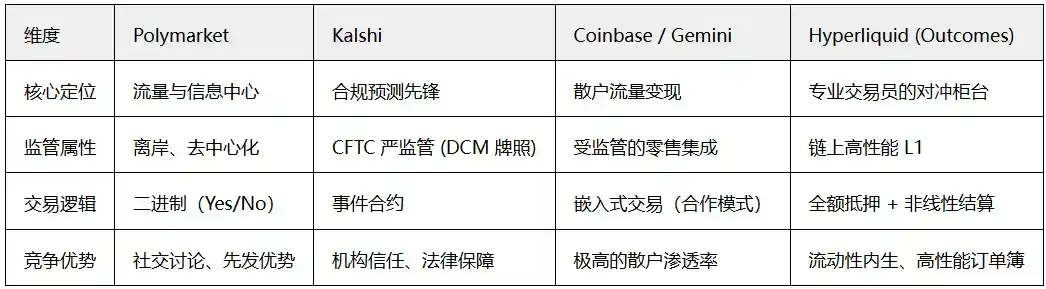
  • Polymarket sells 'opinions'; it's a barometer of social trends.
  • Kalshi sells 'compliance'; it attracts US domestic capital seeking to avoid legal risks.
  • Coinbase is about 'dimensionality reduction attack', turning the prediction market into a mass consumer product through an in-app feature.
  • Hyperliquid's logic is the most hardcore: it doesn't require you to click Yes or No on a webpage; it wants you to buy an Outcomes contract hedging 'non-farm payroll data exceeding expectations' while shorting BTC.

Right now, the community is most focused on the synergistic effect between HIP-3 (Permissionless Listing) and HIP-4 (Outcomes).

Under this architecture, Hyperliquid's evolution path is clear: first, official deployment of 'Canonical Markets' based on objective data sources, such as interest rates and macroeconomic indicators; followed by enabling permissionless deployment.
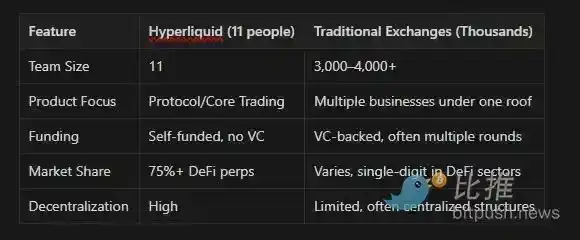
Behind this strategy is Hyperliquid's legendary team advantage. It's hard to imagine that this behemoth, with annualized revenue exceeding $1.1 billion and trading volume rivaling top-tier CEXs, is supported by a core team of only about 11 people. This 'special forces' team, composed of Harvard, MIT elites, and top quantitative hedge fund professionals, has created an astonishing efficiency of over $100 million in annualized revenue per capita. Precisely because the team is extremely lean with short decision-making paths, Hyperliquid can iterate rapidly.

A senior DeFi observer commented: 'Coinbase's entry validates the business model, but it is still centralized. Hyperliquid's Outcomes is challenging a proposition: the endgame of prediction markets does not lie in social media, but in financialization. When trading prediction outcomes becomes as smooth as buying and selling stocks, and can share margin with futures, the imagination space for on-chain finance truly opens up.'

Is HYPE Severely Undervalued?

As the crypto options market matures, the Open Interest (OI) in Hyperliquid's HIP-3 market has surged to $1 billion, and the platform's 24-hour trading volume has skyrocketed to $4.8 billion, hitting a new all-time high.
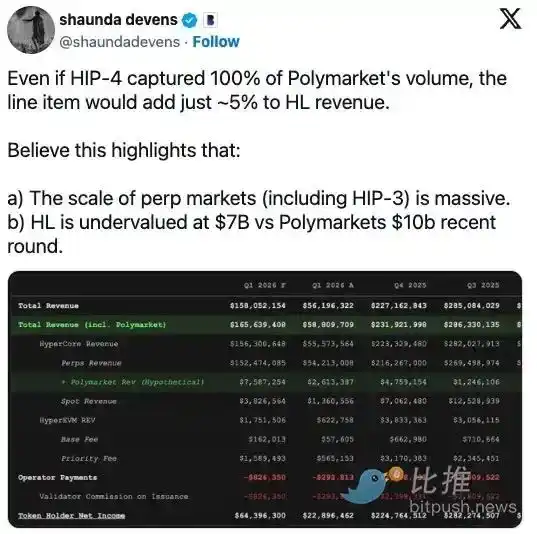
Regarding this move, Blockworks researcher Shaunda Devens believes it further supports Hyperliquid's valuation upside.

Devens pointed out that even if HIP-4 captured 100% of Polymarket's trading volume, its contribution to Hyperliquid's revenue would only be about 5%.

This data seems surprising at first glance, but the underlying logic is: the perpetual contracts market (including the long-tail assets brought by HIP-3) is extremely large. Devens believes that Hyperliquid's current valuation of approximately $7 billion is clearly in a state of significant undervaluation compared to Polymarket's latest round valuation of $10 billion (based on 2025 funding data). The launch of Outcomes is primarily about supplementing a key piece of its full-category financial matrix.

Despite the high market sentiment, it is important to note that Outcomes is currently still in the testnet phase, and a specific timeline for the mainnet launch has not been announced yet. However, with the explosion of the HyperEVM ecosystem, future mainstream service providers like Kalshi or Crypto.com could, in theory, migrate to run on the Hyperliquid chain using the HIP-4 protocol.

In summary, the prediction market is ushering in its best era. In the US, thanks to the advancement of regulatory clarity, the cooperation between Kalshi and Coinbase has already made prediction markets available in all 50 states; similarly strong growth momentum is also seen in the EU and Asia. For Hyperliquid, Outcomes is not a simple 'gambling game'; it is an indispensable piece of the puzzle in building the 'on-chain Wall Street'.

Original link

Preguntas relacionadas

QWhat is Hyperliquid's new feature called and what market is it targeting?

AHyperliquid's new feature is called 'Outcomes', and it is targeting the prediction market.

QWhat are the three core design principles of Hyperliquid's Outcomes feature?

AThe three core design principles are: 1. Full collateralization with no liquidation risk. 2. Non-linear settlement for greater strategic flexibility. 3. Native integration on HyperCore, sharing cross-margin with existing spot and perpetual contracts.

QHow did the announcement of Outcomes affect the price of the HYPE token?

AThe announcement caused the HYPE token to surge over 10% in 24 hours, pushing its price above $30.

QAccording to the article, how does Hyperliquid's approach to the prediction market differ from competitors like Polymarket and Kalshi?

AHyperliquid's approach is not a simple gambling interface; it leverages its native chain's performance to create a financialized product that integrates seamlessly with other derivatives, allowing for complex hedging strategies. This contrasts with Polymarket, which focuses on social sentiment, and Kalshi, which focuses on regulatory compliance.

QWhat was a key observation from Blockworks researcher Shaunda Devens regarding Hyperliquid's valuation after the Outcomes announcement?

AShaunda Devens observed that Hyperliquid's ~$7 billion valuation is significantly undervalued compared to Polymarket's latest $10 billion valuation, even if Outcomes captured 100% of Polymarket's volume, as the perpetuals market is vastly larger and is Hyperliquid's primary revenue driver.

Lecturas Relacionadas

You Bet on the News, the Pros Read the Rules: The True Cognitive Gap in Losing Money on Polymarket

The article explains that the key to profiting on Polymarket, a prediction market platform, lies not just predicting real-world events correctly, but in meticulously understanding the specific rules that govern how each market will be resolved. It illustrates this with examples, such as a market on Venezuela's 2026 leader, where the official rules defining "officially holds" the office overruled the intuitive answer of who was in practical control. Other examples include debates over the definition of a "token" or what constitutes an "agreement." The core argument is that a "reality vs. rules" gap creates pricing discrepancies that savvy traders ("车头" or "whales") exploit. The platform has a formal dispute resolution process managed by UMA token holders to settle ambiguous outcomes. This process involves proposal submission, a challenge window, a discussion period, and a final vote. However, the article highlights a critical flaw in this system compared to a traditional court: the lack of separation between the arbiters (UMA voters) and the interested parties (traders with financial stakes in the outcome). This conflict of interest undermines the discussion phase, leads to herd mentality, and results in opaque final decisions without explanatory rulings. Consequently, the system lacks a body of precedent, making it difficult for users to learn from past disputes. The ultimate takeaway is that success on Polymarket requires a lawyer-like scrutiny of the rules to identify and capitalize on the cognitive gap between how events appear and how they are contractually defined for settlement.

marsbitHace 12 min(s)

You Bet on the News, the Pros Read the Rules: The True Cognitive Gap in Losing Money on Polymarket

marsbitHace 12 min(s)

Will the Fed Still Cut Interest Rates? Tonight's Data Is Crucial

The core debate surrounding the Federal Reserve's potential interest rate cuts is intensifying amid geopolitical conflict and rebounding inflation. The key question is whether high energy prices will cause persistent inflation or weaken consumer demand enough to force the Fed to cut rates. Citigroup presents a bullish case for cuts, arguing that oil supply disruptions from the Strait of Hormuz are temporary and will not lead to lasting inflationary pressure. They point to receding bond yields and oil prices as evidence the market is pricing in a short-lived shock. Citi's data also shows tightening financial conditions, a stabilizing labor market, and healthy tax returns, supporting their view that the path to lower rates remains open. Conversely, Deutsche Bank offers a starkly contrasting, more hawkish outlook. They argue the Fed's current policy is already neutral and expect rates to remain unchanged indefinitely. Their view is based on stalled disinflation progress and a shift toward more hawkish rhetoric from key Fed officials like Waller, who cited risks from prolonged Middle East conflict and tariffs. Other officials, including Williams and Hammack, signaled rates would likely stay on hold for a "considerable time." The market pricing has shifted dramatically, now forecasting zero cuts in 2026. The imminent release of the March retail sales "control group" data is highlighted as a critical test. This metric, which excludes gas station sales, will reveal if high gasoline prices are eroding consumer spending in other areas. A weak reading could support the case for imminent rate cuts, while a strong one would bolster the argument for the Fed to hold steady. This data is pivotal for determining the near-term policy path.

marsbitHace 32 min(s)

Will the Fed Still Cut Interest Rates? Tonight's Data Is Crucial

marsbitHace 32 min(s)

The Second Half of Macro Influencer Fu Peng's Career

Fu Peng, a prominent Chinese macroeconomist and former chief economist of Northeast Securities, has joined Hong Kong-based digital asset management firm Bitfire Group (formerly New Huo Group) as its chief economist. This move, announced in April 2026, triggered an 11% surge in Bitfire's stock price. Fu, known for his accessible macroeconomic commentary and large social media following, will focus on integrating digital assets into global asset allocation frameworks, particularly combining FICC (fixed income, currencies, and commodities) with cryptocurrencies for institutional clients. His career includes roles at Lehman Brothers and Solomon International, with significant influence gained through public communication. However, in late 2024, Fu faced temporary social media bans after a controversial private speech at HSBC on China's economic challenges, though he denied regulatory sanctions. He later left Northeast Securities citing health reasons. Bitfire, a licensed virtual asset manager serving high-net-worth clients, seeks to build trust and attract traditional capital through Fu’s expertise and credibility. The partnership represents a strategic shift for both: Fu enters the crypto sector after a traditional finance peak, while Bitfire aims to leverage his macro framework for institutional adoption. Outcomes remain uncertain regarding capital inflows and compatibility within corporate structure.

marsbitHace 1 hora(s)

The Second Half of Macro Influencer Fu Peng's Career

marsbitHace 1 hora(s)

Trading

Spot
Futuros
活动图片