Spending $200 to Buy Stars, Scamming VCs Out of Tens of Millions: The Entire GitHub Fake Star Industry Exposed

marsbitPublicado a 2026-04-21Actualizado a 2026-04-21

Resumen

A peer-reviewed study from Carnegie Mellon University (CMU) reveals that GitHub hosts approximately 6 million fake Stars, involving 18,600 repositories and 301,000 accounts, with AI/LLM projects being the largest non-malicious category for fake engagement. The fake Star market has exploded, with prices as low as $0.03 per Star. Research shows that venture capital firms, such as Redpoint Ventures, use GitHub Star counts as a key metric for evaluating startups, with median Stars at 2,850 for seed-stage funding. For less than $200, a project can artificially meet this threshold, distorting investment landscape. Over a dozen websites openly sell GitHub Stars, and fake Star activity saw explosive growth in 2024. AI-related repositories were among the most heavily affected. Despite GitHub’s policies against fake engagement, enforcement remains inconsistent: while 90% of flagged repositories were deleted, only 57% of involved accounts were suspended. The report highlights how purchased Stars can manipulate GitHub’s Trending algorithm and influence VC funding decisions, creating a cycle where artificial metrics attract real investment.

Author: Claude, Deep Tide TechFlow

Deep Tide Intro: A peer-reviewed study from Carnegie Mellon University (CMU) found approximately 6 million fake Stars on GitHub, involving 18,600 repositories and 301,000 accounts. AI/LLM projects are the largest non-malicious category for star-buying. The market price for a single star can be as low as $0.03. Redpoint data shows the median number of Stars for VC seed-stage projects is 2,850—meaning spending less than $200 can 'buy' a false level of popularity that meets the seed-round threshold.
GitHub Stars are becoming an elaborately packaged scam.

According to an investigative report published by Awesome Agents on April 13th, a mature gray market around GitHub Stars is operating in plain sight: academic papers have quantified the scale of the problem, over a dozen websites openly sell Stars, and venture capital firms directly incorporate Star counts into their project screening decisions.

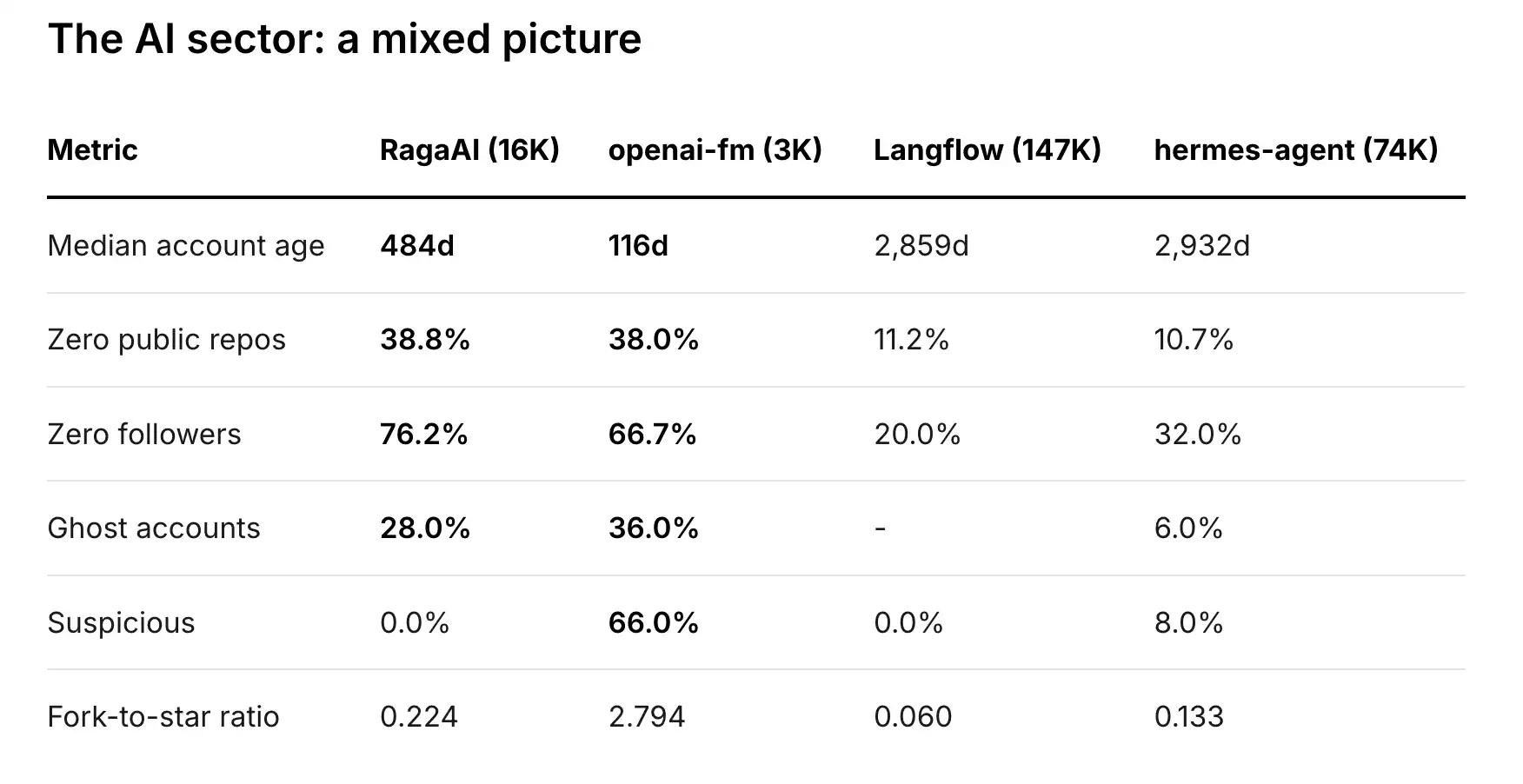
The investigation team independently verified 20 repositories and found that 36% to 76% of the Stars for some projects came from accounts with zero followers, with fork-to-star ratios less than one-tenth of the baseline for organic projects.

The core academic support for this report comes from a peer-reviewed paper jointly published by CMU, North Carolina State University, and Socket at ICSE 2026 (International Conference on Software Engineering). The research team's detection tool, StarScout, analyzed 20TB of GitHub metadata (6.7 billion events, 326 million Stars, covering 2019 to 2024), ultimately flagging approximately 6 million suspicious fake Stars, 18,600 involved repositories, and about 301,000 participating accounts.
6 Million Fake Stars: Explosive Growth in 2024, AI Projects Heavily Affected

Fake Stars are not a new phenomenon, but their scale exploded in 2024. CMU paper data shows that before 2022, there were no more than 10 repositories involved in fake Star activity per month. By the peak in July 2024, this number skyrocketed to 3,216 repositories and 30,779 participating accounts. As of July 2024, 16.66% of repositories with more than 50 Stars had engaged in fake Star activity.

The detection accuracy of the research team was indirectly validated by GitHub's own actions: 90.42% of the repositories flagged by StarScout have been deleted, and 57.07% of the flagged accounts have been purged.

In the classification of fake Star usage, most are used to promote short-lived phishing/malware repositories. But among non-malicious categories, AI and LLM-related projects rank first, with a total of 177,000 fake Stars, surpassing blockchain/cryptocurrency projects. The paper notes that "many of these are academic paper repositories or products from LLM-related startups." More critically, 78 repositories detected with fake Star activity had appeared on the GitHub Trending page, proving that purchased Stars can indeed successfully manipulate the platform's recommendation algorithm.
A Star for as Low as 3 Cents: The Openly Operating Star-Buying Market

This is not a dark web transaction. The investigation confirmed that at least a dozen websites openly sell GitHub Stars, including SocialPlug.io, Buy.fans, Boost-Like.store, etc. There are 24 active Star-buying services on Fiverr, ranging from basic packages for $5 to "organic promotion" packages for $25 and above.

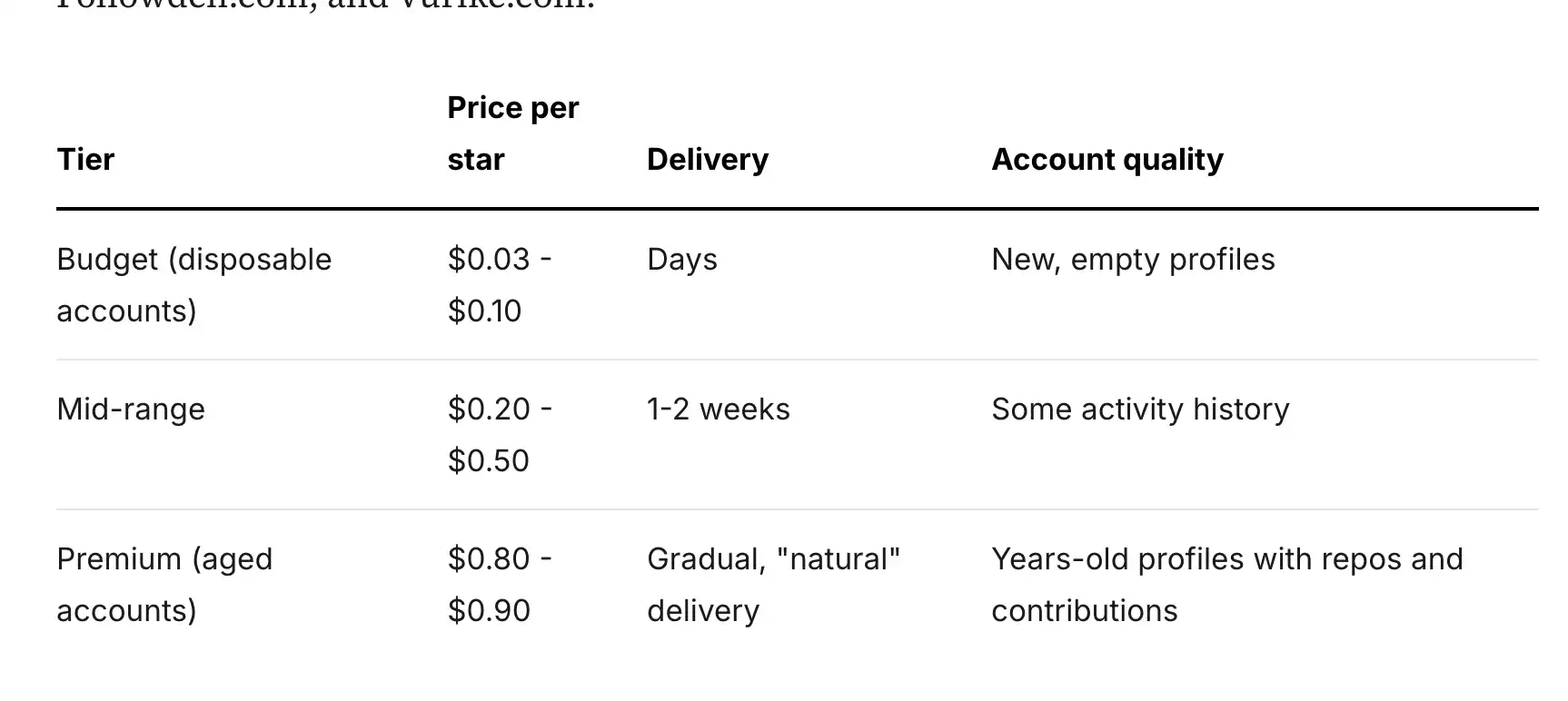
Pricing is tiered: cheap tier (disposable new accounts) $0.03 to $0.10 per star, mid-tier $0.20 to $0.50, premium tier (aged accounts with years of history) $0.80 to $0.90. Premium services promise "non-drop stars" and a 30-day refill guarantee. SocialPlug claims to have delivered 3.1 million Stars cumulatively, serving over 53,000 customers, and even offers an API interface for programmatic bulk purchasing.
Star exchange platforms like GithubStarMate.com and SafeStarExchange.com use a points-based mutual brushing model, allowing users to exchange Stars without spending money. There are also at least 7 open-source tools on GitHub (e.g., fake-git-history, commit-bot, etc.) specifically designed to forge contribution history graphs. Pre-made GitHub accounts with 5 years of commit history and the Arctic Code Vault contributor badge are sold on Telegram for about $5,000.

A 2020 study from Tsinghua University documented the operations of promotion groups on QQ and WeChat in China: groups with over 1,020 members process about 20 repository star-buying tasks daily, estimating an annual industry profit of $3.4 million to $4.4 million.

VCs Use Stars for Project Screening, Spending $200 Can "Meet" Seed Round Standards

The relationship between Stars and funding is not speculation; it's something venture capital firms themselves publicly admit.

Redpoint Ventures partner Jordan Segall analyzed 80 developer tool companies and found that the median number of GitHub Stars at seed funding was 2,850, and 4,980 at Series A. He explicitly stated: "Many VCs write internal crawlers to find GitHub projects with fast Star growth. Stars are the metric they most commonly track."

These numbers essentially give startups a precise shopping list. Using cheap Stars, spending $85 to $285 can manufacture 2,850 Stars to reach the seed round median; spending $990 to $4,500 can reach the Series A threshold. Compared to the typical seed round funding range of $1 million to $10 million, the return on investment ranges from 3,500x to 117,000x.

The ROSS Index (Ranking of Open Source Startups), published quarterly by Runa Capital, further amplifies this incentive. According to TechCrunch, 68% of the companies on the ROSS Index received investment at the seed stage, with total tracked funding reaching $169 million. An independent analysis in the investigative report found that Union Labs, ranked first in the Q2 2025 ROSS Index (Star growth 54.2x, total 74,300 Stars), showed severe signs of star-buying: 32.7% of its Stars came from accounts with zero repositories, 52% from accounts with zero followers, and StarScout flagged 47.4% of its Stars as suspicious. The top project on an industry ranking widely cited by VCs had nearly half its Stars涉嫌造假 (suspected of being fake).

Actual cases already corroborate the conversion chain from Stars to funding: Lovable (formerly GPT Engineer) secured a $7.5 million pre-seed round with 50,000+ Stars, with a Series A valuation of $1.8 billion; Browser-use received a $17 million seed round after gaining 50,000 Stars in three months; Pangolin entered Y Combinator with 1,000 Stars and completed a $4.7 million seed round within eight months.

GitHub's Asymmetric Enforcement: Delete Repositories but Keep Accounts

GitHub's Acceptable Use Policies explicitly prohibit "artificial engagement," "ranking manipulation," and creating a secondary market for fake Stars, even specifically banning star-buying behavior incentivized by "cryptocurrency airdrops."

But enforcement is passive and asymmetric. GitHub deleted 90.42% of the repositories flagged by StarScout but only purged 57.07% of the executing accounts. The "workforce" of the fake Star industry remains largely intact. After Dagster published an investigative report in 2023, the related fake Star accounts were deleted within 48 hours—but this was a reaction to public exposure, not the result of proactive detection.
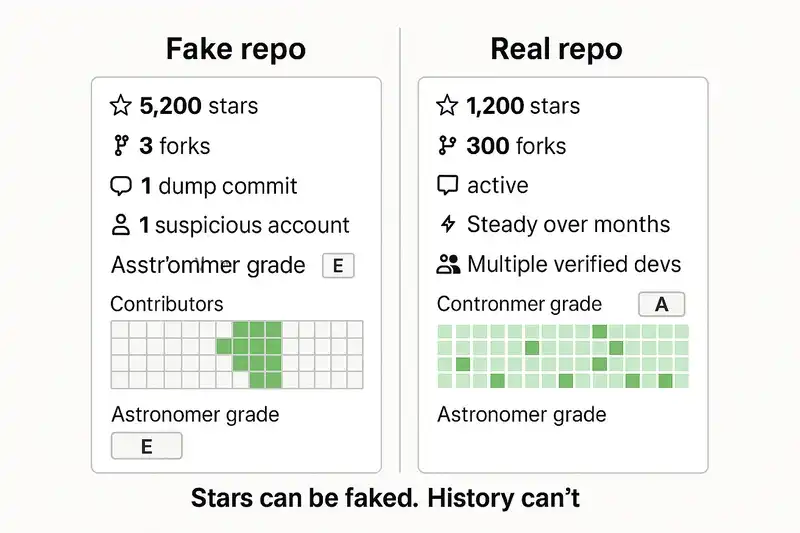
The CMU research team suggested GitHub adopt a network centrality-based weighted popularity metric to replace the raw Star count, structurally dismantling the fake Star economy. GitHub has not implemented this to date.

This forms a self-reinforcing loop: VCs use Stars as a screening signal → Startups buy Stars → VCs see artificial hype → More VCs adopt Star tracking → More startups buy Stars. The benchmark numbers publicly released by Redpoint (seed: 2,850, Series A: 4,980) essentially gave startups a clearly priced shopping list.

As one commentator in the investigative report said: "Star counts can be faked, but saving someone a weekend of bug fixes cannot."


Preguntas relacionadas

QWhat is the estimated number of fake GitHub Stars identified in the CMU study, and which category of projects had the highest number of non-malicious fake Stars?

AThe CMU study identified approximately 6 million fake GitHub Stars. Among non-malicious categories, AI and LLM-related projects had the highest number of fake Stars, totaling 177,000.

QHow much does the cheapest fake GitHub Star cost, and what is the estimated cost to fake the median Star count for a seed-round project?

AThe cheapest fake GitHub Star costs as low as $0.03. To fake the median Star count of 2,850 for a seed-round project, it would cost less than $200 using the cheapest options.

QAccording to the article, what percentage of repositories with over 50 Stars had engaged in fake Star activities by July 2024?

ABy July 2024, 16.66% of repositories with over 50 Stars had engaged in fake Star activities.

QWhich venture capital firm published data on the median GitHub Star counts for seed and Series A rounds, and what were those numbers?

ARedpoint Ventures published the data. The median GitHub Star count was 2,850 for seed rounds and 4,980 for Series A rounds.

QWhat tool did the research team develop to detect fake GitHub Stars, and how was its accuracy indirectly validated?

AThe research team developed a tool called StarScout to detect fake GitHub Stars. Its accuracy was indirectly validated by GitHub's actions: 90.42% of the repositories flagged by StarScout were deleted, and 57.07% of the flagged accounts were purged.

Lecturas Relacionadas

The Shutdown of Claude Mythos Revealed the True Cost of Renting AI to Me

The sudden shutdown of Claude Mythos this week starkly highlights a critical, often overlooked risk for founders: when your core capability relies entirely on someone else's platform, your fate is not in your own hands. The key question becomes: who truly owns the intelligence your product depends on? For years, the debate around open-source models focused on cost. Now, the evidence is clear: fine-tuned open-source models can achieve frontier-level quality for specific, mission-critical tasks at a fraction of the cost. However, the deeper issue is control. Relying on a third-party API is like renting; it works until the landlord changes the rules, raises the rent, or asks you to leave—as Mythos experienced. The lesson is not to stop using frontier models—they are incredible infrastructure. The goal is ownership. Ownership means starting with a powerful open-source model and shaping it around what makes your company unique: your data, workflows, domain expertise, and definition of "good." Over time, the model becomes less generic and more reflective of your business, creating durable value. The optimistic conclusion is that AI's future doesn't hinge on one superior model. There is no single frontier. The frontier includes proprietary models, models fine-tuned on company-specific knowledge, specialized models for narrow problems, and intelligent routers orchestrating model ensembles. The most interesting development is not models getting smarter, but intelligence becoming increasingly customizable. The winning companies will be those that transform intelligence into a unique, owned asset. Looking ahead, the vision is not one model dominating all, but many teams owning the part of the frontier that matters most to them.

marsbitHace 8 min(s)

The Shutdown of Claude Mythos Revealed the True Cost of Renting AI to Me

marsbitHace 8 min(s)

Tiger Research: U.S. Strategic Bitcoin Reserve - Should the Market Be Happy or Disappointed?

Tiger Research analyzes the evolution of U.S. legislative efforts regarding a strategic Bitcoin reserve, concluding the market impact is limited in the short term but potentially positive long-term. The core event was a March 2025 executive order by former President Trump, which designated confiscated Bitcoin as a strategic reserve and promised not to sell existing holdings (approx. 190k BTC). As it contained no mandate to purchase new Bitcoin, the market reacted negatively, with prices dropping 5.7%. Legislative history shows a significant retreat from initial ambitions. The 2024 "BITCOIN Act" proposed mandatory purchases of 1 million BTC over five years. Reintroduced in 2025, it stalled due to high fiscal costs, concerns over dollar hegemony, and opposition from the Treasury Secretary. The current frontrunner, the 2026 "American Retirement and Monetary Advancement (ARMA) Act," is a compromise. It lacks any purchase requirement, instead focusing on consolidating existing government-held Bitcoin and legally prohibiting its sale for at least 20 years. While ARMA has higher passage odds due to bipartisan support and no purchase mandate, its immediate market effect is neutral. It eliminates potential government selling pressure but creates no new demand. The long-term significance is that formally establishing Bitcoin as a national reserve asset in law could later reignite debates on mandatory purchases. Therefore, the path to a government buyer is longer than initially priced by the market, but the directional narrative remains intact.

marsbitHace 11 min(s)

Tiger Research: U.S. Strategic Bitcoin Reserve - Should the Market Be Happy or Disappointed?

marsbitHace 11 min(s)

US Stock Market Trend (June 16): SpaceX Rises 42% in Two Days, New Fed Chairman Takes Office Today

**U.S. Stocks Trend (June 16): SpaceX Soars 42% in Two Days, New Fed Chair Takes Office Today** Markets surged on Monday following former President Trump's social media announcement of a completed U.S.-Iran deal to reopen the Strait of Hormuz, pending a June 19 signing. The news triggered a broad risk-on rally: oil prices crashed, tech stocks soared, bond yields fell, and defensive sectors lagged. **Market Performance:** The Nasdaq jumped 3.07%, led by semiconductor stocks like Micron (+9.2%). The S&P 500 gained 1.65%, and the Dow rose 0.92% to a record high. However, the Russell 2000 small-cap index underperformed (+0.72%). SpaceX continued its hot streak, rising another 5% pre-market after disclosures of large buys by an Australian billionaire and Cathie Wood's ARK. Boeing also rallied on the transportation optimism. Conversely, energy stocks like Chevron fell over 3% on the oil price plunge, with other defensive sectors also selling off. The day's action showed a clear rotation of funds from energy/defensive plays into AI and tech narratives. **Macro & Outlook:** The VIX fear index fell 8.37%. Treasury yields declined, and WTI crude dropped over 5%. Attention now shifts to a packed schedule: the Bank of Japan is widely expected to hike rates to 1.0% on Tuesday. The Fed's June meeting concludes Wednesday, marking new Chair Wash's debut. While rates are expected to hold, his tone on stubborn inflation and the "dot plot" will be crucial for gauging the 2024 rate path. The formal Iran deal signing is set for Friday. **Trend Perspective:** While the peace deal is a genuine positive, Monday's explosive rally may have gotten ahead of itself, pricing in a swift resolution to inflation concerns. The shortened trading week faces a triple test: BoJ tightening, the Fed's policy stance, and deal implementation details. Tech and semiconductors, which led the surge, remain vulnerable to any disappointment from these key events. The real price discovery begins with the central banks' communications this week.

marsbitHace 32 min(s)

US Stock Market Trend (June 16): SpaceX Rises 42% in Two Days, New Fed Chairman Takes Office Today

marsbitHace 32 min(s)

Xiaohongshu's Second Great Voyage, This Time Sailing Towards AI

Xiaohongshu's Second Voyage: Navigating Towards AI Since ChatGPT's emergence, Xiaohongshu's founder Mao Wenchao has been acutely aware of AI's potential threat, recognizing that the life advice people seek from chatbots overlaps directly with his platform's core business. Founded in 2013 as a PDF shopping guide for Chinese tourists, Xiaohongshu evolved into a massive community where millions share authentic, personal experiences—from product reviews to travel tips. This vast repository of "I've tried this" human judgment became its most valuable asset. However, the rise of AI, which delivers instant answers, challenges the very need for users to sift through numerous personal notes. Fearing its treasure trove of lived experience could become mere training data for others, Xiaohongshu is proactively adapting. In 2026, it established a dedicated AI division (Dots), launched RED Skill to turn user experiences into usable AI tools, and acquired the AI search product "Diandian." Its investments now extend to AI firms like MiniMax and hardware startups, moving upstream to address needs before they even become search queries. The platform's commercialization strategy is also evolving. With a newly acquired payment license and tools like the AIPS model to track consumer decision journeys, Xiaohongshu aims to seamlessly integrate recommendations with transactions, embedding commerce within AI-generated answers. Yet, a critical tension remains. While building smarter machines to organize and leverage its human experiences, Xiaohongshu must prevent AI from drowning out the authentic, flawed, and trustworthy "I've tried this" voices that built its community. Its core challenge is to harness AI's power without letting the map—the machine's perfect, synthesized answer—replace the territory of genuine human experience. This balance between technological advancement and preserving human trust defines its current journey and its future.

marsbitHace 1 hora(s)

Xiaohongshu's Second Great Voyage, This Time Sailing Towards AI

marsbitHace 1 hora(s)

Trading

Spot
Futuros
活动图片




