Polymarket Sues Massachusetts Over Prediction Market Regulation – SUBBD Token Takes Advantage

bitcoinistОпубліковано о 2026-02-10Востаннє оновлено о 2026-02-10

Анотація

Polymarket, the world's largest prediction market, is suing the Commonwealth of Massachusetts after receiving a cease-and-desist order from the state's Attorney General, who accused it of operating an unlicensed gambling platform. The company argues its markets are financial derivatives under the jurisdiction of the Commodity Futures Trading Commission (CFTC), not gambling subject to state laws. This lawsuit represents a critical test for the crypto industry's ability to operate under a single federal framework rather than fragmented state regulations. Amid this regulatory battle, the SUBBD Token is capitalizing on the demand for decentralized platforms. It aims to disrupt the $85 billion creator economy by merging Web3 financial sovereignty with AI tools, offering lower fees and censorship-resistant monetization for content creators. The project has already raised $1.47 million in its presale and offers a 20% APY staking reward, positioning itself as a utility-driven alternative in a market seeking alternatives to centralized control.

Trusted Editorial content, reviewed by leading industry experts and seasoned editors. Ad Disclosure

Quick Facts:

  • ➡️ Polymarket is suing Massachusetts to establish that prediction markets are federally regulated derivatives, not state-regulated gambling.
  • ➡️ The lawsuit represents a critical test for the crypto industry’s ability to operate under federal oversight rather than fragmented state laws.
  • ➡️ SUBBD Token leverages similar decentralized principles to disrupt the $85B creator economy, offering AI tools and lower fees than Web2 competitors.
  • ➡️ The conflict highlights a broader market trend toward platforms that offer user sovereignty and resistance to centralized censorship.

The battle for decentralized information markets just hit a breaking point.

Polymarket, the world’s largest prediction platform, has officially filed a lawsuit against the Commonwealth of Massachusetts. This legal maneuver serves as a sharp counter-offensive to the Cease and Desist order issued by the state’s Attorney General, who accused the platform of running an unlicensed gambling operation.

Polymarket’s argument hangs on a single hook: federal preemption. The company contends its markets are financial derivatives under the jurisdiction of the Commodity Futures Trading Commission (CFTC), not games of chance subject to state-level gambling laws.

That distinction isn’t just legalese, it’s survival. If prediction markets are classified merely as gambling, they face a fractured nightmare of 50 different state regulators. If they’re derivatives? They face a single federal framework.

This lawsuit follows the precedent set by Kalshi, a regulated competitor that recently scored a massive win against the CFTC, emboldening platforms to challenge regulatory overreach.

But this isn’t just about election betting or sports outcomes. The conflict highlights the friction between decentralized protocols and legacy frameworks that struggle to categorize Web3 innovation. The market’s reaction? Telling.

Rather than fleeing, liquidity in decentralized sectors has deepened. Investors are hunting for sovereignty and utility outside the reach of arbitrary restrictions.

While prediction markets fight for the right to trade truth, SUBBD Token ($SUBBD) is using this sentiment to disrupt the $85 billion creator economy. As users look for platforms that guarantee ownership and freedom from censorship, SUBBD is capitalizing on the shift toward decentralized monetization.

Explore the SUBBD Token ecosystem.

Disrupting The $85B Content Economy With AI And Web3

While the Polymarket case highlights the struggle for permissionless trading, the content creation industry faces a parallel crisis: centralization.

Right now, Web2 giants strangle the landscape, extracting up to 70% of creator earnings through fees and maintaining absolute authority over who can monetize. Sound familiar?

This centralized control creates a fragile ecosystem where influencers face arbitrary bans, demonetization, and payment processor restrictions. SUBBD Token has emerged to fix these inefficiencies by merging Web3 financial sovereignty with advanced AI tooling.

The project’s architecture is built to return value to the user (a concept foreign to most legacy platforms). By utilizing the Ethereum blockchain, SUBBD eliminates the intermediaries that typically siphon revenue, offering a transparent payment infrastructure that supports creators, fans, and even AI-driven influencers.

The platform integrates proprietary AI models directly into the ecosystem, offering features like AI Personal Assistants for automated interactions and AI Voice Cloning. Why does that matter? It lets creators scale their output without the burnout associated with traditional streaming.
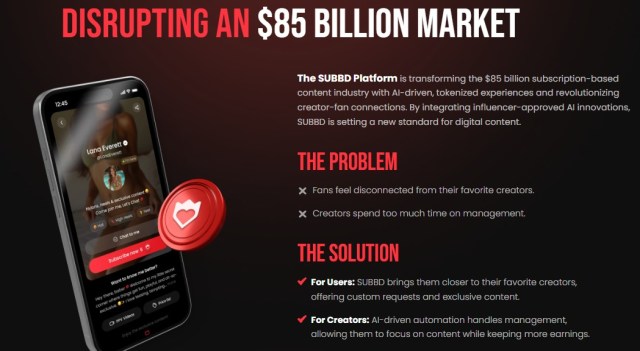
From a market perspective, the utility here goes beyond simple tokenization. The platform introduces governance mechanisms that allow token holders to vote on feature rollouts and creator curation, fostering a community-owned ecosystem rather than a corporate dictatorship.

For investors watching the regulatory squeeze on platforms like Polymarket, SUBBD represents a tangible application of decentralized tech, solving a clear operational problem rather than relying on purely speculative trading. The integration of ‘HoneyHive’ membership tiers and token-gated exclusive content further aligns the token’s velocity with platform growth.

Read more about $SUBBD here.

SUBBD Presale Momentum Signals Demand For Decentralized Monetization

You can see the hunger for utility-driven crypto assets in the project’s early numbers. According to official presale data, SUBBD Token has already raised $1.47M, indicating strong capital inflows despite the broader market’s regulatory uncertainty.

The token’s current price of $0.057495 offers a vital entry point for investors looking to capitalize on the intersection of AI and the creator economy before the platform fully launches.
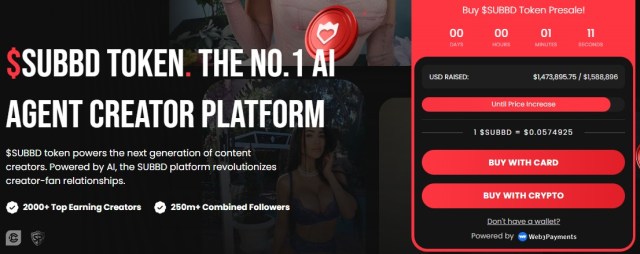
Financial incentives play a major role in this early accumulation phase. The protocol offers a robust staking mechanism, providing a fixed 20% APY for the first year to users who lock their tokens. This strategy is designed to reduce circulating supply volatility during the project’s initial expansion phase.

Plus, stakers unlock platform-specific benefits, including exclusive livestreams, daily behind-the-scenes drops, and XP multipliers that enhance their standing within the ecosystem.

Smart money seems to be betting on the convergence of two high-growth narratives: the explosion of AI tools and the necessity of censorship-resistant payments. While the Polymarket lawsuit dominates the headlines regarding regulatory jurisdiction, projects like SUBBD Token are building the infrastructure that renders traditional gatekeepers obsolete.

By offering a solution that combines lower fees, AI utility, and staking yields, the project positions itself as a hedge against the centralization risks currently plaguing both the prediction and content markets.

Buy your $SUBBD tokens here.

This article is for informational purposes only and doesn’t constitute financial advice. Cryptocurrencies are volatile assets; always conduct your own research before investing. The regulatory landscape is evolving and may impact project viability.

Editorial Process for bitcoinist is centered on delivering thoroughly researched, accurate, and unbiased content. We uphold strict sourcing standards, and each page undergoes diligent review by our team of top technology experts and seasoned editors. This process ensures the integrity, relevance, and value of our content for our readers.

patrubogdan

Follow

Full Profile

Related Posts

Binance Dominates Trump’s USD1 Supply as Bitcoin Hyper Breaks Records

Cathie Wood’s Ark Invest Buys More Bullish Assets Just Days After Last Purchase, While LiquidChain Turns Heads

Bitcoin Hyper Could Conquer 2026 if Bitcoin Regains Lost Ground

Tether Pushes for $1 Despite Market Crash, While Maxi Doge Reaches New Heights

Ethereum Holds Strong Above $2K, While $LIQUID Starts Turning Heads: Price Analysis & Outlook

Convicted FTX CEO SBF Cries ‘Biden Lawfare’ In Trump Pardon Pitch

Пов'язані питання

QWhat is the core legal argument Polymarket is using in its lawsuit against Massachusetts?

APolymarket argues that its prediction markets are financial derivatives under the jurisdiction of the Commodity Futures Trading Commission (CFTC), not state-regulated gambling, and are therefore subject to federal preemption.

QHow does the SUBBD Token aim to disrupt the creator economy?

ASUBBD Token aims to disrupt the $85 billion creator economy by merging Web3 financial sovereignty with AI tools, eliminating high fees from Web2 intermediaries, and offering a transparent, censorship-resistant payment infrastructure for creators and fans.

QWhat precedent did the prediction market platform Kalshi set that is relevant to Polymarket's case?

AKalshi, a regulated prediction market competitor, recently scored a significant win against the CFTC, which emboldened other platforms like Polymarket to challenge regulatory overreach and assert that they operate under federal oversight.

QWhat financial incentive does the SUBBD Token offer to early investors during its presale?

AThe SUBBD Token offers a fixed 20% APY for the first year to users who stake their tokens, along with platform-specific benefits like exclusive content and XP multipliers, to encourage early adoption and reduce supply volatility.

QWhat two major market trends does the SUBBD Token capitalize on, according to the article?

AThe SUBBD Token capitalizes on the convergence of two high-growth narratives: the explosion of AI tools and the necessity for censorship-resistant, decentralized payment systems in the creator economy.

Пов'язані матеріали

In Jinjiang, Fujian, a Storage Super Unicorn Lies Quiet

In Fujian's Jinjiang, a city known for sportswear, lies a quiet semiconductor giant: Fujian Jinhua Integrated Circuit Co. (JHICC). Once a promising domestic DRAM manufacturer alongside Yangtze Memory and ChangXin Memory Technologies (CXMT), its journey was derailed in 2018 when the U.S. placed it on an Entity List and filed criminal charges for alleged trade secret theft. This halted production for years. A turning point came in February 2024 when a U.S. federal court found JHICC not guilty. However, it had lost crucial time. While CXMT soared to become a top-valued A-share company in 2024, JHICC, with an estimated valuation of 80 billion RMB, was just restarting. Its current output is primarily customized DDR4 chips, not the advanced DDR5/HBM demanded for AI, but it still benefits from the broader memory chip upcycle. JHICC's story is tied to Chen Zhengkun, a veteran engineer who left Micron to lead the venture. Founded in 2016 with state-backed funding, JHICC partnered with Taiwan's UMC to develop DRAM technology. Rapid progress was cut short by the U.S. actions, which Micron initiated, partly due to its heavy reliance on the Chinese market. Post-sanctions, Chen's team worked to rebuild the production line with reduced reliance on U.S. technology. According to its records, JHICC achieved small-scale production and revenue growth under immense pressure. It now focuses on the stable "niche" DRAM market (e.g., TVs, routers) with a monthly capacity of ~40,000 wafers, aiming for 60,000 by 2026. It holds over 1,000 patents but remains on the Entity List. For Jinjiang, investing in JHICC was a bold industrial leap. The local government provided unwavering financial and logistical support during the crisis, helping the company survive. JHICC has become the anchor for a growing local semiconductor cluster. Though its scale lags behind domestic peers, JHICC's persistence symbolizes a hard-won foothold in a global market long dominated by Samsung, SK Hynix, and Micron. Having missed one boom, it seeks a place in the new AI-driven memory supercycle.

marsbit13 хв тому

In Jinjiang, Fujian, a Storage Super Unicorn Lies Quiet

marsbit13 хв тому

Must-Watch Events Next Week|CLARITY Act Could Face Senate Vote; SpaceX, Circle to Report Earnings (8.3-8.9)

**Summary: Key Events and Developments to Watch (August 3-9)** The upcoming week is marked by significant financial disclosures, key legislative deadlines, and notable product updates. **Major Financial Events:** Several companies are scheduled to release their Q2 2026 earnings. American Bitcoin (ABTC) will report on August 3, followed by SpaceX and Hut 8 Mining Corp. on August 4, and Circle on August 5. Notably, a significant portion of SpaceX shares (up to 12% of total shares) will be unlocked on August 6 following their earnings release. **Key Legislative Deadline:** The U.S. Senate faces an August 7 deadline to secure 60 votes for the CLARITY Act, a bipartisan bill aiming to establish a federal regulatory framework for cryptocurrencies. The Senate may hold a full vote on the bill during the week. **Economic Data:** The U.S. July Non-Farm Payrolls report will be released on August 7, providing crucial labor market data. **Technology & Product Updates:** * **Shutdowns:** DeFi portfolio tracker Zapper and wallet app Ctrl Wallet will cease operations on August 3. * **Upgrades:** LayerZero will deprecate its v1 relayers on August 3. XRP Ledger's new version 3.3.0, featuring five new functions, is expected next week. * **AI:** Elon Musk announced that the advanced Grok 4.6 AI model is set for release around August 7. * **Bitcoin:** The BIP-110 forced signaling for a potential Bitcoin network change is scheduled to begin around August 8. **Other Notable Events:** Chinese robotics firm Unitree Tech has set its preliminary price inquiry for its IPO for August 5. South Korean exchange Upbit will delist AQT and AERGO tokens on August 3.

marsbit2 год тому

Must-Watch Events Next Week|CLARITY Act Could Face Senate Vote; SpaceX, Circle to Report Earnings (8.3-8.9)

marsbit2 год тому

Торгівля

Спот
活动图片





