Polymarket acquires Brahma to fix ‘liquidity imbalance’: Report

ambcryptoОпубліковано о 2026-03-19Востаннє оновлено о 2026-03-19

Анотація

Polymarket has acquired crypto infrastructure firm Brahma to address liquidity imbalances and improve its on-chain trading systems. While popular markets like elections attract significant activity, niche markets suffer from low participation and unreliable pricing. The acquisition aims to distribute liquidity more evenly and enhance platform efficiency. Despite rapid growth and a valuation of $18–20 billion, driven by the 2024 election cycle, Polymarket faces inconsistent trading activity and a recent drop in market share. Competitor Kalshi, a regulated non-crypto platform, briefly captured 66% market share during the election. Polymarket continues to focus on crypto, with plans for a native token, contrasting with Kalshi’s traditional approach.

In a surprising shift, Polymarket has moved beyond simply hosting bets on future events and is now working to build the full infrastructure behind those wagers.

According to reports, Polymarket has acquired Brahma, a company specializing in crypto and DeFi infrastructure. This means Polymarket wants better technology to make its platform faster, smoother, and more on-chain.

Polymarket has grown rapidly, now valued at an estimated $18–20 billion, boosted by heavy activity during the 2024 elections. Yet with that growth come new challenges.

What is Polymarket trying to revamp with Brahma?

One of the core problems is liquidity imbalance. This means popular wagers, like elections or major sports events, attract a lot of money and activity.

Whereas, smaller or niche wagers struggle because not enough people are betting on them. That makes prices less reliable and the markets less useful.

Citing examples, Fortune added,

Larger event contracts, like those in sports or politics, easily bring lots of money into the pool. But smaller wagers focused on niche areas such as, for instance, the outcome of a bowling match in Spain, struggle to amass a sizable amount of liquidity.

Therefore, by acquiring Brahma, Polymarket is trying to fix this by improving how liquidity is distributed across markets. The plan also focuses on making trading more efficient and strengthening its blockchain-based system.

Remarking on this initiative, Shayne Coplan, founder and CEO of Polymarket, told Fortune,

Building reliable infrastructure across blockchain networks and traditional financial rails is hard—there are no shortcuts.

That said, Brahma, founded in 2021, has already processed over $1 billion in transactions, and by bringing its team in-house, Polymarket is effectively shutting down Brahma’s external operations to focus entirely on its growth.

Polymarket’s metrics paint a confusing picture

However, the platform’s internal data suggests that growth is not entirely balanced. While more capital is flowing into the system, as seen in the steady rise in Open Interest, actual trading activity remains inconsistent.
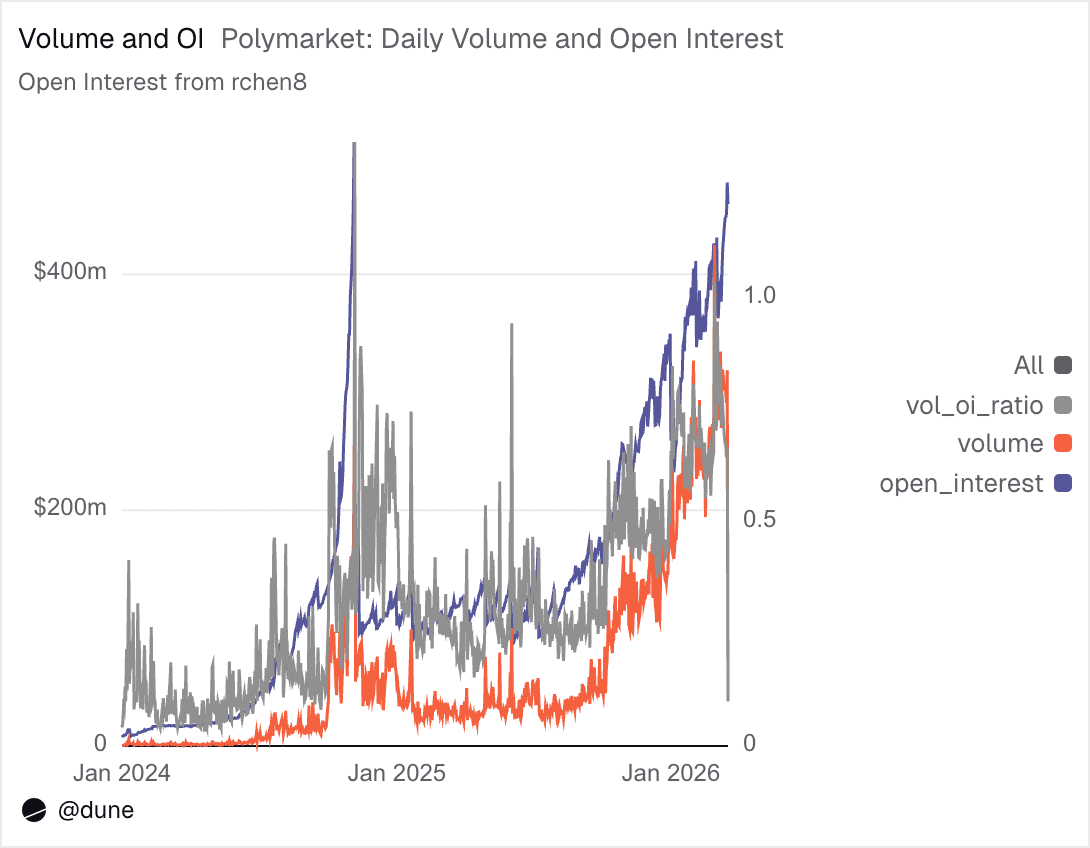
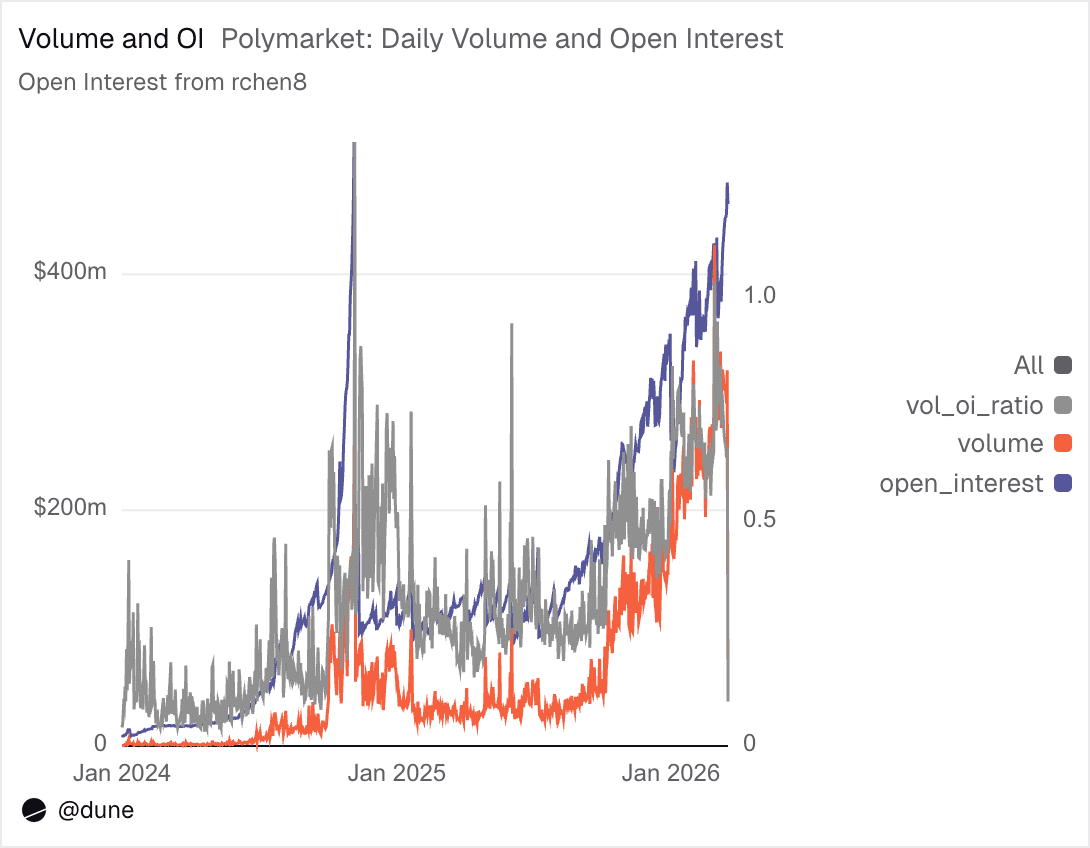
Source: Dune

This gap shows that users place long-term bets but trade inconsistently, resulting in low liquidity and one-sided markets.

Even though the platform became very popular during the 2024 election cycle, its dominance didn’t last. Its market share dropped sharply from over 61% to around 32% as the hype faded. However, at press time, Polymarket’s stock price stood at $141.60, marking a more than 20% increase year-to-date.

Is Polymarket losing ground against Kalshi?

In fact, during the 2024 election, its U.S.-based competitor Kalshi took advantage of the slowdown, briefly capturing about 66% market share and handling nearly $1 billion in weekly trading volume.

This competition reflects two very different paths. Kalshi follows a fully regulated approach with no blockchain, DeFi, or token layer.

Polymarket, in contrast, is doubling down on crypto. Besides Brahma, the platform’s CEO is also hinting at a potential POLY token. With a possible 2026 launch, it acts as a strong incentive for users, something regulated platforms like Kalshi are struggling to offer.


Final Summary

  • The Brahma acquisition shows that fixing liquidity and market efficiency is now more important than just attracting users.
  • Competition from regulated players like Kalshi adds pressure, especially as they gain ground during periods of low hype.


Пов'язані питання

QWhat is the primary reason Polymarket acquired Brahma, according to the report?

APolymarket acquired Brahma to fix the 'liquidity imbalance' on its platform by improving how liquidity is distributed across markets, making trading more efficient, and strengthening its blockchain-based system.

QWhat specific problem does the 'liquidity imbalance' cause for smaller wagers on Polymarket?

ASmaller or niche wagers struggle to attract enough betting activity, which makes their prices less reliable and the markets less useful due to low liquidity.

QHow did Polymarket's market share change after the hype of the 2024 election cycle faded?

APolymarket's market share dropped sharply from over 61% to around 32% after the hype of the 2024 election cycle faded.

QWhich competitor briefly captured about 66% market share during Polymarket's slowdown, and what is its key operational difference?

AKalshi, Polymarket's U.S.-based competitor, briefly captured about 66% market share. Its key difference is that it follows a fully regulated approach with no blockchain, DeFi, or token layer.

QWhat potential incentive is Polymarket's CEO hinting at to attract users, and how does it contrast with regulated platforms?

APolymarket's CEO is hinting at a potential POLY token, which acts as a strong incentive for users. This is something regulated platforms like Kalshi struggle to offer.

Пов'язані матеріали

In Jinjiang, Fujian, a Storage Super Unicorn Lies Quiet

In Fujian's Jinjiang, a city known for sportswear, lies a quiet semiconductor giant: Fujian Jinhua Integrated Circuit Co. (JHICC). Once a promising domestic DRAM manufacturer alongside Yangtze Memory and ChangXin Memory Technologies (CXMT), its journey was derailed in 2018 when the U.S. placed it on an Entity List and filed criminal charges for alleged trade secret theft. This halted production for years. A turning point came in February 2024 when a U.S. federal court found JHICC not guilty. However, it had lost crucial time. While CXMT soared to become a top-valued A-share company in 2024, JHICC, with an estimated valuation of 80 billion RMB, was just restarting. Its current output is primarily customized DDR4 chips, not the advanced DDR5/HBM demanded for AI, but it still benefits from the broader memory chip upcycle. JHICC's story is tied to Chen Zhengkun, a veteran engineer who left Micron to lead the venture. Founded in 2016 with state-backed funding, JHICC partnered with Taiwan's UMC to develop DRAM technology. Rapid progress was cut short by the U.S. actions, which Micron initiated, partly due to its heavy reliance on the Chinese market. Post-sanctions, Chen's team worked to rebuild the production line with reduced reliance on U.S. technology. According to its records, JHICC achieved small-scale production and revenue growth under immense pressure. It now focuses on the stable "niche" DRAM market (e.g., TVs, routers) with a monthly capacity of ~40,000 wafers, aiming for 60,000 by 2026. It holds over 1,000 patents but remains on the Entity List. For Jinjiang, investing in JHICC was a bold industrial leap. The local government provided unwavering financial and logistical support during the crisis, helping the company survive. JHICC has become the anchor for a growing local semiconductor cluster. Though its scale lags behind domestic peers, JHICC's persistence symbolizes a hard-won foothold in a global market long dominated by Samsung, SK Hynix, and Micron. Having missed one boom, it seeks a place in the new AI-driven memory supercycle.

marsbit13 хв тому

In Jinjiang, Fujian, a Storage Super Unicorn Lies Quiet

marsbit13 хв тому

Must-Watch Events Next Week|CLARITY Act Could Face Senate Vote; SpaceX, Circle to Report Earnings (8.3-8.9)

**Summary: Key Events and Developments to Watch (August 3-9)** The upcoming week is marked by significant financial disclosures, key legislative deadlines, and notable product updates. **Major Financial Events:** Several companies are scheduled to release their Q2 2026 earnings. American Bitcoin (ABTC) will report on August 3, followed by SpaceX and Hut 8 Mining Corp. on August 4, and Circle on August 5. Notably, a significant portion of SpaceX shares (up to 12% of total shares) will be unlocked on August 6 following their earnings release. **Key Legislative Deadline:** The U.S. Senate faces an August 7 deadline to secure 60 votes for the CLARITY Act, a bipartisan bill aiming to establish a federal regulatory framework for cryptocurrencies. The Senate may hold a full vote on the bill during the week. **Economic Data:** The U.S. July Non-Farm Payrolls report will be released on August 7, providing crucial labor market data. **Technology & Product Updates:** * **Shutdowns:** DeFi portfolio tracker Zapper and wallet app Ctrl Wallet will cease operations on August 3. * **Upgrades:** LayerZero will deprecate its v1 relayers on August 3. XRP Ledger's new version 3.3.0, featuring five new functions, is expected next week. * **AI:** Elon Musk announced that the advanced Grok 4.6 AI model is set for release around August 7. * **Bitcoin:** The BIP-110 forced signaling for a potential Bitcoin network change is scheduled to begin around August 8. **Other Notable Events:** Chinese robotics firm Unitree Tech has set its preliminary price inquiry for its IPO for August 5. South Korean exchange Upbit will delist AQT and AERGO tokens on August 3.

marsbit2 год тому

Must-Watch Events Next Week|CLARITY Act Could Face Senate Vote; SpaceX, Circle to Report Earnings (8.3-8.9)

marsbit2 год тому

Торгівля

Спот
活动图片




