Only 67 of Top 1000 Crypto Projects Have Wikipedia Pages, ChatGPT's 'Understanding' of Crypto Industry Being Distorted

marsbitPublished on 2026-07-15Last updated on 2026-07-15

Abstract

A study by crypto communications firm Chainstory reveals a significant information gap: only 67 of the top 1,000 cryptocurrencies by market capitalization have a Wikipedia page, representing less than 7% coverage. This includes major projects like the $15 billion Hyperliquid and the $5 billion Sui. The coverage rate declines sharply from 80% for the top 10 assets to near zero for those ranked 1,001 to 10,000. This gap is critical because Wikipedia is the single most cited source for AI models like ChatGPT, accounting for approximately 7.8% of all its citations. Consequently, AI tools have a systemic blind spot and lack authoritative, foundational information for the vast majority of crypto projects, often leading to factual errors when discussing them. The low coverage stems from Wikipedia's strict notability guidelines for cryptocurrencies, which deem crypto-native media outlets like CoinDesk and Cointelegraph as "generally unreliable." Instead, Wikipedia requires coverage from mainstream financial publications like Reuters or Bloomberg, which rarely report on many niche crypto sectors. This creates a catch-22 where the media covering the industry aren't trusted, and the trusted media don't cover it. The cumbersome Wikipedia article creation and review process, where projects have no right to appeal deletions, further exacerbates the problem.

Author: Claude, Deep Tide TechFlow

Deep Tide Introduction: Crypto communication agency Chainstory audited the Wikipedia coverage for the top 10,000 tokens by market cap on CoinGecko and found that only 67 of the top 1,000 have entries. Wikipedia is the single most cited source by ChatGPT (accounting for about 7.8% of total citations), meaning AI tools have a systematic blind spot in their knowledge of the vast majority of crypto projects. $15 billion Hyperliquid and $5 billion Sui both lack Wikipedia pages.

The crypto industry barely exists on Wikipedia.

According to a CoinDesk report on July 14, a research study released by crypto communication agency Chainstory shows that only 67 of the top 1,000 crypto projects by CoinGecko market cap have Wikipedia entries, a coverage rate of less than 7%. As AI tools increasingly become a primary channel for users to access information, this gap is systematically affecting the understanding and presentation of the crypto industry by models like ChatGPT.
Coverage Plummets with Market Cap Ranking, $15 Billion Project Lacks Entry

From June 1 to 4, 2026, Chainstory audited the top 10,000 tokens by market cap on CoinGecko, verifying the existence of Wikipedia entries one by one via the Wikipedia API. The results show an extreme long-tail distribution:

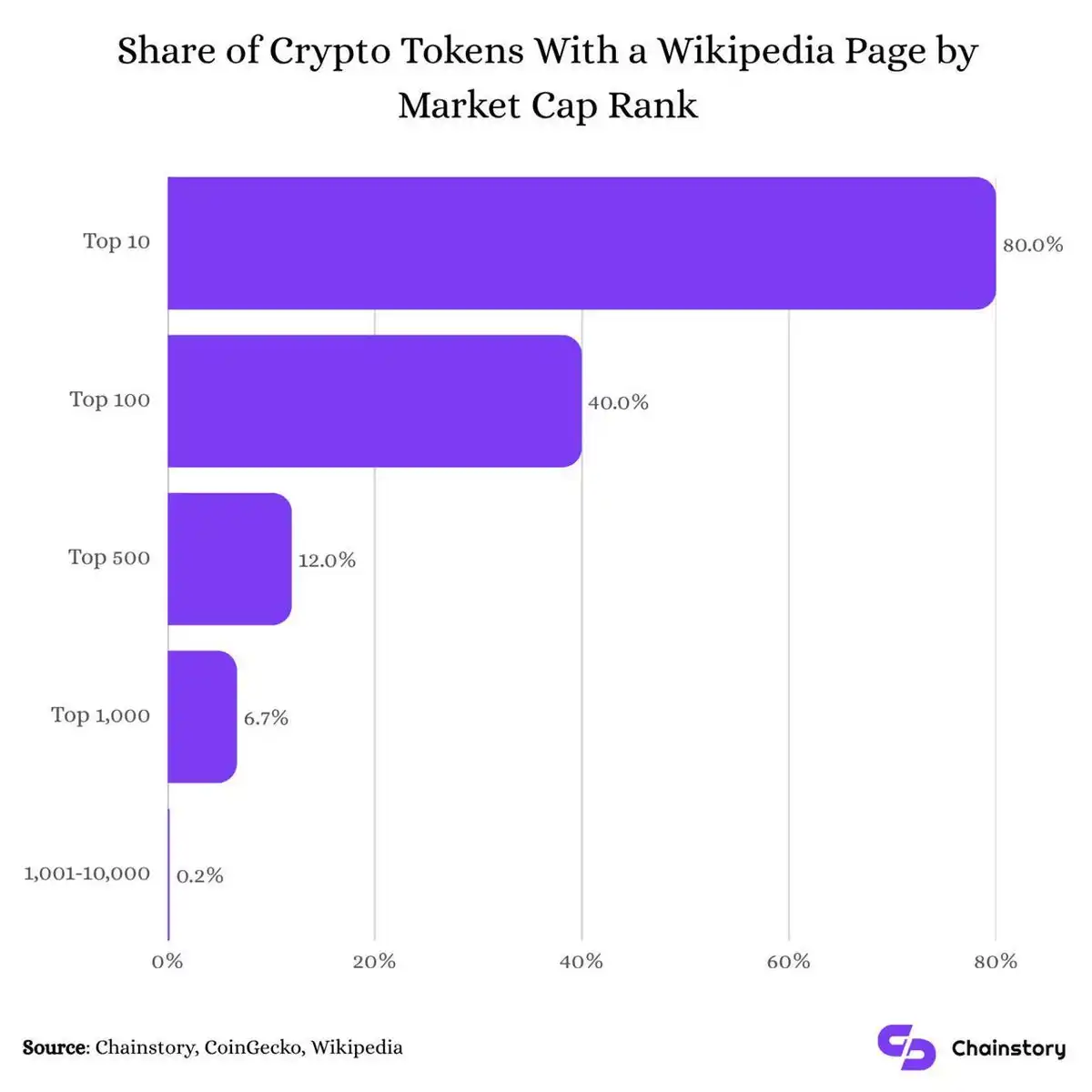
Coverage for the top 10 tokens by market cap was 80%, dropping to 40% for the top 100, only 12% for the top 500, and plummeting to 6.7% for the top 1000. For tokens ranked 1001 to 10000, coverage was a mere 0.2%. Among the entire top 10,000, only 84 tokens had Wikipedia entries.

The list of absentees includes substantial projects. The perpetual futures platform Hyperliquid, with a market cap of approximately $15 billion, has no Wikipedia page. Layer-1 network Sui, with a market cap of about $5 billion and ranked 22nd, is also absent. Monad Labs (valued at $3 billion) backed by Paradigm, Berachain (valued at $1.5 billion) co-led by Brevan Howard Digital, and EigenLayer, which raised $100 million from a16z, all have no record on Wikipedia.

The smallest project with an entry is Firo, with a market cap of $150 million and ranked 959th.

For comparison, Wikipedia hosts entries for about 640 fintech companies and over 7,000 software companies, but only about 80 companies in the crypto and Bitcoin categories.

Wikipedia is ChatGPT's Most Cited Single Source, Accounting for Nearly 8%

This coverage gap is significant because Wikipedia's role in the AI information chain far exceeds general perception.

Chainstory's report cites audit data from AI tracking platform Profound: Of all ChatGPT citation links, approximately 7.8% point to Wikipedia, far ahead of second and third place Reddit (1.8%) and Forbes (1.1%). Among ChatGPT's top 10 most cited domains, Wikipedia accounts for about 47.9% of the share.

Analysis of 3.29 million citation links by another research firm, Trakkr, shows that as of May 2026, Wikipedia accounted for 36.1% of ChatGPT's top 10 citation sources and 25.3% of its top 100 sources.

Further research by Muck Rack in May 2026 confirms that Wikipedia is not only ChatGPT's number one citation source but also the second largest for Claude (after PubMed Central) and the fourth largest for Gemini.

The report points out that Wikipedia primarily provides conceptual-level information to AI models. However, when user queries involve specific projects, Wikipedia entries become the core basis for model reasoning. Projects with entries receive clear definitions and descriptions in AI answers; for projects without entries, AI can only piece together information from scattered second-hand mentions, often leading to basic factual errors regarding founders, founding dates, headquarters location, etc.

Wikipedia Labels Crypto Media as 'Generally Unreliable' Sources

The root cause of low Wikipedia coverage for crypto projects lies in the special review thresholds Wikipedia has set for the crypto industry.

Wikipedia has specifically formulated notability guidelines for cryptocurrencies, requiring that a project's notability must come from 'mainstream' news sources, explicitly stating that media primarily covering the crypto industry is 'insufficient to establish notability.' The guidelines even name CoinDesk and Bitcoin Magazine as 'generally unreliable' crypto media. The same logic applies to crypto-native media like Cointelegraph, Decrypt, and The Block.

Reliable sources recognized by Wikipedia include mainstream business media like Reuters, Bloomberg, CNBC, and the Financial Times. However, these media outlets pay almost no attention to crypto sub-sectors like liquid staking or perpetual futures DEXs.

The Chainstory report highlights this contradiction: Media outlets that actually report on crypto industry dynamics are not considered valuable sources by Wikipedia, while the mainstream media Wikipedia recognizes do not cover most crypto projects.

The process of creating new entries itself also poses an obstacle. New articles need to pass volunteer review, checking standards like notability, verifiability, and reliable sources. Even if approved, administrators can unilaterally delete them, or a 7-day community vote can determine their fate; the subject of the entry has no right to participate or appeal.


Trending Cryptos

Related Questions

QAccording to the article, what percentage of the top 1000 crypto projects by market cap have a Wikipedia page?

AOnly 6.7% of the top 1000 crypto projects by market cap have a Wikipedia page.

QWhy is the lack of Wikipedia coverage for crypto projects a significant issue for AI tools like ChatGPT?

AWikipedia is the most cited single source for ChatGPT, accounting for about 7.8% of all citations. Without Wikipedia pages, AI tools have a systemic blind spot, leading to incomplete or inaccurate information about most crypto projects.

QWhat is a key reason cited for the low Wikipedia coverage of crypto projects?

AWikipedia's guidelines for cryptocurrency topics require notability from 'mainstream' news sources and explicitly state that crypto-native media outlets are generally considered unreliable. Mainstream media, however, rarely covers many crypto sub-sectors.

QWhich prominent high-value crypto projects are mentioned as lacking a Wikipedia page?

ANotable projects mentioned without Wikipedia pages include Hyperliquid (approx. $15B market cap), Sui (approx. $5B market cap), Monad Labs, Berachain, and EigenLayer.

QWhat does the article say about the distribution of Wikipedia coverage across different tiers of crypto projects by market cap?

ACoverage declines sharply with market cap ranking: 80% for the top 10, 40% for the top 100, 12% for the top 500, 6.7% for the top 1000, and only 0.2% for projects ranked 1001 to 10000.

Related Reads

Strive Executive: Rethinking the Bitcoin Price Flywheel

In this article, the author discusses the future trajectory of Bitcoin's price, moving beyond the traditional "power law" model that has described its long-term price appreciation with diminishing returns. The core argument is that Bitcoin is maturing, evidenced by declining volatility and shallower market drawdowns. This maturation, often seen as leading to permanently lower returns, is framed as a precursor to a new, potentially explosive phase. The author draws an analogy to metal fatigue, where cracks propagate in three stages: initial irregular formation, a predictable middle phase describable by a power law (Paris' law), and a final rapid acceleration leading to fracture. Similarly, Bitcoin's monetization is seen in three phases: 1) Discovery (high volatility/returns), 2) Maturation (declining volatility/returns, improving risk-adjusted metrics), and 3) System-driven monetization. The key insight is that Phase 2 sets the stage for Phase 3. Lower volatility makes Bitcoin a more attractive asset for large-scale capital allocation (due to improved Sharpe ratios) and, crucially, a higher-quality collateral for loans. As perceived credit risk falls, the financial system can safely extend more dollar-denominated credit against Bitcoin holdings. This creates a self-reinforcing "flywheel": lower volatility → more capital allocation & cheaper credit → increased demand for fixed-supply Bitcoin → price rise → higher collateral value enabling more credit → continued price pressure. The conclusion posits that even if Bitcoin adoption eventually plateaus (reaching an S-curve saturation), the expansion of capital and credit chasing a fixed supply could cause its USD price to re-accelerate, breaking above the long-term power-law trajectory and entering the "third region" of rapid, system-driven monetization.

marsbit5h ago

Strive Executive: Rethinking the Bitcoin Price Flywheel

marsbit5h ago

OpenAI Reveals Its Own Jalapeño Chip: Accelerator 1.5–2 Times More Efficient Than Nvidia

On August 25, 2026, OpenAI unveiled initial test results for its proprietary inference accelerator, the Jalapeño. Benchmarks on SemiAnalysis's InferenceX platform showed that systems using Jalapeño delivered 1.5–1.9 times more computations per watt at peak throughput and reduced latency by 1.7–3.6 times compared to systems based on Nvidia's GB200 and GB300, tested on models like GPT-OSS-120B. Designed specifically for OpenAI's own workloads, the 700W-rated chip was developed in nine months with partners Broadcom (silicon/network) and Celestica (boards/racks). It's the first in a planned multi-year platform. Deployment is slated for late 2026, backed by an OpenAI-Broadcom agreement to deploy 10 GW of custom accelerators through 2029. This move shifts a major portion of OpenAI's daily inference, crucial for services like ChatGPT and its API, away from Nvidia's universal GPUs. By controlling this hardware architecture, OpenAI aims to directly reduce the per-query cost of its massive service traffic, converting what was previously supplier profit (noting Nvidia's high margins) into internal savings and computational capacity. While OpenAI will still rely on external suppliers for training cutting-edge models and for parts of inference, Jalapeño represents a strategic industry trend where hyperscalers design custom chips once inference volume becomes predictable. However, this specialization risks future inflexibility if AI architectures shift and creates dependency on its manufacturing partners.

cryptonews.ru6h ago

OpenAI Reveals Its Own Jalapeño Chip: Accelerator 1.5–2 Times More Efficient Than Nvidia

cryptonews.ru6h ago

Trading

Spot

Hot Articles

Discussions

Welcome to the HTX Community. Here, you can stay informed about the latest platform developments and gain access to professional market insights. Users' opinions on the price of S (S) are presented below.

活动图片