Original | Odaily Planet Daily (@OdailyChina)
Author | jk
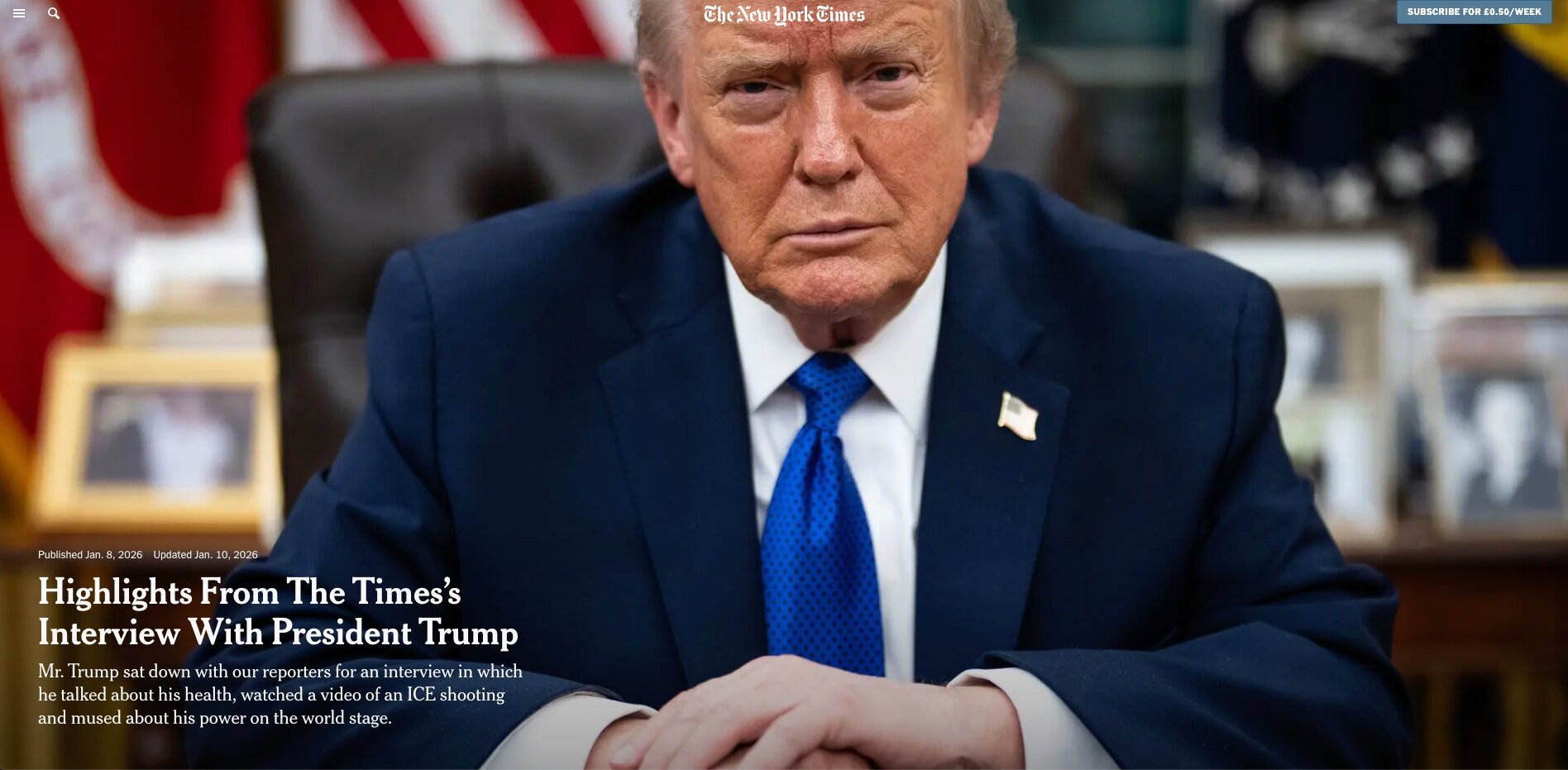
In the Oval Office of the White House this week, four New York Times reporters faced President Trump for a rare, nearly two-hour long interview.
"My power is constrained by only one thing, which is my own morality," Trump said. "I don't need international law." In the interview, he discussed topics ranging from Venezuela to Greenland, from the Federal Reserve to family business, and from immigration policy to pardon lists. This interview essentially clarified the logic of power for Trump's second term.
Here are the seven key points you need to know from this interview.
Has Chosen Next Fed Chair Nominee, But Refuses to Reveal
Trump stated that he has already decided whom to nominate as the next Federal Reserve Chair but refused to reveal the choice during the interview. "I've made a decision in my mind," he said during the interview on Wednesday evening, "but I haven't discussed it with anyone yet."
When specifically asked about his chief economic advisor, Kevin A. Hassett, Trump said, "I don't want to say," but described him as "certainly one of the people I like."
Treasury Secretary Scott Bessent stated at an event on Thursday that he expects Trump to make a decision on the Fed Chair this month, possibly around the time of the World Economic Forum in Davos. Bessent also hinted that the job was not guaranteed for Hassett, saying there were a total of four candidates.
According to the original purpose of the U.S. Congress, the Federal Reserve needs to be protected from political interference to ensure the central bank can pursue low and stable inflation and a healthy labor market unimpeded. But Trump has been outspoken in his desire to see the central bank act according to his wishes.
Trump made it clear that his choice for Fed Chair must support lowering borrowing costs, even stating outright that anyone who disagrees with his views would never get the job.
Whoever Trump chooses, the successor will take over the Fed at a critical juncture. At this moment, Trump is pressuring the Fed to significantly reduce borrowing costs. Powell will serve as Chair until his term ends in May; he has become a frequent target of Trump's attacks. It's hard to imagine what storm the next chair would face if they fail to meet the president's demands.
No Intention to Pardon SBF, Nor Other High-Profile Figures
Trump also stated he has no intention to pardon Sam Bankman-Fried. This question was raised when the New York Times asked Trump if he would pardon a series of high-profile individuals.
Other prominent figures mentioned included:
- Nicolás Maduro: The recently captured leader of Venezuela, facing charges of narcoterrorism and conspiracy to import cocaine;
- Robert Menendez: Former senator from New Jersey, convicted in 2024 for trading political influence for gold, cash, and a Mercedes convertible;
- Sean Combs (aka Puff Daddy or Diddy): Reportedly wrote a letter to President Trump seeking a pardon, but Trump indicated he would not consider approving the request.
When asked if he would consider pardoning Derek Chauvin, the former Minneapolis police officer who knelt on George Floyd's neck during the 2020 arrest, Trump said, "No one has asked me that question."
Trump pardoned former Honduran President Juan Orlando Hernández last month, but when the New York Times asked if he would consider pardoning Maduro, who also faces drug trafficking charges, the president said, "No, I don't think so."
Maduro has pleaded not guilty to the federal charges.
U.S. Control Over Venezuela Could Last for Years
Trump indicated that U.S. oversight and oil extraction in Venezuela could last for many years. When asked if the duration would be three months, six months, a year, or even longer, he replied, "I would say much longer."
Trump expects the U.S. to operate in Venezuela for years to come and extract oil from the country's vast oil reserves. The U.S. has already announced it will receive 30 to 50 million barrels of Venezuelan heavy crude. However, Trump also acknowledged that reviving Venezuela's neglected oil industry will take years.
Trump expressed great pride in the successful operation to capture Maduro, stating he followed the training process of the operation forces throughout and revealed that the forces built a one-to-one scale model of the Caracas fortification at a military facility in Kentucky for this operation.
Trump emphasized that Maduro's allies, now the interim government, are "giving us everything we deem necessary."
Trump also sidestepped several questions: about why he recognized Maduro's vice president, Delcy Rodríguez, as the new leader of Venezuela, why he did not support opposition leader Machado, and made no mention of when elections would be held in Venezuela.
When asked how long the U.S. government would demand direct oversight of this South American country, he said, "Only time will tell."
Trump made these comments hours after government officials stated that the U.S. plans to effectively control Venezuela's oil sales indefinitely, as part of a three-phase plan outlined by Secretary of State Rubio to members of Congress.
"I Don't Need International Law," Trump Says His Power Is Constrained Only by "Own Morality"
When asked if there were any limits to his global power, Trump gave his most straightforward statement: "Yes, one thing. My own sense of morality. My own ideas. That's the only thing that stops me."
He added: "I don't need international law. I'm not out to hurt people." When the reporter pressed further on whether his administration needed to abide by international law, Trump said, "I will abide by it," but made it clear he would decide for himself when these constraints applied to the U.S. "It depends on what your definition of international law is," he said.
He made it clear that he would use his reputation for being "unpredictable" and his willingness to quickly resort to military action to coerce other countries.
Most notably, shortly after the New York Times journalists sat down with him, Trump paused the interview to take a call from Colombian President Gustavo Petro. Days earlier, Trump had threatened action against Colombia because the country is a hub for drug trafficking.
The content of the conversation was not public, but the leader was apparently concerned about the possibility of a U.S. attack on Colombia similar to the one on Venezuela.
After the call with Petro, Mr. Trump dictated a social media post to an aide, stating that the Colombian president had called "to explain the drug situation."
After the call, which lasted about an hour, the New York Times reporters noted that "the call seemed to remove any immediate threat of U.S. military action." Trump subsequently stated that he believed the collapse of the Maduro regime had intimidated other leaders in the region, "making them compliant."
The New York Times claimed they witnessed the actual operation of Trump's "coercive diplomacy" firsthand.
Greenland Sovereignty Issue: Trump Insists on "Ownership"
Trump reiterated his stance that the U.S. must own Greenland, claiming that merely reopening a military base on the land under the 1951 treaty is insufficient.
"Ownership is very important," Trump said. The New York Times commented that he discussed Greenland with a "real estate magnate's eye." The land is three times the size of Texas but has a population of less than 60,000. "I think psychologically, ownership is necessary for success. Whether you're talking about a lease or a treaty, ownership gives you something you can't get otherwise. Ownership gives you elements that signed documents cannot provide."
When asked whether Greenland or NATO was a higher priority, Trump refused to answer directly but admitted "it might be a choice." He made it clear that without the U.S. at its core, the transatlantic alliance was largely useless.
Family's Crypto Activities and Overseas Business Deals "Not a Problem"
In the interview, Trump made it clear that concerns about conflicts of interest raised by his family's global money-making activities over the past year do not bother him at all.
"I banned them from doing business in the first term, but got absolutely no credit for it," he said. "I didn't have to do that. It was really unfair to them." He added: "I found that nobody cared, and I'm allowed to do it."
Donald Trump Jr. has previously expressed similar views, but the president responded more comprehensively than in the past to concerns about his family's economic interests. The White House has repeatedly stated that Trump and his family never engage in conflicts of interest and that he always puts the interests of Americans first.
He also added that he has never accepted his presidential salary.
Trump defended his support for the cryptocurrency industry, which his family has become a major player in. "I got a lot of votes for supporting crypto, and I'm starting to like it," Trump said. "But he stated that the strong push for cryptocurrency was to make the U.S. the global leader in the industry.
Advancing "De-naturalization" Plan, Specifically Targeting Somali-Americans
Trump stated that his administration is taking steps to revoke the citizenship of some naturalized Americans, with a particular focus on people of Somali origin.
"I wouldn't hesitate to do it if they were dishonest," Trump said during the Oval Office interview. "I think many people from Somalia, they hate our country."
Trump said his administration is reviewing the criteria for denaturalization. He indicated this measure is not limited to the Somali community but refused to specify which other groups of foreign-born U.S. citizens his administration is targeting.
This would be a significant escalation of Trump's immigration crackdown, which has already begun to extend beyond targeting illegal immigrants. The New York Times reported last month that the administration issued guidance to USCIS field offices instructing them to "provide 100-200 denaturalization cases per month to the Office of Immigration Litigation in FY 2026."
Under federal law, citizenship can only be revoked if the person committed fraud on their citizenship application or in a few other specific circumstances. But activists warn that the denaturalization effort could sweep up those who made honest mistakes on their citizenship paperwork.






