Nasdaq Plans to Launch 23-Hour Trading, Paving the Final Stretch for On-Chain Stocks and Tokenized Assets

marsbitPublished on 2025-12-17Last updated on 2025-12-17

Abstract

Nasdaq has submitted a proposal to the SEC to extend U.S. stock trading hours to 23 hours per day, effectively formalizing overnight trading. This move is seen as a step toward preparing the market infrastructure for future 24/7 on-chain stock trading and asset tokenization. Key implications include: - Improved accessibility for retail investors, enabling trading across more time zones without waiting for traditional market hours. - Enhanced performance for on-chain stock platforms (e.g., Ondo Finance, StableStock), as their broker-mediated transactions will align with extended market hours, ensuring smoother and more liquid operations. - Stronger support for DeFi protocols, as near-24-hour official pricing improves oracle reliability for lending, derivatives, and other decentralized applications. - Better risk management for brokers and market makers, who can hedge positions throughout most of the day, leading to smoother pricing and deeper on-chain liquidity. This shift signals accelerating momentum toward on-chain equities and tokenized assets.

Just saw a very interesting piece of news:
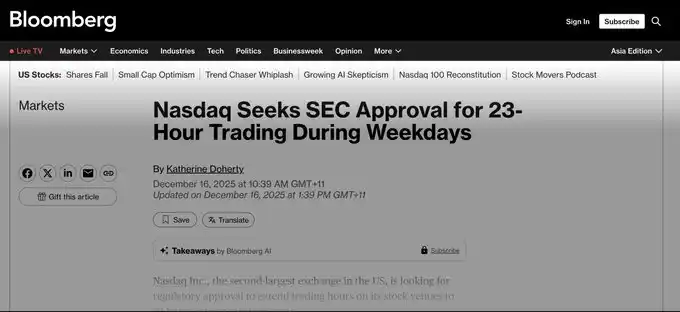
A few hours ago, Nasdaq officially filed documents with the SEC, planning to extend U.S. stock trading hours to 23 hours per day, formally incorporating the "night session" into the official trading system.

Hmm? Are you trying to set the stage for the 7x24 "on-chain stocks" and "tokenized assets" market two years from now, starting with 5x23?

Simply put, it currently looks like the image above. If approved, it will change to the image below.
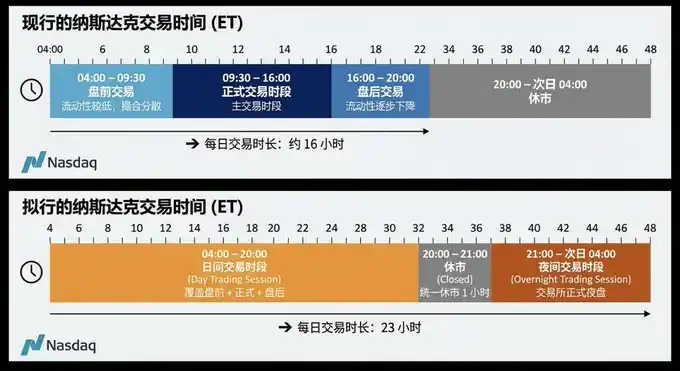
If it really gets approved, the impact will be significant:

1. Retail Investors - First and foremost, the experience for retail investors will improve. No more staying up late waiting for the market to open; they can buy and sell during the day too.

And this enhanced experience isn’t limited to Futu and Tiger Brokers. It applies equally if you’re using on-chain U.S. stocks like Ondo Finance or StableStock. This is because, fundamentally, your buying and selling are executed through their brokers acting as intermediaries. This is also the underlying mechanism for "on-chain U.S. stocks having no slippage and infinite liquidity," as they are backed by the NYSE and Nasdaq. As long as broker transactions become smoother, your on-chain actions will naturally become smoother too.

2. DeFi - Previously, the low liquidity and trading volume in pre-market and after-hours sessions affected the composability of on-chain U.S. stocks in DeFi, as the price discovery mechanism was in a "downgraded mode" during non-trading hours. Now, with nearly 24-hour official markets, it will provide the most authoritative and uninterrupted "price oracle" for future DeFi protocols (such as lending and derivatives).

3. Brokers/MMs for On-Chain U.S. Stocks - These brokers and market makers will now be able to hedge in the U.S. stock market for 23 hours, making the price curve smoother. Market makers can provide deeper liquidity on-chain around the clock without worrying about extreme risks. Unlike before, where a major event or black swan during the pre-market hours left prices unreflected and nowhere to run, forcing everyone to wait for the market to open.

The era of on-chain U.S. stocks and the tokenization of everything is undeniably drawing closer.

Related Questions

QWhat is Nasdaq's plan for extending trading hours, as mentioned in the article?

ANasdaq has submitted a proposal to the SEC to extend U.S. stock trading hours to 23 hours per day, effectively incorporating overnight trading into the official system.

QHow would extended trading hours benefit retail investors according to the article?

ARetail investors would have a better experience as they wouldn't need to wait for the market to open, allowing them to trade during their daytime hours more conveniently.

QWhat impact would near-24-hour trading have on DeFi protocols?

AIt would provide a more authoritative and continuous price oracle for DeFi protocols (like lending and derivatives), improving price discovery mechanisms during previously low-liquidity periods.

QHow do on-chain U.S. stock platforms like Ondo Finance achieve 'slippage-free' and 'infinite liquidity'?

AThey achieve this through brokers who execute buy/sell orders on their behalf, connecting to traditional exchanges like NYSE and Nasdaq, so extended trading hours make on-chain actions smoother.

QWhy is the extended trading window beneficial for brokers and market makers in the on-chain stock space?

AIt allows them to hedge in the U.S. stock market for 23 hours, leading to smoother price curves and deeper on-chain liquidity without worrying as much about extreme risks during off-hours.

Related Reads

U.S. Government Bans Foreign Nationals from Using Fable 5, Anthropic Issues Rebuttal

U.S. Government Bans Foreign Access to Fable 5, Anthropic Issues Rebuttal On June 12th, the U.S. government ordered AI company Anthropic to immediately suspend all foreign access—including foreign nationals within the U.S. and Anthropic's own foreign employees—to its newly released Fable 5 and Mythos 5 AI models, citing national security concerns. This forced Anthropic to temporarily disable access to both models for all users globally, as it cannot technically differentiate user nationality at scale. The models, released just three days prior, represent Anthropic's highest public capability tier. Fable 5 is the first publicly available model from the advanced "Mythos" family, while Mythos 5 is a less-restricted version for approved cybersecurity and critical infrastructure partners. The government's directive was reportedly triggered by claims from another company that it could "jailbreak" Mythos 5, raising alarm within the Trump administration. Anthropic, in a detailed public statement, strongly challenged this rationale. The company argues the demonstrated "jailbreak" is a narrow, non-generalized technique that merely involves identifying minor, known software vulnerabilities—a capability common to other publicly available models like OpenAI's GPT-5.5 and routinely used by cybersecurity defenders. Anthropic stated it has complied with the order but disagrees with the government's standard, warning that applying it industry-wide would halt all new frontier model deployments. The company criticized the lack of a transparent, fact-based legal process and expressed confidence the situation stems from a misunderstanding. It is working to restore access and will release more technical details within 24 hours. Other Anthropic models remain unaffected.

链捕手14m ago

U.S. Government Bans Foreign Nationals from Using Fable 5, Anthropic Issues Rebuttal

链捕手14m ago

The Revelation from the Raydium Theft Incident: New DeFi Vulnerabilities Lurking in Forgotten Old Contracts

**Raydium Exploit Reveals DeFi's Hidden Risk: Forgotten "Zombie" Contracts** A recent attack on Raydium's deprecated V3 AMM pools resulted in a loss of approximately $1.34 million. The hacker exploited pools that were no longer supported by Raydium's current UI or SDK but remained fully functional and accessible on-chain. This incident highlights a critical, often overlooked category of risk in DeFi: inactive or legacy smart contracts that projects fail to properly decommission. Since March 2025, there have been at least 8 publicly reported attacks targeting such abandoned contracts, with total losses around $10.8 million. Including older pools and deprecated features, the count rises to 10 incidents with roughly $22.5 million in losses. These "zombie contracts" represent a lifecycle management failure rather than a code vulnerability, yet they are typically misclassified under general "code bug" categories in security reports, masking the true scale of the problem. The root cause is that projects often merely document a contract as "deprecated" without taking essential technical steps to secure it: withdrawing remaining assets, disabling external call functions, and implementing ongoing monitoring. These forgotten, under-monitored components become prime targets for attackers. To address this, the industry needs to recognize "zombie contracts" as a distinct risk category and establish standardized decommissioning protocols. Essential steps should include: 1) a formal retirement announcement, 2) removal of all front-end integrations, 3) withdrawal of locked assets, 4) disabling key contract functions, 5) ongoing security monitoring, 6) clear user communication, and 7) a post-mortem analysis. The value of a DeFi project lies not only in its current TVL but also in the security of its historical codebase, which has now become a new attack surface.

Foresight News2h ago

The Revelation from the Raydium Theft Incident: New DeFi Vulnerabilities Lurking in Forgotten Old Contracts

Foresight News2h ago

Robots Begin to 'Consume Data': The Hidden Production Chain from Indian Data Factories to Billion-Dollar Humanoid Robots

Robots have started to 'consume data,' driving the formation of a new industrial supply chain focused on producing training data for embodied AI. Unlike large language models, which are trained on vast internet text corpora, embodied AI models face a 'data desert' in the physical world. This has created a massive demand for first-person perspective video data (Ego Data), captured by workers wearing cameras in places like Indian garment factories. Companies like Neocambrian AI are establishing 'data factories' where workers perform standardized tasks (e.g., sorting clothes, kitchen organization) to generate thousands of hours of video. Research, such as NVIDIA's EgoScale, demonstrates that scaling this human demonstration data predictably improves robot performance, particularly for dexterous manipulation. This has validated a training path combining large-scale human data for pre-training with smaller amounts of robot-specific data for fine-tuning. The value of different data types varies significantly, forming a 'data pyramid.' The base consists of low-cost, large-scale internet and Ego Data. Higher layers include more expensive motion-capture data (e.g., from data gloves), simulation/synthetic data, and the most costly and scarce layer: real robot teleoperation data. This demand has spawned a layered ecosystem of data suppliers: low-cost data factories, motion capture and alignment specialists, robot-native teleoperation service providers, simulation data companies, and platforms aiming for data standardization. Robot companies themselves are adopting a 'layered procurement' strategy: outsourcing generic Ego Data while building in-house capabilities for robot-specific adaptation data and the critical deployment/failure data generated in real-world applications. The industry is shifting focus from hardware and basic mobility to the data pipelines required for general-purpose capability. While parallels exist to data labeling companies like Scale AI in the LLM boom, the physical complexity of robot data—involving action success ambiguity and sim-to-real gaps—requires more integrated solutions for data collection, annotation, and a continuous feedback loop. The race is on to build the data engines that will teach robots to operate reliably in the unstructured real world.

marsbit4h ago

Robots Begin to 'Consume Data': The Hidden Production Chain from Indian Data Factories to Billion-Dollar Humanoid Robots

marsbit4h ago

Trading

Spot
Futures

Hot Articles

What is USOIL

USOILUSDT Perpetual Contract is the trading symbol for West Texas Intermediate (WTI) Crude Oil priced in US dollars, representing 1 barrel of crude oil.

798 Total ViewsPublished 2026.05.25Updated 2026.05.25

What is USOIL

How to Buy USOIL

Welcome to HTX.com! We've made purchasing WTI Crude USOil/ CL (USOIL) simple and convenient. Follow our step-by-step guide to embark on your crypto journey.Step 1: Create Your HTX AccountUse your email or phone number to sign up for a free account on HTX. Experience a hassle-free registration journey and unlock all features.Get My AccountStep 2: Go to Buy Crypto and Choose Your Payment MethodCredit/Debit Card: Use your Visa or Mastercard to buy WTI Crude USOil/ CL (USOIL) instantly.Balance: Use funds from your HTX account balance to trade seamlessly.Third Parties: We've added popular payment methods such as Google Pay and Apple Pay to enhance convenience.P2P: Trade directly with other users on HTX.Over-the-Counter (OTC): We offer tailor-made services and competitive exchange rates for traders.Step 3: Store Your WTI Crude USOil/ CL (USOIL)After purchasing your WTI Crude USOil/ CL (USOIL), store it in your HTX account. Alternatively, you can send it elsewhere via blockchain transfer or use it to trade other cryptocurrencies.Step 4: Trade WTI Crude USOil/ CL (USOIL)Easily trade WTI Crude USOil/ CL (USOIL) on HTX's spot market. Simply access your account, select your trading pair, execute your trades, and monitor in real-time. We offer a user-friendly experience for both beginners and seasoned traders.

564 Total ViewsPublished 2026.05.25Updated 2026.05.25

How to Buy USOIL

Discussions

Welcome to the HTX Community. Here, you can stay informed about the latest platform developments and gain access to professional market insights. Users' opinions on the price of A (A) are presented below.

活动图片