Mt. Gox Hacker Unloads 1,300 Bitcoin As $360 Million Still Remains

bitcoinistPublished on 2025-12-25Last updated on 2025-12-25

Abstract

Mt. Gox-linked entities associated with Aleksey Bilyuchenko have deposited another 1,300 BTC (worth $114 million) into unknown exchanges over the past week, according to Arkham analyst Emmett Gallic. The wallets still hold approximately 4,100 BTC ($360 million), with a total of 2,300 BTC sold so far. This continues a pattern of gradual selling observed since late 2023. Bilyuchenko faces charges in the U.S. for his alleged role in the 2011 Mt. Gox hack and money laundering conspiracy, carrying potential 20-year sentences. In Russia, he was convicted in a separate case related to the WEX exchange and sentenced to 3.5 years in prison. Uncertainty remains over who currently controls the funds, with some analysts suggesting possible involvement by Russian authorities.

Mt. Gox-linked bitcoin tied to Aleksey Bilyuchenko is continuing to filter onto exchanges, extending a slow, closely watched stream of legacy supply that on-chain analysts have been flagging since the fall.

Mt. Gox Hacker Unloads More Bitcoin

Arkham analyst Emmett Gallic said entities related to Aleksey Bilyuchenko deposited another 1,300 BTC, about $114 million, into unknown exchanges over the past seven days. The wallets still hold roughly 4,100 BTC (around $360 million), and have sold a total of 2,300 BTC.

Gallic wrote via X on Dec. 23: “The entity related to Aleksey Bilyuchenko has deposited another 1.3K BTC ($114M) to the unknown exchanges in the past 7 days. They still hold 4.1K BTC ($360M). They have sold a total of 2.3K BTC.”
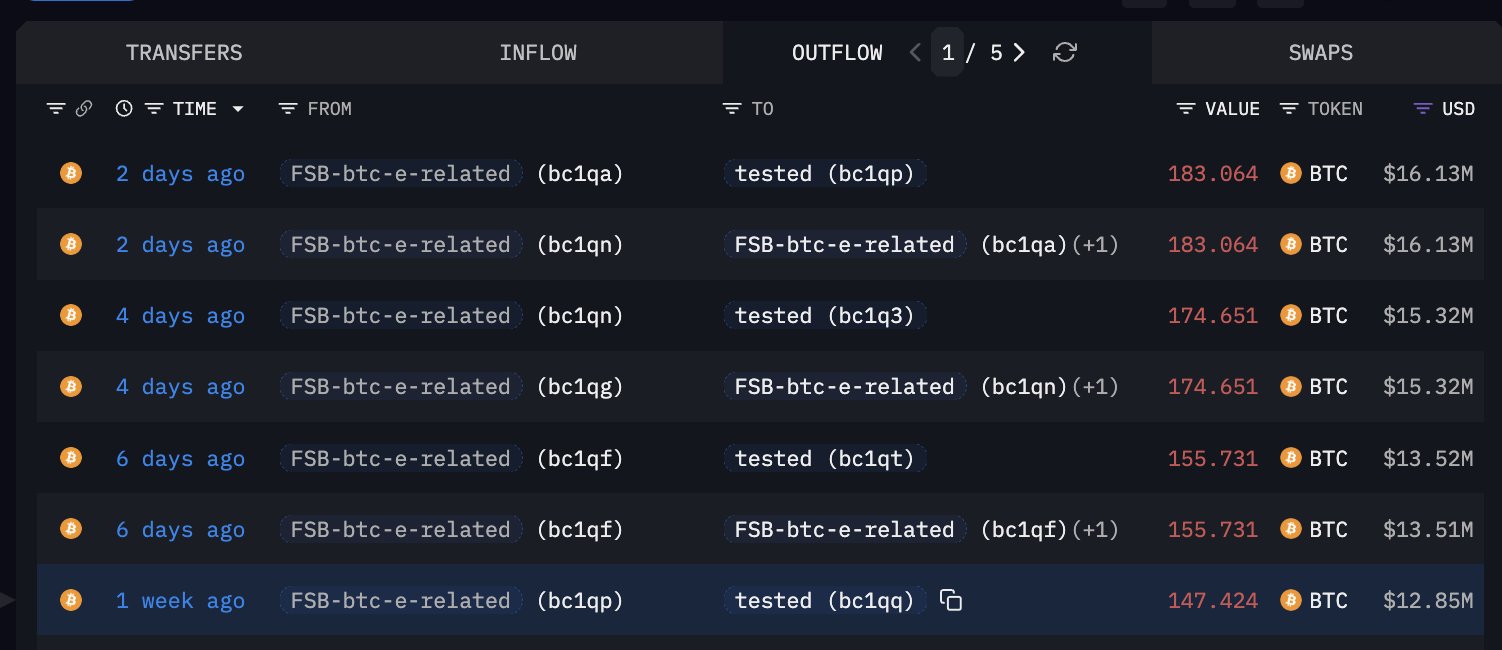
Aleksey Bilyuchenko on Arkham | Source: X @emmettgallic

Bilyuchenko has been charged by the US Department of Justice in connection with the Mt. Gox hack.

The Dec. 23 deposits build on earlier posts in which Gallic described a methodical unwind rather than a one-off dump. On Nov. 9, he said bitcoins “once belonging to BTC-E cofounder Aleksey Bilyuchenko are slowly being sold off through unknown exchanges,” citing 110 BTC deposited over two days.

That Nov. 9 note also emphasized uncertainty around who is actually controlling the funds. “Unclear if he’s still jailed in Russia or in control of these funds, but Moscow courts have seized most of his other assets,” Gallic wrote.

The repeated use of “unknown exchanges” suggests the destination clusters are not cleanly attributable to major, labeled venues in the datasets Gallic is using. For market participants, that makes the flow harder to handicap: deposits can signal intent to sell, but the execution path is less transparent than transfers into well-known exchange wallets.

In an Oct. 17 post, Gallic went further, alleging that “almost 8K BTC ... related to the WEX/BTCE case are controlled by Russian authorities,” including “the 6.5K BTC that moved earlier today.” He attributed that control to a specific unit—“3rd department of the 2nd service of the CSS of the FSB”—and linked to a Russian-language investigative article.

Who Is Bilyuchenko?

In Russia, Bilyuchenko has faced a separate WEX-related criminal case that has already produced a conviction. On March 18, 2024, the Moscow City Court upheld an earlier guilty verdict against Alexey Bilyuchenko, described in local reporting as a system administrator of the WEX exchange.

Bilyuchenko was accused of embezzling 3.1 billion rubles in WEX assets; the Meshchansky District Court sentenced him in September 2023 to 3.5 years in prison and a 500,000-ruble fine, and the appeal court left that decision in place, bringing the verdict into legal force.

In the United States, the posture is different: prosecutors have unsealed charges. The case is still ongoing. In June 2023, the Department of Justice announced the unsealing of charges against Bilyuchenko and Aleksandr Verner in the Southern District of New York, accusing them of conspiring to launder approximately 647,000 bitcoin tied to the 2011 Mt. Gox hack. The SDNY indictment charges both men with conspiracy to commit money laundering, carrying a maximum potential penalty of 20 years in prison.

Separately, Bilyuchenko is charged in the Northern District of California with conspiracy to commit money laundering and operating an unlicensed money services business, tied to allegations that he worked with Alexander Vinnik and others to operate BTC-e from 2011 until it was shut down in July 2017. DOJ listed a maximum potential penalty of 25 years on those NDCA charges.

At press time, BTC traded at $87,756.
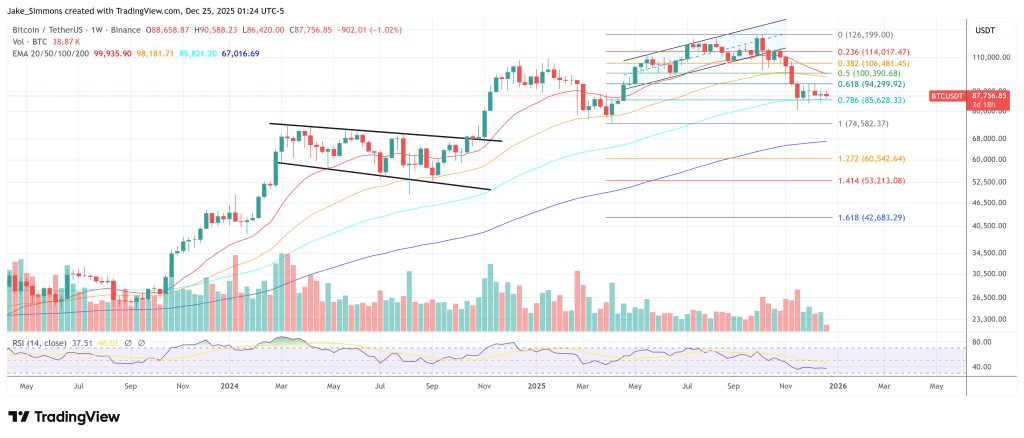
Bitcoin remains stuck between the 0.618 and 0.786 Fib, 1-week chart | Source: BTCUSDT on TradingView.com

Related Questions

QHow much Bitcoin did the entity related to Aleksey Bilyuchenko deposit into unknown exchanges in the past week, and what is its approximate value?

AThe entity deposited 1,300 BTC, which is approximately $114 million.

QWhat is the total amount of Bitcoin that the wallets linked to Bilyuchenko still hold, and what is its current value?

AThe wallets still hold roughly 4,100 BTC, which is valued at around $360 million.

QWhat specific charges has the U.S. Department of Justice brought against Aleksey Bilyuchenko in the Southern District of New York?

AHe has been charged with conspiring to launder approximately 647,000 bitcoin from the 2011 Mt. Gox hack, which carries a maximum penalty of 20 years in prison.

QWhat was the outcome of the separate criminal case against Bilyuchenko in Russia?

AHe was found guilty of embezzling 3.1 billion rubles in WEX assets and was sentenced to 3.5 years in prison and a 500,000-ruble fine, a verdict that was upheld on appeal.

QAccording to the analyst, which Russian government body is alleged to control almost 8K BTC related to the WEX/BTCE case?

AThe analyst alleged that the funds are controlled by the "3rd department of the 2nd service of the CSS of the FSB" (Russian Federal Security Service).

Related Reads

Raising Interest Rates Is Not a Tech Killer, EPS Is: A Strategy for Discarding the Weak and Retaining the Strong After the AI Theme's Sharp Decline

**Summary: Rising Interest Rates Are Not the Killer of Tech; EPS Is: The "Keep the Strong, Ditch the Weak" Strategy After the AI Theme Plunge** The author argues that the sharp sell-off in tech and AI-related stocks, triggered by a strong US jobs report that heightened Fed rate hike fears, represents a "pullback to pick up passengers" rather than a "car crash." The true end of a tech bull market is not determined by an extra 25 basis point hike, but by industry overcapacity and the disproval of earnings per share (EPS) expectations. Historical analysis shows that during past rate hike cycles, the Nasdaq-100 often outperformed, provided EPS growth remained strong. The current phase is seen as a shift from a "broad narrative-driven rally" to a "focused verification stage" for AI. The investment strategy should be to "keep the strong, ditch the weak." * **Retain exposure** to high-conviction AI infrastructure leaders with clear order visibility, stable margins, strong cash flow, and upward EPS revisions (e.g., AI servers, advanced packaging, optical modules, key cloud suppliers). * **Reduce exposure** to high-beta, narrative-driven stocks with unclear profit paths (e.g., some quantum computing, space, or speculative chip stocks), especially on rebounds. Valuation concerns should focus on whether earnings can catch up to high multiples, not on high P/E alone. Crowded positioning signals a concentration into quality assets, not necessarily a market top. The upcoming Q2 earnings season will be a key validation point. The core principle is to hold stocks with proven EPS, while using macro events (CPI data, central bank meetings) to manage timing and risk.

marsbit34m ago

Raising Interest Rates Is Not a Tech Killer, EPS Is: A Strategy for Discarding the Weak and Retaining the Strong After the AI Theme's Sharp Decline

marsbit34m ago

The Largest IPO in History Ignites Heated Debate: Is SpaceX Worth $1.77 Trillion?

SpaceX's potential IPO is priced at $135 per share, aiming to raise $75 billion and valuing the company at approximately $1.77 trillion, which would make it the largest IPO in history. This valuation has sparked intense debate among investors. Bullish analysts, including major underwriters Goldman Sachs and Morgan Stanley, argue the valuation is justified by SpaceX's long-term potential. They see it not just as a rocket company but as a future leader in space infrastructure, with key growth drivers being Starlink satellite internet, low-cost rocket launches, and future AI-related ventures. They project revenues reaching hundreds of billions to trillions of dollars by 2030-2040. ARK Invest's model suggests a 2030 enterprise value could reach $2.5 trillion. Bearish analysts from independent research firms like Morningstar, PitchBook, and New Constructs contend the IPO price is excessively high, already pricing in unrealistic future growth. Using DCF and sum-of-the-parts models, they estimate fair value between $780 billion and $1.7 trillion, significantly below the IPO target. They highlight risks such as the speculative nature of AI projections, over-dependence on Elon Musk, high growth expectations, and corporate governance concerns. Trefis set a target price of just $79 per share. While both sides acknowledge SpaceX's unique position in commercial space, the core disagreement centers on whether the $135 share price offers a reasonable margin of safety or is overly optimistic. Despite the valuation controversy, reported strong demand for the IPO indicates significant market interest.

marsbit2h ago

The Largest IPO in History Ignites Heated Debate: Is SpaceX Worth $1.77 Trillion?

marsbit2h ago

After the Passage of the GENIUS Act and the CLARITY Act, What Is the Correct Architecture for On-Chain Yield?

The article discusses the evolution of on-chain credit, distinguishing three markets: overcollateralized crypto lending, unsecured lending (largely unsuccessful), and asset-backed credit (ABC). ABC, backed by identifiable real-world collateral with legal recourse, is identified as the fastest-growing category and the only one credibly addressing adverse selection—the core problem in credit where the riskiest borrowers self-select. Current growth in on-chain Real World Assets (RWAs), particularly tokenized private credit funds (e.g., Maple Finance, Centrifuge), is substantial but often merely "wraps" existing fund structures, inheriting their risks rather than solving adverse selection at the protocol level. The regulatory landscape is a key driver, with the US GENIUS Act (prohibiting stablecoin issuers from paying yield) and the proposed CLARITY Act (closing loopholes on indirect yield) set to redefine permissible yield-bearing products. This makes vaults (like ERC-4626) the critical architecture—they become the primary compliant vehicle for delivering yield, functioning as issuance, disclosure, distribution, and recovery mechanisms. The author's thesis is that the correct post-GENIUS/CLARITY architecture involves building ABC solutions where credit assessment, structure, and recovery are encoded directly into the smart contract vault layer, moving beyond mere tokenized fund wrappers to solve adverse selection fundamentally and ensure regulatory compliance.

Foresight News2h ago

After the Passage of the GENIUS Act and the CLARITY Act, What Is the Correct Architecture for On-Chain Yield?

Foresight News2h ago

Trading

Spot
Futures

Hot Articles

What is $BITCOIN

DIGITAL GOLD ($BITCOIN): A Comprehensive Analysis Introduction to DIGITAL GOLD ($BITCOIN) DIGITAL GOLD ($BITCOIN) is a blockchain-based project operating on the Solana network, which aims to combine the characteristics of traditional precious metals with the innovation of decentralized technologies. While it shares a name with Bitcoin, often referred to as “digital gold” due to its perception as a store of value, DIGITAL GOLD is a separate token designed to create a unique ecosystem within the Web3 landscape. Its goal is to position itself as a viable alternative digital asset, although specifics regarding its applications and functionalities are still developing. What is DIGITAL GOLD ($BITCOIN)? DIGITAL GOLD ($BITCOIN) is a cryptocurrency token explicitly designed for use on the Solana blockchain. In contrast to Bitcoin, which provides a widely recognized value storage role, this token appears to focus on broader applications and characteristics. Notable aspects include: Blockchain Infrastructure: The token is built on the Solana blockchain, known for its capacity to handle high-speed and low-cost transactions. Supply Dynamics: DIGITAL GOLD has a maximum supply capped at 100 quadrillion tokens (100P $BITCOIN), although details regarding its circulating supply are currently undisclosed. Utility: While precise functionalities are not explicitly outlined, there are indications that the token could be utilized for various applications, potentially involving decentralized applications (dApps) or asset tokenization strategies. Who is the Creator of DIGITAL GOLD ($BITCOIN)? At present, the identity of the creators and development team behind DIGITAL GOLD ($BITCOIN) remains unknown. This situation is typical among many innovative projects within the blockchain space, particularly those aligning with decentralized finance and meme coin phenomena. While such anonymity may foster a community-driven culture, it intensifies concerns about governance and accountability. Who are the Investors of DIGITAL GOLD ($BITCOIN)? The available information indicates that DIGITAL GOLD ($BITCOIN) does not have any known institutional backers or prominent venture capital investments. The project seems to operate on a peer-to-peer model focused on community support and adoption rather than traditional funding routes. Its activity and liquidity are primarily situated on decentralized exchanges (DEXs), such as PumpSwap, rather than established centralized trading platforms, further highlighting its grassroots approach. How DIGITAL GOLD ($BITCOIN) Works The operational mechanics of DIGITAL GOLD ($BITCOIN) can be elaborated on based on its blockchain design and network attributes: Consensus Mechanism: By leveraging Solana’s unique proof-of-history (PoH) combined with a proof-of-stake (PoS) model, the project ensures efficient transaction validation contributing to the network's high performance. Tokenomics: While specific deflationary mechanisms have not been extensively detailed, the vast maximum token supply implies that it may cater to microtransactions or niche use cases that are still to be defined. Interoperability: There exists the potential for integration with Solana’s broader ecosystem, including various decentralized finance (DeFi) platforms. However, the details regarding specific integrations remain unspecified. Timeline of Key Events Here is a timeline that highlights significant milestones concerning DIGITAL GOLD ($BITCOIN): 2023: The initial deployment of the token occurs on the Solana blockchain, marked by its contract address. 2024: DIGITAL GOLD gains visibility as it becomes available for trading on decentralized exchanges like PumpSwap, allowing users to trade it against SOL. 2025: The project witnesses sporadic trading activity and potential interest in community-led engagements, although no noteworthy partnerships or technical advancements have been documented as of yet. Critical Analysis Strengths Scalability: The underlying Solana infrastructure supports high transaction volumes, which could enhance the utility of $BITCOIN in various transaction scenarios. Accessibility: The potential low trading price per token could attract retail investors, facilitating wider participation due to fractional ownership opportunities. Risks Lack of Transparency: The absence of publicly known backers, developers, or an audit process may yield skepticism regarding the project's sustainability and trustworthiness. Market Volatility: The trading activity is heavily reliant on speculative behavior, which can result in significant price volatility and uncertainty for investors. Conclusion DIGITAL GOLD ($BITCOIN) emerges as an intriguing yet ambiguous project within the rapidly evolving Solana ecosystem. While it attempts to leverage the “digital gold” narrative, its departure from Bitcoin's established role as a store of value underscores the need for a clearer differentiation of its intended utility and governance structure. Future acceptance and adoption will likely depend on addressing the current opacity and defining its operational and economic strategies more explicitly. Note: This report encompasses synthesised information available as of October 2023, and developments may have transpired beyond the research period.

363 Total ViewsPublished 2025.05.13Updated 2025.05.13

What is $BITCOIN

Discussions

Welcome to the HTX Community. Here, you can stay informed about the latest platform developments and gain access to professional market insights. Users' opinions on the price of BTC (BTC) are presented below.

活动图片