Market Plunge, But These Crypto OGs Are Still 'Topping Up Their Faith'

marsbitPublished on 2026-02-06Last updated on 2026-02-06

Abstract

Summary: On February 6, Bitcoin plunged 15.48% to $60,000, marking its largest single-day drop since the FTX collapse. The Crypto Fear & Greed Index hit 9, indicating "extreme fear" and a new low since the 2022 bear market. Despite widespread panic, several crypto veterans reaffirmed their conviction. Michael Saylor encouraged buying Bitcoin as a form of support. The founder of Base emphasized long-term commitment to building. Lily Liu, President of the Solana Foundation, argued that blockchain's core purpose is financialization, stressing the importance of protecting liquidity unity. She criticized the "Web3 narrative" as overly simplistic and called for creating new markets rather than relying on speculative narratives. Balaji expressed strong bullishness, stating that "code-based order" is rising as "rules-based order" collapses, making short-term prices irrelevant. He emphasized the need for on-chain companies and internet-native systems. The founder of Helius shared similar optimism, advocating for filtering out "tourists" to improve signal-to-noise ratio in the space. Linda Xie shared her experience of a 75% drawdown in 2018, advising against emotionally-driven decisions and emphasizing holding assets with strong fundamental belief. Crypto influencer神鱼 (Shenyu) succinctly stated: "1 BTC = 1 BTC." Overall, these leaders urge perseverance, focus on fundamentals, and long-term belief in crypto's transformative potential despite market volatility.

Editor's Note: On February 6th, Bitcoin fell to a low of $60,000, plummeting 15.48% in a single day, marking its largest single-day drop since the FTX collapse. At the same time, the Crypto Fear & Greed Index dropped to 9, indicating a state of 'Extreme Fear' in the market, hitting a new low since the 2022 bear market.

However, as pessimism spreads, many veteran Builders and thought leaders in the crypto world are voicing a different perspective. This 'Crypto Faith Topping-Up List' compiles their thoughts and perseverance amidst the storm. Perhaps it can offer you a sliver of solace and direction to move forward during this market winter.

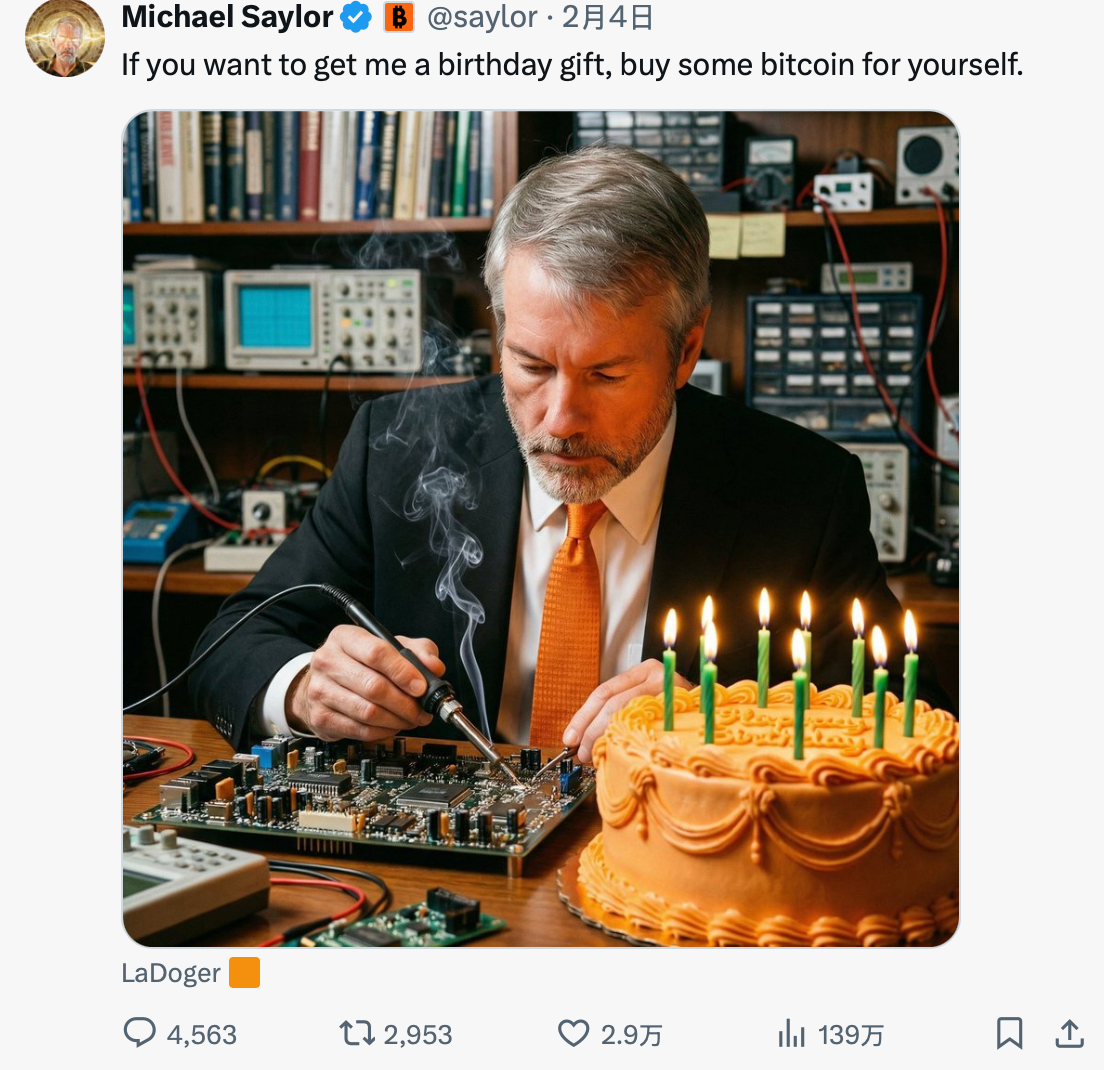
Michael Saylor:

If you want to give me a birthday present, buy yourself some Bitcoin!
Base Founder:

13 years have passed, and I'm not going anywhere.

There's still so much to build.

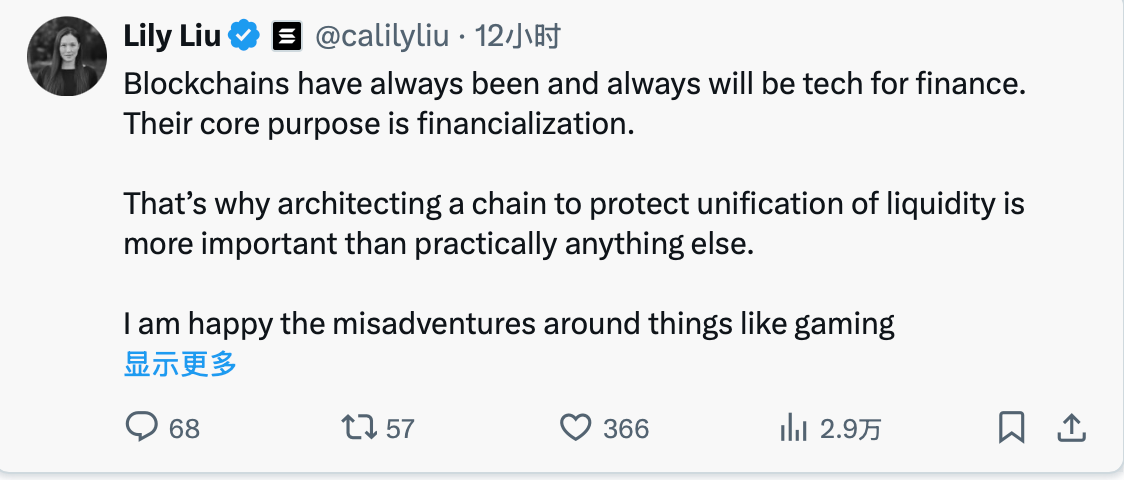
Solana Foundation President LilyLiu:

Blockchain was, is, and always will be financial technology. Their core purpose is financialization.

This is also why, when designing a chain, protecting the unity of liquidity is more important than almost anything else.

I'm glad the misguided focus on things like 'chain games' is finally over.

More broadly, the 'read write own' / 'Web3 narrative' is essentially too skeuomorphic and, to be honest, a bit intellectually lazy. New technology is never as simple as 'put something on-chain, and voilà—everything changes'; you must truly create new markets.

The old narrative was more of a fig leaf, used to justify VCs pouring money into various unnecessary infrastructures, hoping to create a private asset that could become 'magic internet money.'

The more projects try to attract prices through narrative packaging and take a share of the liquidity from the 'wild west' of the internet, the harder the 'narrative justification machine' has to work, shaping everything into the 'great third wave of applications'—'everything you do today can now earn you money.'

The reality is, the opportunities are indeed huge, far beyond what even our most creative minds can imagine, but not in the way they've been described over the past few years.

The blockchain journey has always been about finance: providing open financial infrastructure for anyone and everyone on the internet.

This enables capital formation and internet innovation to happen anywhere in the world, allowing the resulting innovation and progress to truly take root. Open finance brings greater economic freedom, and economic freedom brings individual sovereignty and autonomy.
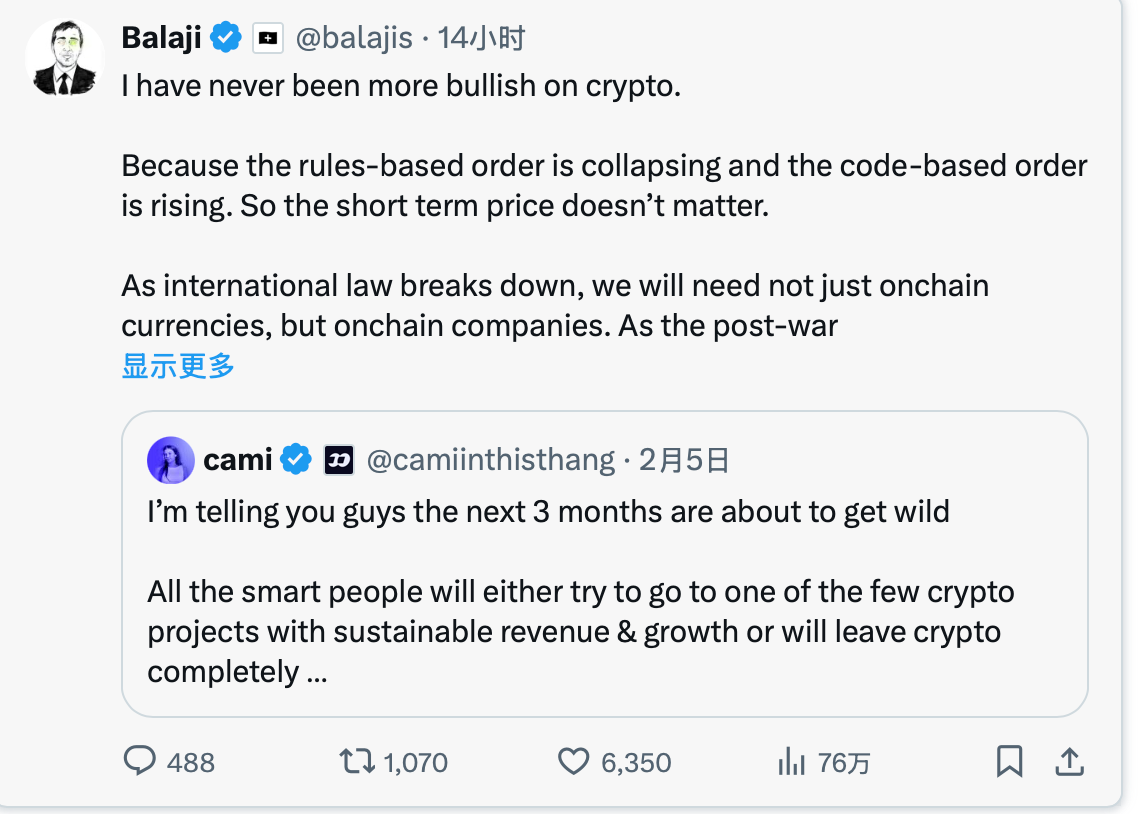
Balaji:

I have never been more bullish on cryptocurrency than I am now.

Because the 'rules-based order' is collapsing, and the 'code-based order' is rising. So short-term prices simply don't matter.

As the international legal system disintegrates, we need not only on-chain money but also on-chain companies. As the post-war order unravels, we similarly need a 'post-internet order.' Nations will fail, and networks will replace them.

We need internet capitalism, we need internet democracy, we need internet privacy.

So we need cryptocurrency.
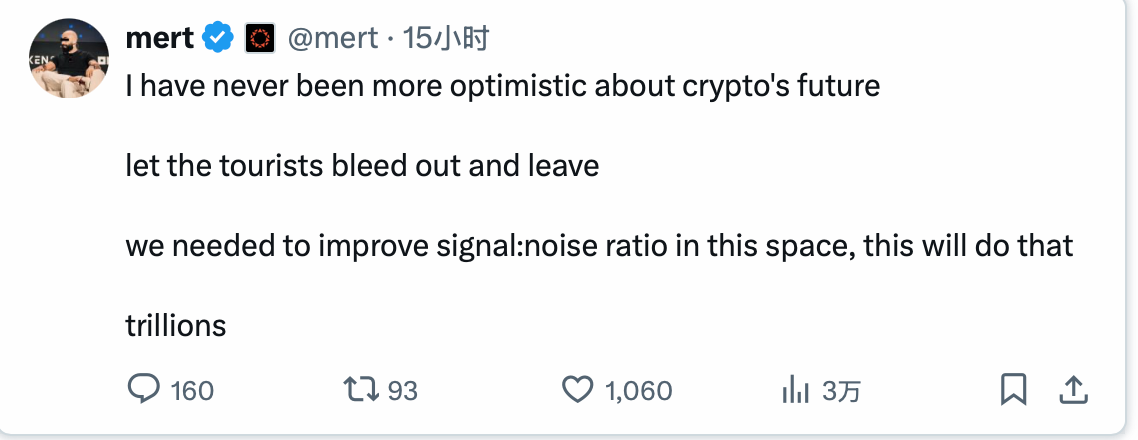
Helius Founder:

I have never been more confident about the future of cryptocurrency than I am now.

Let the tourists bleed out and leave.

We need to increase the signal-to-noise ratio in this space, and this will achieve that goal.

Trillion
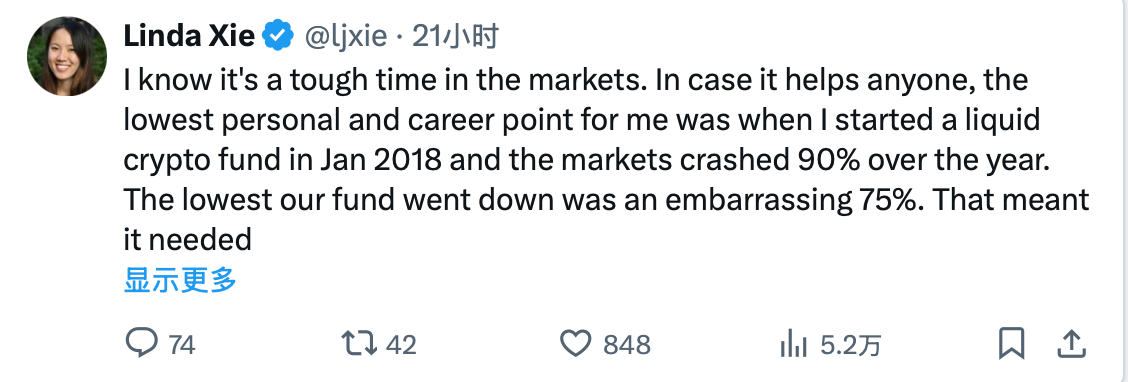
Linda Xie:

I know the current market environment is tough. I hope these experiences can be helpful to some. For me, the personal and professional low point was in January 2018, after launching a crypto liquidity fund, when the market fell 90% that year. Our fund experienced a maximum drawdown of a humiliating 75%, meaning the fund needed to quadruple just to break even.

At the time, many investors chose to trust us (this was after about 1,000 fundraising meetings), some of whom I deeply respected, and I felt I had let them down; some investors even yelled at me over the phone. I was extremely worried about what I had gotten everyone into, including employees. I had also invested almost all of my personal savings.

But we stuck to the direction we truly believed in, and it eventually paid off years later (currently delivering about 4x DPI for investors). Hold onto assets you genuinely believe in fundamentally, and don't make any extreme decisions driven by emotion.
Shenyu:

1btc = 1btc

Related Questions

QWhat was the significance of Bitcoin's price drop to $60,000 on February 6th?

AIt marked a 15.48% single-day drop, the largest since the FTX crash, and pushed the Crypto Fear & Greed Index to 9, indicating 'extreme fear' and a new low since the 2022 bear market.

QAccording to Solana Foundation's Lily Liu, what is the core purpose of blockchains?

ABlockchains are, and always will be, financial technology. Their core purpose is financialization, providing open financial infrastructure to anyone on the internet to enable capital formation and innovation globally.

QWhat is Balaji's main argument for being extremely bullish on cryptocurrency despite short-term price movements?

AHe believes the 'rules-based order' is collapsing and a 'code-based order' is rising. As international law and the post-war order disintegrate, there is a need for on-chain money, companies, and new systems like internet capitalism and democracy, which cryptocurrency enables.

QWhat personal experience did Linda Xie share to help others during the difficult market?

AShe shared that her crypto liquidity fund launched in Jan 2018 experienced a 90% market drop and a 75% drawdown, requiring a 4x return just to break even. By sticking to their convictions and not making emotional decisions, they eventually delivered about 4x DPI (Distributed to Paid-In Capital) to investors.

QWhat common sentiment is expressed by multiple figures like Michael Saylor, the Base founder, and the Helius founder?

AThey express unwavering confidence and a long-term commitment to cryptocurrency. Saylor encourages buying Bitcoin, the Base founder states he's 'not going anywhere,' and the Helius founder says he's 'never been more confident,' suggesting that weak hands (tourists) leaving will improve the space.

Related Reads

Promised Year of Crypto IPOs? Only One Went Public in Six Months, Down 70%

The much-anticipated wave of crypto IPOs in 2026 has failed to materialize, with market conditions worsening dramatically. While SpaceX prepares for the largest IPO in history, raising $75 billion at a $1.75 trillion valuation, the crypto sector faces a frozen pipeline. The sole crypto IPO success this year, BitGo, serves as a cautionary tale. After launching on the NYSE in January at $18, its stock has plummeted approximately 70%. Other major contenders have stalled or delayed. Kraken, which secretly filed in late 2025, has put its plans on ice, seeing its valuation drop 33% to $13.3 billion. Consensys has postponed its filing until autumn at the earliest, and Bitpanda is poised to miss its self-imposed H1 deadline for a Frankfurt listing. This widespread retreat is driven by a severe liquidity crunch. Bitcoin has fallen below $60,000, with capital being diverted to AI stocks and the massive SpaceX offering. The poor performance of earlier crypto listings like Gemini and the stagnant price of Coinbase further dampen investor appetite. A key underlying pressure is the impending US midterm elections in November, which could alter the currently favorable regulatory landscape. Companies had hoped to go public during this window of policy certainty, but challenging market dynamics have overridden those plans. The transparency that comes with being a public company is now seen as a potential liability rather than a benefit in a down market. The industry's fate now hinges on a few critical watchpoints: whether Kraken restarts its process in H2, if Consensys files in the fall, and if SpaceX's debut can revitalize market liquidity. Otherwise, the promised "crypto IPO year" will likely be pushed beyond the election.

marsbit12m ago

Promised Year of Crypto IPOs? Only One Went Public in Six Months, Down 70%

marsbit12m ago

Behind Musk and Huang Jen-hsun's 'AI Factories', an Unseen Battle for Freshwater Has Begun

Behind the "AI factories" of Elon Musk and Jensen Huang lies a hidden battle for a critical resource: fresh water. As AI models like ChatGPT and Claude process billions of prompts daily, they consume vast amounts of water for cooling. By 2030, global AI infrastructure is projected to use 9.3 trillion liters annually—enough to meet the basic needs of 1.3 billion people. This "water grab" stems from the massive heat generated by high-powered GPUs. Over 70% of data centers use evaporative cooling systems, where water absorbs heat and evaporates into the atmosphere, depleting local groundwater. Training models like GPT-4 can consume over 600 million liters of water. Tech giants like Google and Microsoft report skyrocketing water usage, sparking conflicts with local communities over resources. A flashpoint occurred in Memphis, Tennessee, where Musk's xAI built the Colossus supercomputer. It draws nearly 3.8 million liters of drinking water daily from local aquifers, leading to public outrage and legal action. In response, xAI is building an $80 million water recycling plant to use treated wastewater instead. Facing pressure, companies like Microsoft promote "waterless" closed-loop cooling systems. However, these systems increase electricity consumption by 20-30%, shifting the water burden to power plants, which require immense cooling water themselves—a case of indirect water footprint transfer. For China's AI industry, this crisis offers a strategic warning and opportunity. Instead of replicating the West's resource-intensive model, China can leverage its "East Data, West Computing" policy to locate data centers in cooler, water-rich regions like Guizhou. Furthermore, developing lightweight edge computing for smart homes and embodied AI robots can drastically reduce the need for constant cloud queries, cutting both water and energy consumption at the source. The freshwater war underscores a fundamental question: Will AI be a tool for human advancement or a silicon-based monster competing for our planet's last drops of clean water? The answer is becoming clearer as the water vapor rises.

marsbit58m ago

Behind Musk and Huang Jen-hsun's 'AI Factories', an Unseen Battle for Freshwater Has Begun

marsbit58m ago

AGI is Just One Step Away

The article discusses Anthropic's release of the Fable 5 model, a heavily restricted version of its powerful Mythos model. Initially unveiled in April, Mythos reportedly identified over 10,000 high-risk vulnerabilities for 50 enterprise clients, causing significant concern. Due to its dangerous capabilities in areas like autonomous cyber-attacks and biochemical weapons design guidance (classified as CB-1 level), the unaltered Mythos 5 remains limited to about 200 vetted entities like government agencies. Fable 5, released with a safety classifier, demonstrates extraordinary performance, leading benchmarks in coding (SWE-Bench Pro), software engineering, and research. It exhibits true "long-horizon agency," autonomously planning and executing complex, multi-step tasks like migrating 50 million lines of code in a day, moving beyond simple question-answering. The article positions Fable 5 at OpenAI's Level 3 ("Agent") and progressing toward Level 4 ("Innovator"), suggesting AGI (Artificial General Intelligence) is within reach, potentially 18-24 months away. To mitigate risks, Anthropic implemented a two-layer safety "cage": a silent routing system that redirects dangerous queries to a weaker model, and a mandatory 30-day data retention policy for all Mythos traffic to detect patterns of malicious use. Despite its high cost ($10/$50 per million input/output tokens), the model targets the enterprise market, where its unparalleled productivity and defensive capabilities against AI-powered cyber threats justify the premium. This signals a market maturation where top-tier AI becomes a strategic, high-value tool for businesses, potentially widening the gap with consumer-focused models and accelerating the rise of "one-person companies" while disrupting labor markets.

marsbit1h ago

AGI is Just One Step Away

marsbit1h ago

Trading

Spot
Futures
活动图片





